Mechanism Capital Founder: Excessive Worry About Bubbles Is Foolish

marsbitPublished on 2026-02-11Last updated on 2026-02-11

Abstract

Mechanism Capital founder Andrew Kang argues that excessive worry about market bubbles is misguided in the current technological landscape. He emphasizes that we are at a uniquely asymmetric moment in history, driven by exponential advancements in AI, robotics, energy, and other innovative fields. Short-term volatility and corrections are noise compared to the long-term transformative potential of these technologies. Kang predicts a near-future "singularity" with billions of AI agents, humanoid robots, space data centers, multi-planetary colonization, and revolutionary medical therapies. He states that the technological progress and economic growth compressed into the next 20 years will surpass the entirety of human history. Companies leveraging AI are already seeing order-of-magnitude improvements in productivity. Traditional valuation models are inadequate for pricing this unprecedented growth, which could reach "20-sigma" levels in historical statistical terms. The wealth creation will be extreme, and those without exposure will find it difficult to enter the market later. Kang advises adopting a long-term, exponential mindset and avoiding short-term trading, as the potential upside represents the largest asymmetric opportunity in history.

Original Author:Andrew Kang, Founder of Mechanism Capital

Compiled by: Ken, Chaincatcher

For those who have experienced at least one full market cycle, you develop an instinct to be wary of price increases that far exceed historical growth rates. Witnessing the dot-com bubble, the 2008 global financial crisis, and the rise and fall of cryptocurrencies sets off pattern recognition alarms in your brain. You are afraid to enter the market because prices are too high, and you want to sell your assets for fear of being at a peak.

But it is important to recognize that we are in one of the most profound and unique asymmetric moments in history. The only move right now is to extend your time horizon and completely abandon short-termism.

Excessive worry about bubbles is foolish. Trying to time the market is also foolish. Short-term fluctuations and corrections will always happen, but given how close we are to the "singularity," these fluctuations are completely just noise. Artificial intelligence, robotics, energy, and innovation are about to experience runaway explosive growth.

Within the next decade, we will have billions (or more) of AI agent workforces, humanoid robots, space data centers, multi-planetary colonization, and significantly improved medical therapies; we will fundamentally change the development pace and output of technological breakthroughs in all fields. The technological progress and economic growth we compress into the next twenty years will exceed the sum total of all human civilization history.

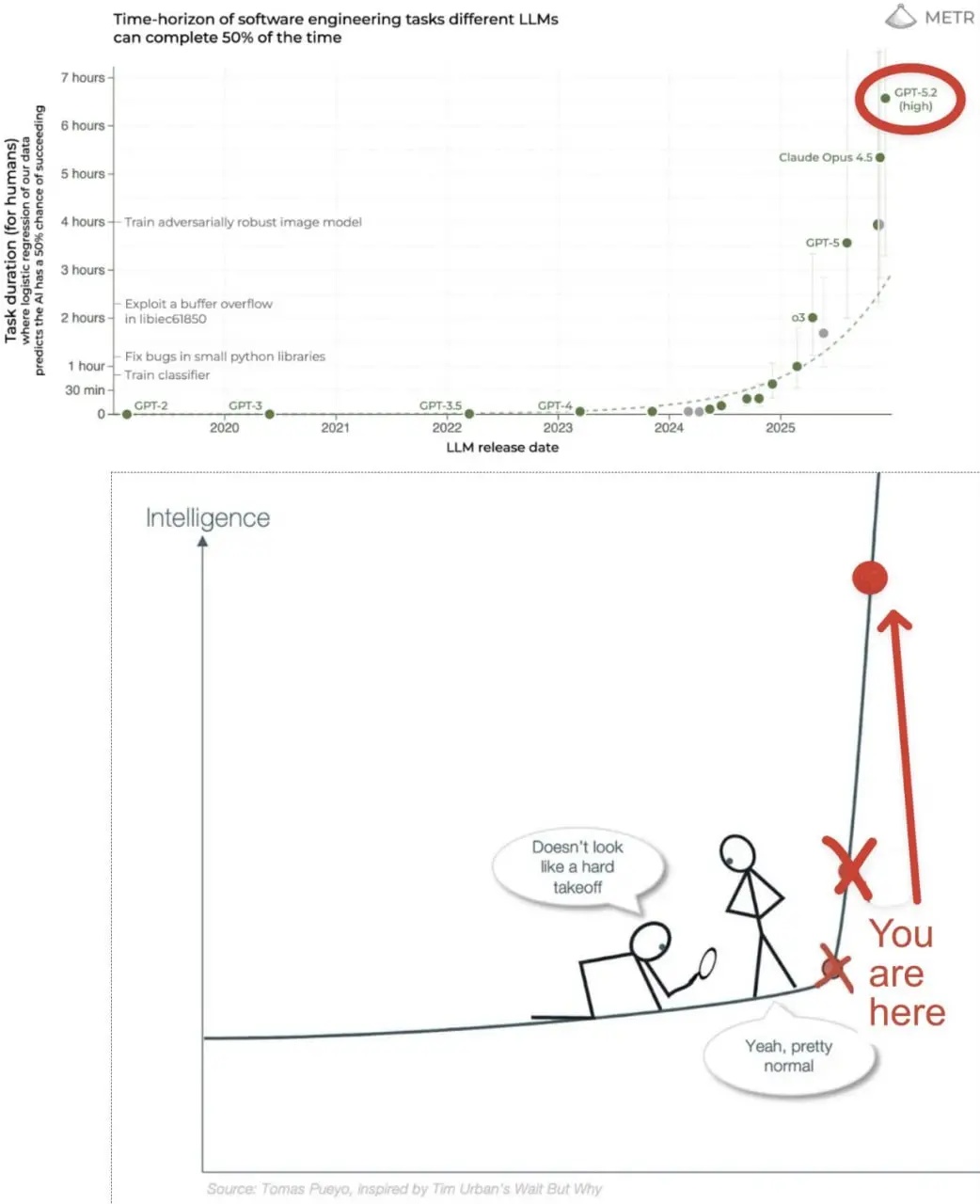
We are already in an extremely steep phase of the J-curve, but this is hard to perceive when we zoom in to the micro level of daily or weekly views. 100% of Anthropic's product code is now written by Claude. Product managers have a virtual team of software engineers, so efficient it's as if they can change time. The improvement in product iteration speed for companies that efficiently utilize AI is not single-digit, not double-digit, but triple-digit.

Moreover, the capabilities of these tools are still evolving at an even faster rate. Whether we officially achieve Artificial Superintelligence (ASI) in 2027 or 2029 doesn't really matter. It will happen. By the time it's officially announced, the assets you want to own will have already multiplied in price.

It is highly likely that the actual economic growth over the next 3-10 years will be on the order of 20 standard deviations (20-sigma) in any historical distribution model. This growth, once considered almost impossible, will be driven by unprecedented second and third-order changes. Traditional valuation models cannot price these transformations. The potential upside is so vast that traditional present value calculations struggle to capture them.

The speed of wealth appreciation will be staggering, much like how cryptocurrencies initially created numerous billionaires and millionaires in a short time, but the magnitude this time will be far more extreme. If you have no exposure, it will be difficult to pull the trigger and buy into such vertically rising asset prices; but unlike previous bubbles, the creation of real economic value will better keep pace with the vertical rise in asset prices. Over the past three years, those operating in the market with the cognition of an "exponential perspective" have reaped significant rewards. If you haven't adopted this perspective yet, it's not too late.

While it's important to always be mindful of downside risk, this is the largest upside risk in world history. Learn to bear risk over longer time horizons. Now is not the time for swing trading. For the vast majority of people, long-term investing typically outperforms short-term trading, but the gap in expected value between "trading" and "investing" will be wider than ever before. Ask yourself, what is the value of the call option embedded in the singularity?
Related Questions

QAccording to Andrew Kang, why is it foolish to be overly concerned about market bubbles in the current economic climate?

AHe believes we are at a profoundly unique asymmetric moment in history, where the potential upside from technological advancements like AI, robotics, and energy innovation is so immense that short-term volatility and bubbles are merely noise. The focus should be on long-term growth rather than short-term fluctuations.

QWhat does Andrew Kang predict will be achieved in the next decade in terms of technological progress?

AHe predicts that in the next decade, we will have billions of AI agent workers, humanoid robots, space data centers, multi-planetary colonization, and significantly improved medical therapies. The technological progress and economic growth compressed into the next 20 years will exceed the sum of all human civilization history.

QHow does Andrew Kang describe the current stage of the J-curve in technological development?

AHe describes the current stage of the J-curve as extremely steep, though it is hard to perceive at a daily or weekly micro-level. Companies effectively using AI are seeing product iteration speed improvements not in single or double digits, but in triple digits.

QWhat does Andrew Kang suggest about the timing of achieving Artificial Superintelligence (ASI) and its impact on asset prices?

AHe suggests that whether ASI is achieved in 2027 or 2029 is not important because it is inevitable. By the time it is officially announced, the prices of assets one would want to own will have already increased manifold.

QAccording to the article, why might traditional valuation models fail in the current economic transformation?

ATraditional valuation models are unable to price the unprecedented second and third-order changes driven by technologies like AI. The potential upside is so vast that traditional present value calculations struggle to capture them, making historical distribution models irrelevant for predicting future growth.

Related Reads

Will Quantum Computing Kill Bitcoin and Mining? Is This Alarmist?

The article addresses the recurring concern that quantum computing could break Bitcoin's encryption and disrupt mining. It references a Google Quantum AI white paper from March 2026, which suggests that the resources needed for a quantum computer to crack Bitcoin’s elliptic curve digital signature algorithm (ECDSA) have been reduced by about 20 times. Under ideal conditions, such an attack could theoretically derive a private key from a public key in roughly 9 minutes using 500,000 physical qubits. However, the threat is not immediate. Current quantum processors, like Google’s Willow (105 qubits) or IBM’s Condor (~1,121 qubits), are far from the scale required. The risk primarily targets transaction signatures—especially during the brief window when a transaction is broadcast but not yet confirmed, or when public keys have been historically exposed. It is estimated there is only a 10% probability of a “quantum break” by 2032. The impact on mining is considered negligible. Research indicates that quantum mining would require astronomically high qubit counts and energy—far exceeding entire national grids—making it economically and physically infeasible. The broader solution lies in post-quantum cryptography (PQC). Standards like ML-DSA and SLH-DSA are being developed, and Bitcoin improvement proposals such as BIP 360 aim to reduce quantum vulnerability by modifying transaction structures to avoid exposing public keys. While quantum computing poses a future risk to all public-key encryption systems—not just Bitcoin—the cryptocurrency ecosystem has time to adapt. Upgrades and migration to quantum-resistant algorithms are underway, ensuring the network evolves ahead of the threat.

marsbit1h ago

Will Quantum Computing Kill Bitcoin and Mining? Is This Alarmist?

marsbit1h ago

5 Minutes to Make AI Your Second Brain

This article introduces a powerful personal knowledge management system combining Claude Code and Obsidian, designed to function as an "AI second brain." Unlike traditional RAG systems that perform temporary, one-off retrievals, this system enables AI to continuously build and maintain an evolving knowledge wiki. The architecture consists of three layers: a raw data layer (notes, articles, transcripts), an AI-maintained structured knowledge base that builds cross-references, and a schema layer that governs organization and system logic. Core operations are Ingest (bringing in external information), Query (instant knowledge access), and Lint (checking consistency and fixing issues). The system's power lies in creating a "compound interest" effect for knowledge: it reduces cognitive load by offloading the tasks of connecting, organizing, and understanding information to AI, while simultaneously improving the accuracy and contextual consistency of the AI's outputs. The setup process is quick, requiring users to download Obsidian, create a vault (knowledge repository), configure Claude Code to access that vault, and apply a specific system prompt. Advanced tips include using a browser extension to easily add web content, maintaining separate vaults for work and personal life, and utilizing the "Orphans" feature to identify unlinked ideas. The main drawbacks are the need for visual thinking, a commitment to ongoing maintenance, and local storage usage. Ultimately, the system transforms scattered information into a reusable, interconnected network of knowledge.

marsbit3h ago

5 Minutes to Make AI Your Second Brain

marsbit3h ago

Trading

Spot
Futures
活动图片