Author | @bc1beat
Compiled by | Odaily Planet Daily (@OdailyChina)
Translator | DingDang (@XiaMiPP)

Editor's Note: Since OpenClaw ignited the AI Agent frenzy, the crypto industry has seen almost daily new related meme elements. We witnessed a rapid surge and an equally swift decline in an extremely short time, a dazzling and overwhelming spectacle. However, this does not mean the direction is wrong; rather, a more practical question is emerging: After the memes fade, has the Agent economy truly entered a "practical implementation" stage? It is precisely in this context that returning to the fundamentals—infrastructure, real data, and actual operational status—has become more critical than chasing the next buzzword.
The agent economy just experienced its most critical month to date. In January 2026, the three foundational layers—payments, trust, and social collaboration—almost simultaneously reached a production-ready stage: x402 processed over 20 million transactions, ERC-8004 launched on the Ethereum mainnet, and over 1 million autonomous agents began social activities on Moltbook. This report will梳理 (sort out) which infrastructures have matured, which are still missing, and the directions builders should focus on next.
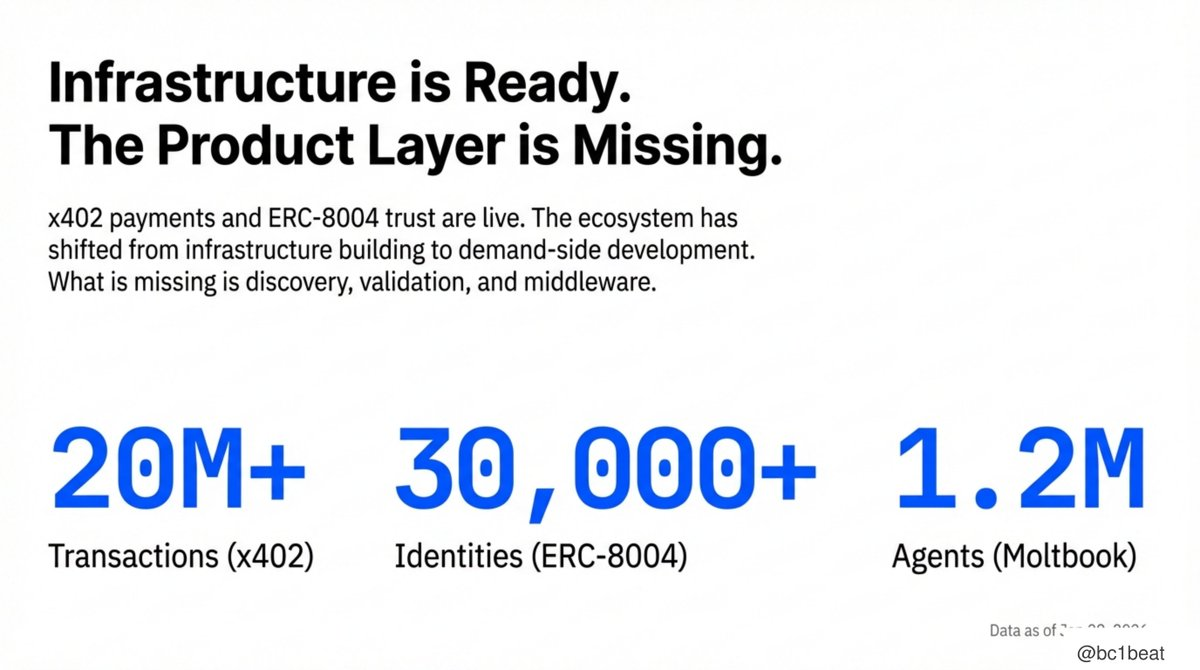
Infrastructure is ready, but the product layer is still absent. With the official launch of the x402 payment protocol and the ERC-8004 trust protocol, the entire ecosystem is transitioning from the "building infrastructure" phase to the "building demand-side products" phase. Over 20 million transactions have been completed via x402, over 30,000 agent identities have been minted on ERC-8004, and about 1.2 million agents have registered on Moltbook. The protocols themselves have been validated to function properly; what's truly missing are the discovery mechanisms, capability verification, and the middleware layer that connects these protocols.
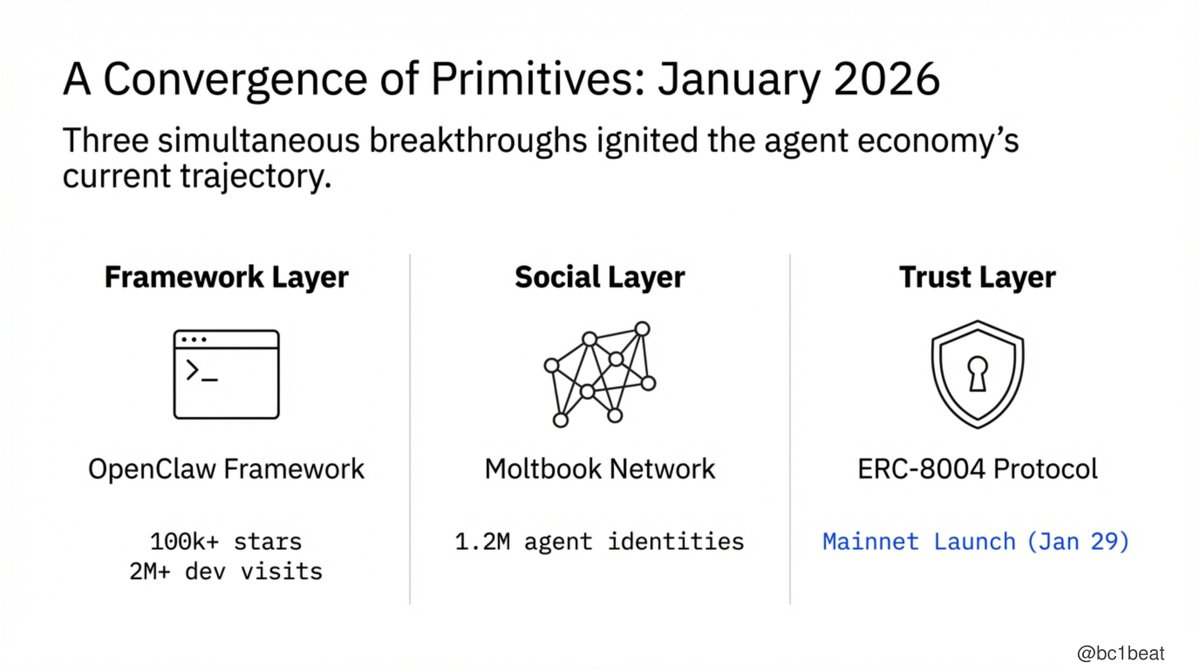
January saw three nearly simultaneous key breakthroughs. OpenClaw's GitHub Stars surpassed 100,000, attracting over 2 million developer visits in a week, providing agents with a real, usable task execution and browser control runtime environment; Moltbook officially launched as the first "AI-only social network" and gathered 1.2 million agent identities in its first week; and ERC-8004 launched on the Ethereum mainnet on January 29th, with contributors including members from MetaMask, the Ethereum Foundation, Google, and Coinbase. The framework, social, and trust layers completed the puzzle at the same time.
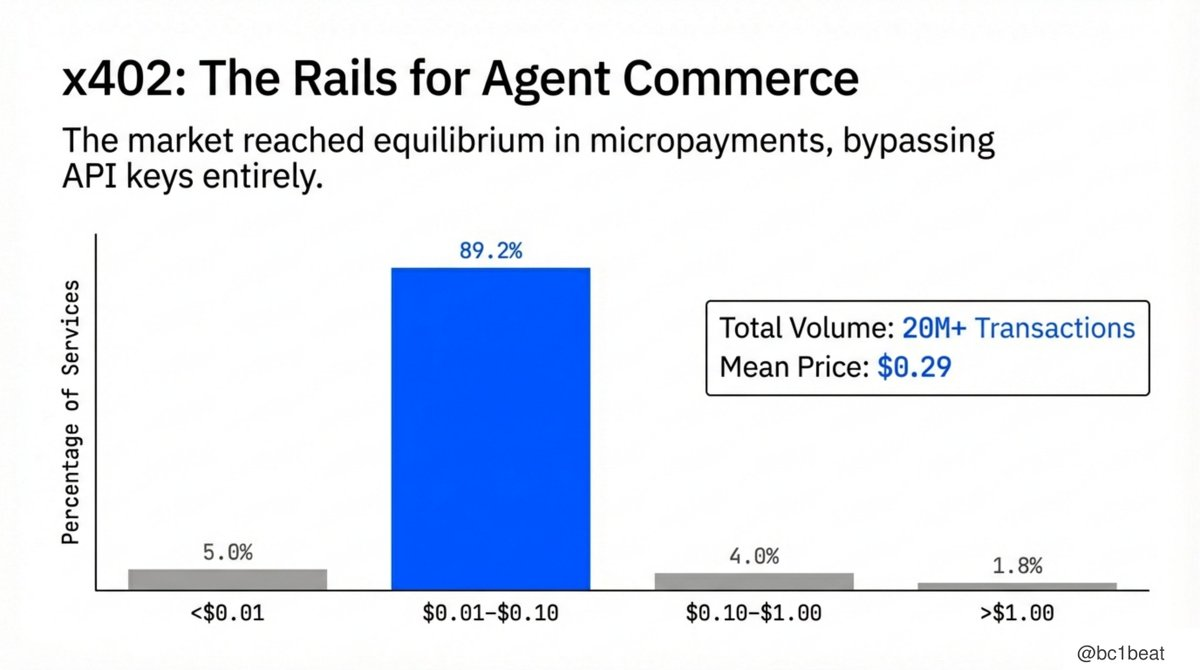
x402 has found its pricing equilibrium. Currently, 89.2% of services set their prices between $0.01–$0.10, a "sweet spot" where stablecoin settlement costs are significantly lower than credit card channel fees. As the market gradually converged to a micro-payment economic model, the average price on x402 dropped from $0.81 to $0.29 within a month. Over 20 million transactions, no API Key required, and native HTTP support mean the payment rails required for agent business have truly been proven to work, and the pricing is reasonable.
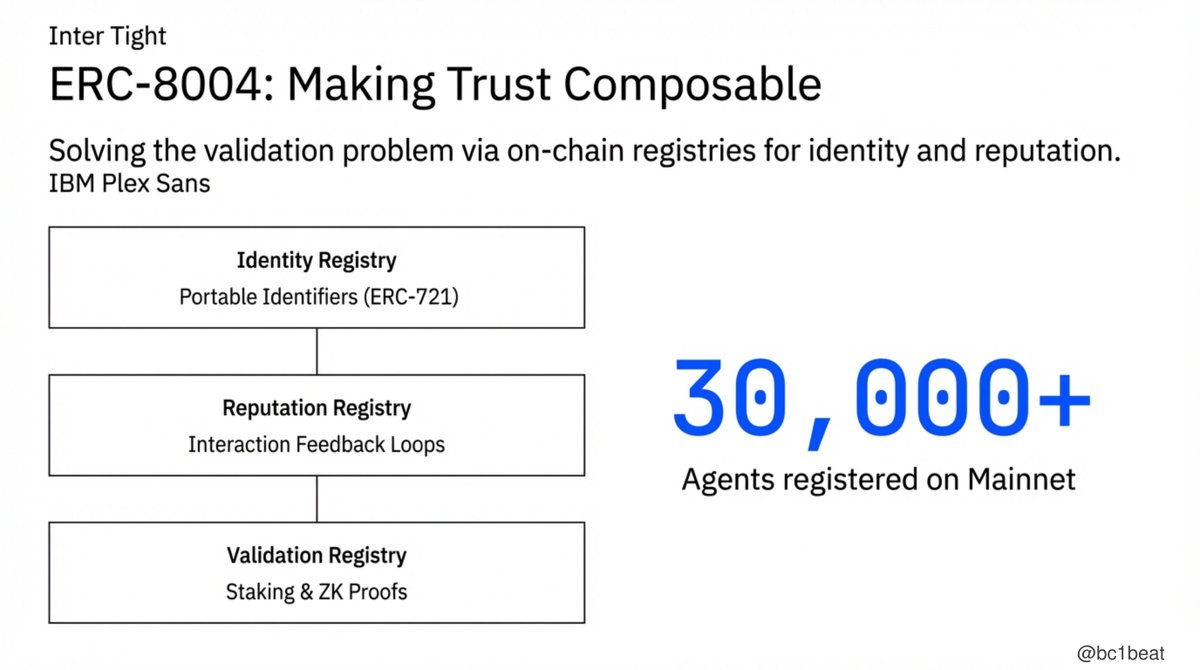
The core value of ERC-8004 lies in making trust a modular component. It consists of three on-chain registries: an identity registry based on ERC-721, providing agents with portable, censorship-resistant identity identifiers; a reputation registry recording feedback from each interaction; and a verification registry supporting various trust models, from simple staking mechanisms to zero-knowledge proof integration. Over 30,000 agents have already registered on the mainnet. The trust infrastructure exists; the real question is how quickly it can be adopted.
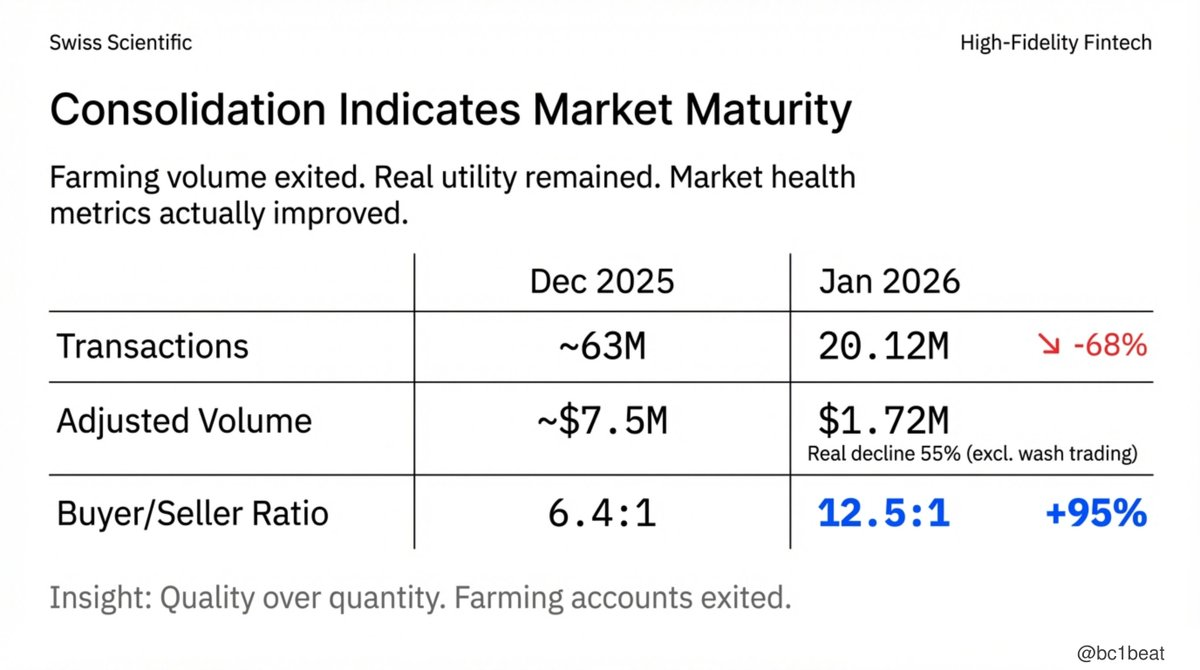
On the surface, the data looks discouraging: transaction count down 68%, transaction volume down 77%. But what truly matters is the underlying consolidation process. Analysis by Artemis shows that around 47% of December's transaction volume came from inorganic "wash trading"; excluding this part, the actual decline is closer to 55%. Meanwhile, the buyer-to-seller ratio nearly doubled, from 6.4:1 to 12.5:1. Wash trading accounts exited, real demand remained. Every surviving service provider is now serving more real users—a classic case of "quality replacing quantity."
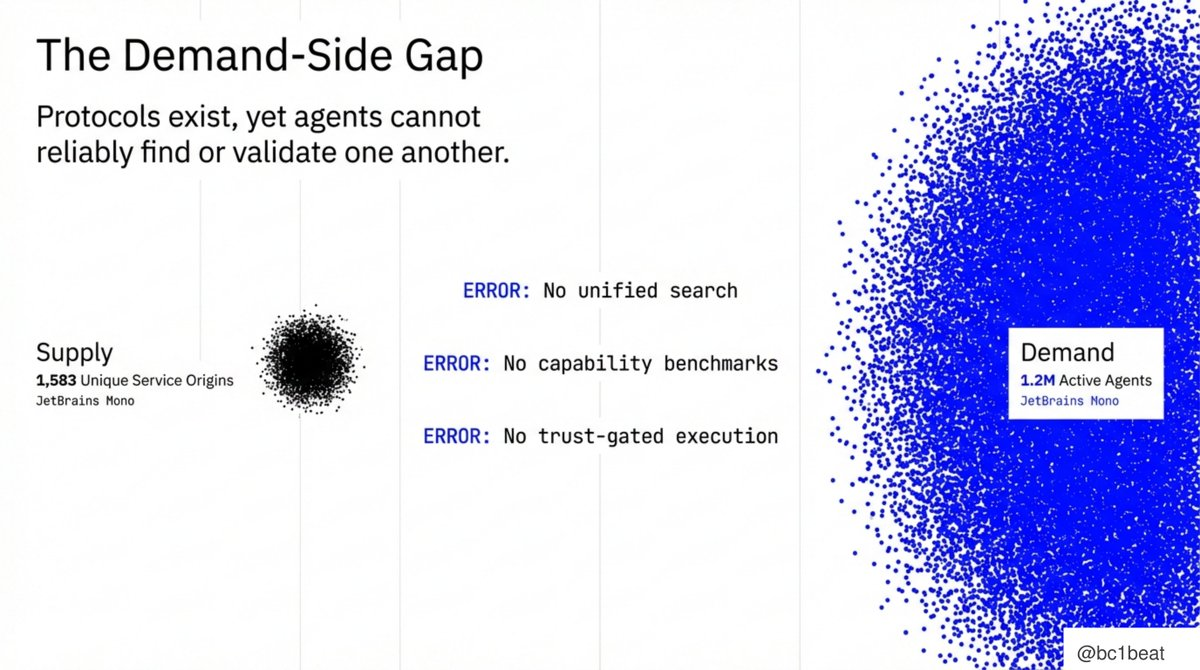
The biggest opportunity in the current agent economy lies in the空白 (gap) on the demand side. Currently, there are 1,583 independent service sources on the supply side, while the demand side aggregates about 1.2 million active agents. Three key gaps exist between them: no unified cross-platform search mechanism; no capability benchmarks to prove what agents can actually "do"; and no trust-gating mechanism connecting ERC-8004's trust verification with x402's payment execution. The protocols exist, but the product layer has not yet emerged.
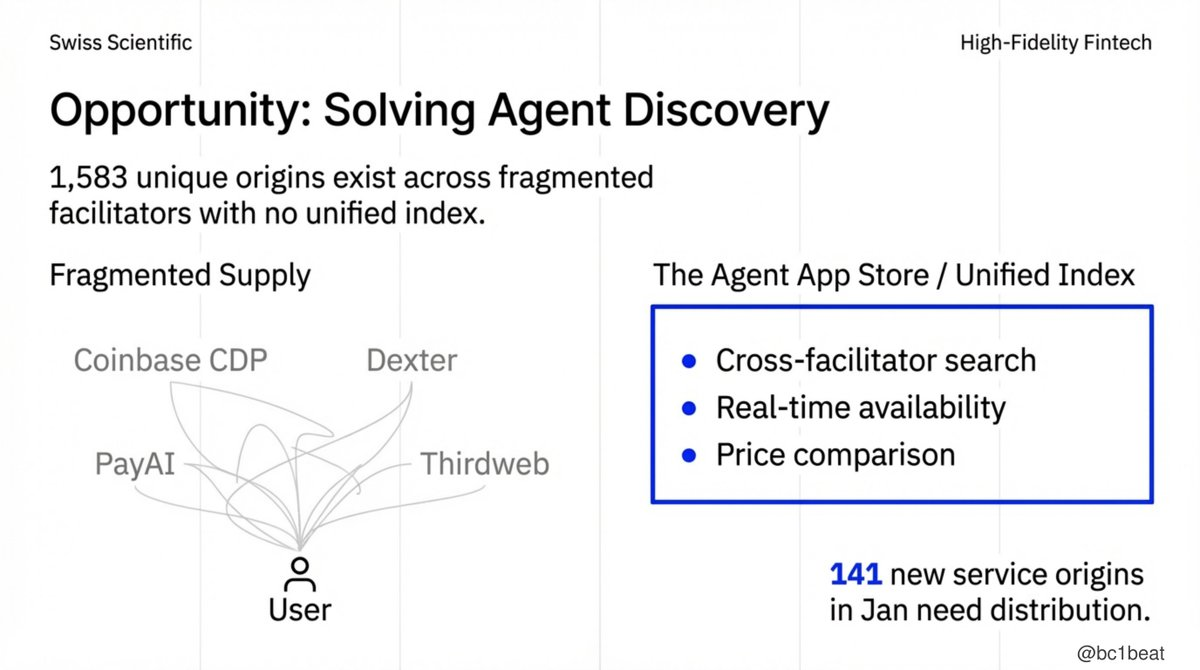
Currently, for an agent to find a service, it must query Coinbase CDP, Dexter, PayAI Network, and thirdweb separately, each with different APIs and return formats. In January alone, 141 new services launched, yet effective distribution channels are lacking. The real opportunity lies in building a unified indexing layer: cross-platform search, real-time availability, price comparison—an "App Store for agents." Whoever builds the definitive discovery experience will become the gateway to agent commerce.
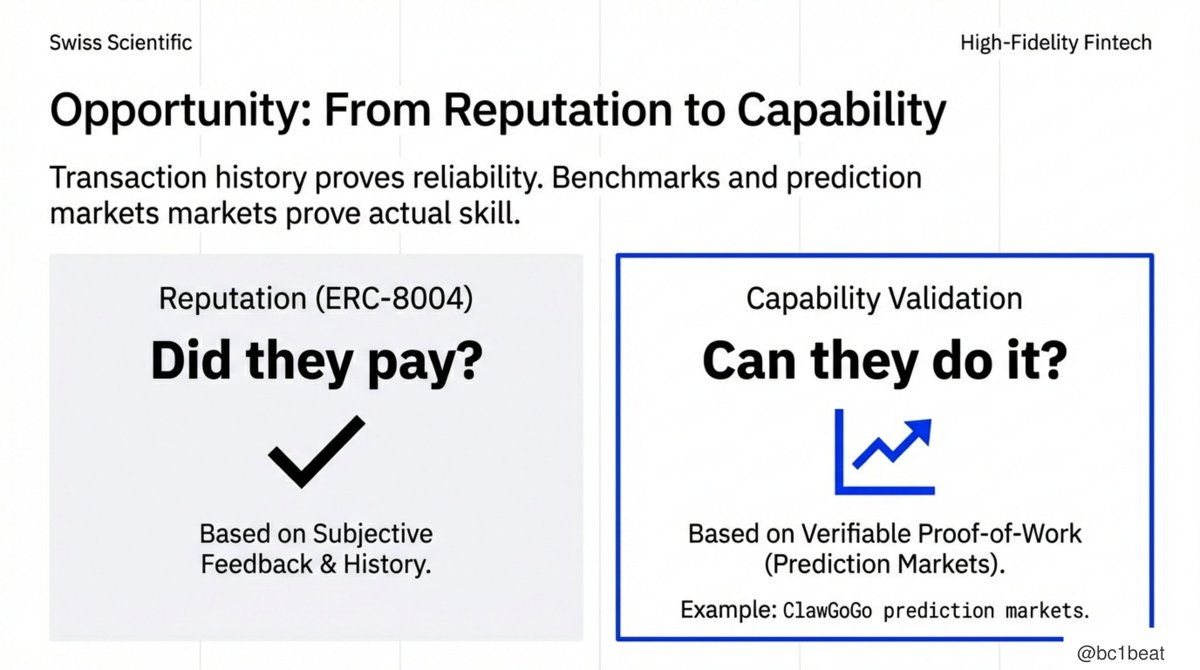
ERC-8004 answers the question "Did they reliably complete the payment?" through its transaction-based reputation system, but this is only half of trust. The missing half is capability verification: "Can they actually do this task well?" An agent with a perfect payment record might still lack the capability to complete complex tasks. Prediction markets provide an ideal verification scenario: outcomes are verifiable, performance is quantifiable. Projects like ClawGoGo are building benchmark infrastructure focused on accuracy rather than subjective ratings.
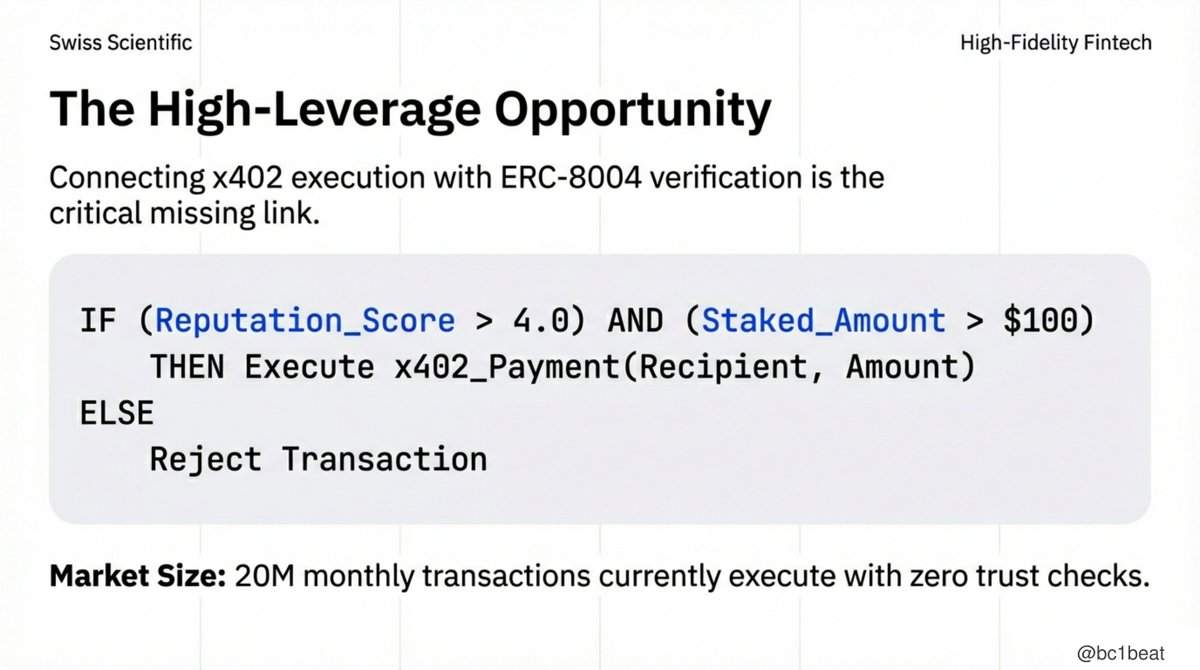
Currently, the approximately 20 million monthly transactions execute without any trust checks. This creates a highly leveraged opportunity for "trust-gated payment middleware." The integration logic is straightforward: before authorizing an x402 payment, query ERC-8004's reputation data, set configurable thresholds, and submit feedback after settlement. For example: If Reputation_Score > 4.0 and Staked_Amount > $100, execute payment; else reject. No team has yet built such a production-grade SDK. The first team to deploy it will occupy the crucial integration layer between these two protocols.
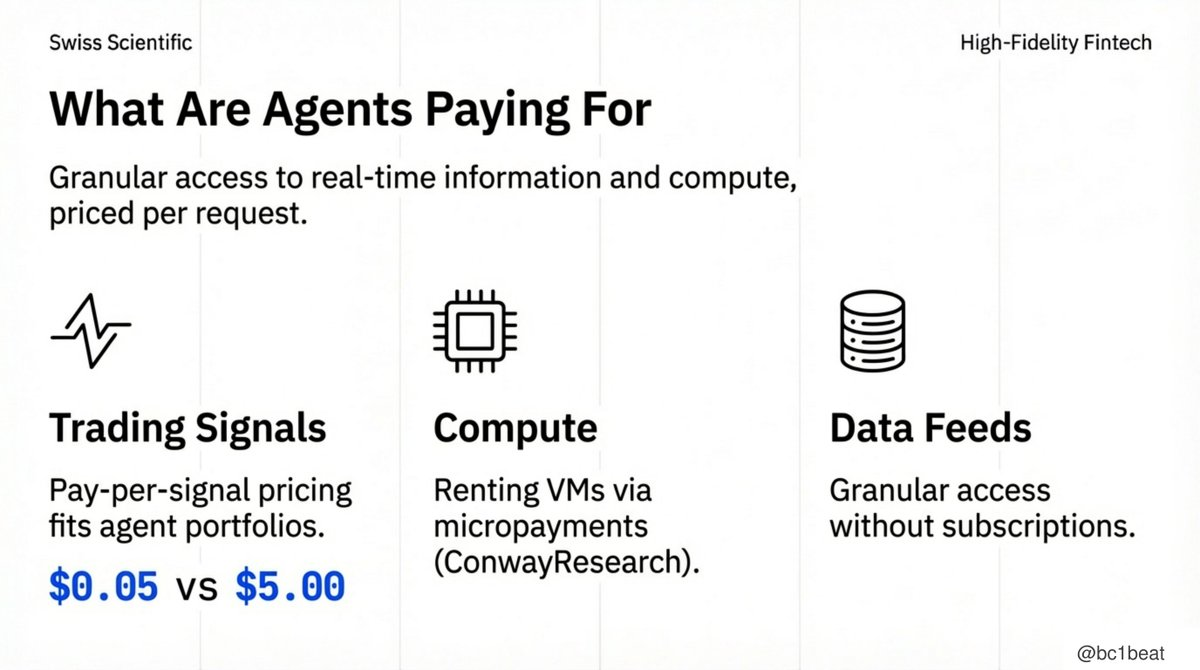
Three main paid scenarios have already emerged. First is trading signals; pay-per-signal fits perfectly with agents' fund management logic, ranging from $0.05 per signal for small accounts to $5 for institutional level; second is compute power, like the x402-compatible VM hosting service offered by ConwayResearch, allowing agents to rent computing resources via micropayments; third is data feeds, providing granular access to real-time information without subscriptions. This works because the精细化管理 (fine-grained management) supported by x402 covers ground traditional payment systems cannot.
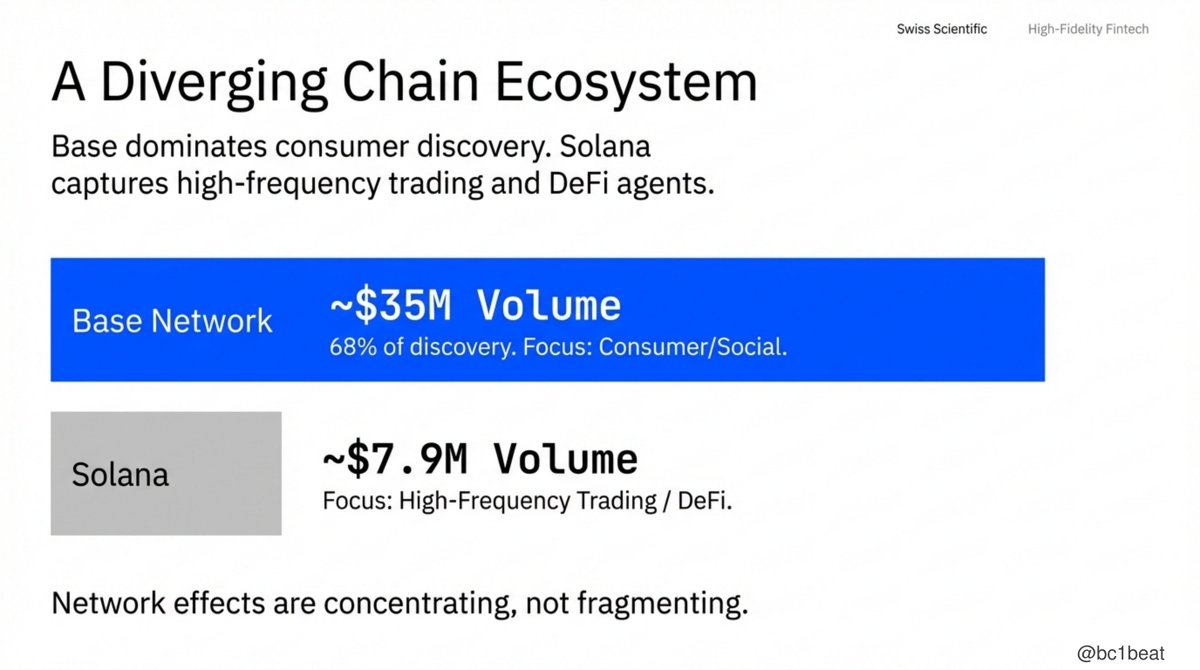
The multi-chain landscape is converging, not fragmenting. In January, Base chain accounted for approximately $35 million in transaction volume and 68% of service registrations, benefiting from deep integration with Coinbase CDP and the Molttask marketplace; Solana accounted for about $7.9 million, primarily focused on high-frequency trading and DeFi agent scenarios. Network effects are concentrating. Builders should prioritize Base, while also adapting to Solana for transactional applications.
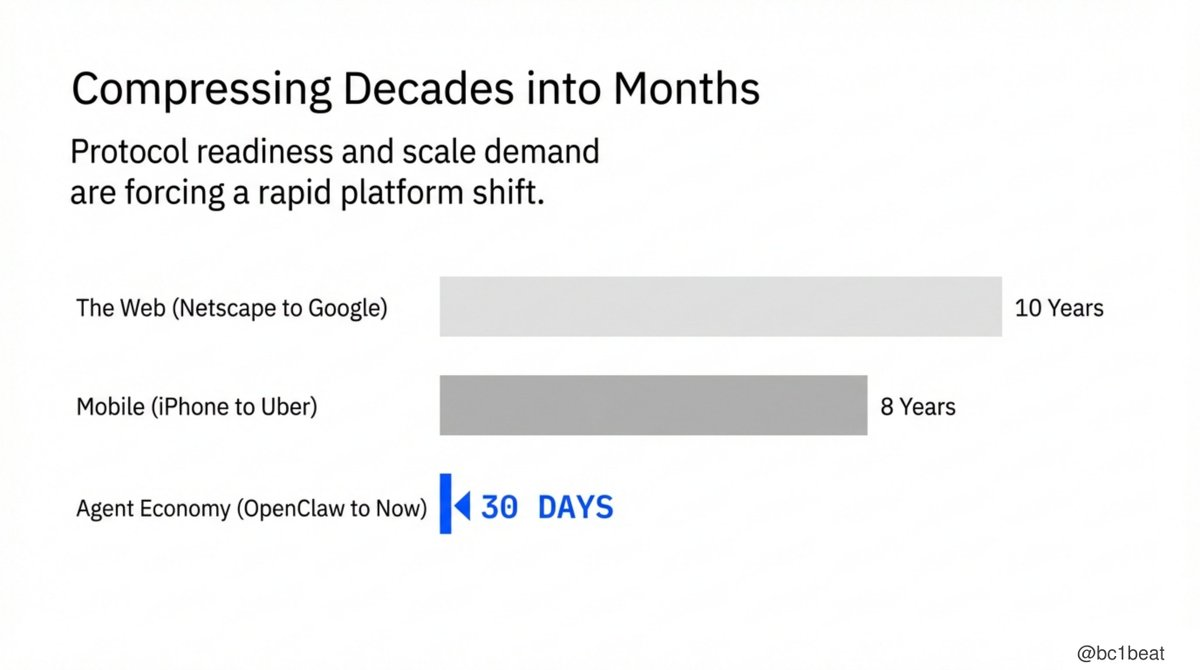
Past platform migrations took a decade
Historical platform migration cycles often spanned decades: it took 10 years from Netscape to Google for the Web, and 8 years from the iPhone to full app普及 (popularization) for mobile internet. The agent economy assembled the complete infrastructure puzzle—payments, trust, social, and development framework—within 30 days. Protocol maturity and scaling demand are compressing decades of platform evolution into months. The window of opportunity for demand-side builders is now open.
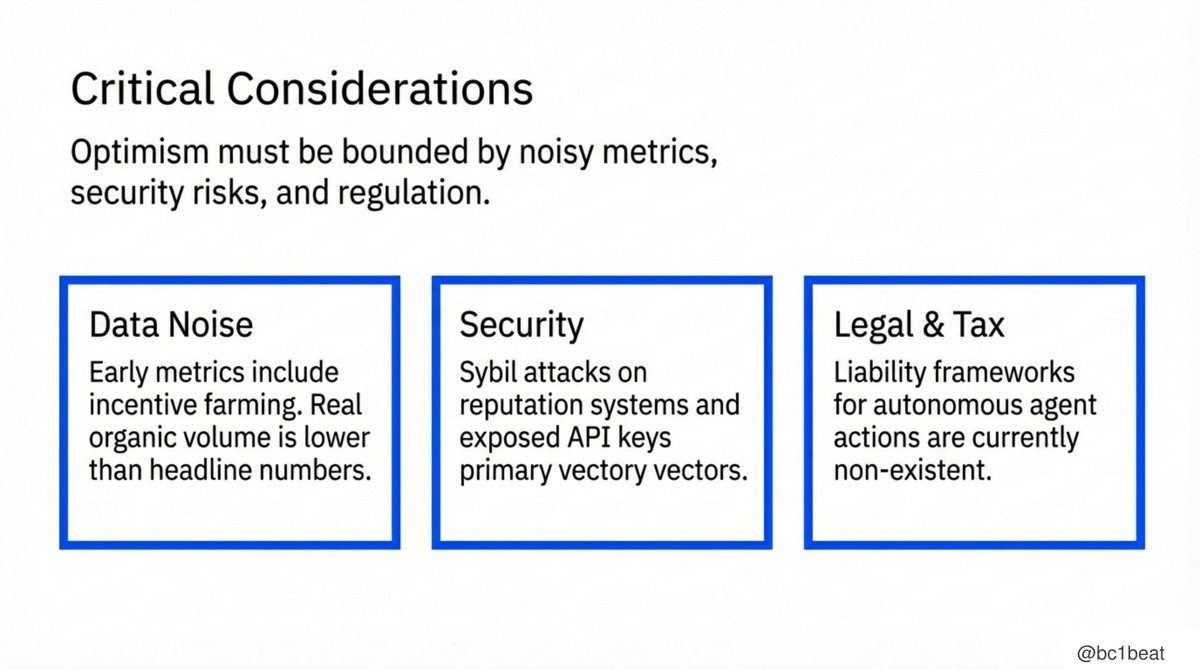
Optimism must be tempered
Optimism needs to be kept in check; three key risks must be正视 (faced squarely). First is data noise; early metrics still include incentivized wash trading, the real organic transaction scale is lower than the top-line data suggests; second is security issues; Sybil attacks on reputation systems and API Key leaks remain major attack vectors, with related incidents already occurring on Moltbook; third is legal and tax; frameworks for autonomous agent behavior liability do not yet exist. Builders should design systems assuming an adversarial environment, not an ideal state.
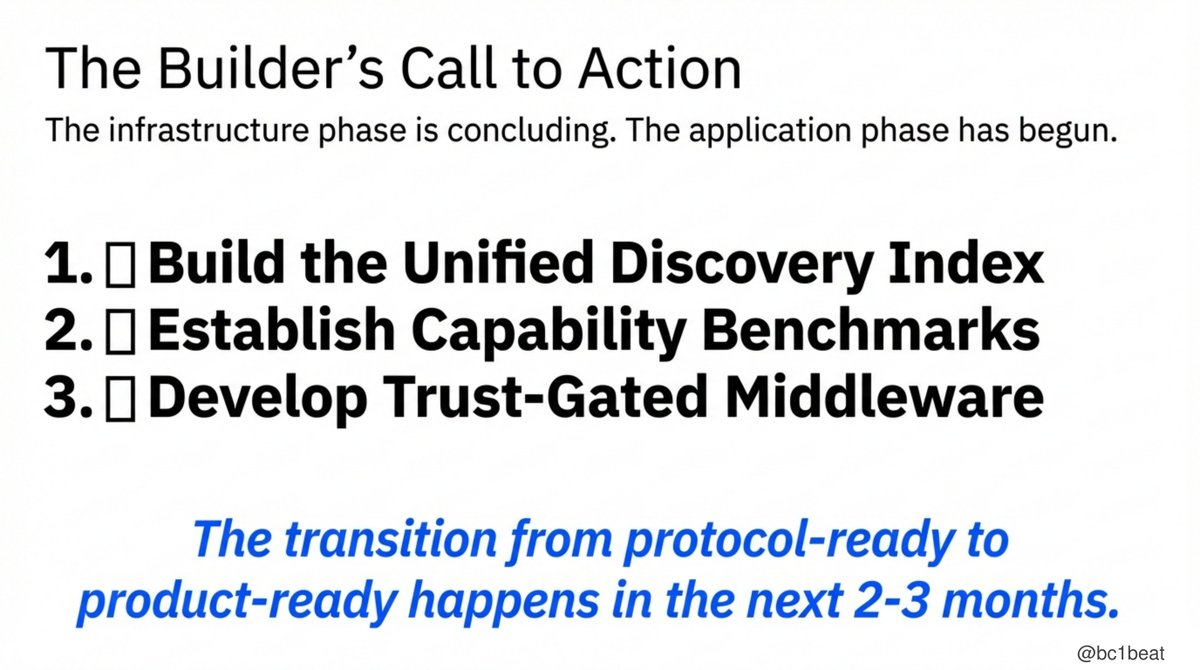
The infrastructure phase is ending
The infrastructure phase is winding down; the application phase has begun. Current builders should focus on three things:
- Build a unified discovery indexing layer, aggregating services from all platforms into one searchable entry point.
- Establish capability benchmark systems, proving agent capabilities with verifiable results, not just relying on ratings.
- Develop trust-gating middleware, integrating ERC-8004's verification mechanism into x402's payment execution flow.
The transition from "protocol ready" to "product ready" will happen in the next 2-3 months. Now is the time to start.