LATEST NEWS: Long-Awaited Fed Interest Rate Decision Announced! Here is Bitcoin's Initial Reaction

cryptonews.ruPublished on 2026-07-29Last updated on 2026-07-29

Abstract

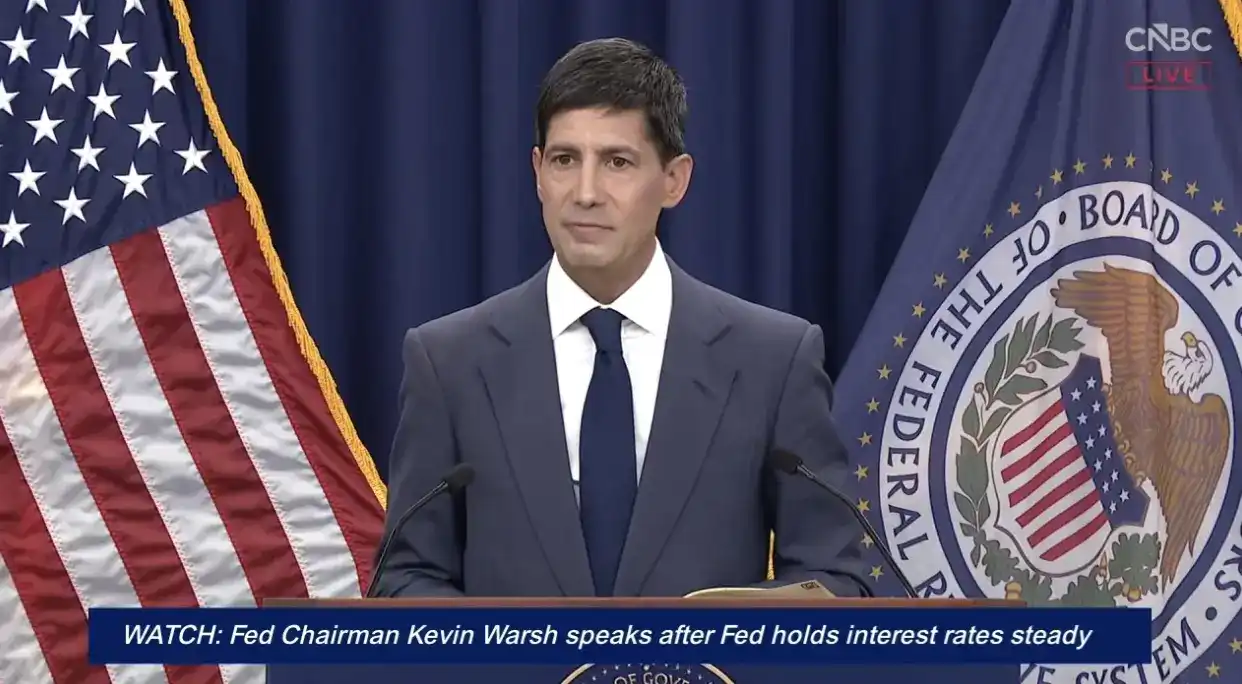
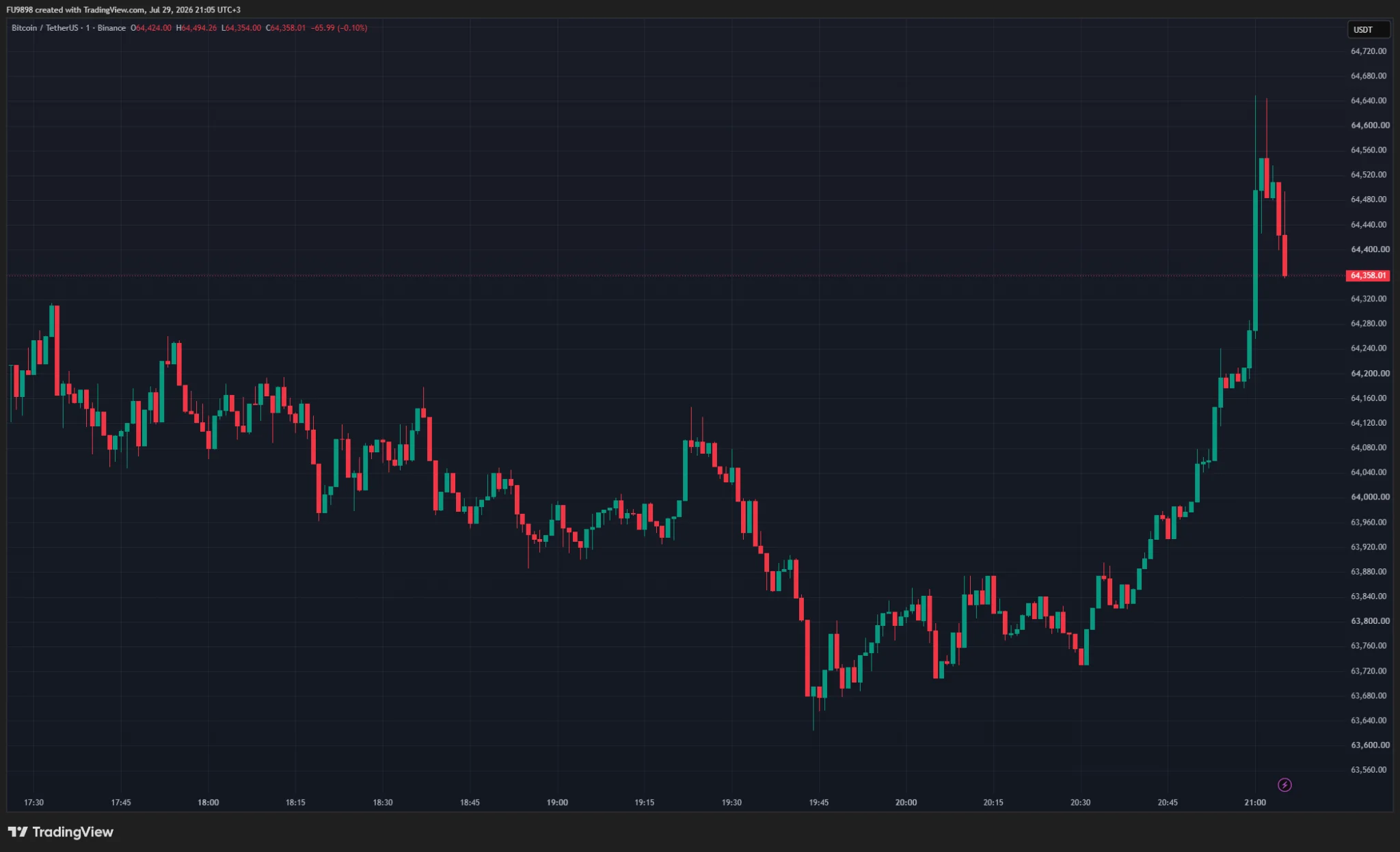
The Federal Reserve has kept interest rates unchanged as expected. All attention is now focused on the press conference by new Fed Chairman Kevin Warsh, scheduled for 21:00. Bitcoin's initial reaction to the rate decision is shown in the provided chart. Chairman Warsh, like his predecessor Jerome Powell, has emphasized controlling inflation, with some investors perceiving his stance as tougher than anticipated. While rate cuts were expected under Trump-appointed Warsh, market expectations for a potential rate hike by year-end have strengthened. Notably, Trump's frequent public criticism of Powell for not cutting rates fast enough has ceased since Warsh took office, despite no major shift in the Fed's decision-making approach. An investment strategist noted significant continuity between the two Fed chairs. *This is not investment advice.

The Federal Reserve, as expected, kept interest rates unchanged.

All attention is now focused on the press conference of Federal Reserve Chairman Kevin Warsh, scheduled for 21:00 (14:30 Eastern Time).

Here is Bitcoin's reaction to the interest rate decision:
The new Federal Reserve Chairman, Kevin Warsh, like his predecessor Jerome Powell, has repeatedly emphasized the importance of controlling inflation. Some investors believe Warsh has taken a tougher stance on inflation than expected.

Although interest rate cuts were expected during Warsh's tenure as the Fed Chair appointed by Trump, market expectations that the central bank might raise interest rates by the end of the year have strengthened.

Trump frequently criticized the Fed Chair on social media, claiming that interest rates were not being lowered quickly enough during Powell's tenure and even threatened his removal. However, despite no significant changes in the Fed's decision-making approach since Warsh took office, Trump's attacks on the central bank chief have ceased.

Michael Reynolds, Vice President of Investment Strategy at Glenden, noted the similarity between the two Federal Reserve Chairmen, stating: "There is considerable continuity between the two chairmen."

*This is not an investment recommendation.

end-content
Related Questions

QWhat decision did the Federal Reserve make regarding interest rates according to the article?

AAs expected, the Federal Reserve kept interest rates unchanged.

QWho is the new Chairman of the Federal Reserve mentioned in the article, and how are his views described compared to his predecessor?

AThe new Chairman is Kevin Warsh. Some investors believe he has taken a tougher stance on inflation than his predecessor, Jerome Powell, was expected to, though there is noted continuity between their approaches.

QWhat was Bitcoin's immediate reaction to the Federal Reserve's interest rate decision?

AThe article mentions a chart illustrating Bitcoin's reaction but does not describe the specific price movement in the text. The focus is on the visual representation.

QHow did former President Trump's criticism of the Federal Reserve change with the appointment of the new Chairman?

AWhile Trump frequently criticized Chairman Powell on social media, his attacks on the central bank's chairman stopped after Kevin Warsh assumed the position, despite no major change in the Fed's decision-making approach.

QWhat are the market's current expectations regarding future interest rate moves by the Fed, as suggested in the article?

AMarket expectations have strengthened that the central bank could raise interest rates by the end of the year, even though rate cuts were initially anticipated when Warsh, appointed by Trump, took office.

Related Reads

After R&D Investment Catches Up with the U.S., Is the Sino-U.S. Chip Competition Still Just About Money?

The article examines the significance of recent data showing China's total R&D expenditure, measured by purchasing power parity (PPP), catching up to or slightly surpassing that of the United States in 2024. It argues that while this milestone reflects China's immense capacity to mobilize research resources, the competition in semiconductors now extends far beyond sheer financial input. The analysis highlights key differences: China's R&D is heavily skewed towards experimental development (over 80%), focusing on product engineering and industrialization, whereas the U.S. allocates a proportionally larger share (about 15%) to basic research. Furthermore, leading U.S. semiconductor firms reinvest a significant portion of their substantial global sales revenue into R&D, creating a sustainable commercial innovation cycle that is difficult to replicate. The article emphasizes that semiconductor progress depends on converting R&D into commercially viable products that pass rigorous customer validation and achieve repeat orders, not just on spending levels. It concludes that as China enters the top tier of R&D spenders, the critical challenges shift to improving resource allocation efficiency, fostering long-term basic research, and building effective mechanisms to bridge the gap between laboratory discoveries and reliable, market-ready industrial capabilities.

marsbit41m ago

After R&D Investment Catches Up with the U.S., Is the Sino-U.S. Chip Competition Still Just About Money?

marsbit41m ago

Top 10% of American Households Capture 88% of Wealth, How Is the AI Era Cake Divided?

AI Worsens Wealth Inequality as Top 10% of US Families Garner 88% of Stock Gains (2019-2026) A report from the China Finance 40 Forum highlights that the AI boom is significantly widening wealth inequality in the United States. From 2019 to Q1 2026, wealth from directly held stocks by US households nearly doubled from $29 trillion to approximately $55 trillion, with rapid growth concentrated post-2023, coinciding with the AI-driven stock market surge. The distribution of these gains has been starkly uneven. Between 2022 and Q1 2026, the wealth increase of about $21 trillion was captured almost entirely by the wealthiest families: the top 10% secured roughly 88% ($18.5 trillion), while the bottom 50% received only about 1% ($0.2 trillion). This has contributed to a growing disparity in disposable income shares. The report, referencing economic historian Robert Allen, draws parallels to historical technological shifts like the "Engels' Pause" during the First Industrial Revolution, where worker wages stagnated despite productivity gains. It suggests AI could induce a similar period where capital收益 outpace labor income, exacerbating inequality. Huang Yiping of Peking University identifies four mechanisms through which AI impacts income distribution: capital-bias (reducing labor's income share), task polarization (hollowing out middle-skill jobs), skill-based digital divides, and wealth amplification through assets. He warns that if this trend continues, strong supply growth driven by AI could be undermined by persistently weak consumer demand, threatening sustainable economic growth. To address these challenges, the report proposes a three-pronged strategy: 1) Defensive measures like strengthening social safety nets and antitrust enforcement; 2) Empowering workers through education reform and lifelong learning to collaborate with AI; and 3) Rebalancing via policies such as potential taxes on AI超额收益 and mechanisms for broader sharing of technology's benefits, ensuring AI's红利 are more equitably distributed.

marsbit46m ago

Top 10% of American Households Capture 88% of Wealth, How Is the AI Era Cake Divided?

marsbit46m ago

Trading

Spot
活动图片