A Former ByteDance Employee's Account: How I Started with Two Pinduoduo Hard Drives and Made a 600% Profit with Seagate to Achieve Financial Freedom?

链捕手Published on 2026-07-01Last updated on 2026-07-01

Abstract

Summary: A former ByteDance employee describes how a personal observation led to a highly profitable investment in Seagate Technology ($STX). Needing hard drives for a personal data project in August, he noticed their prices on Pinduoduo were rising consistently. Investigating further using price-tracking tools, he confirmed a broader, sustained price increase for high-capacity HDDs. He traced this to surging AI demand, as data centers require massive, cost-effective storage for model training and data, favoring high-capacity enterprise HDDs like those from Seagate. This demand was squeezing consumer supply. After initial research and a small purchase, he waited for confirmation from institutional 13F filings. Seeing a clear multi-quarter trend of increasing institutional ownership in Seagate, he significantly increased his position. From an entry around $150, Seagate's stock price rose over sixfold to approximately $965. He attributes the success to a methodology of identifying anomalies in everyday life (e.g., product shortages/price hikes), researching the underlying structural cause, identifying the publicly-traded beneficiary, and using 13F data to confirm institutional interest over multiple quarters. He cautions that this was one successful case among others that failed and is not offering investment advice.

Author:Leto Bao, the protagonist behind the '30 million stock investment leading to financial freedom' at ByteDance

All information below was shared in ByteDance's US stock group last year, including trading targets, positions, and P&L, all verifiable.

Last August, I just wanted to buy two hard drives.

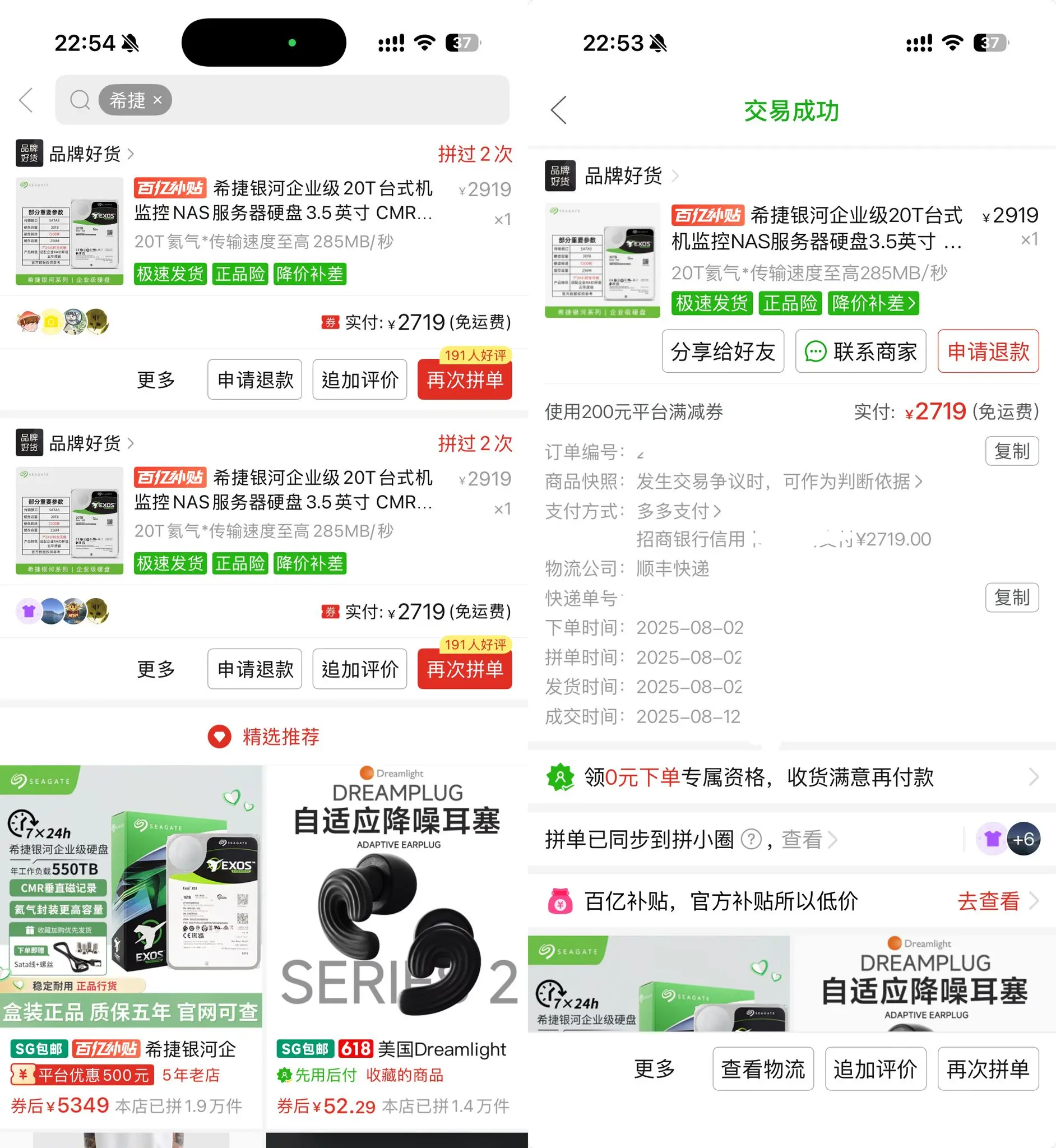
I was building a small quantitative platform and wanted to pull some tick-level market data for local storage, which required tens of terabytes of space, so I ordered two high-capacity Seagate drives from Pinduoduo. Looking back later, that purchase was the starting point of my entry into the storage theme over the past two years.
Hard Drive Prices Started Changing Daily

After receiving the drives, I bookmarked the link, planning to buy more if needed. A few days later, the price had increased; a few more days, it rose again. The same model, from the same store, had its price adjusted multiple times within a week, only going up, never down.

For a high-volume, highly standardized industrial product, retail prices shouldn't show such a sustained, one-way upward trend. I saw this as an anomaly worth investigating, not just simple merchant price hikes.

Using price comparison tools like Manmanbuy and Keepa, I pulled up the price curve for this specific drive over the past few months and compared it with other high-capacity models from Seagate and Western Digital. The conclusion was consistent: it wasn't an issue with a single model. The entire line of high-capacity mechanical hard drives was rising, and doing so continuously and unidirectionally, unlike short-term fluctuations caused by promotions.

At this point, it was almost certain there was a larger reason behind it.

Following the Thread, It Was AI Snapping Up Hard Drives

Digging deeper, the logic gradually became clear.

The market focused more on AI's demand for GPUs, but its demand for storage was equally massive. Large model training and inference generate vast amounts of data that need long-term preservation. For long-term, low-cost data storage, the primary reliance isn't SSDs, but high-capacity mechanical hard drives. The drives used in data centers for this are called nearline enterprise-grade hard drives, which major cloud providers like Microsoft, Amazon, Google, and Meta are purchasing in large quantities.

Seagate happened to be positioned perfectly for this wave of demand. Its key HAMR technology significantly increases per-drive capacity, aligning precisely with data center needs. With limited production capacity, manufacturers prioritized the more profitable enterprise-level orders, squeezing supply in the retail channel. The price increase I saw on Pinduoduo was essentially the procurement demand from AI data centers transmitting all the way to consumer pricing.

I checked Seagate's earnings report at the time: revenue for the latest quarter grew 39% year-over-year, gross margin hit a record, and the market also began pricing the data storage sector as part of the AI industrial chain.

After confirming the logic, I bought 500 shares at over $150, and posted my reasoning, cost basis, and position in the company's internal US stock discussion group.

What Gave Me the Conviction to Add Was the Subsequent 13F Filings

Being personally convinced wasn't enough; I needed to confirm if institutional money was making the same judgment.

The US market has a very useful public data set: institutions managing over $100 million are required to disclose their US equity holdings quarterly, known as 13F filings. This is essentially a legal, public record of institutional holdings that anyone can access.

I didn't add to my position immediately, wanting to observe the trend for another quarter or two. A change in a single quarter might be coincidental; a trend across consecutive quarters in the same direction is more credible. When the November filing for Q3 came out, plotting Seagate's institutional holdings over the past year into a line, the direction was already clear:
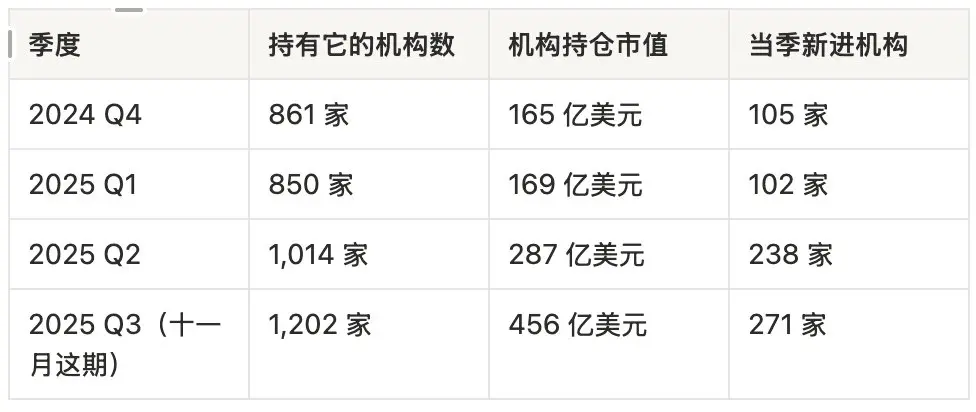
In the second half of 2024, this stock was largely ignored, with the number of institutions holding it hovering around eight hundred, even slightly declining. Entering Q2 2025, a clear inflection point emerged, accelerating further in Q3: the number of institutions holding it increased from over eight hundred to over twelve hundred, with the number of new entrants also increasing quarter by quarter.

It should be noted that the rise in total holding value to $45.6 billion within a year was largely due to the stock price appreciation itself, not entirely new capital inflows. However, 'breadth' indicators like the number of institutions and new positions tell a more important story. Their sequential increase meant this wasn't a bet by one or two funds, but a group of professional capital consistently entering the market.

After confirming this step, I added to my position on a larger scale with more confidence. I also began seriously researching the storage sector and later used LEAPS CALLs to continue adding to positions in $STX and $SNDK.

Looking Back Now

On the day I bought the hard drives, Seagate closed at over $150; today it's around $965, a gain of over six times. It once surpassed Palantir last year to become the top performer in the S&P 500 for the full year. Just the initial 500 shares alone represent a paper profit of around $400,000; the profits from subsequent additions aren't detailed here.

It's still somewhat surprising that two hard drives ultimately led to such a trade.

To Summarize This Framework

It's actually not complicated:

  • Anomalies encountered in daily life (price increases, shortages, queues) often appear earlier than news or earnings reports. Ordinary people sometimes receive first-hand signals earlier than professional institutions.

  • Don't stop at the impression of "seems more expensive." Plot the price into a curve; you can usually judge whether it's a trend or just noise.

  • Ask the next question: Is this driven by a long-term, structural demand? Then find the listed company that directly benefits and is in a key position in the industrial chain.

  • Finally, use 13F filings to verify institutional sentiment, focusing on the trend across consecutive quarters, not just a single quarter.

This method doesn't guarantee being right every time, but at least it allows your buy decision to be based on logic, not just feeling.

Finally, Being Clear About the Risks

This was one successful instance. I've also had cases where I focused on a price increase signal that turned out to be just short-term volatility. Those weren't posted in the group, but they are equally real—survivorship bias is evident.

The above is a personal review and does not constitute investment advice. Invest at your own risk.

However, I endorse this framework: pay attention to anomalies encountered daily, ask the next 'why', find the underlying listed company, and then use 13F to see if professional capital agrees. Next time something you regularly buy increases in price for no apparent reason, you might want to think: who is making that money, and is that company already public.

Related Questions

QWhat was the initial personal observation that triggered the author's interest in investing in Seagate Technology ($STX)?

AThe author noticed that the retail price of the high-capacity hard drives he bought on Pinduoduo for his personal project kept rising repeatedly in a short period, which he considered an anomaly for a standardized industrial product.

QAccording to the author, what was the fundamental reason behind the persistent price increase of high-capacity hard drives in the consumer market?

AThe price increase was driven by surging demand from AI data centers. Large-scale AI model training and inference generate massive data requiring long-term, low-cost storage, primarily on high-capacity nearline enterprise hard drives. Manufacturers prioritized these profitable enterprise orders, squeezing supply for the retail consumer market.

QWhat key public data source did the author use to validate his investment thesis before making a larger commitment?

AThe author used the quarterly 13F filings, which are mandatory disclosures of U.S. equity holdings by institutional investment managers with over $100 million in assets under management. He analyzed trends over multiple quarters to see if professional funds were consistently increasing their positions in Seagate.

QWhat specific trend in the 13F data gave the author more confidence to significantly increase his investment in Seagate?

AHe observed a clear, multi-quarter trend: the number of institutions holding Seagate stock increased from around 800 in late 2024 to over 1,200 by Q3 2025, and the number of institutions initiating new positions also grew each quarter, indicating broad and sustained institutional buying interest.

QWhat is the core investment framework or methodology the author summarizes from this experience?

AThe framework involves: 1) Noticing anomalies in everyday life (like price hikes or shortages). 2) Quantifying the signal (e.g., plotting price history) to distinguish trend from noise. 3) Investigating if it represents a long-term, structural demand shift and identifying the key publicly-traded beneficiary. 4) Using 13F data to validate if institutional money agrees with the thesis over multiple quarters.

Related Reads

The Largest Upgrade Since The Merge? How Glamsterdam Will Affect Ethereum and Regular Users?

The upcoming Glamsterdam upgrade, scheduled for late 2026, is considered Ethereum's most significant change since The Merge. It focuses on fundamentally restructuring Ethereum's block production, transaction execution, and gas pricing to enable major scalability improvements while preserving decentralization. The upgrade centers on three key innovations: * **Enshrined PBS (ePBS)**: Moves the Proposer-Builder Separation mechanism into the protocol's core, eliminating reliance on external relays. This reorganizes the block pipeline, extending the time window for processing execution payloads, which is crucial for safely increasing block capacity. * **Block-Level Access Lists (BALs)**: Attaches a "map" to each block, declaring in advance which state data its transactions will access. This enables potential parallel transaction processing and faster node synchronization, breaking a key performance bottleneck. * **Gas Repricing**: Introduces a more accurate resource pricing model by separating computation costs from state storage costs. This discourages uncontrolled state growth by making operations that create permanent data (like new accounts) more accurately reflect their long-term network burden. Together, these changes aim to solve the core challenges of increasing Ethereum's throughput (e.g., raising the Gas Limit) without overburdening node hardware or increasing centralization risks. They prepare the infrastructure for higher capacity, targeting a credible post-upgrade capacity of up to 200 million Gas. For users, the impact will be nuanced: * General transaction fees may become lower and more stable as block space increases. * Simple transfers could see cost reductions, while state-intensive operations (like contract deployment) may become relatively more expensive due to the new gas model. * Gas fee estimations by wallets will become more accurate. * L2 networks could benefit long-term from increased data blob capacity. * Standardized logs for all ETH transfers (EIP-7708) will improve tracking for wallets and exchanges. Ultimately, Glamsterdam represents a foundational shift, not a simple block size increase. It seeks to expand Ethereum's capacity by re-engineering its underlying mechanics, maintaining its commitment to decentralization while enabling significant performance gains.

marsbit2h ago

The Largest Upgrade Since The Merge? How Glamsterdam Will Affect Ethereum and Regular Users?

marsbit2h ago

Circle CEO Responds to the OUSD Challenge: Stablecoin is a Winner-Takes-All Business, and We Won't Slow Down

In response to questions about the OUSD stablecoin initiative, Circle CEO Jeremy Allaire argues that the stablecoin market is a "winner-take-most" platform business driven by powerful network effects, and Circle has no plans to slow down. He outlines three key drivers behind USDC's dominant position: 1. **Protocol/Software Layer Network Effects**: The value of a stablecoin network grows as more developers and services integrate it, creating compounding utility and user preference. Circle has spent nearly a decade building this ecosystem with USDC, now accelerated by mainstream adoption and enhanced by software stacks like CCTP and Gateway for interoperability. 2. **Liquidity Network Effects**: Liquidity begets more liquidity. USDC has achieved top-tier global liquidity—ranking among the top three digital assets alongside BTC and USDT—through nearly a decade of building deep primary and secondary market access across regions and venues. 3. **Regulatory and Policy Integration**: Establishing a global stablecoin requires deep regulatory engagement, licensing, and compliance across key markets—a significant, long-term investment where Circle is a leader. Allaire cites Artemis data showing USDC facilitated 80% of all dollar stablecoin on-chain transaction volume in Q1 2026, with USDT at 20% and all others negligible. He addresses OUSD's purported advantages: "free" minting/burning is often not sustainable in practice; redistributing all revenue can starve essential infrastructure investment; and large consortium models historically struggle with inefficiency and slow execution, unlike focused strategic partnerships. He reaffirms Circle's strong ongoing partnership with Coinbase on USDC and notes Circle collaborates with dozens of other stablecoin issuers through its expanding platform (Arc, CCTP, CPN, etc.). While welcoming OUSD to the ecosystem, Allaire asserts that Circle's vast, trusted network and continued investment make USDC the foundational digital dollar infrastructure for the world.

链捕手2h ago

Circle CEO Responds to the OUSD Challenge: Stablecoin is a Winner-Takes-All Business, and We Won't Slow Down

链捕手2h ago

Q2 Crypto Market Review: Did Bitcoin Rise for 'Nothing'? Did Money Flow to AI and On-Chain?

Q2 2026 Crypto Market Recap: Bitcoin's Gains Erased Amid Shift to AI and On-Chain Activity The second quarter of 2026 saw a significant reversal for the cryptocurrency market. Bitcoin gave back all its April gains, ending Q2 down approximately 11%, while major stock indices posted strong gains. This divergence was driven by a hawkish shift in Fed rate expectations, capital rotation into AI stocks, and weakening liquidity channels into crypto. Key demand pillars deteriorated simultaneously. Spot Bitcoin ETFs recorded net outflows of $4.08 billion for the quarter, with outflows dominating June. Crypto treasury entity Strategy's bitcoin accumulation slowed markedly, and the total stablecoin market cap contracted by ~$4.2 billion. This created a tighter liquidity environment. Exchange data reflected the downturn. Spot trading volumes fell 28% quarter-over-quarter. The market underwent significant deleveraging, with $8.35 billion in long liquidations for BTC and ETH, primarily in late May/early June. Open interest and order book liquidity also declined. Despite the bearish price action, structural developments point to an expanding on-chain ecosystem. These include the rise of tokenized stocks with full legal rights, the growth of RWA (real-world asset) perpetual contracts for trading stocks and commodities 24/7, and the use of crypto markets for price discovery ahead of major events like the SpaceX IPO. On-chain vaults are also emerging as a core layer for institutional capital allocation.

Foresight News2h ago

Q2 Crypto Market Review: Did Bitcoin Rise for 'Nothing'? Did Money Flow to AI and On-Chain?

Foresight News2h ago

Trading

Spot
活动图片