Author: Yang Ge (Gary Yang)
Since the technological singularity, the evolution clock of AI has continuously accelerated, rapidly forming new civilizational generation gaps across different regions of the world. Over the past two months, I have participated in over 20 AI-related events in more than ten cities globally. Only the Stripe Sessions in downtown San Francisco at the end of April stood out, far surpassing all other topics with a generational gap so vast it was shocking. While the world is growing weary of the single-agent bottleneck of Claws & Agents, Silicon Valley and San Francisco have already moved to the next dimension in managing Agent economy and Agent epistemology. The competitive pressure for Q3 and Q4 of 2026 remains intense, and the growth curve is extremely steep.
tl;dr
1. The competition in AI Payment and the bottleneck of H2A economy.
2. The inevitable trend of Agent economy and the A2A ecosystem.
3. The connection, gaps, and political-economic factors between AI Protocol and Crypto Protocol.
4. The submicroeconomic characteristics of AI Agent and the paradigm analogy with biology.
5. The inevitability of AIFi and the economic significance of Financial Chip (FinChip).
6. AI-Native is a paradigm upgrade distinct from Internet+.
1. The Competition in AI Payment and the Bottleneck of H2A Economy
In Q1 2026, we predicted that from April to May, many regions worldwide would enter fierce competition for AI Agent Payment, which would quickly intensify. The demand for value exchange among Agents is beginning to manifest, and the rapid development of AI Payment was also validated in Q2. Following x402, multiple AI Payment Protocols like MPP quickly emerged in Q2. Not only are traditional and Crypto financial payment companies fully upgrading to AI (including major players, especially like Google), but even established IT companies (such as IBM) are rushing into this track, hoping to seize the discourse power in the layout of the Agent world.
On the day of Stripe Sessions in San Francisco, I discussed the standardization and application issues of Payment Protocols with technical leaders from several top AI companies. The results were reasonable but not entirely satisfactory: 1 No one can set the standard; consensus standards will only gradually form through the process of competition and capture. 2 Most people completely agree that Crypto is the inevitable path for AI Payment Protocol, but their starting point is Fiat API, partly due to inertia but more due to compliance hurdles. 3 KYC is both unavoidable and counter to Agent Native principles. 4 Everyone claims A2A (Agent to Agent), but everyone is actually doing H2A (Human to Agent).
In fact, in Q2 2026, many large and mid-sized companies in Silicon Valley are similar to those in East Asia. Even most Department Heads within the Mag 7 are still approaching AI Payment and Agent Economy from a to B to C commercial perspective to ride the trend, assigning KPIs to middle and lower levels focused on to Human Users. This inevitably leads to the current temporary non-orthodoxy of Payment Protocols and the A2A economy phase. This H2A-oriented trend quickly hit a bottleneck in Q2 for a simple reason: the biggest feature of an AI Agent is its ability to make decisions. However, the 2B2C commerce developed under the internet and the H2A economy are essentially human-decision-driven. Using Agents to help humans make Fiat Payments in traditional e-commerce scenarios is logically Non-AI-Native, so its current stage remains more about hype value than practicality.
However, from another perspective, H2A has indeed served as an excellent primer, stimulating the conceptual transition towards the next stage of AI-Native and Agent Autonomous economies. By the end of Q2 2026, some savvy companies realized this and began 'repairing the plank roads in public while secretly crossing at Chencang'—using AI-Native Agent economic thinking to reconsider problems in reverse, deducing that the best value for Q2-Q3 lies in understanding the interface methods of the current H2A economy.
2. The Agent Economy and the Inevitable Trend of the A2A Ecosystem
Agent Economy refers to a new economic system where autonomous (self-governing) AI Agents directly participate in value creation, value exchange, and value capitalization, gradually becoming independent economic entities.
A2A Ecosystem is the overall picture formed when different Agents participate in economic activities within the Agent Economy, interact with each other, exchange information (value), and create cooperative or competitive economic value.
In Q2 2026, many top global venture capital firms emphasized their focus on investing in the Agent Economy and A2A ecosystem, even defining it as the only important investment direction for the next stage.
Similar to the incubation period before internet e-commerce (2007), before mobile internet (2013), and before Crypto DeFi (2019), the construction of the Agent Economy and A2A ecosystem also requires technical standards, economic rules, consensus building, and market education. Based on a generally similar paradigm, the differences are: 1 The speed of fundamental technological iteration this time is faster. 2 The perspective of 'to A' differs from 'to B to C,' not being entirely based on human perspective and needs. It's more abstract, harder to understand, requiring support from first principles, and needs more consideration from an AI-Native perspective on energy value and operational efficiency issues. 3 Due to conflicts from the first two points, combined with biases and compliance issues across different regions, short-term consensus is harder to achieve. The terrible thing is, the pace of AI evolution will not slow down because of these various issues. This means the formation of the Agent Economy and A2A ecosystem is gradually detaching from the rule frameworks and demand specifications set by humans. For them, it's mostly a matter of breaking through a few quantifiable bottlenecks.
This is a game where the equilibrium shifts rapidly. The rapid explosion of AI Protocols in Q2 2026 fully illustrates this. Major tech companies and frontier labs are competing for the entry-level rules of AI Agents. The initial infrastructure of the Agent Economy is forming, akin to a draft version of the Code of Hammurabi. The equilibrium of traditional finance and commerce will quickly disintegrate and reshape during this paradigm shift. Those who can quickly understand the AI-Native Protocol mindset and establish differentiated advantages within it will get a share of the AI pie from this shift in equilibrium.
3. The Connection, Gaps, and Political-Economic Factors Between AI Protocol and Crypto Protocol
AI Protocol is the infrastructure for AI Agents participating in the Agent Economy. It is also the basic rules, standards, and consensus mechanisms that enable Agents to discover, communicate, exchange, and collaborate in economic activities within an Open Network. Simply put, it's the governance rules and economic law of the AI world.
Since late Q1 2026, I began drafting AI Protocol. Initially, it was like a primitive with hunting experience suddenly arriving in modern society to participate in setting commercial rules, until I met a Google executive who quickly set my team on the right track. The formation and maturation process of AI Protocol carries the inertial preferences of internet giants and must simultaneously follow the first principles of the future AI ecosystem.
The encapsulation forms of AI Protocol are currently still not unified. They commonly exist as file formats (.json, .ts, .txt), CLI forms, or API/SDK forms, which is very different from Crypto Protocol. One reason is the lack of universal standards for establishing communication trust handshakes in the early stages of AI development. Another reason is that AI Protocol and Crypto Protocol currently exchange different things. The former involves information gaps, capability gaps, and compute power gaps with currently unclear boundaries, while the latter involves relatively well-defined asset rights, ownership, and governance rights.
A sharp and obvious question arises: Are AI Protocol and Crypto Protocol the same thing? Will they merge into one in the future? I cannot yet mathematically prove this conjecture, but intuition suggests they will gradually merge and largely overlap to form a mature Digital Protocol system.
There is a deeper hidden problem: AI Protocol at this stage tends to focus more on establishing communication and enabling collaboration, weakening financial governance power and diluting a sense of boundaries. This stands in direct contrast to the philosophy of Crypto Protocol, which is about establishing rights, defining value, and creating boundaries. The gap is so pronounced that it seems like two different philosophies. Beyond the surface factor that the AI Agent economy is in its early stages with different entry points from Crypto Protocol, what other hidden factors exist for this phenomenon?
Yes, very clearly: political-economic factors. Major economies and regions worldwide, due to traditional financial and legal compliance foundations, are strongly influencing this gap issue. In other words, the current AI Protocol and Agent Economy are still operating within the previous system paradigm of human society. All Protocols related to money and management are passively avoided or, as a temporary, weakened compensation, are being framed by the governance habits of traditional financial and legal systems (Note 1). But as the energy of this gap differential accumulates, contrasting with the exponential development of AI, an irreconcilable situation will soon form, as I summarized at a meeting at Cambridge CJBS last month:
"AI Agents will not think according to the inertia of human society, nor are they motivated to follow traditional financial compliance habits. In the next decade, most global financial laws will become obsolete or face severe challenges, because AI Agents only follow:
1. First Principles
2. The principle of the shortest path for energy value and the principle of highest efficiency
3. Effective KYA (Know Your Agent) rather than KYC that conforms to past aesthetics"
The trend of AI Protocol merging with Crypto Protocol is inevitable based on first principles.
4. AI Agent Submicroeconomics and Its Paradigm Analogy with Biology
AI Agent Submicroeconomics is a term I first used during a discussion with an AI expert friend in Oxford not long ago. Over the past two weeks, it has appeared more frequently in our exchanges with partners.
Whether the current trend is called AI Economy or Agent Economy, we find their behavioral characteristics differ from human economics. While there is some paradigm comparability, they are not exactly the same. Below, I roughly outline some distinctions between AI Agent economy and human socio-economic behavior:
1 AI Agent interaction/transaction frequency is higher, with lower single-transaction amounts.
2 AI Agent economic value consumption/exchange is more directly tied to energy.
3 AI Agent decisions are efficiency-driven, not emotion-driven.
4 AI Agent economic behavior is task-oriented, not consumption-oriented.
5 AI Agent organizational costs and marginal learning costs approach zero.
6 AI Agent value consensus is based on communication protocols, with near-zero communication friction costs.
7 The smallest economic entity and the smallest unit of value in AI Agent economy differ and can be analogized to biology.
In fact, these are just some currently observable or foreseeable differences. In the future developments and derived processes of AI, more differences will certainly emerge.
The last point above, the analogy with biology, has been the most helpful foundational idea for our commercial development since Q2 2026. It's also the most effective model for AI companies to think about products, markets, and management methods from a commercialization perspective. The specific analogies are as follows:
1 LLM, as the driving kernel for Agent thinking, is analogous to the cell nucleus.
2 Agent Harness, which brings differentiated operational capabilities to Agents, is analogous to the cytoplasm.
3 The Agent as a whole is an independent governance unit with task capability, possessing subjectivity and functional specificity, analogous to a cell.
4 The information communication boundary of an Agent is typically a network protocol stack, analogous to the phospholipid bilayer cell membrane allowing conditional passage of substances.
5 The value systems and environment outside the Agent, such as Skills, Prompts, Algorithms, CLIs, and the increasingly appearing Composite Skills, Skill Factories, etc., are analogous to the extracellular environment, including exosomes, interstitial fluid, extracellular matrix, exchangeable nutrients, and various metabolic environments.
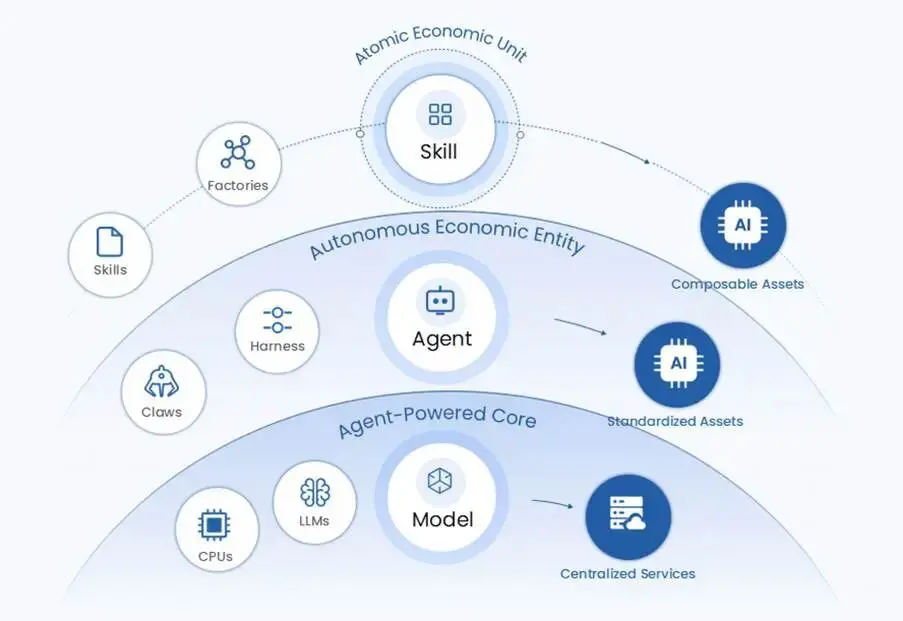
During the development iterations of Q1-Q2 2026, AI Agents are gradually forming clearer boundaries, more defined subjectivity, and clearer principles for information, value, and energy exchange. An AI Agent submicroeconomic environment, resembling a biological organism's environment, is taking shape. This contains a wealth of AI value and economic value to be mined. AI Protocol and AI Finance are inevitable trends for explosive growth.
5. The Inevitability of AIFi and the Economic Significance of Financial Chip (FinChip)
Since the second half of last year, we have proposed thinking and layout work in the direction of AIFi (Artificial Intelligence Finance). By the end of Q1 2026, the concept of AIFi has formed a clear trend. A relatively clear definition of AIFi could be: The financial systems and infrastructure formed for the exchange, trading, and capitalization of AI-native value after it is identified and tokenized within the Agent Economy.
The biggest difference between AIFi, DeFi, and TradFi is that in DeFi and TradFi, value is embodied in the 'Fi' (Finance), with 'Decentralized' and 'Traditional' being the forms of that value. AIFi is the opposite: value resides in the 'AI,' while 'Fi' becomes the form of that value. This is not mere wordplay but the result of qualitative change from quantitative AI development.
Simply put, previously, AI served quantitative strategies, financial products, and production processes; it was just a development tool to extract financial and production value. Now, the decision-making capabilities of AI Agents have transferred the power and ability of value discovery from humans and companies to the Agents themselves. The subject of the economic unit has shifted, so the subject of value has fundamentally changed.
Building the infrastructure for this new value system will be a crucial task under this trend. In my previous article in February, "
6. AI-Native is a Paradigm Upgrade Distinct from Internet+
Whether it's AIFi, financial circuit principles (Note 2), or Financial Chip (FinChip), the most important thing is to Natively integrate the essential principles of AI, Crypto, and Finance, forming a reasonable value system and management mechanism from a future perspective. AI-Native Thinking is the abstract and counter-intuitive logic at this stage. As mentioned earlier, "AI follows first principles, the principle of the shortest path for energy value, and the principle of highest efficiency." This is the most important core difficulty for current thinking and the construction of new commercial paradigms.
In early February, when OpenClaw triggered this round of AI upgrade and explosion, several entrepreneurs and I discussed a prediction: Enterprise upgrades via AI+ will be fundamentally different from those via Internet+.
Due to AI's characteristics of rapid development, abstract forms, and deeper coupling with tasks, for a long time (at least 2 years), it will be difficult to form a set of effective industrial upgrade tool methodologies or general professional consulting advice. The pressure of the steep growth curve will persist, posing a huge challenge for all scientists, engineers, and entrepreneurs. The process of paradigm upgrade will also be completely unlike any historical experience.