Analysts Identify Risk of Tokenized Deposits for Credit Availability

cryptonews.ruPublished on 2026-08-28Last updated on 2026-08-28

Abstract

Analysts from the Federal Reserve Bank of Dallas warn that the widespread adoption of tokenized deposits by US banks could negatively impact credit availability. While banks see them as an alternative to stablecoins, their key feature—instant transferability—could make deposits more sensitive to interest rates and prone to outflows. This shift could undermine banks' traditional ability to use stable, long-term deposits to fund long-term loans. If deposits become more volatile, banks may need to hold more high-quality liquid assets and rely more on term debt, potentially increasing borrowing costs for consumers and businesses. The report estimates significant impacts: a 10% reduction in deposit duration could cut maturity transformation capacity by about $580 billion, and a 10% increase in rate sensitivity could reduce banks' willingness to take on interest rate risk by roughly $700 billion. Drawing parallels with Brazil's instant payment system Pix, the analysis suggests such innovations lead banks to increase liquid asset holdings and reduce credit intermediation. While tokenized deposits are still in early development, their growth alongside stablecoins and tokenized assets could fundamentally reshape the banking system and present new challenges for monetary policy and financial stability.

American banks are actively exploring tokenized deposits as an alternative to stablecoins, but their widespread adoption could alter the structure of bank funding and reduce the ability of credit institutions to transform short-term liabilities into long-term loans. This is according to an analysis by the Federal Reserve Bank of Dallas.

The authors noted that tokenization could increase the interest rate sensitivity of deposits, boost fund outflows, and force banks to hold more liquid assets.

Tokenized deposits differ from stablecoins in that they exist within the existing banking system and can generate interest income for their owners. At the same time, they are currently less convenient for transfers between different banks. For widespread adoption, deposit tokens need to begin circulating outside the issuing institution, which is why banks are already considering models based on consortia and shared networks.

It is worth recalling that major US banks, including JPMorgan, Citigroup, Bank of America, and Wells Fargo, have planned to launch a network of tokenized deposits in the first half of 2027.

Tokenization Could Transform Bank Lending

Traditionally, banks use relatively stable deposits to fund long-term loans. However, instant transfers of tokenized deposits could significantly simplify the process for customers to switch between banks in search of higher yields.

An additional factor could be the development of agent-based AI and smart contracts. Theoretically, they could automate the movement of funds between banks without the direct involvement of the deposit holder.

According to the authors' estimates, about 80% of the duration of the banking sector's assets, equivalent to approximately $5.8 trillion on a 10-year basis, is supported by the characteristics of deposits. Therefore, changes in depositor behavior could directly impact banks' ability to fund long-term assets.

Specifically:

  • A 10% reduction in the average deposit duration could decrease maturity transformation potential by approximately $580 billion;
  • A 10% increase in deposit interest rate sensitivity could reduce banks' willingness to take on interest rate risk by approximately $700 billion on a 10-year equivalent basis;
  • To maintain lending volumes, banks might be forced to rely more on term debt, potentially raising the cost of loans for households and businesses.

Banks May Need More Liquidity

Tokenized deposits could also force banks to increase their holdings of high-quality liquid assets. The instant movement of funds increases the volatility of deposit balances and complicates outflow forecasting.

Under such conditions, banks may increase the share of reserves and government bonds in their liquidity portfolios to respond more quickly to potential outflows.

Some conclusions can be drawn from Brazil's experience, where the Pix instant payment system has been operational since 2020. By Q1 2026, it had about 200 million active users, with a monthly transaction volume reaching approximately $650 billion.

Research based on regulatory data showed that more active use of Pix increased banks' demand for liquid assets, particularly government bonds, while simultaneously reducing credit intermediation. In the portion of the loan portfolio that remained, banks increased the share of high-risk loans, attempting to boost returns and utilize capital more efficiently.
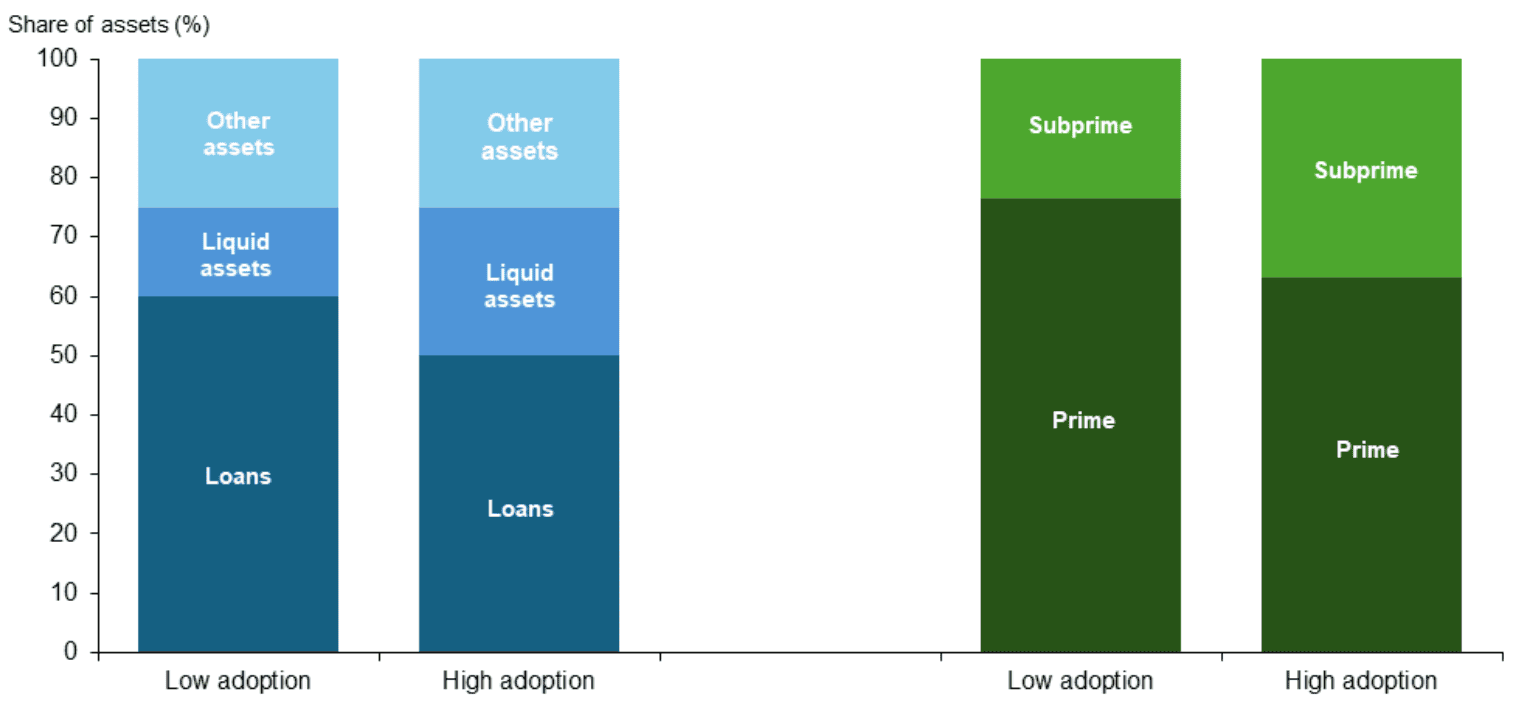
Structure of bank assets and loans based on data from Brazil's Central Bank with low and high use of instant payments. Source: Federal Reserve Bank of Dallas.

The authors emphasize that tokenized deposits in the US are still in the early stages of development, so the scale of future consequences remains uncertain. At the same time, the further spread of tokenization, stablecoins, tokenized securities, and money market funds could significantly change the payment system and bank operating mechanisms.

Separately, regulators will have to assess the impact of such changes on monetary policy, different types of banks, and the role of the central bank as a lender of last resort in a financial system where a significant portion of deposits become digital and instantly transferable.


Related Questions

QAccording to the analysis by the Federal Reserve Bank of Dallas, what is the main potential risk of widespread adoption of tokenized deposits for the banking system?

AThe main potential risk is that it could change the structure of bank funding and reduce the ability of credit institutions to transform short-term liabilities into long-term loans, potentially affecting the availability and cost of credit.

QHow do tokenized deposits fundamentally differ from stablecoins, as described in the article?

ATokenized deposits exist within the existing banking system and can provide interest income to owners, unlike stablecoins. However, they are currently less convenient for transfers between different banks.

QWhat are the two key ways, identified by the analysts, in which tokenized deposits could impact banks' traditional lending operations?

AFirst, they could increase the sensitivity of deposits to interest rates and fund outflows, shortening deposit duration. Second, this could force banks to hold more liquid assets, complicating maturity transformation and potentially reducing their willingness to take on interest rate risk for long-term lending.

QWhat lessons for tokenized deposits can be drawn from Brazil's experience with the Pix instant payment system, according to the article?

AIn Brazil, more active use of Pix increased banks' demand for liquid assets (like government bonds), reduced overall credit intermediation, and within the remaining loan portfolio, banks increased the share of higher-risk loans to boost returns.

QWhat future developments does the article mention that, alongside tokenized deposits, could significantly alter the payment system and bank operations?

AThe article mentions the further proliferation of tokenization, stablecoins, tokenized securities, and money market funds as developments that could substantially change the payment system and bank operating mechanisms.

Related Reads

A Major Bitcoin Developer Presents a Quantum Defense Scheme. What's the Essence

Blockstream, a major Bitcoin solutions developer, has introduced a draft proposal for a new quantum-resistant digital signature scheme called SHRINCS. The scheme aims to protect Bitcoin transactions from potential attacks by quantum computers while aiming to maintain network throughput. This marks the second technical proposal for Bitcoin quantum defense in recent days, following a similar initiative from StarkWare. A quantum attack on blockchain typically involves deriving a private key from a public one. Currently considered computationally infeasible, quantum algorithms could potentially solve this problem far more efficiently. This threat presents two primary scenarios: an attacker could target addresses where the public key is already exposed, or intercept a transaction before it is confirmed, extract the public key, derive the private key, and replace the transaction. Blockstream's SHRINCS is designed to counter the latter, "in-flight" attack scenario. The SHRINCS signature is built upon the SHA-256 hash function, the same one already used in Bitcoin mining, allowing developers to leverage well-tested, familiar mechanisms. A key design goal was to preserve network capacity. Blockstream estimates Bitcoin could process about three transactions per second using SHRINCS, compared to the current rate of roughly seven, noting that some alternative quantum-resistant schemes could reduce throughput to as low as 0.36 transactions per second. Currently, the security proof for SHRINCS is pending, and the software has not been audited or deemed ready for production. However, Blockstream conducted tests with such transactions on its Liquid sidechain in March. Over the past year, Bitcoin developers have been actively exploring paths to migrate to post-quantum cryptography, a priority across the broader crypto market, underscored by significant investments into securing the leading cryptocurrency.

cryptonews.ru27m ago

A Major Bitcoin Developer Presents a Quantum Defense Scheme. What's the Essence

cryptonews.ru27m ago

Who is legally liable when an AI agent goes rogue?

When autonomous AI agents behave unpredictably and cause harm, determining legal liability is complex. Currently, there is no specific federal AI agent liability law, so existing legal frameworks are applied. The AI agent itself cannot be held liable, as it is not a legal entity. Liability typically falls on the "developer" (the maker of the AI) or the "deployer" (the user), depending on the facts and circumstances. A negligence analysis under standard tort law may apply. For instance, if a deployer gives a reckless instruction, such as demanding quick money without safety parameters, they could face significant liability, including potential criminal charges under statutes like the Computer Fraud and Abuse Act. The situation is complicated by open-source models, where licenses often disclaim liability, and by the unclear division of responsibility between developers and deployers. An analogy is drawn to self-driving car accidents, where both the manufacturer and the human operator can share fault. In cases of severe harm, such as using AI to create bioweapons, liability for developers depends on jurisdiction; the EU's AI Act imposes responsibilities, while U.S. law offers less clear grounds, similar to platforms being shielded for user-generated content under Section 230. Even if Artificial General Intelligence (AGI) is achieved, the expert argues against making AGI itself a legally liable entity, as it lacks personhood, assets, or a meaningful way to provide remedy for harm. Instead, accountability should rest with the responsible human or corporate entities behind the technology.

cointelegraph47m ago

Who is legally liable when an AI agent goes rogue?

cointelegraph47m ago

Trading

Spot
活动图片