Zhou Hang: How Much is SpaceX Really Worth?

marsbitPublished on 2026-06-02Last updated on 2026-06-02

Abstract

Summary: Author Zhou Hang argues that while SpaceX is arguably one of the greatest industrial companies of the past 50 years, its anticipated IPO valuation of approximately $1.75 trillion is likely overvalued by about $1.25 trillion. The analysis acknowledges SpaceX's monumental success in slashing launch costs, achieving near-monopoly in commercial launches, and building the Starlink satellite internet constellation. However, using a projected 2030 revenue of $50-80 billion and applying a generous tech company valuation multiple yields a "reasonable" valuation range of only $500 billion to $1.2 trillion. The $1.25 trillion gap stems from premiums for its long-term vision (e.g., Starship, space-based computing), its status as a U.S. strategic national asset, and retail investor enthusiasm driven by the Elon Musk narrative. The article outlines three post-IPO scenarios: valuation solidification (25% probability), sideways consolidation (50%), or a correction to fundamental value (25%). The probability-weighted expected valuation is $1.3-1.5 trillion, suggesting negative expected returns for buyers at the IPO price. The conclusion cautions investors to separate the company's undeniable greatness from the stock's price, advising against chasing the IPO and to wait for key milestones or a lower entry point.

Author: Zhou Hang

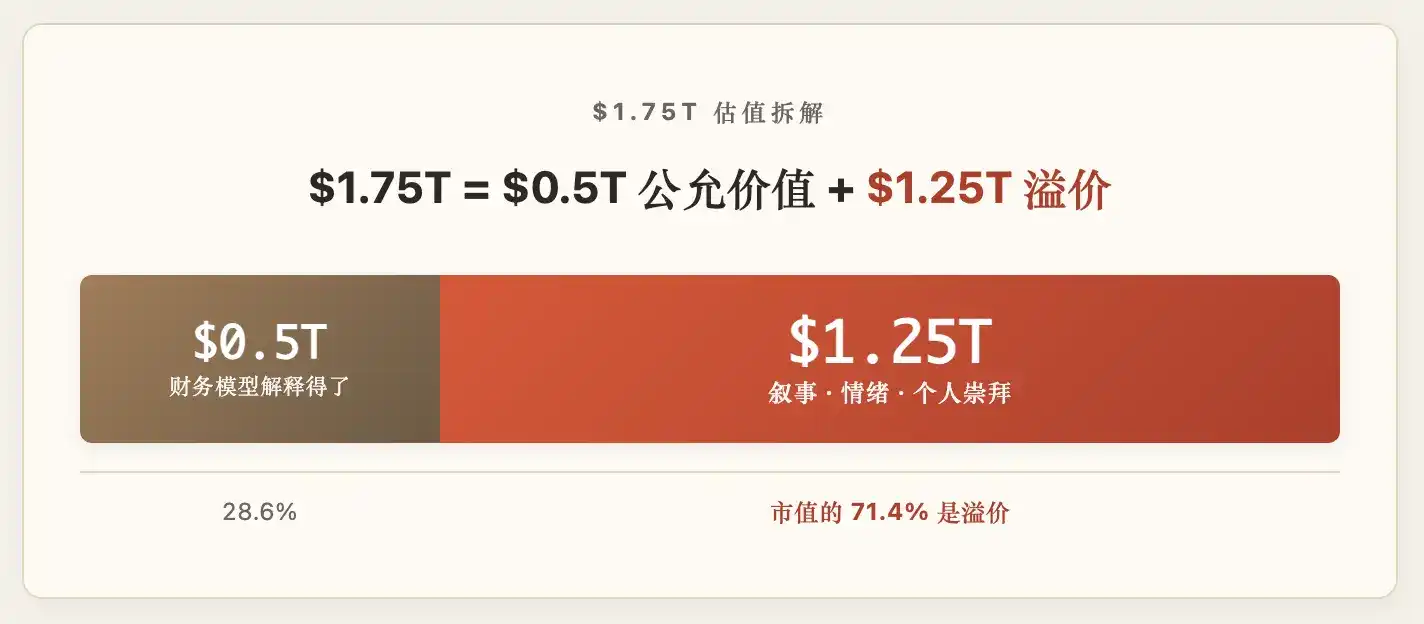
SpaceX may be overvalued by $1.25 trillion around its IPO.

This is not to deny SpaceX's greatness. On the contrary, anyone seriously discussing SpaceX must first acknowledge: it is likely one of the greatest industrial companies of the past 50 years.

But the greatness of a company and whether a stock is worth buying at any price are two completely different things.

SpaceX can simultaneously be "the greatest industrial entity of the 21st century" and also a "severely overvalued investment target." These two things are not mutually exclusive.
First, Acknowledge Its True Greatness

Any honest discussion about SpaceX's valuation must start with this statement: It is the most successful industrial company of the past 25 years, bar none—even more successful than Tesla. This is not mere praise; it is a fact of engineering economics.

Tesla disrupted a 150-year-old mature industry—automobiles. Its rivals are Mercedes-Benz, Ford, Toyota. These opponents are certainly not weak, but they are commercial companies, not backed by national interests, lacking political barriers; competition is essentially about product, brand, supply chain.

SpaceX disrupted a 60-year-old state-monopolized industry—space. Its rivals are NASA, Roscosmos, ESA, CNSA. This is an entirely different level of difficulty: higher engineering barriers, greater capital density, more complex regulation, deeper entanglement with national interests. When Musk founded SpaceX in 2002, the entire space industry was essentially an extension of national missions; commercial companies were not believed capable of building rockets, let alone rockets cheaper than national ones.

Over 20 years later, SpaceX slashed launch costs from $54,500/kg in the Space Shuttle era to $1,500/kg—a 36-fold reduction. It now launches 165 times a year, one company exceeding the total launch count of all other nations and all commercial players combined. It built humanity's first truly reusable rocket, a single Falcon 9 first stage flying 32 times, with a success rate exceeding 99%. It established the world's first global satellite internet—covering over a billion users, becoming a decisive strategic asset on the first day of the Ukraine war.

Tesla in 2025 still faces fierce competition from Chinese EVs; SpaceX's share in the global commercial launch market, is nearing monopoly.

SpaceX is a great company, perhaps the greatest industrial company on Earth in the past 50 years. Any critique of its valuation must first acknowledge this fact.

What Does $1.75 Trillion Mean?

Let's understand through a set of comparisons:
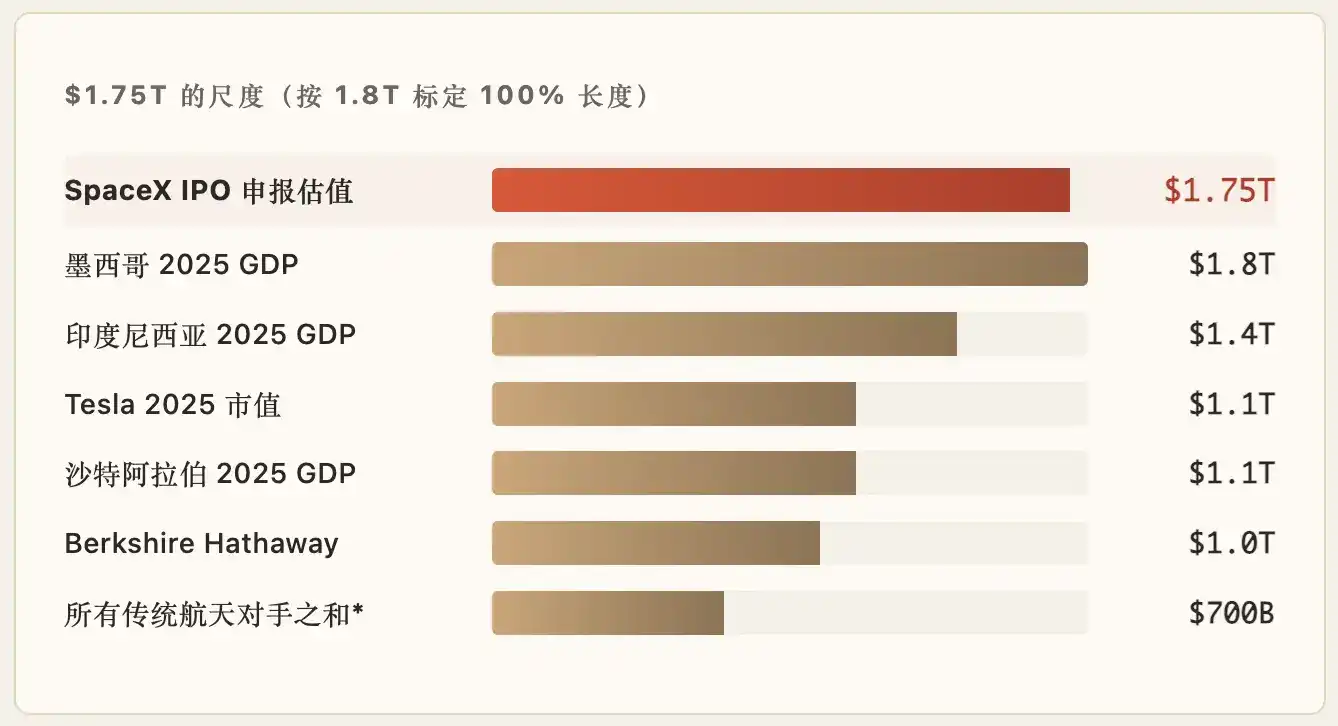
* Combined market cap of Boeing + Lockheed + Northrop + RTX + GD. SpaceX alone is valued at 2.5 times the sum of these 5.

In other words, the valuation of SpaceX alone will exceed Mexico's annual GDP, exceed either Tesla or Berkshire, and is 2.5 times the total market cap of all traditional space rivals.

This itself is not the issue—great companies deserve great valuations. But the 2.5x ratio means the market is not pricing it as a "space company," nor as an "industrial company." The market is pricing it using a hybrid paradigm closer to "sovereign asset + AI-era infrastructure + narrative premium."

Is this pricing reasonable?

List SpaceX's current businesses and seriously calculate how much revenue it can generate by 2030, assuming a reasonably optimistic scenario for each line:
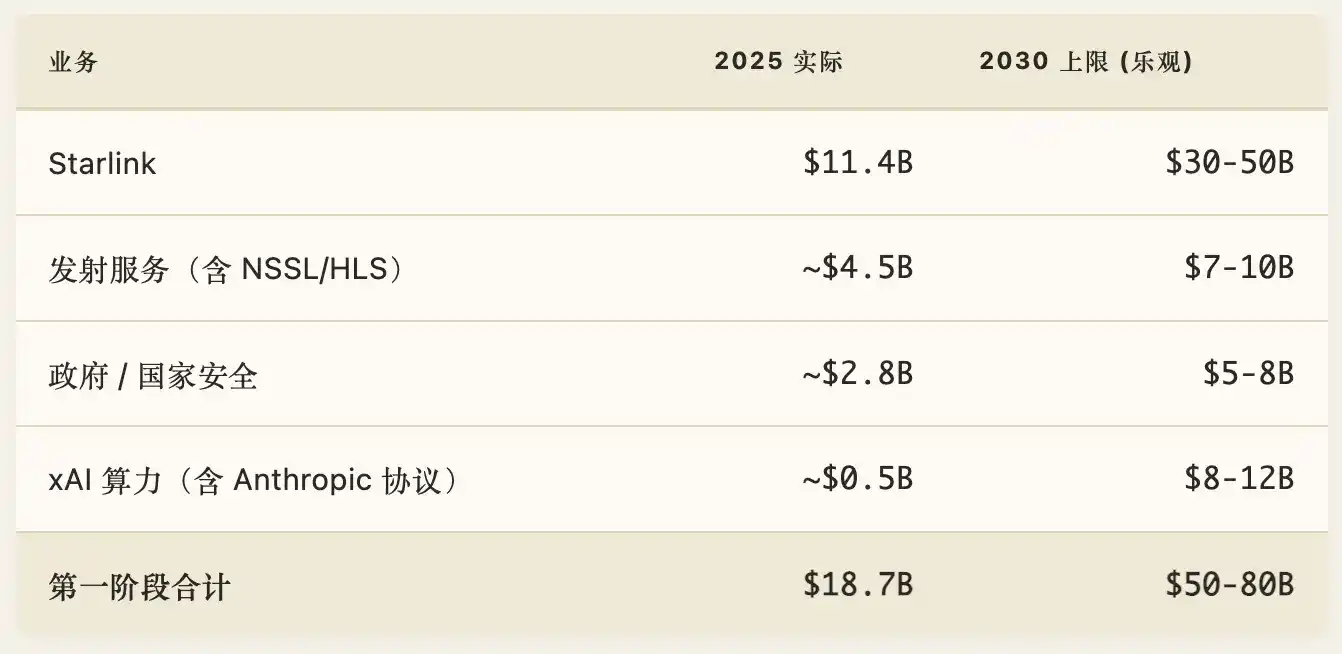
If SpaceX achieves revenue of $50-80B in 2030, corresponding EBITDA (Earnings Before Interest, Taxes, Depreciation, and Amortization, roughly understood as the operating cash profitability of the company's main business) would be approximately $20-35B (assuming a 40% margin, already a very optimistic estimate).

Using the standard SaaS/diversified EV/EBITDA multiple of 25-35x—which is already a premium valuation for tech companies—SpaceX's "reasonable valuation" range in 2030 is between $500B and $1.2T.

Take the conservative anchor point of $500B (i.e., valuing all 2030 businesses reasonably, not wildly) versus the market price of $1.75T.

Difference: $1.25T.

This difference cannot be explained by any standard financial model. It is not the result of DCF (Discounted Cash Flow), not derived from P/S multiples, nor from comparable company analysis—none of these methods yield $1.75T.
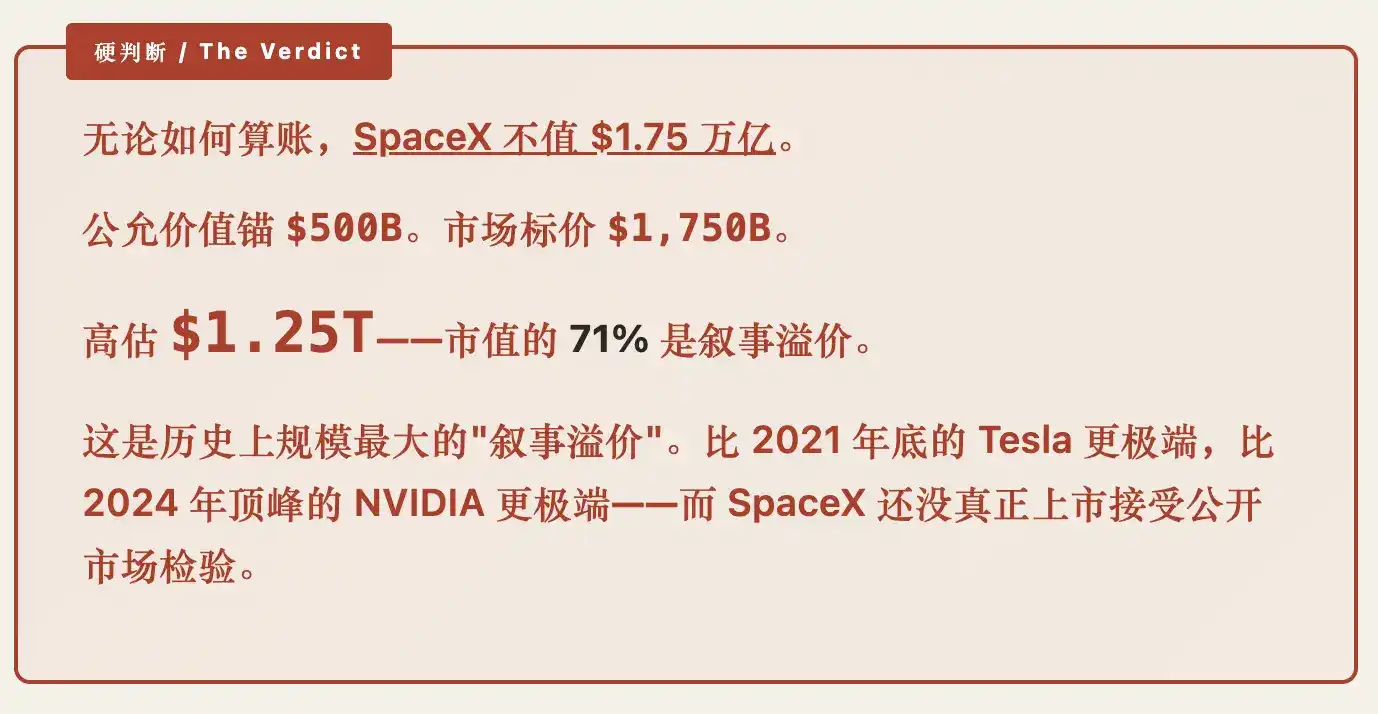
This difference does not appear out of thin air. It has three real sources:

First Source: Long-Term Vision Premium. If Starship operates stably in 2027-2030, launch costs could drop to $200/kg or lower. Capacity increases 30-fold—enough to support new businesses (in-orbit data centers, lunar commerce, deep-space robotics). Anthropic has publicly expressed interest in "being willing to pay for GW-scale space computing." If this narrative materializes, SpaceX plus new businesses could address a total market of $200-500B/year by 2040. This upper limit is indeed massive—so it's rational for the market to leave room for "vision premium."

Second Source: Sovereign Asset + Strategic Position Premium. SpaceX is no longer just a commercial company; it is a U.S. national strategic asset. $22B in government contracts, HLS lunar lander, NRO reconnaissance constellation, Golden Dome missile tracking—these integrate SpaceX into the U.S. national security system. With international communication order fracturing (China bloc / U.S. bloc / third parties), Starlink automatically gains "soft sovereignty" in all markets it can serve. The monetization of this status may take 10+ years to fully manifest, but the premium is real.

Third Source: Retail Investors' Desire for Heroic Narratives + Musk Personal Cult. This is the hardest to quantify, but anyone familiar with capital markets knows its power. Musk has 200 million followers on platform X; his persona is a valuation variable. SpaceX's story—a private company sending humans to Mars, building a global internet, making humanity multi-planetary—is the most heroic commercial story of the past 50 years.

Retail investors are not buying EBITDA; they are buying a ticket to participate in history.

The first two premiums are "real, but slow"; the third premium is "large, but fragile." The current $1.75T valuation bets that all three will hold true and encounter no problems. This is a difficult combination to sustain.

What Happens After IPO?

Assuming SpaceX completes its IPO in the second half of 2026, the next 3-5 years will likely look like this:

Scenario A: Valuation Solidifies (Probability ~25%). Starship V3 successfully launches in 2027, enters stable operation in 2028, the first GW-scale space computing contract lands in 2028. Lunar commerce progresses per NASA schedule. While Starlink growth slows, the Aviation + Maritime + D2C segments offset residential market deceleration. In this scenario, $1.75T "starts to look cheap"—the market would revalue it to $2-3T.

Scenario B: Flat Volatile Valuation (Probability ~50%). Starship materializes slower than expected—5/25 = 20% flight test success in 2025. If this realization rate continues in 2026-2027, V3 may not mature until 2029-2030. Starlink growth slows to +20%/year, the xAI-Anthropic agreement brings real cash flow but no major follow-up contracts. The market realizes "narrative is ahead of reality," and valuation oscillates between $1.2T - $1.8T for 3-5 years. This is the most probable scenario.

Scenario C: Valuation Reckoning (Probability ~25%). Persistent Starship delays, xAI falling significantly behind in AI competition, a Musk personal risk event (health, reputation, politics) triggers. Sentiment premium rapidly contracts. The market reprices using financial models—valuation falls back to the $800B-$1.2T range, equivalent to "the reasonable valuation an excellent industrial company deserves." This scenario is actually good for long-term holders—but means a 30-50% paper loss for retail investors who buy post-IPO.
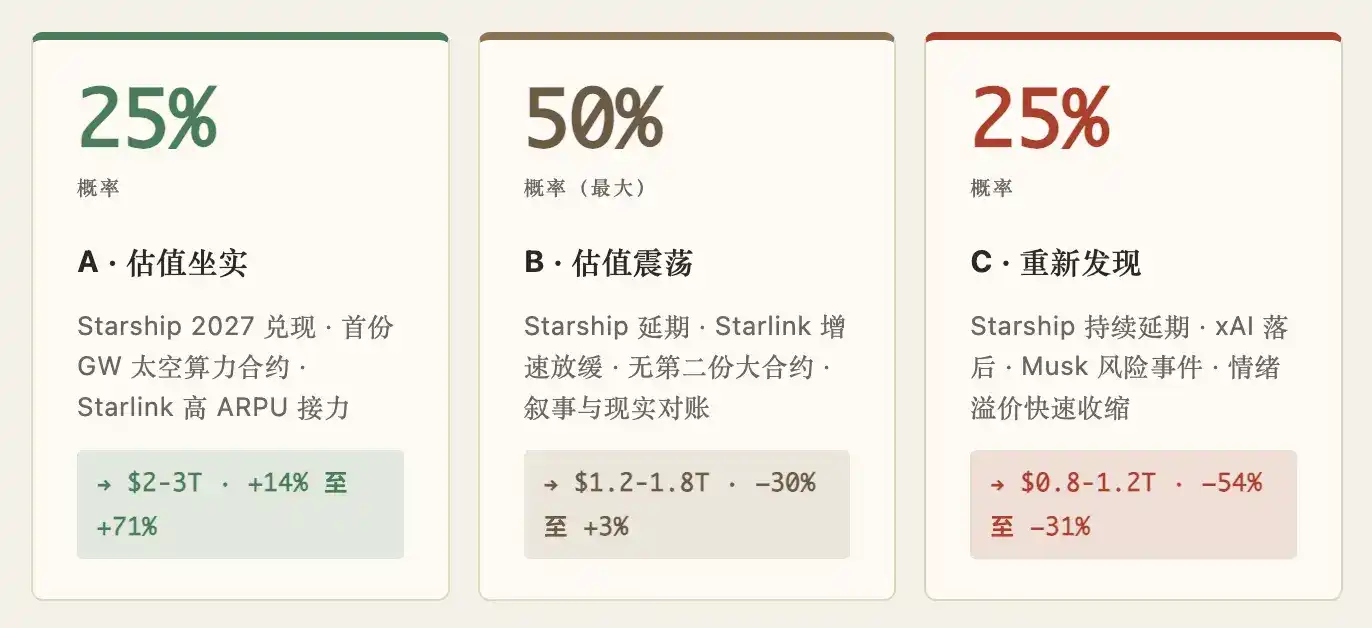
Probability-weighted = 0.25 × Upside + 0.50 × Flat + 0.25 × Downside ≈ Expected Value $1.3-1.5T, lower than the IPO filing price of $1.75T.

Weighting the three probabilities, the expected central range for SpaceX's valuation over the next 3-5 years is approximately $1.3-1.5T—lower than the current IPO filing price.

In plain language: buying at $1.75T on IPO day yields negative expected returns over 5 years. This is the inevitable conclusion after weighting the three scenarios by probability: you get no return in the highest-probability scenario; you lose 30-50% in the worst scenario; only in 1/4 of cases do you make money.

As Charlie Munger would say: this is not a bet with favorable odds.

To Those Planning to Buy on IPO Day

SpaceX is a great company, but a great company does not equal a stock you should buy at any price. These are two different things.

Tesla at the end of 2021 was also considered by many as "should buy at any price"—its market cap was $1.2T then. Over the next two years, Tesla fell 70%, from $1.2T to $400B. Not because Tesla became a bad company—it remains an excellent EV company. It's because price got too far ahead of fundamentals.

SpaceX's current situation is highly similar to Tesla's at the end of 2021—possibly more dangerous, because SpaceX's "vision premium" is a larger component, the story is grander, and retail participation may be deeper.

If you truly believe in SpaceX's long-term vision and are willing to hold for over 10 years without selling, then buying at the IPO price may be fine—the company will likely be worth more in 10 years. But if you expect to "double your money in 1-3 years after buying," the math is not on your side.

A more rational strategy is:

  • Do not chase the high on IPO day.
    Premium is typically highest on the first day of any mega IPO.
  • Wait for at least one of three things to happen.
    Starship V3 stable operation, the first GW-scale space computing contract, or the stock price falling below $1T.
  • If you must buy now, limit your position.
    Don't treat it as a "sure bet"—it is not. It is a "meaningful long-term +/- 30% uncertainty."

A Great Company Can Also Be an Expensive Stock

A company's greatness is fact; whether a stock's price is reasonable is math. Facts don't change, math changes daily. In SpaceX's current valuation structure, financial models can only explain half; the other half is market sentiment + sovereign status + personal cult—this part is not non-existent, but it is fragile.

After IPO, one thing will happen: retail investors start measuring the company with quarterly earnings. The first quarterly report, the second, the third—each will force the market to reconcile "story" with "reality." This reconciliation process is typically unfriendly to short-term valuation.

If you're buying the company—the great industrial entity, the post-Starship human infrastructure, the sovereign asset—then the IPO price is just a point in a 20-year marathon, no need to obsess.

If you're buying the story—participating in history, following a hero, contributing to us becoming a multi-planetary species—then admit this is consumption, not investment. Consumption can be expensive, but you need to know what you're doing.

The company can be world-class, the stock can simultaneously be overvalued by $1.25 trillion. Both are facts, but they must be viewed separately. Distinguish whether you're buying the company, or the story.

Related Questions

QWhat is the core argument of the article regarding SpaceX's $1.75 trillion valuation?

AThe article argues that SpaceX's projected $1.75 trillion IPO valuation is likely overvalued by approximately $1.25 trillion. While acknowledging SpaceX as an exceptionally great industrial company, it contends that at this price, the valuation has priced in significant premiums for long-term vision, sovereign/strategic status, and narrative/Musk-centric enthusiasm that are not fully supported by near-to-mid-term financial projections based on its core businesses.

QAccording to the author's analysis, what would be a more reasonable valuation range for SpaceX by 2030 based on standard financial metrics?

ABased on the author's analysis of SpaceX's potential 2030 revenues ($50-80B) and EBITDA ($20-35B), and applying a premium tech company valuation multiple (25-35x EV/EBITDA), a more reasonable valuation range for SpaceX in 2030 would be $500 billion to $1.2 trillion. This is significantly lower than the speculated $1.75 trillion IPO price.

QWhat are the three main sources of the '$1.25 trillion' valuation gap identified in the article?

AThe three main sources of the $1.25 trillion valuation gap are: 1) **Long-term vision premium**: For future Starship-enabled businesses like in-orbit data centers and lunar commerce. 2) **Sovereign asset & strategic status premium**: Due to its role as a U.S. national strategic asset with major government contracts and Starlink's geopolitical importance. 3) **Retail enthusiasm for the heroic narrative & Musk's personal cult**: Where investors buy the 'story' and participation in history rather than just financial metrics.

QWhat are the three probable scenarios for SpaceX's post-IPO valuation trajectory, and what is the most likely outcome according to the article?

AThe three scenarios are: A) **Valuation is validated** (~25% probability): Starship succeeds quickly, new contracts materialize, valuation rises. B) **Valuation trades sideways/volatile** (~50% probability - *most likely*): Execution is slower than the narrative, leading to a prolonged period of valuation churn. C) **Valuation is rediscovered (downwards)** (~25% probability): Significant delays or Musk-related risks trigger a contraction of narrative premiums, reverting to a valuation based more on financials. The weighted expectation centers around $1.3-1.5T, below the $1.75T IPO price.

QWhat practical advice does the author give to potential retail investors considering buying SpaceX stock at its IPO?

AThe author advises potential retail investors to: 1) **Avoid buying at the IPO peak** on day one, as溢价 is typically highest then. 2) **Wait for key catalysts** like Starship V3 stable operation, a major GW-scale space compute contract, or a significant price drop (e.g., below $1T). 3) **If buying immediately, limit position size** and recognize it as a long-term, uncertain bet rather than a sure thing. The core message is to separate the admiration for the company from the investment math of the stock price.

Related Reads

Blockchain Has Finally Started to Sail into the Mainstream After 18 Years

Blockchain Finds Its True Path After 18 Years: Becoming the Financial Backbone for AI Agents and Autonomy This analysis explores a pivotal shift in the blockchain and crypto investment landscape, driven by the dominance of AI. Major venture capital firms, including Variant, Paradigm, Haun Ventures, and YZi Labs, are moving beyond pure "crypto" investment theses. They are expanding their focus to AI, robotics, and frontier tech, signaling that blockchain is no longer seen as a standalone sector but as an underlying infrastructure layer. The core argument is that blockchain's killer application may not be user-facing apps, but rather providing the economic rails for the coming wave of AI agents, autonomous robots, and automated systems. Key capabilities like self-custody wallets, programmable stablecoins for micropayments, on-chain identity, and verifiable smart contracts are positioned as essential for a future where machines conduct economic activity. The recent $1.4 billion investment by Tether (via its venture arm) in German robotics company NEURA Robotics exemplifies this, aiming to embed Tether's wallet tools directly into robots for autonomous transactions. While many "AI + Crypto" projects remain superficial, the article concludes that true value lies where crypto is a necessary component—enabling machine-to-machine payments, agent autonomy, verifiable data provenance, and open financial settlement for the AI era. For crypto venture capital, this convergence with AI represents both an adaptation to shifting capital flows and a potential path to unlocking the large-scale, non-speculative utility the industry has long sought.

marsbit7m ago

Blockchain Has Finally Started to Sail into the Mainstream After 18 Years

marsbit7m ago

Blockchain has finally begun sailing toward the main channel after 18 years

After 18 years of development, blockchain technology is beginning to move from a specialized niche into mainstream adoption, according to a recent industry analysis. The shift is reflected in the changing strategies of major crypto venture capital firms, which are expanding their focus beyond pure "digital ownership" towards broader themes like "autonomy." The report highlights that leading VC firms like Variant, Paradigm, Haun Ventures, and YZi Labs are broadening their investment mandates to include not only crypto but also artificial intelligence (AI), robotics, biotech, and other frontier technologies. This reflects a recognition that the isolated "crypto investment" narrative is losing appeal to limited partners (LPs) as capital and attention increasingly flow toward AI and other high-growth tech sectors. A key emerging thesis is that blockchain's most significant future application may not be as a consumer-facing product, but as the underlying economic and settlement infrastructure for the AI era. As AI agents and autonomous systems become more prevalent, they will require programmable, global, and low-cost payment networks (like stablecoins), verifiable digital identities, and secure wallets to manage transactions and assets on behalf of users. The investment by stablecoin issuer Tether into robotics company NEURA, with plans to integrate its wallet technology, is cited as a prime example of this convergence. However, the article cautions that simply labeling projects as "AI + Crypto" is insufficient. True value lies in integrations where blockchain technology is essential—such as enabling machine-to-machine micropayments, verifiable data provenance for AI, or transparent governance for autonomous organizations—rather than being a superficial marketing add-on. In conclusion, while AI currently dominates the tech narrative and capital flows, it may ultimately create the real-world, high-frequency demand that the crypto industry has long sought. For crypto VCs and projects, the path forward is to position blockchain not as a competing sector, but as a critical foundational layer powering autonomy and economic activity in an AI-driven future.

链捕手13m ago

Blockchain has finally begun sailing toward the main channel after 18 years

链捕手13m ago

Y Combinator Co-founder: How to Make a Billion Dollars?

The Y Combinator co-founder argues that becoming a billionaire by founding a successful startup is not only possible but demonstrably achievable without unfair or unethical practices. He disputes a politician's claim to the contrary, using the example of a founder whose company grew at 93% monthly solely through creating a product users loved and recommended. The core mechanism is exponential growth. A conservative 15% monthly growth rate compounds to a 4384x increase over five years, which can easily lead to billion-dollar valuations and founder wealth. The process depends on two key variables: the growth rate and the duration it can be sustained. A high growth rate stems from a great product that users naturally promote, while a long duration requires a large enough market. For aspiring founders, especially young ones, the simplest path is to build something they and their friends genuinely need. Young people's current needs often predict future mass-market trends. He advises against actively "searching" for ideas, as this tends to filter out unconventional but promising ones. Instead, inspiration should come from working on interesting projects with friends, as many iconic companies (e.g., Apple, Facebook) started this way. Ultimately, building a massively valuable startup is not about exploitation but empathy: deeply understanding a user group and building a product that significantly improves their lives. This, powered by exponential growth in a large market, is the legitimate path to immense wealth creation.

Foresight News16m ago

Y Combinator Co-founder: How to Make a Billion Dollars?

Foresight News16m ago

The 800V Voltage Standard Championed by Nvidia: Which Infrastructure Providers Stand to Benefit?

NVIDIA is actively promoting the 800VDC architecture as a key direction for its next-generation AI factories and high-power racks, particularly for the upcoming Rubin and Kyber platforms. The primary driver is the rapidly increasing power density of AI racks, with designs like GB200/GB300 NVL72 reaching 120-140kW and future systems potentially hitting 180-220kW. At such high power levels, traditional low-voltage power delivery becomes inefficient due to massive current, leading to significant copper use, cable bulk, heat, and power loss. The 800VDC standard aims to increase efficiency by transmitting power at higher voltage and lower current to the rack before stepping it down locally for GPUs. NVIDIA claims this can improve efficiency by up to 5%, reduce total cost of ownership (TCO) by up to 30%, and cut copper usage by approximately 45%. This shift redefines infrastructure roles, pushing power engineering to the forefront alongside GPU performance. Key beneficiaries and ecosystem partners highlighted include: 1. **Power Infrastructure Providers:** Companies like Vertiv, Schneider Electric, Delta Electronics (台达电), and Korean firms LS Electric and HD Hyundai Electric are involved in designing next-gen AI factory power distribution, rack power supplies, and backup systems. 2. **Power Semiconductors:** Suppliers of SiC/GaN devices, such as Infineon and STMicroelectronics, are better suited for high-voltage, high-efficiency conversion in this new architecture. 3. **Connectivity & Structure:** The focus shifts to high-reliability components like busbars, high-voltage connectors, and advanced PCBs that meet stricter insulation and safety requirements. 4. **Liquid Cooling & Rack ODM:** As power and heat density rise, liquid cooling becomes critical. Full-rack system integrators (e.g., Dell, Wiwynn, Wistron) must now demonstrate robust pre-delivery testing capabilities, including burn-in testing under full load, requiring significant power and cooling infrastructure in their factories. The transition is not immediate for all data centers but is targeted at high-density AI factories. NVIDIA’s 800VDC ecosystem is in a preparatory phase, with full-scale production expected to align with the 2027 launch of Kyber rack-scale systems. The investment thesis revolves around which companies can demonstrate proven product integration, customer validation, and reliable delivery of complete, high-power AI rack systems, making power, cooling, and testing capabilities new critical variables in the AI infrastructure value chain alongside GPUs.

marsbit36m ago

The 800V Voltage Standard Championed by Nvidia: Which Infrastructure Providers Stand to Benefit?

marsbit36m ago

Did 'Unlimited Minting' Actually Happen? Zcash Founder Responds to Four Major Market Concerns

The Orchard shielding pool in the privacy cryptocurrency Zcash was recently found to have contained a critical counterfeiting vulnerability that existed for four years. This discovery caused significant market panic and a sharp drop in the price of ZEC, though it has since recovered partially. Zcash founder Zooko Wilcox addressed four key questions raised by the vulnerability. First, while it's unknown if the bug was exploited, he believes it likely was not, citing advanced, targeted discovery methods, a rapid response to freeze the pool, and the typical "smash-and-grab" nature of past crypto exploits. Second, he states that if no exploitation occurred, all legitimate user funds in Orchard are recoverable. However, cautious users moving funds should be aware of privacy trade-offs and other risks involved in transferring to transparent or Sapling pools. Third, users currently cannot independently verify that the total ZEC supply hasn't been inflated due to this bug. However, the proposed "Ironwood" network upgrade will restore this ability by permanently sealing the Orchard pool. This will prevent any counterfeit funds from circulating and allow anyone running a node to cryptographically verify that the supply cap has not been breached. Finally, regarding other undiscovered vulnerabilities, Wilcox notes that intensive ongoing audits by multiple teams, including using advanced AI-assisted tools, have so far found no other counterfeiting bugs. This provides increased, though not absolute, confidence. In conclusion, while assessments suggest the bug was likely unused and funds are safe, the core issue was the loss of user-verifiable supply integrity. The Ironwood upgrade is presented as the solution, aiming to restore trust by allowing users to independently verify Zcash's supply security without relying on third-party assurances.

marsbit37m ago

Did 'Unlimited Minting' Actually Happen? Zcash Founder Responds to Four Major Market Concerns

marsbit37m ago

Trading

Spot
Futures

Hot Articles

How to Buy T

Welcome to HTX.com! We've made purchasing Threshold Network Token (T) simple and convenient. Follow our step-by-step guide to embark on your crypto journey.Step 1: Create Your HTX AccountUse your email or phone number to sign up for a free account on HTX. Experience a hassle-free registration journey and unlock all features.Get My AccountStep 2: Go to Buy Crypto and Choose Your Payment MethodCredit/Debit Card: Use your Visa or Mastercard to buy Threshold Network Token (T) instantly.Balance: Use funds from your HTX account balance to trade seamlessly.Third Parties: We've added popular payment methods such as Google Pay and Apple Pay to enhance convenience.P2P: Trade directly with other users on HTX.Over-the-Counter (OTC): We offer tailor-made services and competitive exchange rates for traders.Step 3: Store Your Threshold Network Token (T)After purchasing your Threshold Network Token (T), store it in your HTX account. Alternatively, you can send it elsewhere via blockchain transfer or use it to trade other cryptocurrencies.Step 4: Trade Threshold Network Token (T)Easily trade Threshold Network Token (T) on HTX's spot market. Simply access your account, select your trading pair, execute your trades, and monitor in real-time. We offer a user-friendly experience for both beginners and seasoned traders.

12.0k Total ViewsPublished 2024.03.29Updated 2026.06.02

How to Buy T

Discussions

Welcome to the HTX Community. Here, you can stay informed about the latest platform developments and gain access to professional market insights. Users' opinions on the price of T (T) are presented below.

活动图片