TVL on Robinhood Chain Approaches $100 Billion Amid Uniswap Liquidity: Standard Chartered

cryptonews.ruPublished on 2026-08-13Last updated on 2026-08-13

Abstract

TVL on the Robinhood Chain is approaching $1 billion, driven by a key partnership with Uniswap that provides liquidity, according to Standard Chartered. This collaboration is helping Robinhood scale its new blockchain rapidly by leveraging Uniswap's existing DeFi infrastructure (V2, V3, and V4 versions), instead of building liquidity from scratch. The partnership has also significantly impacted Uniswap's tokenomics. Since activating a fee-redirection mechanism related to Robinhood on July 27, the burn rate for UNI tokens has roughly doubled. At an annualized rate of about $90 million, this equates to burning over 4% of the circulating supply per year at current prices. Launched on July 1 with a focus on tokenizing real-world assets, Robinhood Chain saw nearly 194,000 daily active users in its first week. This blockchain initiative is part of Robinhood's broader strategy to expand beyond traditional stock trading into areas like crypto, prediction markets, and tokenization, which has drawn positive attention from Wall Street analysts.

The partnership between Robinhood and Uniswap is helping the brokerage rapidly build liquidity in its new blockchain. Standard Chartered believes this could remove the main obstacle to attracting users and assets.

In a recent note, Standard Chartered analyst Geoffrey Kendrick reported that the Total Value Locked (TVL) on Robinhood Chain has reached nearly $1 billion. He stated this is the fastest growth rate among all blockchains. Kendrick noted that Uniswap, through its V2, V3, and V4 versions, is providing virtually all of Robinhood Chain's liquidity.

This structure gives Robinhood access to developed DeFi infrastructure as the blockchain scales and strengthens the company's ability to attract users without the need to build liquidity from scratch.

The partnership is also significantly impacting Uniswap's tokenomics. According to Standard Chartered, the protocol's fees from operations on Robinhood have now become the largest source of $UNI token burning.

After the activation on July 27 of the fee redirection mechanism related to Robinhood, the $UNI burn rate approximately doubled, reaching an annualized rate of about $90 million. With $UNI's current price around $3.50, this translates to an annual burn of 25 million $UNI tokens—slightly over 4% of the circulating supply.
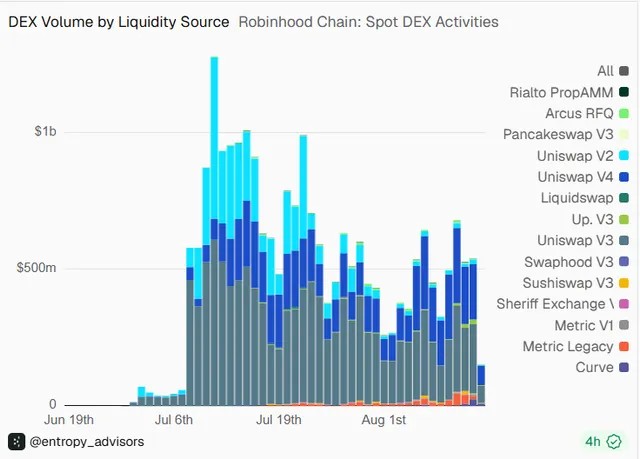
Sources of Robinhood Chain liquidity. Source: Standard Chartered

Robinhood Chain launched on July 1 with a focus on bringing real-world assets on-chain. Adoption accelerated quickly after launch: the number of daily active users reached 194,000 in the first week.

Related: Robinhood Chain Attracted Over $70 Million in ETH via Bridge in First Week

Robinhood's Crypto Business Expands Through Tokenization and Prediction Markets

Robinhood Chain is part of the brokerage's broader strategy to move beyond traditional stock trading: Robinhood is expanding its activities in crypto, prediction markets, and tokenization. The strategy has caught Wall Street's attention: analysts at Bernstein raised their price target for Robinhood (HOOD) stock to $160 per share and named tokenization and prediction markets as key growth factors.
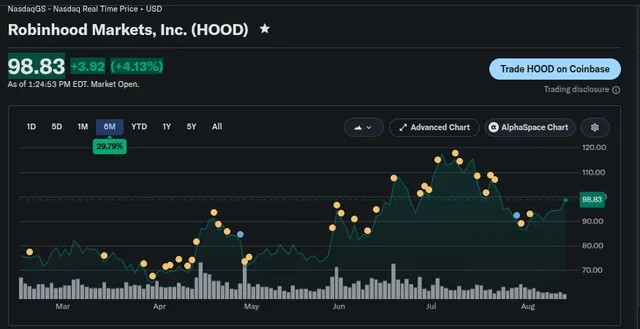
On Thursday, HOOD stock rose more than 4%, extending its six-month gain to nearly 30%. Source: Yahoo Finance.

The business expansion coincides with mixed performance in Robinhood's crypto business. The company reported record revenue and profit in the second quarter, despite a decline in crypto trading volumes and revenue.

Related: Robinhood in Talks with Crypto.com About Prediction Markets: WSJ

end-content
Related Questions

QAccording to Standard Chartered, what is the main reason for the rapid growth of TVL on Robinhood Chain?

AStandard Chartered attributes the rapid growth of TVL on Robinhood Chain primarily to its partnership with Uniswap, which provides the majority of the chain's liquidity through its V2, V3, and V4 versions. This gives Robinhood access to a mature DeFi infrastructure.

QHow did the partnership with Robinhood Chain affect Uniswap's token ($UNI) burn rate?

AFollowing the activation of a fee switch related to Robinhood on July 27th, the burn rate of Uniswap's $UNI token approximately doubled. It reached an annualized rate of about $90 million, which at a price of $3.50 per $UNI, translates to the burning of around 25 million tokens annually.

QWhat is Robinhood Chain's primary focus, as mentioned in the article?

AAccording to the article, Robinhood Chain launched with a focus on bringing real-world assets (RWAs) on-chain.

QWhy did Bernstein analysts raise their price target for Robinhood's stock (HOOD)?

ABernstein analysts raised their price target for Robinhood's stock (HOOD) to $160 per share, citing tokenization and prediction markets as key growth factors for the company's broader strategy beyond traditional stock trading.

QDespite a strong Q2 financial report, what specific segment of Robinhood's business showed declining revenue?

ADespite reporting record revenue and profit in the second quarter, Robinhood's crypto trading segment experienced a decline in both trading volumes and revenue.

Related Reads

Trezor Customer Data Leak: Coins Are Safe, But Phishing Is Inevitable

Trezor, a hardware cryptocurrency wallet manufacturer, reported a data breach at its logistics partner, ShipMonk, affecting around 13,689 customers. The incident, confirmed on August 13, 2026, involved unauthorized access to ShipMonk's systems, which stored order information from May 10 to August 8, 2026. Trezor's own systems and user crypto assets were not compromised. The leaked data varies: for 11,742 customers, full names, email addresses, phone numbers, and delivery addresses were exposed. For 1,947 others, only name, city, and email were leaked. The breach was limited to customers in the US, UK, Sweden, Colombia, Brazil, Italy, and Portugal. Trezor warns affected users of an increased risk of phishing attacks, where malicious actors may use the stolen contact details to impersonate Trezor, banks, or exchanges to steal wallet recovery phrases. All impacted customers have been notified via email. In response, Trezor announced a planned "Anonymous Delivery" feature for the EU (September 2026) and the US (end of 2026), aiming to anonymize logistics data. ShipMonk has not yet issued a public statement on its official website. The analysis highlights this as a recurring industry pattern where third-party logistics vendors become weak links in the supply chain, storing data longer than necessary. Similar incidents, like the 2020 Ledger breach, led to prolonged phishing campaigns. A key question remains whether hardware wallets can ever fully decouple from external logistics risks.

cryptonews.ru36m ago

Trezor Customer Data Leak: Coins Are Safe, But Phishing Is Inevitable

cryptonews.ru36m ago

Trading

Spot
活动图片