Arthur Hayes Puts $100K On Hyperliquid (HYPE) Outrunning Every $1B+ Altcoin

bitcoinistPublished on 2026-02-09Last updated on 2026-02-09

Abstract

Arthur Hayes, co-founder of BitMEX, has placed a $100,000 bet that the Hyperliquid (HYPE) token will outperform every altcoin with a market cap over $1 billion during a specific period in 2026. This wager, made against Multicoin Capital's Kyle Samani, who criticized Hyperliquid for being "everything wrong with crypto," reframes the debate into a performance-based challenge. The bet comes amid analysis of Hyperliquid's new HIP-3 product, which offers non-crypto derivatives like equity and commodity perpetuals. Early data suggests these traditional finance instruments are gaining traction, accounting for 31% of the platform's volume. However, a stress test during a silver selloff revealed liquidity gaps compared to established venues like COMEX. Hayes's bet ultimately tests whether Hyperliquid's growth narrative and 24/7 access to non-crypto markets will translate into superior token performance.

Arthur Hayes is turning a long-running debate about Hyperliquid into a price-denominated wager, staking $100,000 that HYPE will beat every altcoin with a $1 billion-plus market cap over a defined window.

“Since HYPE is bad Kyle Samani let’s make a bet,” Hayes wrote on X. “I bet that from 00:00 UTC 10 Feb 2026 to 00:00 UTC 31 July 2026 $HYPE will out perform any shitcoin >$1bn mcap on coingecko in USD terms. You choose your champion. Loser donates $100k to a charity of the winner’s choice.”

Hayes’ post landed in the wake of a pointed takedown from Multicoin Capital co-founder Kyle Samani, who called Hyperliquid “in most respects everything wrong with crypto,” while listing objections “Founder literally fled his home country to build, openly facilitates crime and terror, closed source, permissioned.”

Why Hyperliquid Could Be Superior

The sparring unfolded alongside a separate thread of bullish commentary on Hyperliquid’s push into non-crypto derivatives via HIP-3, a product line that has begun listing equity and commodity perpetuals. Blockworks analyst Shaunda Devens, whose research was shared by Jon Charbonneau, argued that HIP-3 is already pulling meaningful activity outside pure crypto flow.

In devens’ analysis of HIP-3 silver perpetuals versus CME/COMEX Micro Silver futures, Hyperliquid is framed less as a meme-driven venue and more as an attempt to build an always-on, order-driven derivatives market for traditional underlyings. The report notes that “TradFi instruments now [account for] 31% of venue volume” with “daily notional above $5B,” positioning the silver contract as a stress test of whether those markets can hold up when the underlying is moving fast.

“Pre-crash, Hyperliquid was competitive at top-of-book for the sizes that dominate perp flow,” the report said, citing a 2.4 bps median spread versus 3 bps on COMEX, and “median slippage was 0.5 bps from the benchmark.” But it also emphasized the capacity gap: roughly “~$230k within ±5 bps on Hyperliquid vs. ~$13M on COMEX,” a difference that matters as clip sizes rise.

That trade-off sharpened during a violent silver selloff, when the report says both venues degraded but Hyperliquid developed a heavier execution tail. It cites a brief dislocation of more than 400 bps versus the benchmark before mean reversion via funding, and notes that “1% of Hyperliquid trades printed >50 bps from mid, vs. none on COMEX.”

Hayes’ wager effectively reframes the dispute: not whether Hyperliquid is philosophically “good” or “bad,” but whether its growth narrative, especially around 24/7 access to non-crypto risk, translates into token outperformance relative to large-cap peers.

If the next six months validate the thesis embedded in HIP-3: tight execution for retail-weighted flow, continuous trading when legacy venues are closed, and a path to less cycle-sensitive revenue, HYPE’s relative performance becomes a simple scoreboard. If not, the bet offers a high-visibility way for critics to test whether the market is pricing substance or momentum.

At press time, HYPE traded at $32.275.
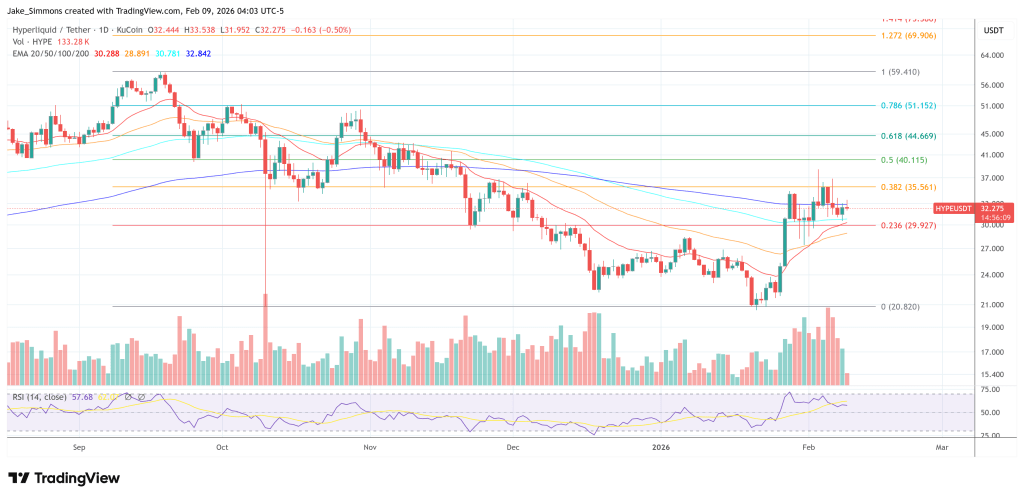
HYPE must break the 0.382 Fib, 1-week chart | Source: HYPEUSDT on TradingView.com

Related Questions

QWhat is the specific bet that Arthur Hayes made regarding Hyperliquid (HYPE)?

AArthur Hayes bet $100,000 that from February 10, 2026, to July 31, 2026, the price of HYPE will outperform any other cryptocurrency with a market cap over $1 billion in USD terms. The loser will donate the money to a charity of the winner's choice.

QWho is the target of Arthur Hayes's bet and what was their criticism of Hyperliquid?

AThe bet is directed at Kyle Samani, co-founder of Multicoin Capital. Samani criticized Hyperliquid, calling it 'in most respects everything wrong with crypto,' citing that its founder fled his home country, it openly facilitates crime and terror, and that it is closed source and permissioned.

QWhat is HIP-3 and why is it significant for Hyperliquid's growth narrative?

AHIP-3 is Hyperliquid's product line for non-crypto derivatives, specifically listing equity and commodity perpetuals. It is significant because it represents the platform's push into traditional finance (TradFi) instruments, aiming to provide 24/7, order-driven derivatives markets and attract activity outside of pure cryptocurrency flow.

QAccording to the analysis cited, how did Hyperliquid's silver perpetuals compare to CME/COMEX futures in terms of market performance?

AThe analysis found that pre-crash, Hyperliquid was competitive with a median spread of 2.4 basis points (bps) versus 3 bps on COMEX, and had median slippage of 0.5 bps. However, it had a significant capacity gap, with ~$230k within ±5 bps on Hyperliquid versus ~$13M on COMEX, which became more apparent during a violent selloff.

QWhat is the ultimate question that Arthur Hayes's bet reframes the debate into?

AThe bet reframes the debate from whether Hyperliquid is philosophically 'good' or 'bad' to whether its growth narrative—particularly its 24/7 access to non-crypto derivatives—will translate into its token (HYPE) outperforming other large-cap altcoins.

Related Reads

From High Growth to Hard Reality: The Q4 Stress Test for Coinbase and Robinhood

Coinbase and Robinhood faced significant challenges in Q4 2025, revealing their continued heavy dependence on cryptocurrency market cycles despite efforts to diversify. Robinhood reported record annual revenue of $4.5 billion and a net profit of $1.9 billion, with strong growth in traditional trading and options. However, its crypto transaction revenue plummeted 38% year-over-year to $221 million, and app trading volume fell 57% in January 2026. Despite its broader financial offerings, the market still views Robinhood as a Bitcoin-dependent asset, causing its stock to drop 50% from recent highs. Coinbase experienced a steeper decline, with revenue falling 21.6% to $1.78 billion and a net loss of $667 million due to crypto asset depreciation. Retail trading volume collapsed to $59 billion, far below institutional volume of $237 billion. While stablecoin revenue and institutional services provided some support, the sharp drop in high-fee retail activity exposed Coinbase’s vulnerability to crypto market downturns. Both companies illustrate the broader industry issue: declining active users and over-reliance on crypto volatility. Their valuations remain tightly correlated to Bitcoin’s performance. Key takeaways include the necessity of stable revenue streams (like interest and stablecoins), excess infrastructure amid shrinking user demand, and the urgent need for sustainable business models beyond pure crypto speculation. Survival in 2026 will depend on financial resilience rather than growth.

比推20m ago

From High Growth to Hard Reality: The Q4 Stress Test for Coinbase and Robinhood

比推20m ago

From Frenzy to Chill: Solana Falls Below $80, Meme Narrative Recedes

Foresight News reports that Solana (SOL) has experienced a significant downturn, falling below $80 and hitting a low of $67 in early February—its lowest point since December 2023. The token has declined for five consecutive months, with a peak drop of over 71% from its October 2025 high. Key NFT projects like Mad Lads also saw major devaluations. During the bull market, SOL rose dramatically from $8 to $295, fueled largely by meme coin mania on platforms like Pump.fun. Meme activity, including tokens like Dogwifhat and Bonk, drove high engagement, further amplified by Donald Trump’s token launch on Solana. However, the meme trend has since cooled, with trading volume on Pump.fun dropping to one-sixth of its peak. Attention and capital have partially shifted to BNB Chain, where meme platforms gained traction in late 2025. Solana also faces growing competition from other blockchains. Ethereum’s upgrades have improved its scalability and reduced fees, narrowing Solana’s speed advantage. Base chain has also grown, attracting users with AI-related tokens. Additionally, real-world asset (RWA) tokenization remains dominated by Ethereum, limiting Solana’s expansion in that sector. Despite earlier support from corporate digital asset treasuries (DATs)—which bought SOL as treasury assets—the overall bear market and declining confidence have outweighed buy-side pressure. Both Bitcoin and Ethereum have also seen significant price drops recently. Solana’s co-founder has openly sought community feedback on the network’s challenges, which include over-reliance on meme culture and lack of diverse, perceived utility beyond speculative assets.

比推26m ago

From Frenzy to Chill: Solana Falls Below $80, Meme Narrative Recedes

比推26m ago

Trading

Spot
Futures
活动图片