Major VCs Back Zcash Developers With $25 Million After ECC Split

bitcoinistPublished on 2026-03-10Last updated on 2026-03-10

Abstract

Zcash Open Development Lab (ZODL), formed by the team formerly known as Electric Coin Company, has raised over $25 million from major investors including a16z, Paradigm, and Coinbase Ventures. The funding will support the development of Zcash-focused wallets and protocol work without relying on the network’s development fund. According to ZODL, its wallet has driven a 400% increase in shielded pool adoption and facilitated over $600 million in ZEC swaps since October 2025. The team emphasizes continuity, with the full ECC engineering team moving to ZODL. Zcash founder Zooko Wilcox highlighted that the investment involves no new token and no control over the Zcash protocol, suggesting backers are betting on Zcash's broader adoption and long-term importance.

Zcash Open Development Lab, the company formed by the team formerly known as Electric Coin Company, has raised more than $25 million from a roster of heavyweight crypto investors including a16z, Paradigm, Winklevoss Capital, Coinbase Ventures, Cypherpunk Technologies, Maelstrom (family office of Arthur Hayes), Chapter One, David Friedberg, Haseeb Qureshi, Mert, Balaji and others.

What This Means For Zcash

The round lands just months after the ECC team regrouped under a new name, and gives the Zcash-focused builder fresh capital to expand its wallet and protocol work without leaning on the network’s development fund.
Josh Swihart, who now leads ZODL after previously serving as CEO of ECC, framed the raise as a bet on product traction rather than a brand reset. “The name is new, but our team has been building Zcash for a decade,” he wrote. “A couple of years ago, my team and I set out to change the trajectory of Zcash with an uncompromising focus on the user experience for shielded ZEC. We released Zodl (then called Zashi) and have never looked back.”

That pitch is backed by a set of numbers the team clearly wants the market to notice. According to ZODL, its wallet has helped drive adoption of the Zcash shielded pool by more than 400% since launch, while facilitating over $600 million in ZEC swaps since October 2025. Swihart said the company first shipped what he called a “normie-friendly wallet,” then layered in integrations with Flexa for retail spending, Keystone for cold storage and, more recently, NEAR-powered intents for ZEC swaps.

The capital raise is also meant to change how that work gets funded. “This funding allows us to bring these ambitions to life, without relying on Zcash dev fund grants to get there,” Swihart wrote. Alongside Zodl, the company said it is building Zallet, a full-node wallet that will serve as the foundation for new desktop software, with the longer-term goal of creating “a private, decentralized financial system as an alternative to legacy institutions.”

ZODL’s own announcement leaned heavily on continuity. The company said the full ECC team, including the engineers responsible for designing and maintaining some of Zcash’s core systems, moved over earlier this year. It added that protocol development remains central to the company’s work, but argued that future upgrades should stay tied to usability and product-market fit rather than protocol design in isolation.

Zcash founder Zooko Wilcox read the raise as something larger than a routine venture financing. “Twenty-five million dollars is a big investment! For a company that makes a wallet!?” he wrote in a thread reacting to the news. “This set of investors is a signal. They are big, sophisticated, long-standing, and reputable.”

He focused on what the deal does not appear to offer. There is no new token for investors to capture, he noted, and no control over the Zcash protocol itself. “There is no new token that the investors can get a cut of! The ZEC supply is locked in, with a 21M total supply cap, like Bitcoin,” Wilcox wrote. “The investors don’t get control of the protocol! Zcash is permissionless, open-source, and has a huge number and variety of stakeholders.”

From there, Wilcox sketched out a theory of the round: investors may see the wallet business as a monetizable entry point, but just as importantly, some may be underwriting broader ZEC adoption itself. He pointed to public disclosures from Cypherpunk Technologies, which he said already holds more than 1% of ZEC’s eventual supply, and argued that its equity stake in ZODL is smaller than its exposure to the coin.

His conclusion was blunt. “These people are betting that Zcash — not crypto, not privacy, not Bitcoin, not zero-knowledge-proofs — Zcash will be critically important for our civilization,” he wrote.

At press time, Zcash traded at $221.95.
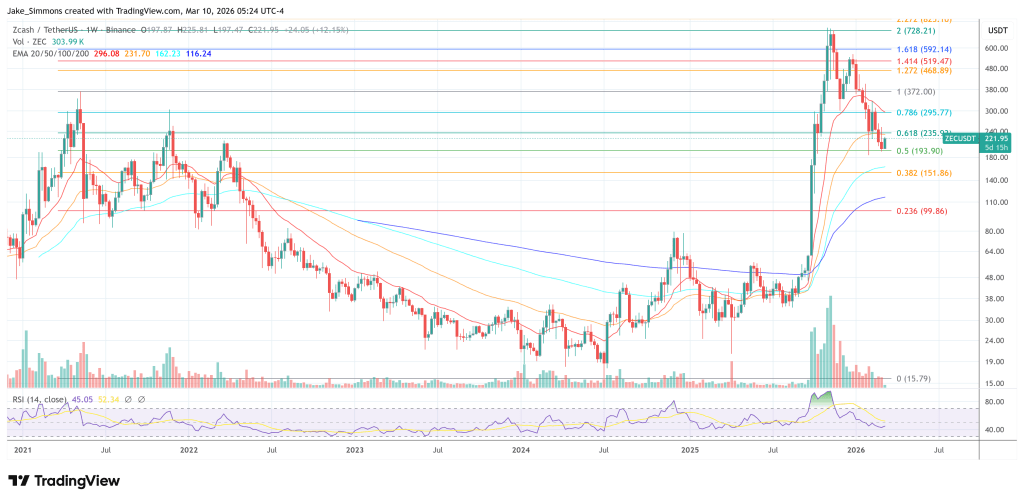
ZEC bounces from the 0.5 Fib, 1-week chart | Source: ZECUSDT on TradingView.com

Related Reads

50 Million USDT for 35,000 USD worth of AAVE: How Did the Disaster Happen? And Who Should We Blame?

In a catastrophic DeFi transaction, a user swapped 50.43 million aEthUSDT (Aave interest-bearing USDT) for only 327.24 aEthAAVE (worth ~$35,900), resulting in a near-total loss of value. The transaction was a collateral swap executed via CoW Protocol’s settlement system and Aave’s interface. The failure occurred due to a deeply flawed routing path: after redeeming USDT from Aave, the funds were routed through a highly liquid Uniswap V3 USDT/WETH pool (correctly executing the first swap). However, the entire amount of ~17,958 WETH was then sent to a tiny SushiSwap V2 AAVE/WETH pool with only ~331 AAVE and ~17.65 WETH in reserves. The massive trade drained 99.9% of the pool's AAVE, resulting in an effective execution price of ~$154,114 per AAVE—over 1000x worse than market price. Critical systemic failures were identified: 1. Aave’s interface requested a CoW quote without including critical hook metadata, leading to an inaccurate quote. 2. CoW’s solver competition logic deemed any quote with non-zero output and positive gas cost as "valid," with no sanity checks against market price or liquidity depth. 3. The routing algorithm modeled the tiny SushiSwap pool as a valid execution venue purely based on its constant-product formula, ignoring the economic absurdity. 4. Aave’s UI only provided a soft warning (a checkbox) for high price impact instead of a hard stop. The lost value was instantly arbitraged in the next block, benefiting MEV searchers and block builders. The core protocols (Aave, CoW Settlement, Uniswap, SushiSwap) functioned as coded. The primary blame lies with CoW’s inadequate routing quality controls and Aave’s flawed interface quote generation and weak risk safeguards.

Odaily星球日报4m ago

50 Million USDT for 35,000 USD worth of AAVE: How Did the Disaster Happen? And Who Should We Blame?

Odaily星球日报4m ago

Lobsters Not Yet Grown, Giants Already Casting Nets: OpenClaw Ecosystem Faces Enclosure Crisis

The article discusses the controversy surrounding Chinese tech giant Tencent's launch of SkillHub, a localized platform for the OpenClaw ecosystem. OpenClaw founder Peter Steinberger publicly accused Tencent of copying the project without providing support, specifically criticizing its impact on official download statistics. Tencent responded that SkillHub is a mirror site designed to serve Chinese users, citing reduced bandwidth strain on the official source and offering sponsorship. Steinberger countered that the core issue was not technical but a lack of prior communication and the risk of Tencent controlling user access and data. The author argues that the incident reflects a broader pattern of major Chinese tech companies exploiting open-source ecosystems for market dominance. While mirror sites are common in China, Tencent’s move is seen as an attempt to capture the user entry point and potential future commercialization of the Agent-based AI ecosystem represented by OpenClaw. The article warns that such platforms, under the guise of localization and convenience, may eventually lead to walled gardens where Tencent controls distribution, visibility, and monetization—echoing past strategies in sectors like ride-hailing and short-video platforms. The piece concludes that OpenClaw’s open, community-driven vision is at risk of being co-opted by corporate interests before it fully matures.

比推20m ago

Lobsters Not Yet Grown, Giants Already Casting Nets: OpenClaw Ecosystem Faces Enclosure Crisis

比推20m ago

Trading

Spot
Futures
活动图片