USDC Begins Nested Issuance, Coinbase Launches Custom Stablecoin Branding Service

链捕手Published on 2026-05-21Last updated on 2026-05-21

Abstract

Coinbase has launched its "Custom Stablecoins" platform, enabling businesses to offer branded stablecoins. The first client is Flipcash, a social payments app, which has introduced USDF. USDF is a Solana-based stablecoin, pegged 1:1 to USDC, and is designed to serve as a stable pricing and settlement unit for Flipcash's user-created community currencies. This move shifts the focus of stablecoins from being standalone assets or investment products to becoming embedded payment and settlement components within broader applications. For businesses like Flipcash, the core need is not to become a stablecoin issuer, but to integrate stable, reliable digital cash functionality—handling pricing, payments, and settlements—without managing the complex underlying infrastructure of issuance, reserves, on-chain contracts, fiat on-ramps, and compliance. Coinbase's platform provides this infrastructure as a service, positioning the exchange as a stablecoin infrastructure provider. While USDC remains the foundational reserve asset, the branded token (e.g., USDF) offers applications a tailored, user-facing financial tool. This development highlights a potential path for stablecoins to become ubiquitous backend utilities in social, gaming, and e-commerce applications, though it also brings significant regulatory and operational complexities associated with handling real user funds.

Author: Attorney Liu Honglin

For a startup looking to integrate stablecoins into its product, the current challenge isn't a lack of stablecoins to use, but rather: with so many stablecoins available in the market, which one should I choose?

Coinbase's answer is, you don't have to choose any of them; I'll tailor-make one for you.

On May 20th, Coinbase announced the launch of USDF for Flipcash via its Custom Stablecoins platform. Flipcash is an application focused on community currencies and social payments, where users can create digital currencies with a fixed supply and use them like digital cash. The role of USDF is to provide these community currencies with a relatively stable pricing and settlement unit.

According to Coinbase's introduction, USDF is issued on Solana and is backed 1:1 by USDC. Flipcash doesn't need to build the underlying capabilities for issuance, reserves, on-chain contracts, and user deposits from scratch; instead, it hands these foundational tasks to Coinbase.

The value of this news lies precisely in this change.

A few days ago, US discussions around the CLARITY Act were still focusing on the boundaries of stablecoin yields: Can stablecoin-related platforms pay users yields similar to bank deposit interest? The regulatory line regulators want to draw is clear: stablecoins cannot easily become high-interest accounts without a license. The direction Coinbase is providing now is to turn stablecoins into a payment and settlement capability that applications can plug into.

The industry significance of this move is that it further pushes stablecoins from being an 'asset used by platforms to retain users' towards being a 'payment component that applications can call upon.'

For entrepreneurs, stablecoins don't necessarily have to exist only as an independent financial product; they can also hide behind specific products like social media, gaming, creator economies, and cross-border e-commerce, becoming an underlying tool for pricing, purchasing, and settlement.

This is much more interesting than simply launching a new coin.

Stablecoins Becoming a Service

Many people's understanding of stablecoins may still be stuck on the logic of the issuer profiting from interest spreads: who issues it, how big is its scale, what's the trading volume, and does it generate yield? But the USDF case reminds us that the commercial value of stablecoins isn't necessarily just in 'issuing an asset'; it can also be in 'helping others leverage stablecoin capabilities.'

To understand USDF, you first need to understand the problem Flipcash is actually trying to solve.

It's not just a simple wallet, nor an ordinary trading platform. It aims to let users create fixed-supply community currencies. For example, a creator, a community, or a small group can all create their own digital currency on it and let other users buy and use it like digital cash.

Looking at specific usage scenarios makes the role of USDF clearer. A user creates a fixed-supply community currency on Flipcash, and this currency needs to be priced in USDF; other users who want to buy or use this type of community currency also complete settlement via USDF. Coinbase also mentions that Flipcash chose it because it needed transparent 1:1 USDC backing, USDC incentives that scale with USDF circulation, convenient fiat on-ramps for users, and the crypto infrastructure Coinbase has built over many years.

So why doesn't Flipcash just use USDC directly?

USDC can certainly serve as the underlying stable asset, but Flipcash clearly wants a settlement unit closer to its own product. The name USDF itself is tied to Flipcash; users see the platform's own stablecoin within the product, not an external, general-purpose asset. More importantly, Coinbase bundles USDF with fiat on-ramps, USDC backing, circulation-based incentives, and on-chain operations. What Flipcash gets is a complete suite of stablecoin capabilities, not just putting USDC into its product.

The focus here isn't 'Flipcash launched another coin,' but rather that community currencies at the application layer need a stable payment and settlement base. USDF serves as that base.

You can view the structure of this as follows:
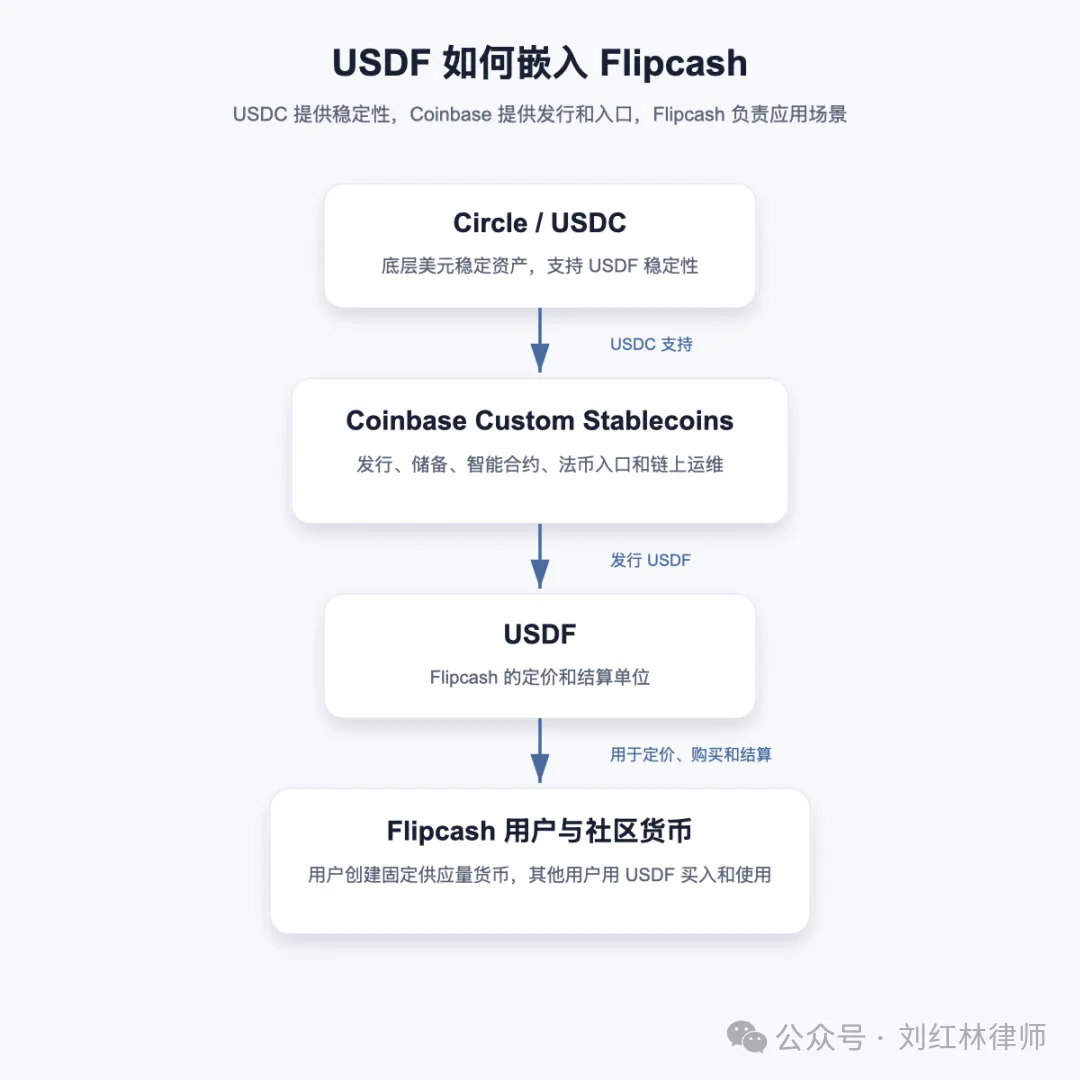
Operational Structure of USDF within Flipcash

Coinbase's Custom Stablecoins platform is designed precisely to solve such problems. According to Coinbase's product description, businesses can create their own branded stablecoins, supported by 1:1 exchange with USDC, with Coinbase handling issuance, reserves, smart contracts, and on-chain operations. These can also be integrated with scenarios like payments, rewards, and developer tools.

Stablecoins are no longer just assets displayed upfront for users; they can also hide behind products, becoming part of the payment, pricing, and settlement process.

For businesses, they may not actually want to become stablecoin issuers. What they care more about is whether their product can have a stable settlement unit, whether users can pay and exchange smoothly, whether cash flows can be reconciled, whether risks can be controlled, and whether the underlying system can operate stably.

These issues are more practical and closer to the work that must be faced when stablecoins enter real business scenarios than 'launching another coin.'

Coinbase's New Role

If you only think of Coinbase as an exchange, it might be harder to understand the USDF initiative.

Traditionally, exchanges handle matching trades, asset listings, user buying/selling, and transaction fees. But in the USDF scenario, the role Coinbase plays is no longer just a trading gateway. It acts more like a stablecoin infrastructure provider: helping applications issue stablecoins, providing USDC backing, connecting fiat on-ramps, maintaining on-chain contracts, and offering enterprise-level technical and compliance capabilities.

It's also important to see the positions of Circle and USDC here. Circle isn't the protagonist in this news, but USDC is the asset backing USDF. That means, on the surface, USDF is Flipcash's branded stablecoin, but its US dollar stability is still provided by USDC underneath.

This is significant for USDC. In the past, typical USDC scenarios were exchange balances, on-chain transfers, DeFi, and institutional settlements. Now, through Coinbase's custom stablecoin platform, USDC can be embedded into more specific applications, becoming the underlying asset behind community currencies, social payments, and platform settlements. What users see might be USDF, but what underpins its stability is still USDC.

From this perspective, the division of labor between Coinbase and Circle becomes clearer. Circle provides the underlying stablecoin asset, Coinbase packages this capability into a product businesses can integrate, and application builders then incorporate it into their own user scenarios. Competition in the stablecoin industry is no longer just about who issues a larger scale, but also about who can enter more real-world applications.

This aligns with Coinbase's direction over the past few years. It no longer just wants to be at the end where users buy and sell crypto assets; it wants to enter more foundational positions like developers, enterprise payments, wallets, and on-chain settlement. USDF is just one concrete example.

Of course, this path is also heavier.

Once stablecoins enter specific application scenarios, the issues aren't just about fast on-chain transfers. They include user identity, fund sources, deposits/withdrawals, anti-money laundering (AML), sanctions screening, reserve transparency, redemption mechanisms, accounting processes, and user complaints. When stablecoins enter real business, relying solely on the technical narrative of the crypto world isn't enough.

What Crypto Payment Entrepreneurs Should Look At

For crypto payment entrepreneurs, the most valuable aspect of USDF isn't necessarily 'can I also issue my own stablecoin?' A more valuable question is: why does Flipcash need Coinbase to help it do this?

The answer is actually quite practical. Flipcash's core business is community currencies and social payments, not stablecoin issuance. It needs stablecoin capabilities so that the community currencies users create can be priced, bought, settled, and used. If it handled issuance, reserves, on-chain contracts, user deposits, and compliance interfaces itself, the entire product's focus would be dragged down by the underlying infrastructure.

This offers a very direct insight for crypto payment entrepreneurs: many applications don't need to become issuers themselves; they need to integrate stablecoin capabilities into their operations. Whoever can make this integration process smoother may become the infrastructure supplier for the next wave of applications.

In the USDF case, the specific problems and business needs are: How does the platform reconcile the cash flow from users buying community currencies with on-chain settlement? How do users enter via fiat on-ramps? How is the exchange relationship between the branded stablecoin and the underlying USDC ensured to be clear? How do you explain to users who exactly issues this stablecoin, who backs it, and who to contact if there are problems?

These issues go beyond 'coin launch marketing' and enter the phase where product, payment, and compliance must be implemented together.

What real customers need isn't a stablecoin concept that sounds novel. They need a system that allows users to pay smoothly, the platform to complete settlements, and the backend to clearly account for fund flows.

However, the USDF matter also cannot be taken to the other extreme, suggesting that any company in the future can issue its own branded stablecoin.

After all, once a product involves real fund exchange, user balances, redemption arrangements, and transferable assets, it naturally approaches financial regulation. Even if it's packaged as a community currency, branded coin, or in-app dollar account, regulators still look at where the funds come from, why users buy it, what the platform promises, whether the asset can circulate, and who bears the risk.

Coinbase can do this because it already has a foundation within the US crypto infrastructure and compliance system, and can integrate USDC, fiat on-ramps, on-chain operations, and enterprise services.

If an ordinary startup team only sees 'every app can have its own stablecoin,' it's easy to imitate superficially and go down the wrong path.


Related Questions

QWhat is the primary service that Coinbase announced regarding stablecoins, and which company was the first to use it?

ACoinbase announced a new service called Custom Stablecoins, which allows companies to create their own branded stablecoins backed 1:1 by USDC. The first company to use this service was Flipcash, which launched its stablecoin called USDF.

QHow does the article describe the strategic shift in the role of stablecoins as illustrated by the USDF case?

AThe article describes a shift where stablecoins are moving from being 'assets for platforms to retain users' towards becoming 'payable components that applications can call upon.' They are evolving into underlying payment and settlement tools that can be embedded into various products like social platforms, games, and e-commerce.

QAccording to the article, what specific problem does Flipcash aim to solve, and how does USDF help?

AFlipcash aims to enable users to create fixed-supply community currencies for use within social and payment contexts. USDF provides a stable pricing and settlement unit for these community currencies, acting as a payment and settlement foundation that is deeply integrated into Flipcash's product.

QWhat are the key infrastructural and compliance challenges mentioned for stablecoins entering real-world business applications?

AKey challenges include user identity verification, tracking fund sources, managing fiat on/off ramps, Anti-Money Laundering (AML) compliance, sanctions screening, ensuring reserve transparency, managing redemption mechanisms, handling accounting processes, and addressing user complaints. It requires more than just technical blockchain capabilities.

QWhy does the article caution entrepreneurs against simply seeing the USDF case as a model for every app to issue its own stablecoin?

AThe article cautions that issuing a branded stablecoin involves significant financial regulatory compliance (concerning fund flows, user balances, redemption, and transferable assets). Coinbase can manage this due to its established infrastructure and compliance framework in the US. For a typical startup, attempting this without the necessary resources and expertise could lead them down the wrong path.

Related Reads

GitHub Empire on the Brink of Collapse: Source Code Leak, 18-Year Veteran Leaves, Microsoft Loses 1.5 Billion Developers

GitHub is facing an unprecedented crisis, marked by a massive exodus of developers and severe operational failures. The tipping point came when Mitchell Hashimoto, creator of Ghostty and an 18-year GitHub user, publicly severed ties, citing persistent platform outages that made serious work impossible. This departure highlights a broader pattern of user frustration. The platform's instability has drawn complaints from major corporate clients like Citibank and Intel, forcing Microsoft to issue substantial service credits. A critical incident last month saw an accidentally triggered, unreleased feature cause widespread repository rollbacks, erasing recent code changes and pushing enterprises to migrate. Security has catastrophically breached. In May 2026, hackers infiltrated over 3,800 of GitHub's internal repositories via a poisoned VS Code extension installed by a developer, leading to the attempted sale of core source code for $50,000. This follows the discovery of a critical zero-day vulnerability in March that threatened access to millions of repositories. Internally, GitHub's autonomy has collapsed. After the resignation of CEO Thomas Dohmke in mid-2025, Microsoft eliminated the CEO role, folding GitHub into its CoreAI division under the unpopular leadership of Jay Parikh. This triggered a talent drain, with key executives and engineers leaving. A disruptive migration of GitHub's infrastructure to Azure servers, pushed by CTO Vladimir Fedorov, is blamed for the recurring outages. Competitively, GitHub Copilot is under "existential threat" from superior AI coding tools like Cursor (now owned by SpaceX) and Claude Code, which offer more advanced contextual coding and automation. Ironically, Microsoft's own engineers reportedly preferred Claude Code, forcing management to revoke licenses. Financially, GitHub is a loss leader. Despite Copilot surpassing 4.7 million paid users and $3 billion in annual revenue, the AI inference costs for free services massively outstrip subscription income, hurting Microsoft's cloud margins. The recent shift from a flat fee to a pay-as-you-go model for Copilot has further alienated developers. The core question for Microsoft is whether a centralized code repository remains essential in the AI agent era. The erosion of trust, developer culture, and platform reliability threatens the very ecosystem Microsoft spent decades building.

marsbit42m ago

GitHub Empire on the Brink of Collapse: Source Code Leak, 18-Year Veteran Leaves, Microsoft Loses 1.5 Billion Developers

marsbit42m ago

SEC Promotes Tokenized Stocks, Is the Traditional Finance Industry Starting to Worry?

The U.S. Securities and Exchange Commission (SEC) is preparing to formally release an "innovation exemption" framework this week. This framework would allow third parties to tokenize U.S. stocks like Apple and Tesla without approval from the listed companies. The move, rooted in a deregulatory vision proposed by pro-crypto commissioners earlier this year, could accelerate the migration of traditional stock markets to blockchain. This development poses a structural threat of "fragmentation" to traditional finance. Core concerns are liquidity fragmentation—where trading volume disperses across multiple blockchains and platforms, leading to price disparities and reduced market efficiency—and revenue fragmentation—where trading fees and intermediary income shift away from domestic exchanges to overseas or competing platforms. The report compares the traditional stock market to a monopolistic "supermarket." Tokenization enables countless "street stalls" to operate outside this system, threatening the exchange's dominance, diluting liquidity for large orders, and slicing into revenue streams. Evidence of this capital fragmentation is already emerging. On the same day the SEC signaled the framework, decentralized platform Hyperliquid saw its RWA (real-world asset) open interest hit a record $2.6 billion, driven by demand for 24/7 on-chain trading of traditional assets. Traditional institutions face a dilemma: either collaborate to build tokenization infrastructure proactively or lobby regulators to block innovation. Regulators must balance controlling the pace of innovation with preventing domestic revenue from being captured by offshore platforms. Key future battles will revolve around defining shareholder rights for tokenized assets and regulating platforms that have grown in regulatory gray areas. In the digital asset era, inaction risks the permanent loss of long-held fee monopolies and financial leadership as capital continues to disperse.

marsbit59m ago

SEC Promotes Tokenized Stocks, Is the Traditional Finance Industry Starting to Worry?

marsbit59m ago

A Comprehensive Analysis of On-Chain Pre-IPO: Why is the Pricing Power of SpaceX and OpenAI Moving On-Chain?

This podcast episode explores the rise of on-chain pre-IPO price discovery and trading, focusing on companies like SpaceX, OpenAI, and Anthropic. Key trends include the recent launch of a SpaceX pre-IPO perpetual contract on Hyperliquid, the secondary market trading of AI company shares, and a new partnership between Nasdaq Private Market and Polymarket. Dio Casares explains why AI companies like OpenAI and Anthropic actively deny the legitimacy of secondary trades. Primary reasons are to protect their primary funding rounds (as secondary trades don't provide cash to the company) and to avoid complex legal and administrative responsibilities associated with settling these transactions. He argues that on-chain **derivatives** (like perpetuals) are a more viable solution than **tokenized spot markets**, as they better navigate U.S. regulatory holding period requirements, provide effective hedging, and avoid antagonizing the companies themselves by competing with their primary raises. The discussion covers the risks and methods of gaining pre-IPO exposure, from direct investments and SPVs to riskier, layered structures that can lead to legal complications and settlement issues. Casares also maps the landscape of key players, differentiating between traditional secondary brokers (like Forge, Hiive, and Setter) and on-chain derivatives protocols (like Trade.xyz/Ventuals on Hyperliquid) and tokenization platforms (often on Solana). He positions Patagon as a facilitator for access to private market deals but clarifies it avoids on-chain tokenization to maintain good relations with portfolio companies. Looking ahead, the convergence of a historic IPO pipeline (with potential trillion-dollar valuations), the 24/7 nature of crypto markets, and the strategic use of pre-market perpetuals as a "loss leader" suggest continued growth and competition in the on-chain pre-IPO space.

marsbit1h ago

A Comprehensive Analysis of On-Chain Pre-IPO: Why is the Pricing Power of SpaceX and OpenAI Moving On-Chain?

marsbit1h ago

Token Packages Are Here, Are Telecom Operators in a Hurry?

Major Chinese telecom operators are launching token-based AI computing packages, sparking public debate and highlighting a strategic shift amid slowing traditional revenue growth. In May, Shanghai Telecom introduced token plans (e.g., 9.9 RMB for 10 million tokens), quickly followed by nationwide offerings from China Telecom, China Mobile, and China Unicom. While priced higher than major AI firms like DeepSeek, these packages allow users to access multiple AI models via API using their phone bills, similar to purchasing universal mobile data. The move reflects operators' anxiety as traditional voice, SMS, and data services stagnate. With revenue growth hitting multi-year lows in 2025, AI and computing power represent a critical new frontier. However, current C端 offerings, such as AI photo editing or virtual pets, are seen as non-essential and highlight operators' role as "pipes" or integrators rather than creators of compelling AI products. Beyond consumer packages, operators aim to become key infrastructure players in China’s national computing power network. They position themselves as the "power grid" delivering AI算力, leveraging their vast network of base stations to ensure low-latency, reliable coverage, especially for applications like autonomous driving. This infrastructure role, coupled with unified national调度, could make算力 a ubiquitous utility, driving new consumption scenarios even if mass adoption of token packages remains uncertain.

marsbit1h ago

Token Packages Are Here, Are Telecom Operators in a Hurry?

marsbit1h ago

Trading

Spot
Futures
活动图片