Ethereum Reaching End Game? Founder Vitalik Buterin Shares New Development

bitcoinistPublished on 2026-03-03Last updated on 2026-03-03

Abstract

Ethereum founder Vitalik Buterin has provided an update on the long-awaited account abstraction feature, stating it could be implemented within a year under the Hegota upgrade. The new EIP-8141 proposal is designed to solve all remaining problems related to this upgrade. Account abstraction enables smart contracts to initiate and validate transactions, allowing users to automate payments while retaining control of their funds. A key feature is the ability to pay gas fees in tokens other than ETH via a paymaster contract. Buterin emphasized that this minimizes intermediaries, aligning with the "cypherpunk Ethereum" vision. The update also includes strategies for integrating with privacy protocols, potentially eliminating the need for public broadcasters. This development follows the Ethereum Foundation's release of the 'Strawmap,' which outlines the network's plans through 2029.

Ethereum founder Vitalik Buterin has provided an update on plans for account abstraction. Given the progress they have made so far on this feature, he stated that it could go live within a year under the Hegota upgrade.

Vitalik Buterin Provides Update On Ethereum Account Abstraction

In an X post, Vitalik Buterin noted that they have made progress with the account abstraction proposal, which they have been working on since early 2016. There is now the EIP-8141 proposal, which the Ethereum co-founder said solves every remaining problem that account abstraction is intended to solve.

Account abstraction enables smart contracts to initiate and validate transactions. This upgrade will enable users to automate payments from their wallets while still retaining control of their funds. Vitalik Buterin drew attention to “Frame Transactions,” which enables native account abstraction. One key component of this Ethereum feature is that users can now pay gas fees in tokens other than ETH via the paymaster contract.

Vitalik Buterin gave an example of users wanting to pay gas in RAI, an Ethereum-backed asset. He stated that one can use a paymaster contract, which is a special-purpose DEX that provides ETH in real time. The Ethereum co-founder broke down the transaction frames, which include deployment, validation, paymaster validation, and then the user sends RAI to the payment, after which execution occurs. The paymaster then refunds unused RAI and converts it to ETH.

The founder’s comments come amid the Ethereum Foundation’s release of the ‘Strawmap,’ which outlines the network’s plans through 2029 as developers work on aspects such as finality and transaction speed. The Strawmap also showed that native account abstraction could happen by the second half of this year.

How This Aligns With The Cypherpunk ETH Vision

Vitalik Buterin said that account abstraction minimizes intermediaries, a core principle of “non-ugly cypherpunk Ethereum,” which maximizes what users can do even if all the world’s infrastructure except Ethereum goes down. This came as the Ethereum co-founder noted that the mechanism for account abstraction is the same as in existing sponsored transaction mechanisms, but with no intermediaries required.

The Ethereum co-founder also touched on how account abstraction will work for privacy protocols, noting that there are two strategies in focus. The first is creating a paymaster contract that checks for a valid ZK-SNARK and pays gas if it finds one. The second strategy is to add 2D nonces, which would enable an individual account to function as a privacy protocol and to receive transactions in parallel for many users.

Vitalik Buterin stated that for privacy protocol users, this strategy means that they can completely remove “public broadcasters” that are the source of “massive UX pain” and replace them with a general-purpose public mempool

At the time of writing, the ETH price is trading at around $2,000, up in the last 24 hours, according to data from CoinMarketCap.

ETH trading at $1,996 on the 1D chart | Source: ETHUSDT on Tradingview.com

Related Questions

QWhat is the key feature of Ethereum's account abstraction according to Vitalik Buterin?

AAccount abstraction enables smart contracts to initiate and validate transactions, allowing users to automate payments from their wallets while retaining control of their funds and pay gas fees in tokens other than ETH.

QWhich Ethereum Improvement Proposal (EIP) does Vitalik Buterin mention as solving the remaining problems for account abstraction?

AVitalik Buterin mentioned EIP-8141 as the proposal that solves every remaining problem that account abstraction is intended to solve.

QHow does account abstraction align with the 'cypherpunk Ethereum' vision?

AAccount abstraction minimizes intermediaries, which is a core principle of 'non-ugly cypherpunk Ethereum,' maximizing what users can do even if all the world's infrastructure except Ethereum goes down.

QWhat are the two strategies mentioned for how account abstraction will work with privacy protocols?

AThe two strategies are: 1) Creating a paymaster contract that checks for a valid ZK-SNARK and pays gas if found, and 2) Adding 2D nonces to enable an individual account to function as a privacy protocol and receive transactions in parallel for many users.

QWhen could native account abstraction potentially go live on Ethereum according to the article?

ANative account abstraction could go live within a year under the Hegota upgrade, with the Strawmap indicating it could happen by the second half of this year.

Related Reads

Zhejiang University Research Team Proposes New Approach: Teaching AI How the Human Brain Understands the World

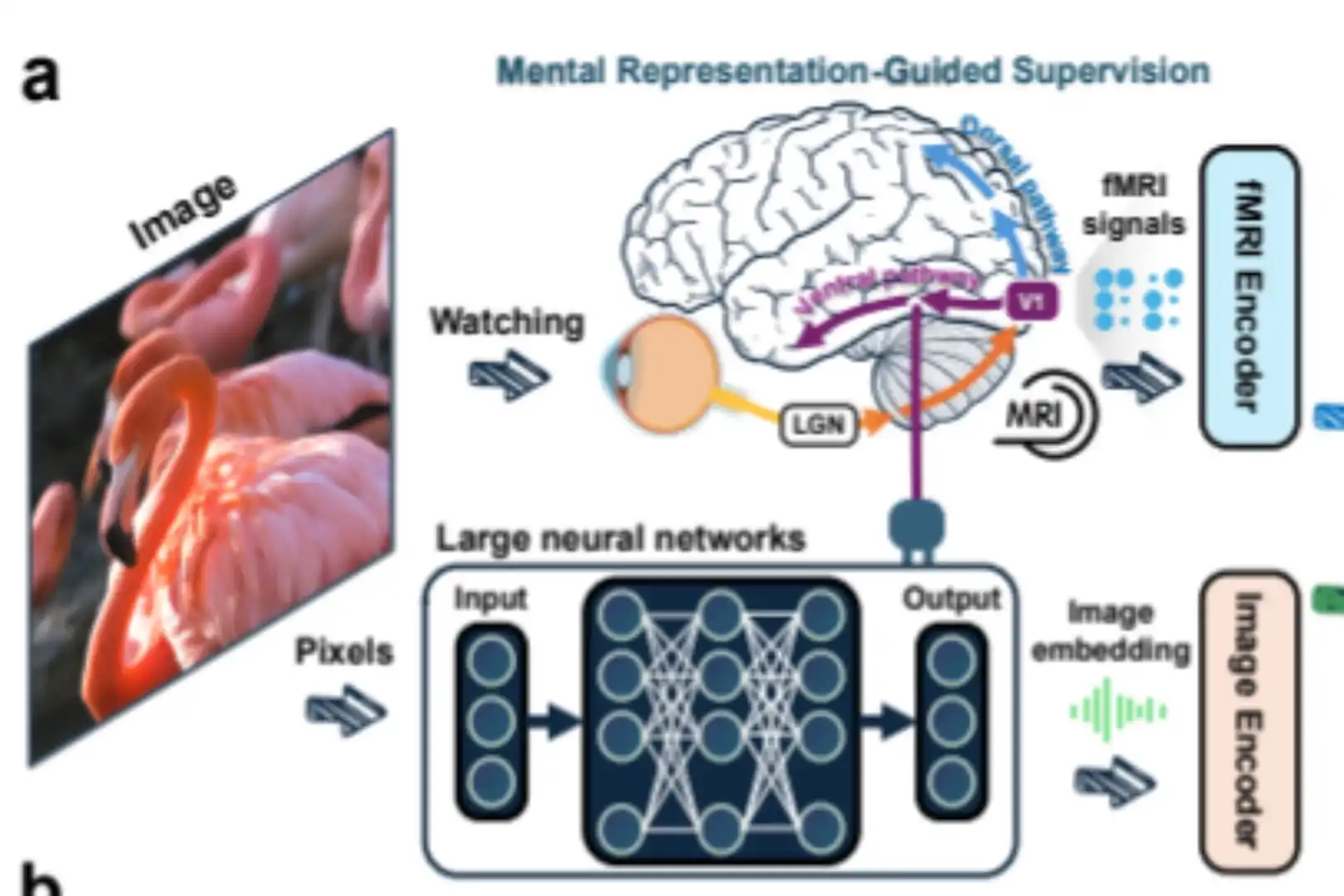
A research team from Zhejiang University published a paper in *Nature Communications* challenging the prevailing notion that larger AI models inherently think more like humans. They found that while model performance on recognizing concrete concepts improved as parameters increased (from 74.94% to 85.87%), performance on abstract concept tasks slightly declined (from 54.37% to 52.82%) in models like SimCLR, CLIP, and DINOv2. The key difference lies in how concepts are organized. Humans naturally form hierarchical categories (e.g., grouping a swan and an owl into "birds"), enabling them to apply past knowledge to new situations. Models, however, rely heavily on statistical patterns in data and struggle to form stable, abstract categories. The team proposed a novel solution: using human brain signals (recorded when viewing images) to supervise and guide the model's internal organization of concepts. This method, termed transferring "human conceptual structures," helped the model learn a brain-like categorical system. In experiments, the model showed improved few-shot learning and generalization, with a 20.5% average improvement on a task requiring abstract categorization like distinguishing living vs. non-living things, even outperforming much larger models. This research shifts the focus from simply scaling model size ("bigger is better") to designing smarter internal structures ("structured is smarter"). It highlights a new pathway for developing AI that possesses more human-like abstract reasoning and adaptive learning capabilities.

marsbit4h ago

Zhejiang University Research Team Proposes New Approach: Teaching AI How the Human Brain Understands the World

marsbit4h ago

Trading

Spot
Futures

Hot Articles

Discussions

Welcome to the HTX Community. Here, you can stay informed about the latest platform developments and gain access to professional market insights. Users' opinions on the price of ETH (ETH) are presented below.

活动图片