Author:Steven,Payment 201
Recently, while chatting with a few friends in the payments industry, I discovered a very interesting contrast.
In recent years, many Chinese perceptions of India often come from business news. In the minds of many, India is a market with huge opportunities but also great complexity. Many Chinese companies have experienced varying degrees of adaptation after entering the Indian market: the regulatory environment, local business rules, and corporate culture are all significantly different from those in China. So, many people's first reaction is: the Indian market is vast, but it's not easy to operate in. It's not another China.
However, in recent years, as more and more Chinese payments professionals venture into international workplaces, they are discovering a completely different India.
Increasingly around them: colleagues are Indian, the boss is Indian, partners are Indian Founders, core leaders at banks, Fintech companies, and payment companies have Indian backgrounds, and even the management of many global payment companies includes Indian-origin talent.
What's more interesting is that the evaluation of these Indian colleagues and bosses by many Chinese professionals often undergoes a very similar process.
Initially: "Not fully convinced," wondering if this person is particularly good at communication? Is their presentation ability strong? Are they better at managing the boss's expectations? Do they talk more than they deliver?
But after experiencing a few truly complex projects, many people's views begin to change. Advancing a cross-regional payment project, a bank cooperation negotiation, a discussion on an account system, handling a regulatory or compliance issue – many people ultimately find: this person is indeed capable.
Why? Because we initially underestimated a certain type of ability.
A Contrast: The Indian Market is Tough, But Indian Talent is Rising in Global Competition
There's a very notable phenomenon here.
Many Chinese perceptions of India often come from India as a country itself.
However, in the global business environment, the Indians we truly encounter are usually not an average sample of India's 1.4 billion population. Rather, they are a group of highly filtered individuals.
India is, of course, a massive market with significant developmental disparities; there are top-tier tech talent, financial talent, entrepreneurs, and also a large population of ordinary laborers.
But when you encounter Indian colleagues in financial and tech hubs like the US, Singapore, Europe, or Hong Kong, you are often meeting some of India's most international talent.
They might have come from India's top educational system or received education in the US or Singapore; they might have grown up in Indian higher education institutions and then entered global banks, tech companies, and financial institutions.
They have already undergone multiple rounds of filtering: educational filtering, professional filtering, and globalization filtering.
So, the Indian talent many Chinese encounter overseas is essentially a group of elite individuals participating in global competition.
This is also why many people's first impressions can be misleading. Many people's imagination of Indians may come from certain stereotypes.
But the Indian talent that truly enters the global fintech industry is often highly internationalized. They may have little noticeable accent, they are familiar with Western business culture, they understand how global enterprises operate, and they know how to collaborate with people from different countries and cultural backgrounds.
They do not simply represent the Indian market; they represent a group of Indians who have entered the global system.
What We Initially Underestimated Was Not Indians' Professional Skills, But Their Organizational Skills
Over the past two decades, China's payments industry has cultivated a cohort of very capable talent. The scale of China's mobile payment development is a very unique case globally. From WeChat Pay and Alipay to e-commerce payments, cross-border payments, and wallet ecosystems, Chinese companies have experienced some of the world's most complex and massive payment scenarios.
As a result, Chinese payments talent has developed a very strong skillset model: understanding business, understanding products, fast execution speed, strong problem-solving ability, and the ability to push forward under pressure.
There's nothing wrong with this capability. In fact, it could be said that this is the core reason for the past success of China's payments industry.
But, when these talents enter large global fintech companies, they find that the evaluation criteria for senior positions are changing. Because the global payments industry, the higher you go, competes not only on professional skills. It competes on organizational skills.
The payments industry is fundamentally not a point product, but a complex network.
A cross-border payment project connects behind the scenes: banks, card networks, regulators, acquiring institutions, wallets, merchants, headquarters and regional offices, front-office and back-office functions. If any link has a problem, the project could stall.
Often, failure isn't due to technical infeasibility, but because: the bank didn't fully understand the requirements, Compliance wasn't involved early enough, the business team didn't reach consensus, headquarters didn't see the strategic value, partners lacked sufficient motivation.
So, the higher the position, the truly important question is not:
"Can I do this well?"
But:
"Can I get a complex organization to do this well together?"
This is also why many Indian managers are initially easily underestimated but eventually easily recognized. They might not be the person in the team most deeply involved in certain technical details.
But they often know:
Who to approach and when, who needs to be involved early, who needs to be persuaded, who needs to see the business value, who needs to gain a sense of security, who needs to become a project supporter.
This kind of ability might not be apparent in small teams. But in large global organizations, its value is extremely high.
Core Competency in Global Organizations: Stakeholder Management
The competency most easily underestimated by many Chinese talents when first entering global enterprises is Stakeholder Management.
The development model of China's internet and payments industry in the past emphasized: identify problems, analyze problems, solve problems, rapid launch, rapid iteration. This culture cultivated a large number of excellent execution-oriented talents.
But in large global organizations, many problems are not technical issues, but organizational ones. Why doesn't this department support it? Why is this bank progressing slowly? Why does Compliance raise a different opinion? Why hasn't headquarters allocated resources? Why don't partners have sufficient motivation?
Behind these questions, what's tested is not a person's professional skill, but whether they understand the goals of different roles and how to build consensus among various stakeholders.
Many Indian managers excel in this regard.
They are accustomed to building relationships before officially pushing things forward, first understanding key individuals' concerns, involving relevant parties early, finding supporters, and reducing potential resistance.
So when the project officially enters the execution phase, many things have already been coordinated in advance.
Externally, it might seem: "Why does he always know who to talk to?", "Why does his project move so smoothly?" But in reality, this is backed by organizational skills honed over long-term practice.
This is also something many Chinese talents need to re-understand.
In the fast-paced domestic development environment, many things can rely on: strong execution, strong resources, strong pushing.
But in global enterprises, often no single person holds absolute authority. You can't demand immediate cooperation from a bank, can't demand immediate investment from headquarters, can't demand other regional teams to act entirely according to your pace.
What you need is: influence, coordination, building trust, forming alliances.
Communication Skills Are Not Packaging, But Influence Within Global Organizations
Another area that often leads to misunderstanding is communication skills.
Many Chinese people, when first encountering Indian managers, might think: "Is this person too talkative?", "Does their presentation ability exceed their actual capability?"
But upon entering global organizations, they realize:Communication itself is part of leadership.
A senior leader doesn't just need to get things done. They also need to make the organization understand: why this is important, why it should be done now, why it's worth investing resources, where the risks lie, what support is needed.
In global enterprises, information is never in short supply.
What's lacking is: someone who can transform complex information into consensus.
This is also why many Indian-origin managers place great emphasis on: Storytelling, Executive Communication, Visibility, Leadership Presence.
In some Chinese workplace environments, these might easily be seen as "showcasing oneself," but in global organizations, they are actually important capabilities for driving resource allocation.
A successful project has two layers.
First layer: The task is actually completed.
Second layer: The organization understands why it succeeded, and why it is willing to support you again next time.
Many Chinese talents excel at the first layer, whereas global leaders need to possess the second layer as well.
Professional Networks: The Long-term Compound Interest of Indian Talent
Beyond individual capability, another very important factor is the professional ecosystem and the tendency to form strong communities.
Many Indian professionals overseas realized early on: career development is not a single-player game, but a network game. One person is at JPMorgan, one at Visa, one at Mastercard, one at Stripe, one at Circle. And a few years later, they might become: partners, clients, investors, recruitment sources, industry resources.
This kind of professional network creates long-term compound interest.
Individual capability determines the starting point, but the professional ecosystem determines the growth rate. This is also why many Indian talents, upon entering global companies, easily form sustained career paths. Today's colleague might be tomorrow's client. Today's boss might be a future investor. People you've collaborated with today might become important sources for talent at your next company.
Of course, Chinese people abroad also have very strong communities.
Especially in entrepreneurship, trade, manufacturing, and investment, the Chinese network has always been strong. But within large Western tech and financial organizations, there are some differences between the two professional cultures. Many Chinese talents are more accustomed to: relying on individual capability breakthroughs, getting things done well, proving themselves.
Whereas Indian talents are more accustomed to placing career development within a long-term ecosystem. Who you know, who you connect with, who you help, who you mentor. These relationships eventually become professional assets.
This isn't to say one culture is necessarily better than the other. Rather, the global competitive environment is changing. In the past, individual capability might have determined 80% of the outcome. In the future, within large organizations and complex industries, the importance of network capability will increasingly grow.
Why Are More and More Indian-background Entrepreneurs Entering the Payments Infrastructure Field?
This is also a very obvious trend in the payments industry in recent years.
If you observe the global payments industry, you'll find many Indian-background entrepreneurs are not simply making a consumer payment product.
They are more entering: cross-border payments, enterprise payments, capital flow infrastructure, digital asset payments – these more foundational areas.
For example, TerraPay focuses on connecting global capital flows, essentially helping wallets, banks, and payment institutions in different countries connect more efficiently; Tazapay focuses on cross-border business payments, solving issues for enterprises in receiving payments, settlement, and capital flow in global markets; Onmeta explores the connection between traditional payment systems and Web3.
The common characteristic of these companies is: they have emerged from highly competitive markets, solving a more fundamental problem: how can global money flow more efficiently.
This is highly correlated with the development path of Indian talent over the past few decades.
Many Indian payments entrepreneurs and executives have experienced: the Indian education system, IT services companies, global banks, payment networks, fintech. They have long-term understanding of: technology, finance, regulation, business.
Therefore, they can more easily enter fields like payments infrastructure that require comprehensive capabilities.
Singapore: The Amplifier of Indian Talent in Asia's Payments Industry
If the United States is an important market for Indian-origin talent entering global tech companies, then Singapore is a very critical node in Asia's payments industry.
The reason is simple.
Singapore is Asia's financial center and also the regional headquarters location for many international payment companies. JPMorgan, Citi, Standard Chartered, DBS, Visa, Mastercard, PayPal, Stripe – much of their Asian business is based here.
Indian-origin talent in Singapore has its own characteristics.
Indian-Americans tend to go more towards global tech companies, headquarters strategy roles, and large enterprise management.
Whereas Singaporean Indians tend to become Asian financial professionals. They are familiar with: banking systems, regulatory environments, Southeast Asian markets, regional business relationships, and long-term cooperation models.
So in Asia's payments industry, you often see: APAC Payment Head, Regional Partnership Head, Bank Partnership Head, Fintech Business Head, with Indian backgrounds.
They are connecting not just the Indian market, but the commercial networks between Asia, the West, and emerging markets.
The Final Puzzle Piece Chinese Payments Talent Needs to Complete When Going Global
Discussing the advantages of Indian talent is not to say that Chinese talent is not strong. In fact, Chinese payments talent possesses experience that is very rare globally. China has gone through: the world's largest-scale mobile payment market, complex e-commerce payment scenarios, wallet ecosystem competition, high-concurrency transaction systems, rapid commercialization. These capabilities are very scarce in the global payments industry.
However, as Chinese payments talent moves towards the global market, it needs to supplement another set of capabilities. In the past, Chinese talent relied more on individual capability to break through. In the future, there is a need to transition from individual heroes to global organization-oriented talent.
First, transition from being an executor to being an enabler.
You don't just need to solve problems yourself. You also need to make different teams willing to solve problems together.
Second, transition from business language to global business language.
You not only need to say: what we did.
You also need to say: why it's important, why do it now, why it's worth the company's investment.
Third, transition from individual struggle to professional ecosystem.
Future global competition is not just about talent competition; it's also about talent network competition.
Chinese talent overseas needs more: industry connections, community building, mentor culture, professional mutual aid. To allow excellent talent to form long-term compound interest.
Fourth, re-understand communication and personal influence.
Many Chinese talents are very capable but accustomed to keeping a low profile. They think: if the work is done well, naturally people will see it.
But global organizations don't work that way. Making others understand your value is not packaging; it's part of leadership.
Finally
The Indian market may not be an easy market to enter. But Indian talent is demonstrating increasingly strong competitiveness in the global payments industry.
Behind this is not simply because of: large population, good English, or any single advantage.
Rather, it's a group of talent that has undergone highly competitive filtering and long-term globalization training, developing a set of capabilities adapted to international organizations. They excel at: connecting different cultures, coordinating different interests, driving complex organizations.
In the future, the truly scarce people in the payments industry will not necessarily be those who know one product best. Rather, they will be those who can connect: banks, regulators, technology, business, capital, different country teams, and make complex systems operate continuously.
The change in attitude of many Chinese payments professionals, from "unconvinced" to "convinced," is actually a process of re-recognizing a type of globalization capability.
This is not about Indian talent replacing Chinese talent, but about the global payments industry entering a new stage of competition.
Chinese payments talent already possesses world-class business capabilities.
The next stage requires supplementing how to make these capabilities seen, connected, and amplified within global organizations.
Because the future truly belongs to the era of global talent, where competition is not just about the ability to do things, but about the ability to make the world work together to get things done.
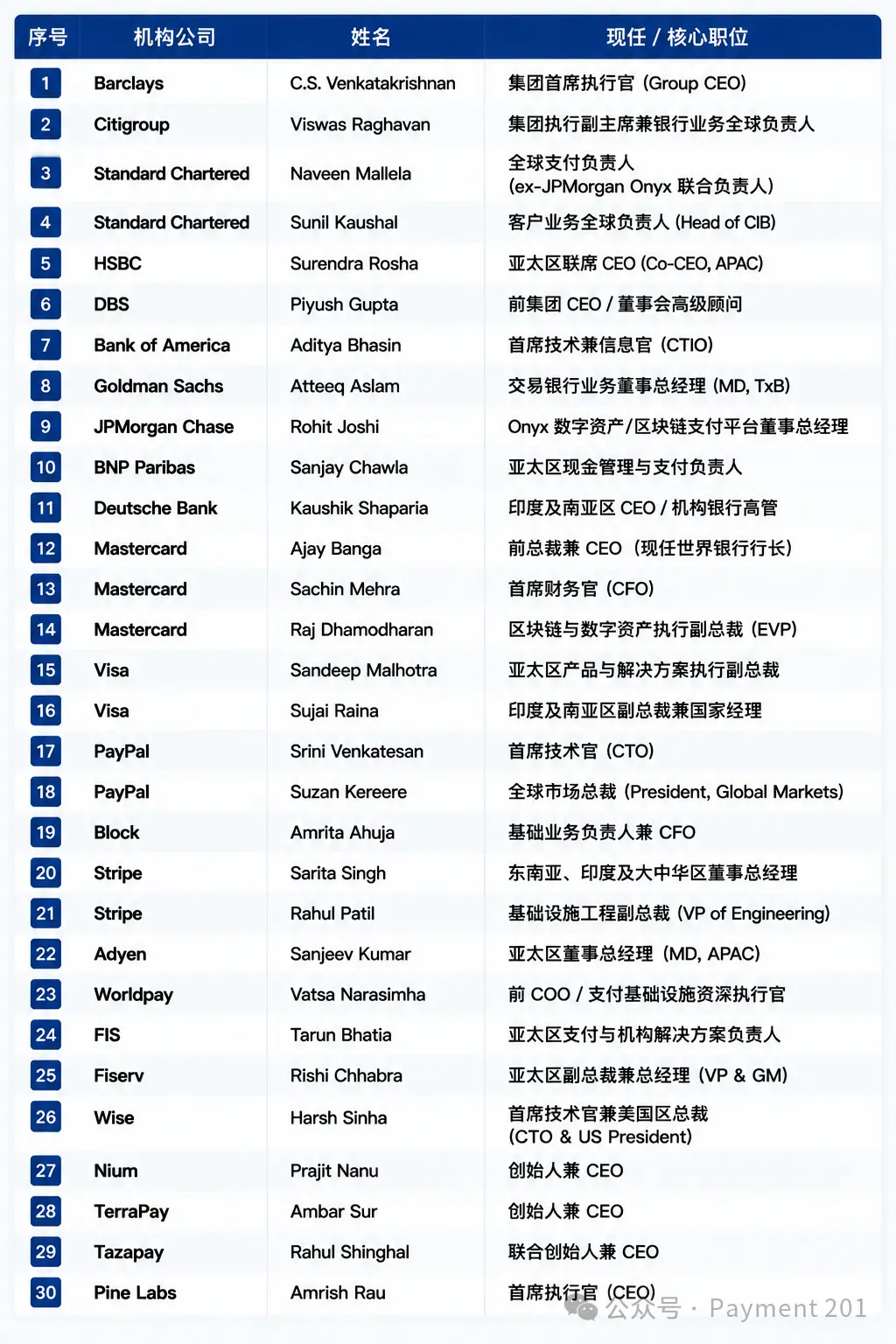
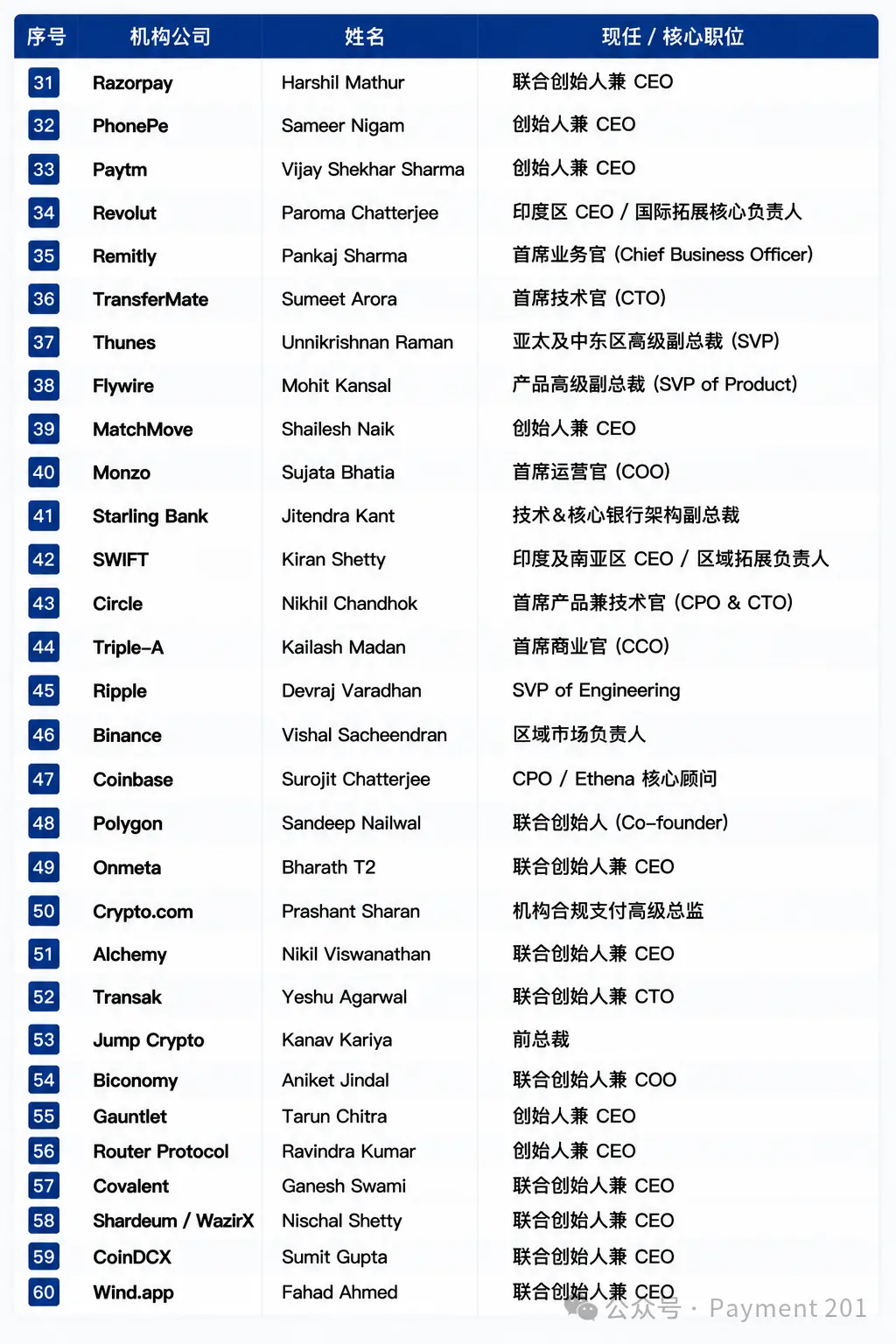
Appendix: Map of Indian-origin Executives and Entrepreneurs in the Global Fintech and Payments Ecosystem (60 Individuals), Data sourced from the internet