SpaceX IPO Unlock Timeline

marsbitPublished on 2026-06-17Last updated on 2026-06-17

Abstract

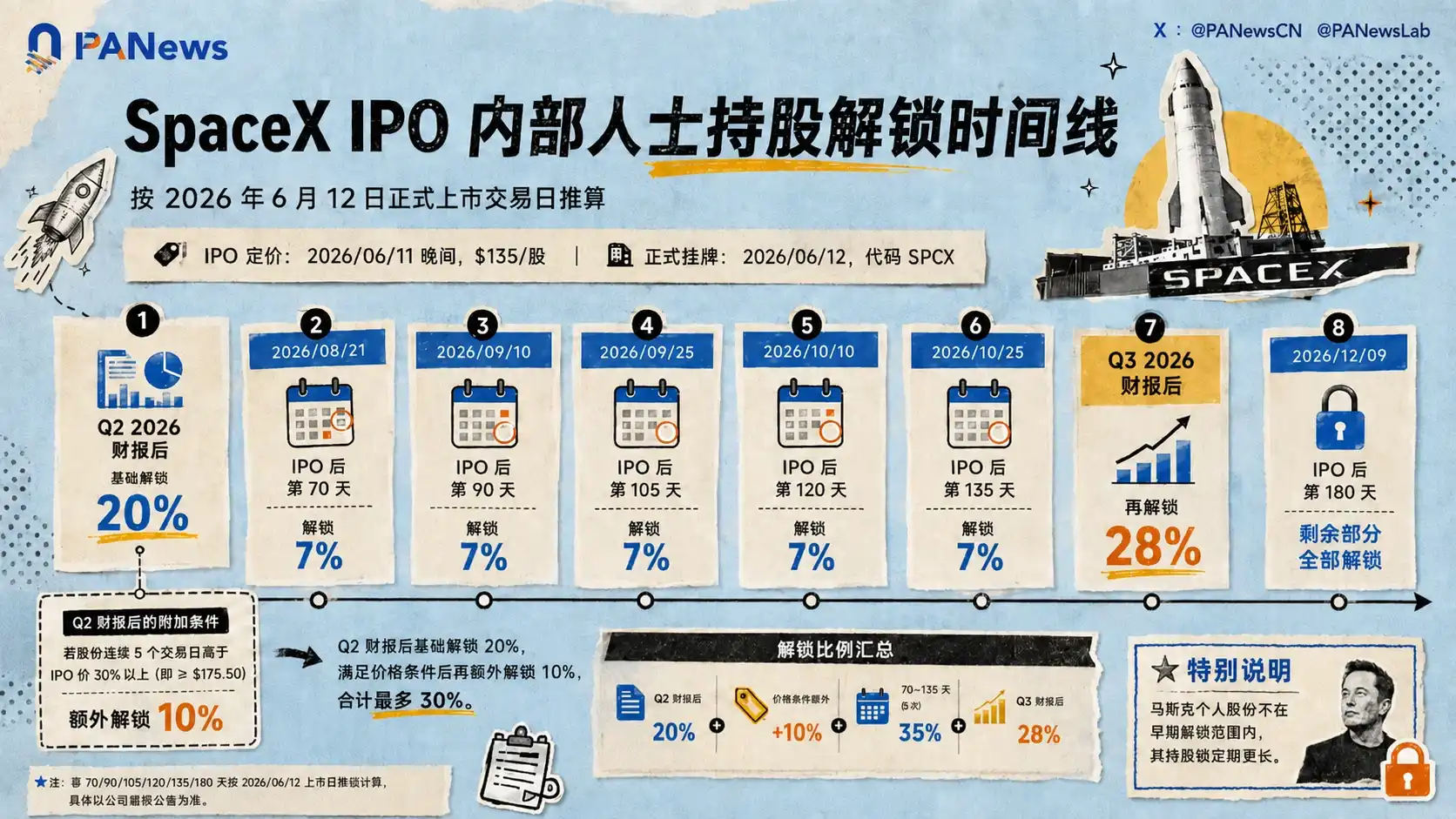
SpaceX (stock symbol: SPCX) shares have been rising strongly since its IPO, largely due to extremely low immediate float. Currently, only about 4.2% of total shares are freely tradable, locking approximately 96% of the equity. However, a series of share unlock events are scheduled, which could increase selling pressure. After the Q2 earnings report, up to 30% of locked shares may be released. Following that, an additional 7% is set to unlock approximately every 15 days. After the Q3 earnings report, another 28% will be released. The final remaining locked shares are scheduled for full release on December 9th, which is 180 days after the IPO. It is noted that Elon Musk's personal holdings are subject to a longer lock-up period and are not included in these early unlock phases.

SpaceX (SPCX) has been continuously rallying since its listing. The reason might be simple: currently, only about 4.2% of the total outstanding shares are floating, with 96% of the shares still unable to be sold.

But the pressure of unlocking is already counting down: Up to 30% will be released after the Q2 earnings report, followed by an additional 7% unlocked approximately every 15 days. Another 28% will be released after the Q3 earnings report. The remaining portion will be fully unlocked on December 9th (the 180th day after the IPO).

Elon Musk's personal holdings are not included in the early unlock scope and have a longer lock-up period.

Related Questions

QWhat is the approximate percentage of SpaceX's total shares currently available for trading after its IPO?

AApproximately 4.2% of SpaceX's total shares are currently in the float and available for trading.

QAccording to the article, what is the main reason suggested for SpaceX's post-IPO stock price rally?

AThe main reason suggested is the extremely low float, with only about 4.2% of total shares initially available for trading, creating limited supply.

QWhat is the maximum percentage of locked shares that could be released after the Q2 earnings report?

AUp to 30% of the locked shares could be released after the Q2 earnings report.

QHow often will additional share unlocks occur after the initial post-Q2 release, and what is the size of each subsequent unlock?

AAfter the initial release, an additional 7% of shares will unlock approximately every 15 days.

QAre Elon Musk's personal shares subject to the same early unlock schedule as described in the article?

ANo, Elon Musk's personal shares have a longer lock-up period and are not included in the early unlock schedule.

Related Reads

Behind HYPE's Repeated Record Highs, the 'Minions' in the Ecosystem Can't Keep Up

While HYPE, the native token of the Hyperliquid ecosystem, surges to new all-time highs above $76 and attracts significant institutional ETF inflows, a starkly different reality unfolds within its HyperEVM application layer. Multiple core DeFi protocols across lending, NFTs, stablecoins, and DEXs have announced shutdowns between May and June. The article argues HYPE functions more like an "application stock" than a traditional ecosystem token. Its value is anchored to the trading fees from Hyperliquid's core perpetual contracts platform (HyperCore), which boasts a diversified revenue stream from crypto, commodities, and indices. Approximately 97% of protocol fees fund buybacks and burns of HYPE. This means HYPE's price is largely decoupled from the health of projects built on HyperEVM. The closures of significant projects like lending protocol HypurrFi (peak TVL >$300M) and NFT marketplace Drip.Trade highlight a structural tension. Hyperliquid's minimalist philosophy offers infrastructure without official grants, liquidity support, or marketing coordination for HyperEVM projects. This forces protocols into a fiercely competitive environment from day one. Furthermore, the success of HyperCore creates a liquidity vacuum, and mechanisms like HIP-3 (allowing direct perpetual market deployment) divert user attention and capital away from application-layer projects. The stronger the core perpetual trading business becomes, the more difficult it is for peripheral "DeFi lego" projects to survive and capture value, despite the flagship token's rising price.

Foresight News52m ago

Behind HYPE's Repeated Record Highs, the 'Minions' in the Ecosystem Can't Keep Up

Foresight News52m ago

Conversation with Arthur Hayes: AI Has Drained Market Liquidity, BTC Will Be Below 100k by Year-End

In this June 2026 podcast interview, BitMEX co-founder Arthur Hayes explains his decision to sell his major crypto holdings (HYPE, NEAR, Worldcoin, Zcash). His rationale is based on a macro view linking oil prices, the Iran conflict, US politics, and an impending AI bubble burst. Hayes argues that high oil prices, driven by the ongoing war, will pressure domestic US inflation. To salvage the Republican Party's chances in the midterm elections, he believes Donald Trump may pivot to a populist, anti-AI stance—advocating for taxes and regulation—which would deflate the AI investment narrative. He sees the AI sector, particularly massive capital expenditure on data centers, as having absorbed nearly all excess market liquidity (around $1.5 trillion in debt issuance since 2025), starving other assets like Bitcoin. He highlights the upcoming SpaceX IPO at a ~$1.8 trillion valuation and 100x price-to-sales ratio as a potential tipping point. If these hyped IPOs underperform, it could shatter market confidence in AI. In such a scenario, all risk assets, including crypto, would fall together as correlations converge to 1 during a broad correction. Hayes has moved his portfolio into Treasuries and energy stocks (like ExxonMobil), predicting Bitcoin will be below $100k by year-end. He sees a potential crypto bull market only after the AI frenzy cools, liquidity stops flowing exclusively into AI, and possibly after a significant market downturn prompts new monetary stimulus.

marsbit1h ago
Conversation with Arthur Hayes: AI Has Drained Market Liquidity, BTC Will Be Below 100k by Year-End

marsbit1h ago

Fed's Internal Doves Flock to Hawkish Stance, Warsh's Debut "Between a Rock and a Hard Place"

U.S. Federal Reserve officials who previously advocated for rate cuts, including Governor Christopher Waller, have recently shifted their stance, with many now not ruling out the possibility of future rate hikes. This sets a challenging stage for new Fed Chair Kevin Warsh's first policy meeting. Appointed by President Trump based on his dovish views, Warsh now faces a committee where the debate has pivoted from "when to cut" to "whether to hike," driven by persistent inflation above 3%, a strong labor market, and supply-side pressures from AI infrastructure demands and geopolitical tensions. Key figures illustrate the shift. Governor Waller, once concerned about employment, now says data has pushed him toward considering rate increases. Even moderate voices like Governor Lisa Cook, while expecting inflation to ease, have indicated readiness to hike if it fails to do so. Long-time hawks such as regional Fed presidents Beth Hammack, Lorie Logan, and Neel Kashkari have grown more vocal, arguing that the real policy rate is effectively falling and that action may soon be needed. The upcoming Fed meeting is expected to keep rates steady but will likely remove the "easing bias" from its statement, signaling a neutral stance between cuts and hikes. The quarterly "dot plot" is anticipated to show most officials projecting no cuts this year, with some potentially indicating hikes. Chair Warsh, a critic of the Fed's reliance on forward guidance like the dot plot, must navigate communicating this pivot using tools he has questioned, all while steering policy in a direction counter to the preferences of the president who appointed him. The consensus suggests the Fed's next move could well be a rate increase.

marsbit2h ago

Fed's Internal Doves Flock to Hawkish Stance, Warsh's Debut "Between a Rock and a Hard Place"

marsbit2h ago

Trading

Spot
Futures
活动图片