Dylan Patel: SemiAnalysis, Praised by Jensen Huang, is Founded by a 'Beekeeper and Forum Warrior'

Odaily星球日报Published on 2026-06-19Last updated on 2026-06-19

Abstract

Dylan Patel, founder of the independent research firm SemiAnalysis, has an unconventional background. Growing up in rural Georgia, he later worked as a beekeeper in Minnesota. His entry into semiconductors began as a self-taught "forum warrior," engaging anonymously in online tech communities from a young age. In May 2020, he started the SemiAnalysis blog on WordPress, later moving it to Substack as a paid subscription service. The firm has since evolved from a one-person operation into a global company with around 60 employees, featuring a dedicated chip teardown lab. Its revenue, reaching $20 million last year, is projected to surpass $100 million this year. SemiAnalysis is highly regarded in the AI and semiconductor industry for its deep technical analysis. NVIDIA founder Jensen Huang has publicly praised its reports. In a notable instance, a critical report on AMD's MI300X GPU software shortcomings prompted a 90-minute call with CEO Lisa Su, who thanked Patel for the "constructive feedback." A later report acknowledged AMD's subsequent improvements. The firm's analyses have significant market impact. For example, a June report discussing potential memory configuration changes in NVIDIA's next-generation servers was cited as a factor in pressure on memory-related stocks. Patel plans to establish a venture capital firm, having already made personal investments in about 20 startups. SemiAnalysis combines roles as a consultancy, model platform, and tech lab, focusing on t...

Original|Odaily Planet Daily (@OdailyChina)

Author|Wenser(@wenser2010 )
The recent market earthquake in the U.S. storage and chip industry triggered by a research report from SemiAnalysis is still fresh in our minds.

As an independent investment research firm with annual revenue potentially exceeding $100 million, today's SemiAnalysis integrates multiple roles including a consulting firm, a model service platform, and a technology lab. The person at the helm of this rapidly growing, highly regarded firm—praised by NVIDIA founder Jensen Huang and AMD CEO Lisa Su—is not a technical expert or an engineer deeply involved in chip manufacturing. Instead, it's a former beekeeper from Minnesota and an "anonymous technical geek" who frequented various American enthusiast forums—a "beekeeper and forum warrior."

This episode of Character Decode by Odaily Planet Daily shares the story of—SemiAnalysis founder Dylan Patel.

SemiAnalysis Founder: A "Forum Geek" Who "Maxed Out His Skill Tree" and Became Self-Taught

Compared to Citrini, which focuses more on macro trends and long-term themes, SemiAnalysis chose to concentrate more deeply on the semiconductor industry. Its founder, Dylan Patel (hereinafter referred to as Dylan), is nothing short of an "industry legend."

Early Life: A Rural Beekeeper in Georgia, America's Version of a "Forum Warrior"

According to Dylan's sharing in a food-interview style show on Latent Space, he grew up in rural Georgia, USA, and attended the University of Georgia. After graduation, he even worked as a beekeeper in Minnesota for about a year and a half.

At that time, he was in a state of "feeling lost." Summarizing his past now, he says: "I feel like I've just gone through many phases of life... It seems there isn't really a clear, direct path to follow." (Odaily Planet Daily Note: This refers to his identity shifts from a chip enthusiast, a semiconductor forum moderator, an anonymous chip blogger, to an investment research firm founder, hedge fund founder, and more roles.)

His entry into the industry was also quite "tumultuous."

As early as age 8 to 12, he was highly active on semiconductor forums as a "forum warrior" (Odaily Planet Daily Note: similar to the domestic tech enthusiast forums like "贴吧," what we commonly call "forum warriors"), teaching himself semiconductor knowledge by reading chip documentation through repairing hardware like Xbox and discussing with community enthusiasts.

Thus, starting as an anonymous chip blogger, he began sharing chip knowledge, discussing chip manufacturing techniques, chip industry supply chains, and other hardcore topics on platforms like Reddit, WordPress, and Silicon Twitter.

In May 2020, Dylan officially founded his personal blog channel, SemiAnalysis, with the goal of providing accurate, independent technical analysis of the semiconductor industry. Looking at that time, before the "AI explosion driven by GPT," the semiconductor industry was still a niche technical field, and there was very little in-depth content of this kind on the market.

Initially, SemiAnalysis was just a very niche personal content channel built on WordPress. Upon repeated suggestions from his good friend Doug, Dylan later migrated it to the Substack platform and switched from a free model to a paid subscription model. (Odaily Planet Daily Note: According to Dylan, this friend joined Substack a few years later.)

From then on, Dylan began building his "personal business system" around the paid content channel, which includes technical content analysis, business consulting, and research report production on semiconductor supply chains, AI infrastructure products, cloud ecosystems, machine learning models, and even more high-tech industries.

SemiAnalysis: From a One-Person Company to a Global Team of Over 60

By 2025, SemiAnalysis has gradually transformed from Dylan's original "one-person company mode" (OPC) into a global company with a professional research team of about 60 people. They also established a professional chip and semiconductor product teardown lab, STEEL (SemiAnalysis Teardown Engineering & Evaluation Lab), in Oregon, USA.

Last year, the firm's revenue reached a scale of $20 million; this year, according to reports from The Information, SemiAnalysis's revenue is expected to exceed $100 million, primarily from hyperscalers, semiconductor giants, startups, and institutional subscriptions/models/consulting. Dylan himself has indicated plans to subsequently establish a VC investment firm. Previously, he had personally invested in about 20 startups, either individually or through SPV structures, and even helped compute giant Fluidstack raise $50 million in funding through an SPV structure.

External Influence: High Recognition from Jensen Huang, AMD CEO, and Others

After nearly 6 years of development, Dylan and SemiAnalysis have become the "industry textbook" and "must-read guide" in today's AI and semiconductor sectors.

Previously, NVIDIA founder Jensen Huang mentioned SemiAnalysis multiple times in his speeches at GTC Developer Conferences and publicly praised the details of its reports, especially regarding NVIDIA's InferenceX benchmarks, which amounted to a form of "public endorsement."

Earlier, in December 2024, after about 5 months of in-depth testing and benchmarking of AMD's MI300X GPU, the SemiAnalysis team published a critical report titled "MI300X vs H100 vs H200 Benchmark Part 1: Training - CUDA Moat Still Alive." The report pointed out that although the AMD MI300X GPU had good hardware specifications on paper, its ROCm software stack had significant shortcomings (e.g., many bugs, poor usability, immature ecosystem), leading to a far inferior actual user experience compared to NVIDIA's CUDA software stack architecture, making it ineffective as a powerful product for training work.

Within hours of the report's release, AMD CEO Lisa Su personally contacted Dylan and spoke with him the next day. Notably, this conversation was originally scheduled for 30 minutes but was extended to 90 minutes due to the large amount of information, numerous feedback issues, and technical detail exchanges involving engineers. This is a rare, in-depth dialogue between the CEO of a multi-hundred-billion-dollar market cap listed company and an independent third-party investment research firm. In the end, Lisa Su publicly thanked him for his "constructive feedback" (even if it was critical) (Odaily Planet Daily Note: Original quote: Feedback is a gift even when it's critical).
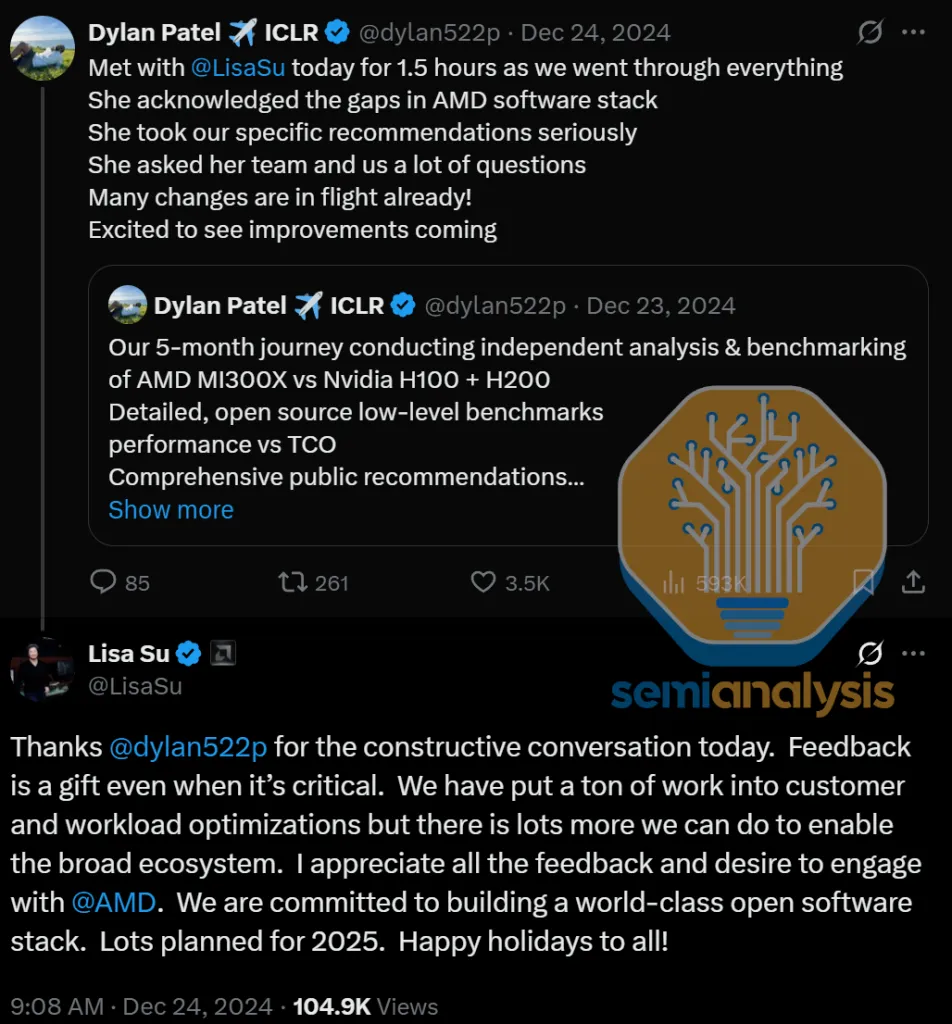
AMD CEO Lisa Su's high praise and positive response

In April 2025, SemiAnalysis released a follow-up report again, stating that "more than 4 months later, AMD has accelerated progress in ROCm, developer relations, CI/CD, etc., and the AMD MI450X is expected to beat NVIDIA," also acknowledging AMD's subsequent improvements, making it a landmark case of "independent research directly influencing major company decisions."

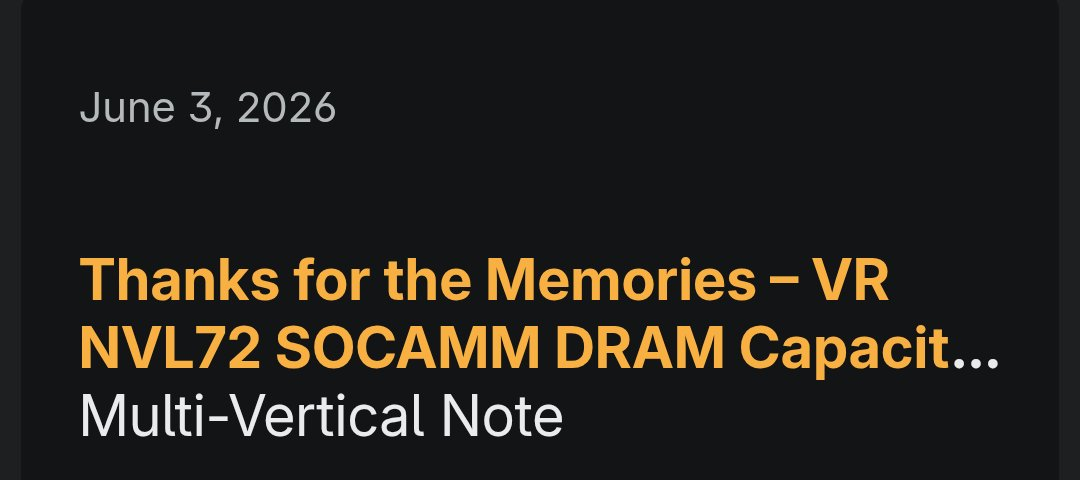
In early June, Citrini analyst Jukan forwarded part of a SemiAnalysis research report, which indicated that "NVIDIA's next-generation AI server cluster Rubin NVL72 made major adjustments to its memory configuration. To cope with tight supply chains and ensure the on-time delivery of Rubin racks, the single-rack capacity was drastically reduced from the original plan of 55TB to 28TB, a reduction of about 50%, using scaled-down 96GB SOCAMM memory modules instead of the previous high-end 192GB modules." Possibly affected by this news, that day, many memory-related stocks, including Micron and SK Hynix, fell under pressure.

In response, Dylan replied: "I love it: when people forward what we say, they often take it out of context. Actually, the original title of our report wasn't this clickbait-style." The image he subsequently posted showed the original report title was "Thanks for the Memories...".
In comparison, SemiAnalysis pays more attention to "technical implementation details," focusing on the real bottlenecks in AI construction (power shortages, supply chain inheritance, inference scaling, NVIDIA ecosystem dynamics, etc.). In optimistic demand judgments, they often embed realistic constraint analysis, making it more suitable for guiding specific investments and industry decisions. For more details on SemiAnalysis, see "From Community 'Hardware Nerd' to AI Circle 'Muddy Waters': How Does SemiAnalysis, With Nearly $100 Million in Annual Revenue, Stir the Semiconductor Market?"

Recommended Reading:

Latent Space Episode 1: Situational Cooking with SemiAnalysis Founder Dylan Patel

Related Questions

QWho is the founder of SemiAnalysis and what unconventional background did he have before starting the company?

AThe founder of SemiAnalysis is Dylan Patel. Before starting the company, he had an unconventional background as a beekeeper in Minnesota and was an active anonymous participant in semiconductor forums and technical communities online.

QWhat pivotal action regarding SemiAnalysis did Dylan Patel's friend Doug suggest, which significantly impacted its growth?

ADylan Patel's friend Doug suggested migrating the SemiAnalysis content channel from a free WordPress blog to a paid subscription model on the Substack platform. This shift was pivotal in allowing Dylan to build his 'personal business system' around the paid channel.

QHow did AMD CEO Lisa Su respond to a critical report by SemiAnalysis about AMD's MI300X GPU?

AAMD CEO Lisa Su personally contacted Dylan Patel shortly after the critical report was published and had a 90-minute call with him to discuss the feedback. She publicly thanked him for the 'constructive feedback,' stating that 'Feedback is a gift even when it's critical.'

QWhat significant impact did a SemiAnalysis report have on the memory chip stock market in June 2025?

AA SemiAnalysis report about NVIDIA potentially using lower-capacity memory modules in its next-generation Rubin NVL72 servers led to share price declines for memory chip companies like Micron and SK Hynix on the day the report's content was circulated.

QWhat are the primary revenue sources for SemiAnalysis as mentioned in the article?

AThe primary revenue sources for SemiAnalysis are hyperscalers (large cloud service providers), semiconductor giants, startups, and institutional subscriptions, models, and consulting services.

Related Reads

STRC Unpegged by 11%, Can Strategy's Perpetual Motion Machine Keep Turning?

STRC, the perpetual preferred stock of MicroStrategy, is experiencing a persistent de-pegging from its target par value of $100, with the discount recently widening to over 11%. This de-anchoring challenges the core design of STRC, which was intended as a stable, income-oriented security operating near $100. As a crucial funding engine for MicroStrategy's Bitcoin acquisition strategy, STRC's price reflects market confidence in the company's entire capital model. The company's "capital flywheel" relies on issuing STRC at or above $100 via an At-the-Market (ATM) program to raise cash for buying Bitcoin, thereby boosting company equity and theoretically supporting STRC's value. A monthly adjustable dividend mechanism was designed to maintain this peg. Despite raising the dividend to 11.5% and increasing payment frequency, the de-pegging persists. Market concerns extend beyond technical factors like leveraged arbitrage unwinding. Analysts point to MicroStrategy's limited cash reserves relative to its ~$1.7 billion annual dividend obligation for preferred shares. While the company counters that its vast Bitcoin holdings could cover decades of payments, this argument hinges on the potential need to sell Bitcoin—a shift from its longstanding "hodl" narrative. The company's recent sale of a small amount of BTC, framed as a test, amplified these liquidity and strategy concerns. If STRC remains discounted, impairing MicroStrategy's ability to raise cheap capital, fears may grow that the company could sell more Bitcoin to meet obligations. This scenario could transform MicroStrategy from a major market buyer into a potential seller, posing significant downside risk for Bitcoin. The re-pegging of STRC is thus a key indicator for the health of MicroStrategy's capital structure and its market impact.

Odaily星球日报7m ago

STRC Unpegged by 11%, Can Strategy's Perpetual Motion Machine Keep Turning?

Odaily星球日报7m ago

Silicon Valley's Most Sought-After New Role Has Emerged

Silicon Valley's New Most Wanted Job: The Rise of the Forward Deployment Engineer The AI industry is witnessing a significant shift. The focus has moved from developing cutting-edge models to deploying them effectively within enterprises. This has made the "Forward Deployment Engineer" (FDE) a critical and highly sought-after role at major firms like OpenAI, Anthropic, and Google. For the past three years, the industry prioritized model scientists. However, companies are now facing a harsh reality: purchasing powerful AI tools does not guarantee productivity gains or organizational change. The biggest hurdle is not the technology itself, but integrating it into complex legacy systems, workflows, and corporate cultures. This includes challenges like data silos, compliance requirements, and internal resistance. The FDE role, pioneered by Palantir Technologies, addresses this "last-mile" problem. FDEs are deployed on-site with clients for extended periods. Their job is to deeply understand the client's specific organizational structure, processes, and pain points, then tailor and implement the AI solution accordingly. They combine skills in technology, project management, and organizational change. A clear signal of this trend emerged in May 2026 when three AI giants made major moves. Anthropic launched a $1.5B joint venture for enterprise deployment. OpenAI formed an independent deployment subsidiary, DeployCo, with over $4B in commitments and acquired a deployment consultancy. Google Cloud's CEO publicly announced a large-scale recruitment drive for FDEs. This shift represents a fundamental change in the software business model: from selling tools to selling guaranteed outcomes. FDEs are the agents of this change, responsible for delivering a working system within the production environment, not just a demo. Real-world cases, such as challenges at Goldman Sachs (compliance barriers) and Target (internal cultural resistance), illustrate that the primary obstacles to AI adoption are organizational, not technical. An FDE's value lies in navigating these human and procedural complexities to facilitate a successful "AI migration." In essence, as core AI technology becomes more accessible and affordable, the true premium is shifting to the human expertise required to understand organizations and drive change—making the FDE role pivotal for the next phase of the AI revolution.

marsbit7m ago

Silicon Valley's Most Sought-After New Role Has Emerged

marsbit7m ago

When the World Cup Collides with Agents: From Web2 to Web3, How Are Wallets Evolving into Agentic Wallets?

World Cup as a Catalyst for Agentic Wallets: From Web2 to Web3 This article explores how the World Cup provides a real-world scenario for observing the evolution of digital wallets from simple asset managers towards "Agentic Wallets"—intelligent, AI-powered interfaces. Using the example of prediction markets like Polymarket, it illustrates how AI Agents can lower the barrier to Web3 interaction. Instead of navigating complex DApps, users can express intent in natural language (e.g., "I think Portugal will win") within platforms like Discord or web pages. The Agent then interprets this intent, finds the relevant market, and seamlessly guides the user through the on-chain transaction via their wallet. The core shift is from wallets as mere "function menus" for signing transactions to "intent interpreters" that understand user goals. The article highlights parallel developments in traditional finance, such as Mastercard's "Agent Pay" and WeChat Pay's AI tests, which focus on granting AI controlled, authorized, and auditable payment capabilities. This underscores a broader trend of AI entering the financial layer. However, the article emphasizes that the primary challenge for Agentic Wallets in Web3 is not automation but establishing clear security boundaries. Unlike traditional systems with chargebacks, on-chain transactions are often irreversible. Therefore, future wallets must ensure users retain ultimate control and comprehension. They need to transparently communicate an Agent's permissions, spending limits, authorized durations, and provide easy ways to pause or revoke access. The World Cup experiments represent early steps toward wallets that are not just applications but ubiquitous, intelligent interfaces that simplify Web3 while keeping users securely in control.

marsbit1h ago

When the World Cup Collides with Agents: From Web2 to Web3, How Are Wallets Evolving into Agentic Wallets?

marsbit1h ago

Options Don't Work in DeFi? Vitalik Might Not Agree

For years, the prevailing view has been that options struggle to gain traction in DeFi due to complexity, fragmented liquidity, and lack of natural demand compared to products like perpetual futures. However, a recent algorithmic stablecoin design proposed by Vitalik Buterin presents a different perspective, using options not as a standalone trading product, but as foundational infrastructure for other financial instruments. In this design, one unit of ETH is split into two components: a "stable" side (P) that retains value up to a specified strike price, and an "upside" side (N) that captures all appreciation above that strike. Combined, they always equal one ETH, eliminating debt, margin, and liquidation risks inherent in typical collateralized debt position (CDP) stablecoins. The stable component essentially mimics the payoff of a covered call option. To function as a stablecoin, this structure requires continuously rolling deep in-the-money calls, which introduces challenges like rollover slippage, predictable transaction flow vulnerable to front-running, and persistent liquidity needs. A core hurdle is finding consistent buyers for the leveraged ETH upside exposure (N). While it offers leverage without funding rates or liquidation, it must compete with simpler alternatives like direct call options or perpetuals. The system's scalability depends on a sustained demand for this specific form of leverage. The author draws parallels to their experience with Rysk, where earlier versions of DeFi options protocols struggled. The breakthrough came with Rysk V12, which aligns incentives: asset holders generate yield by selling covered calls against their holdings, while market makers efficiently acquire the desired option exposure. This demonstrates that options can find product-market fit when embedded as a risk distribution and pricing engine within structured products, stablecoins, or yield-generating assets, rather than marketed as a complex direct trading instrument. Vitalik's proposal reinforces this architectural approach—using fully collateralized, non-custodial, and physically settled options as a fundamental building block. The real opportunity for options in DeFi may lie not in becoming the next perpetual swap, but in powering the next generation of on-chain financial products.

marsbit2h ago

Options Don't Work in DeFi? Vitalik Might Not Agree

marsbit2h ago

Trading

Spot
Futures
活动图片