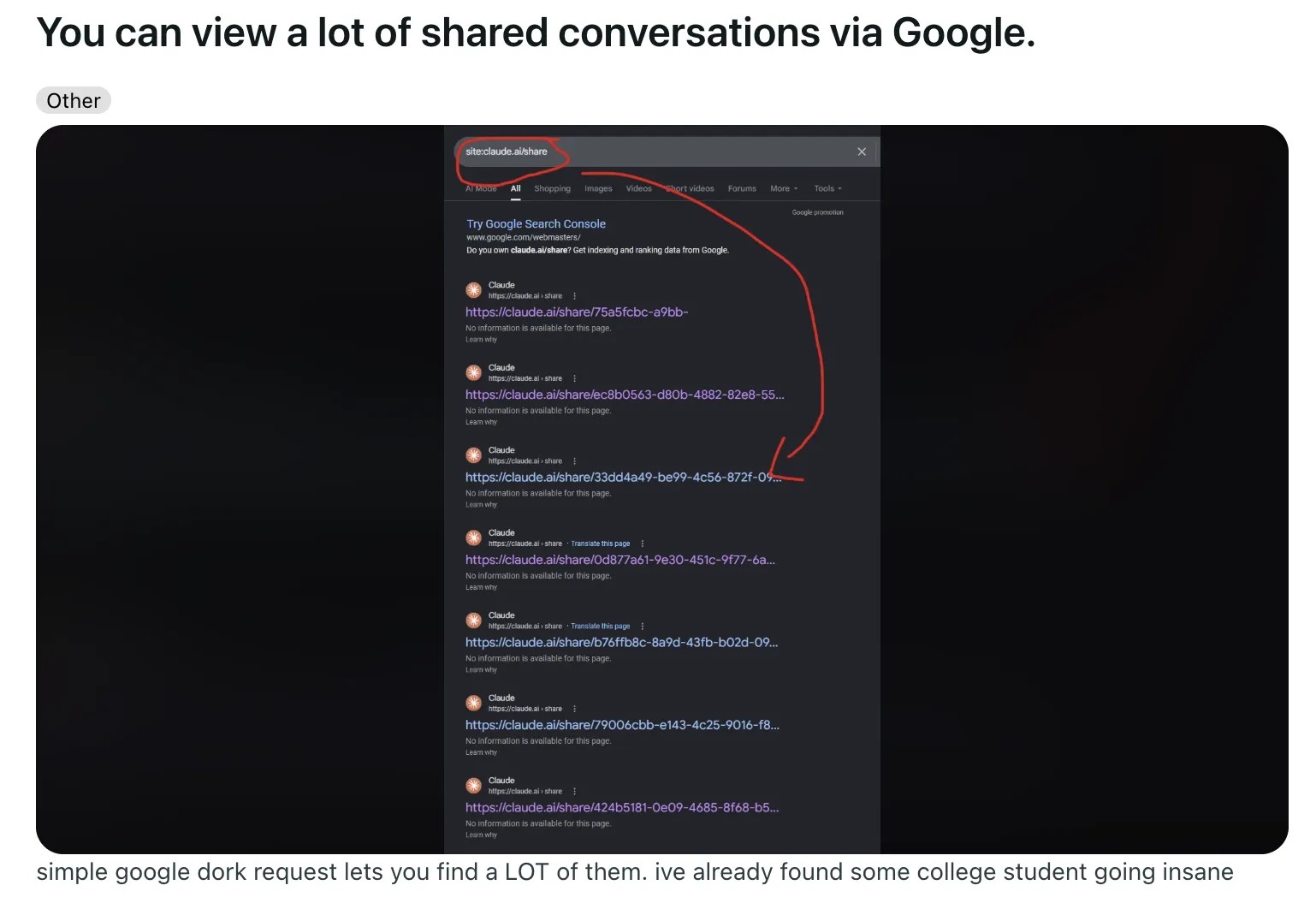
On July 25th, a Reddit user discovered that the search query `site:claude.ai/share` displayed hundreds of other people's conversations with Anthropic's AI assistant Claude in Google search results. Among them were a cryptocurrency wallet seed phrase, API keys, resumes with names and phone numbers, and numbers resembling American Social Security numbers.
Why the Links Ended Up in Google Search
Only those dialogues that users published via the "Share" feature appeared in search. This feature creates a link marked as viewable by anyone with the address. However, the interface did not warn that a search engine could pick up the page.
The Reddit thread garnered about 8000 upvotes. Besides the seed phrase and access keys, the indexed chats contained questions from a lawyer about whether they were obligated to self-report a professional ethics violation, political debates, and erotic texts.
The mechanics of the "Share" function in the chatbot work similarly to "unlisted" videos on YouTube: the link can be shared, but the video cannot be found via search. This is controlled by the `noindex` meta tag, which prohibits search engines from adding the page to their index. Claude lacked this tag, so any published address automatically became a standard indexable page.
At the same time, Anthropic's `robots.txt` file was configured correctly and blocked shared chats from robots. However, this proved insufficient. According to Google's logic, a disallow directive does not prevent indexing if a link to the page is found in open sources. A robot that is denied access also cannot see the internal `noindex` tag. Therefore, some dialogues appeared in search results with a note about the lack of page information—the search engine recorded the address from other publications but did not read the content.
The same problem affected published artifacts—applications, dashboards, and documents that users compile within Claude. The query `site:claude.ai/public/artifacts` revealed salary tables with names, corporate CRM data exports, and unreleased product plans.
By July 26th, Anthropic had added `noindex` and `nofollow` tags. Google began removing the pages from search results. According to Decrypt's observations, Bing also showed links to shared chats.
In a comment to VentureBeat, representatives of the AI developer stated that users independently manage the publication of their dialogues and that Anthropic does not provide search engines with catalogs or sitemaps containing chats. Links cannot be guessed or found unless a person has shared them themselves, the company emphasized.
What Remained in the Public Domain
Some of the conversations have already spread via copies. A repository named `Shared-Claude-Chats` appeared on GitHub, containing an archive of 453 Claude conversations and 519 Grok dialogues—totaling 11,241 text messages. Access can be revoked in Claude's privacy settings. However, this will only prevent further viewing.
A similar incident happened at OpenAI in August 2025. Back then, the "Make this chat searchable" function sent thousands of dialogues to Google, Bing, and DuckDuckGo. The company's Chief Information Security Officer, Dane Stuckey, disabled the option, calling it a "brief experiment." Some of those chats are still available in the Internet Archive.
Earlier, Google indexed user conversations with the DeepSeek AI assistant. The search results contained work documents, financial analysis, and personal correspondence, including in Russian.
Recall that in July of this year, Anthropic mistakenly billed a user on the free Claude tier for $16.6 million.