Hoskinson Says Cardano Just Cleared A Major Binance Hurdle

bitcoinistPublished on 2026-03-13Last updated on 2026-03-13

Abstract

Charles Hoskinson, founder of Cardano, announced a major milestone for the ecosystem: the upcoming Binance spot listing of NIGHT, the native token of the privacy-focused sidechain Midnight. Hoskinson emphasized that this is the first Cardano-native asset to be listed on Binance, which he described as the world's largest altcoin exchange and the center of gravity for liquidity. He framed this development as a breakthrough that removes a significant structural barrier, opening the door for other Cardano assets to access top-tier global liquidity. Beyond market access, Hoskinson connected the listing to broader trends of chain abstraction and compliance, suggesting Midnight's technology could enable privacy-preserving tools essential for scaling tokenized real-world assets. He also presented this achievement as a direct rebuttal to critics who have questioned Cardano's ability to launch large-scale projects and remain relevant in the DeFi space.

Charles Hoskinson says the Cardano ecosystem has crossed a threshold it had struggled to reach for years: a Binance spot listing for a native asset. In a March 11 livestream, the Cardano founder described Binance’s announced support for Midnight’s token NIGHT as a milestone not just for that project, but for the broader effort to bring native assets into tier-one global liquidity.

NIGHT Gets Listed On Binance

Hoskinson framed the development around Midnight, the privacy-focused sidechain project tied to the Cardano ecosystem, whose token had already appeared on Binance Alpha. The bigger breakthrough, in his telling, is the move toward Binance spot. “Binance just tweeted today, Binance is excited to announce the Midnight Holder airdrop,” he said. “Plus, the token is going to be listed on Binance soon. So coming to Binance spot is NIGHT the first Cardano native asset to be listed on Binance. How about that?”

That distinction matters because Hoskinson cast Binance as the center of gravity for altcoin markets. He argued that getting a Cardano-native asset onto the exchange removes a structural barrier that had limited the ecosystem’s reach. “It’s a major milestone for the ecosystem. It’s opened the door for all other Cardano native assets,” he said. “This was a very high bar. It’s the largest market in the world... 80% of all altcoin trading is done here on Binance. It’s the market of markets, the granddaddy of them all.”

In Hoskinson’s telling, the significance goes beyond market access. He tied Midnight’s Binance arrival to a broader thesis around chain abstraction, account abstraction and compliance infrastructure, arguing that Midnight is meant to sit at the intersection of those trends as centralized and decentralized finance draw closer together.“

Traditional finance and DeFi are kind of coming together and Binance has always been on the forefront of that with BNB and what they’ve done with the Binance infrastructure,” he said. “When Midnight comes to this infrastructure and we can do things with this infrastructure, we can talk about reimagining the art of possible compliance and moving into the smart compliance world.”

He then pushed that argument further, saying privacy-preserving compliance tools could be essential if tokenized real-world assets are to scale. “That will open up $10 trillion of real world assets to enter the space above and beyond just making exchanges safer and more efficient,” Hoskinson said, pointing specifically to travel rule compliance and providing information “without revealing the underlying information.”

A rebuttal To Cardano Skeptics

The tone of the stream made clear that Hoskinson sees the Binance milestone as vindication after a long stretch of criticism around Cardano’s relevance in DeFi and its ability to launch large-scale products. He explicitly presented Midnight’s progress as a rebuttal to those narratives.

“There are some people who wrote off Cardano and they said, ‘Cardano can’t launch a billion-dollar project. Cardano can’t get tier one liquidity. Cardano’s days in the DeFi space are over. It’s not relevant anymore,’” he said. “And for us to be able to show them that they’re all wrong — you don’t get too many days like this.”

He compared the moment to earlier ecosystem inflection points, including Coinbase’s ADA listing in 2021 and the more recent arrival of USDCX, suggesting this latest move breaks another long-standing distribution bottleneck for Cardano-linked assets.

At press time, ADA traded at $0.2636.
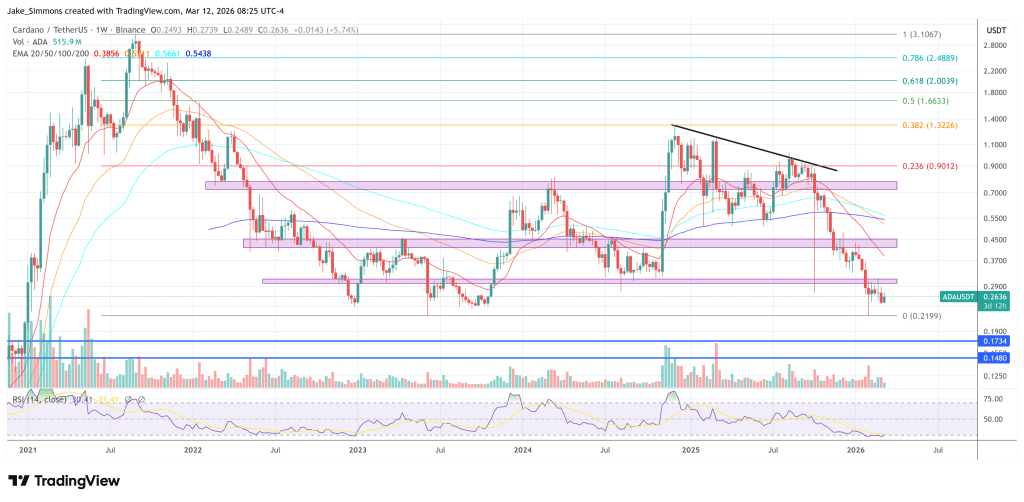
ADA hovers below key resistance, 1-week chart | Source: ADAUSDT on TradingView.com

Related Questions

QWhat major milestone did Charles Hoskinson announce for the Cardano ecosystem regarding Binance?

ACharles Hoskinson announced that Midnight's token (NIGHT) will be listed on Binance spot, making it the first Cardano native asset to achieve a Binance spot listing.

QAccording to Hoskinson, why is Binance's role in altcoin trading significant for Cardano native assets?

AHoskinson stated that Binance is the largest market for altcoin trading, with 80% of all altcoin trading occurring there, making it a critical platform for liquidity and market access.

QHow does Hoskinson connect Midnight's Binance listing to broader trends in finance?

AHe links it to chain abstraction, account abstraction, and compliance infrastructure, suggesting Midnight sits at the intersection where traditional finance and DeFi are converging, enabling advanced privacy-preserving compliance tools.

QWhat does Hoskinson claim the Binance listing rebuts about Cardano?

AIt rebuts criticisms that Cardano cannot launch a billion-dollar project, secure tier-one liquidity, or remain relevant in the DeFi space, demonstrating the ecosystem's capability and growth.

QWhat potential does Hoskinson see for privacy-preserving compliance tools in tokenizing real-world assets?

AHe believes these tools could unlock $10 trillion in real-world assets by enabling compliance (like travel rule) without revealing underlying information, making exchanges safer and more efficient.

Related Reads

Node Count Drops 70%, This Time Solana Is in a Hurry

Solana's validator count has dropped by 70% from its peak of 2,560 in March 2023 to around 756, accompanied by a 35% decrease in its Nakamoto coefficient, indicating increased centralization. This decline is largely due to the phasing out of the Solana Foundation Delegation Program (SFDP), which previously subsidized smaller validators. Many of these validators were economically unviable without support, controlling only 19% of the total stake, while larger nodes held over 80%. In response, Solana is implementing a new validator policy effective May 1, focusing on infrastructure decentralization. The policy imposes limits: no single Autonomous System Number (ASN) can host more than 25% of staked SOL, and no single data center can exceed 15%. It also enforces stricter performance rules, including faster transaction processing and anti-censorship measures, to improve network reliability and security. Critics, like node operator Chainflow, argue that the rules may unfairly penalize competent smaller validators based on their hosting location rather than performance, potentially forcing them into less reliable infrastructure and accelerating their decline. Amid ambitions to become a "Nasdaq on-chain" for global capital markets, Solana trails Ethereum and BNB Chain in real-world asset (RWA) value but leads in user activity. The network's upgrades aim to enhance stability and reduce finality times, competing with Ethereum's efforts to scale and decentralize further. The success of Solana's new policies is crucial for gaining institutional trust and competing effectively in the evolving blockchain landscape.

marsbit36m ago

Node Count Drops 70%, This Time Solana Is in a Hurry

marsbit36m ago

Crypto Bear Market Startup Guide Part 2: The Token Relay Station - Exchanging Crypto Tokens for AI Tokens

"Token Relay Station: A Guide to Starting a Crypto Bear Market Business (Part 2) - Exchanging Crypto Tokens for AI Tokens" This article explores the business opportunity of creating an AI token relay station, a service that acts as an API aggregation layer. It allows users to pay with cryptocurrency (Crypto Tokens) to access credits for various AI models (AI Tokens), bypassing traditional payment barriers. The piece highlights a significant, underserved market: using crypto to directly purchase AI API credits and the potential "reverse export" of cheaper, high-performing Chinese models (like Qwen, Kimi, GLM) to overseas users. It uses OpenRouter, co-founded by OpenSea's ex-CTO Alex Atallah, as a key case study of a successful pivot from crypto to AI infrastructure, noting its support for crypto payments. The analysis reveals market challenges, including widespread fraud where users pay for premium models but receive inferior ones, and unstable supply chains reliant on bulk accounts prone to bans. It outlines three business models: global/developer-focused (OpenRouter), multi-modal/China-focused (APIMart.ai), and hyper-localized operations. Substantial risks are also detailed: high capital requirements for API procurement and infrastructure, the necessity of stable supply channels, complex legal and compliance issues around data resale and cross-border regulations, and the critical importance of user trust. Ultimately, the article posits this as a viable, revenue-generating business model for the crypto bear market, built on real API usage-based income rather than speculative token narratives.

Odaily星球日报1h ago

Crypto Bear Market Startup Guide Part 2: The Token Relay Station - Exchanging Crypto Tokens for AI Tokens

Odaily星球日报1h ago

Trading

Spot
Futures

Hot Articles

Discussions

Welcome to the HTX Community. Here, you can stay informed about the latest platform developments and gain access to professional market insights. Users' opinions on the price of ADA (ADA) are presented below.

活动图片