Tools for Humanity expands World app toward super-app model

cointelegraphPublished on 2025-12-12Last updated on 2025-12-12

Abstract

Tools for Humanity, co-founded by OpenAI CEO Sam Altman, is expanding its World app into a super-app model by adding encrypted messaging, financial services, and third-party mini-apps. The update includes end-to-end encrypted messaging with verified accounts, support for stablecoins like USDC and EURC, and yield products offering up to 18% returns. Users in Argentina can make QR code payments at over a million merchants, and virtual US dollar accounts are available in 18 countries. This move aligns with a broader trend in the U.S., where companies like Elon Musk’s X and Coinbase are also developing super-apps that integrate social, financial, and payment features.

Tools for Humanity is broadening its World platform beyond digital identity and crypto payments, adding encrypted messaging and financial services to its app as part of a push toward a super-app model.

The company, co-founded by OpenAI CEO Sam Altman, introduced an in-app messaging feature with end-to-end encryption that distinguishes between verified and unverified World ID accounts and enables users to send or request digital assets within chats.

According to an announcement, the application now supports third-party mini-apps, including prediction markets, games and financial tools, that run inside conversations. Tools for Humanity said it plans to add optional profile photo verification to help reduce impersonation and misuse.

The changes were released in San Francisco on Thursday by co-founders Altman and Alex Blania.
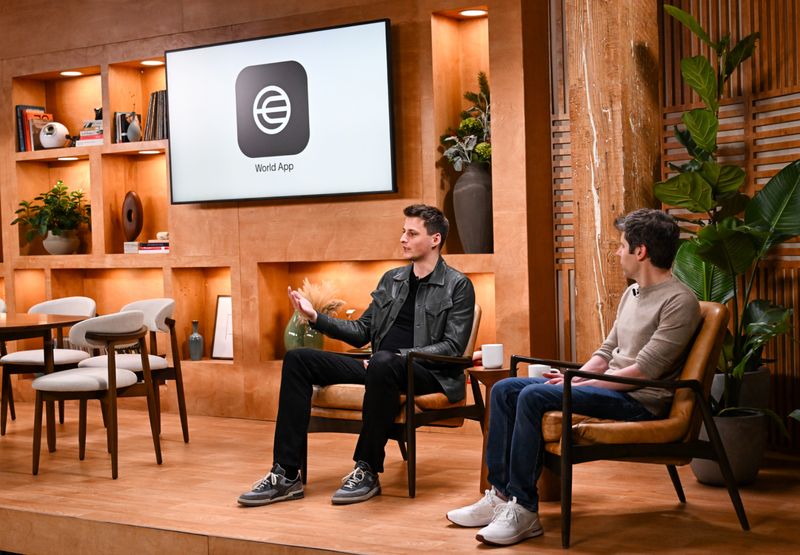
Alex Blania, left, and Sam Altman. Source: Tools for Humanity

World App has also expanded stablecoin support to include USDC (USDC), EURC (EURC) and several Latin American peso-linked tokens. The release introduces yield products offering rates of up to 18% on Worldcoin (WLD) holdings and up to 15% on USDC, powered by the DeFi protocol Morpho, according to the company.

On the payments side, users in Argentina will be able to pay at more than one million merchants using QR codes.

The update also adds US dollar virtual accounts powered by Bridge in 18 countries, including the United States, Japan and several markets across Latin America, allowing users to receive wages, fund accounts from banks and spend USDC inside the app.

Tools for Humanity is a technology company that led the development of World Network and operates World App. World, formerly known as Worldcoin, is the digital identity and financial infrastructure project developed and operated by Tools for Humanity.

Related: Thai regulators raid alleged World iris scanning site, arrest multiple suspects

The evolution of super apps in the US

Tools for Humanity is joining a growing group of companies trying to build super-app ecosystems in Western countries. After buying Twitter in October 2022, Elon Musk posted that “buying Twitter” was the “accelerant to creating X, the everything app.”
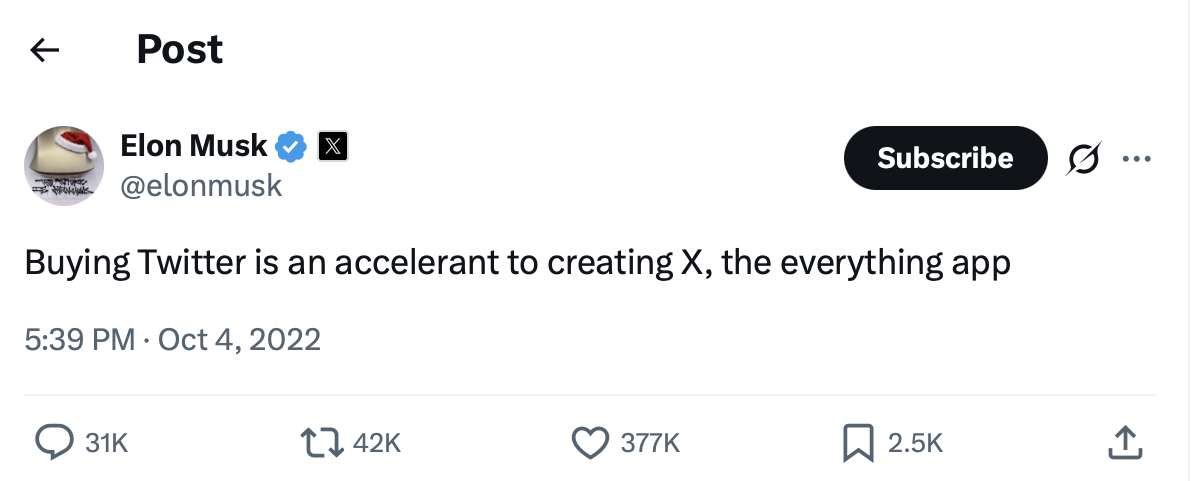
Source: Elon Musk

A super app is a single platform that combines social interaction, payments, commerce and financial services, a model popularized in Asia by services like WeChat. Today, several US companies are expanding crypto, payments and financial tools as they inch toward becoming their own versions of everything apps.

In October, Musk said X has rebuilt its messaging infrastructure into a standalone product called “X Chat,” describing it as a peer-to-peer, encrypted messaging service designed to compete with Telegram and WhatsApp.

Musk, who co-founded OpenAI with Sam Altman in 2015 and has had an ongoing feud with the OpenAI CEO since Musk left the organization in 2018, said in December on the People by WTF podcast that he likes the idea of having a “unified app or website where you can do anything you want” and that he sees China’s WeChat as a model for X.

“There’s no real WeChat outside of China,” he added.

Cryptocurrency exchange Coinbase also signaled a push toward a super app by rebranding Coinbase Wallet as the “Base app,” combining trading, payments, social features, messaging and mini-apps.

In addition, the banking app owned by Walmart OnePay is expected to roll out cryptocurrency trading and custody later this year, beginning with support for Bitcoin (BTC) and Ether (ETH). The app already offers banking, credit, loans and wireless plans and has positioned itself as a US-style super-app.

Magazine: Quantum attacking Bitcoin would be a waste of time: Kevin O’Leary
Related Reads

On the Eve of the Bank of Japan's Interest Rate Hike, Why Did Bitcoin Fall First?

On December 15, Bitcoin fell over 5% to $85,616, while gold remained nearly unchanged. The drop was not due to crypto-specific news but was instead linked to expectations around the Bank of Japan’s (BOJ) upcoming interest rate decision. The BOJ was widely expected to raise rates from 0.5% to 0.75% on December 19—its highest rate in 30 years. This triggered a unwind of the "yen carry trade," a strategy where investors borrow cheap yen to invest in higher-yielding assets like U.S. stocks, bonds, and cryptocurrencies. Higher Japanese interest rates reduce the profitability of this trade, forcing global funds to sell assets—including Bitcoin—to repay yen-denominated loans. Bitcoin, being highly liquid and volatile, is often among the first to be sold. Historically, BOJ rate hikes have correlated with significant Bitcoin declines. For example, after the July 2024 hike, BTC fell 23% in a week. This reaction underscores Bitcoin’s shifting identity: once considered "digital gold," it now behaves more like a high-risk asset correlated with tech stocks. Since the approval of U.S. spot Bitcoin ETFs in early 2024, institutional investors have treated Bitcoin as part of a broader risk-asset portfolio, selling it alongside stocks during market stress. While the BOJ’s decision was largely anticipated, its wording could influence market volatility. If the bank signals further tightening, additional selling pressure may follow. However, some analysts believe the impact may be milder this time due to shifted market positioning and broader global liquidity conditions. In summary, Bitcoin’s decline ahead of the BOJ meeting reflects its increased sensitivity to global macro liquidity shifts. As institutional adoption grows, Bitcoin has become more integrated into traditional finance—gaining legitimacy but losing its earlier immunity to external monetary events.

marsbit4m ago

On the Eve of the Bank of Japan's Interest Rate Hike, Why Did Bitcoin Fall First?

marsbit4m ago

DeFi Trend Shifts: Stablecoin Public Chains Recede, RWA Faces Critical Regulatory Window

Crypto market sentiment is currently bearish, with many traders predicting Bitcoin could fall below $50,000. Attention and capital are shifting toward AI, away from crypto. The author’s strategy has shifted toward holding mostly BTC and ETH, along with a few cash-flow-generating alts like AAVE and LINK, avoiding speculative public chains and L2s. Key topics discussed: - Aave faces governance tension between Aave DAO and Aave Labs, reflecting broader DeFi governance challenges. - Aave V4 introduces improved liquidation mechanisms. - Stablecoin-focused Layer 1 blockchains are struggling to gain market share against established chains like Ethereum and Tron. Their real potential lies in onboarding off-chain users, not competing internally. - RWA and stock tokenization gain momentum after the SEC approved DTCC’s tokenization plan. Ethereum and L2s are seen as compliant options. This development is viewed as a net positive for the sector, including projects like Ondo Finance. - Ondo uses a clever system with its own stablecoin, USDₒ, to enable large on-chain tokenized stock trades without relying on external liquidity. - Ethena’s Season 4 airdrop requires users to deposit and trade on HyENA to qualify, aiming to boost its perps trading platform. - Tempo, developed by Stripe and Paradigm, has launched its testnet, targeting efficient stablecoin payments with major enterprise partners.

比推15m ago

DeFi Trend Shifts: Stablecoin Public Chains Recede, RWA Faces Critical Regulatory Window

比推15m ago

Grayscale's Latest Report: Top 10 Investment Themes for 2026 and the End of the 'Four-Year Cycle'

Grayscale's 2026 Digital Asset Outlook report posits a fundamental shift in the crypto market, moving away from the volatile, retail-driven "four-year cycle" narrative and into an era dominated by institutional capital. The core drivers for 2026 are identified as: 1) rising macro demand for alternative stores of value (e.g., BTC, ETH) due to fiat currency uncertainties, and 2) significantly improved regulatory clarity, including anticipated bipartisan U.S. market structure legislation. The report outlines ten key investment themes for 2026: demand for monetary alternatives; regulatory support; stablecoin expansion post-GENIUS Act; the inflection point for asset tokenization; the need for privacy solutions; blockchain-based answers to AI centralization; DeFi acceleration led by lending; next-gen infrastructure; a focus on sustainable revenue models; and staking becoming a default investment strategy. Grayscale expects a continued institutional bull market, with Bitcoin likely reaching new all-time highs in H1 2026, driven by steady inflows via Exchange-Traded Products (ETPs) rather than speculative retail surges. Two topics are dismissed as "red herrings" for the year: quantum computing's threat and Digital Asset Treasury Companies (DATs). The conclusion emphasizes that the institutional era will widen the gap between assets with clear use cases, compliant access, and sustainable models and those without.

marsbit15m ago

Grayscale's Latest Report: Top 10 Investment Themes for 2026 and the End of the 'Four-Year Cycle'

marsbit15m ago

Trading

Spot
Futures

Hot Articles

Discussions

Welcome to the HTX Community. Here, you can stay informed about the latest platform developments and gain access to professional market insights. Users' opinions on the price of SUPER (SUPER) are presented below.

活动图片