Chainlink and Mastercard Join Swapper Finance To Bring Direct Deposits To 3.5B Users

bitcoinistPublished on 2025-12-10Last updated on 2025-12-10

Abstract

Swapper Finance has launched Direct Deposits in collaboration with Chainlink and Mastercard, aiming to bring global payments directly into the on-chain economy for over 3.5 billion users. This new feature, powered by Chainlink Runtime Environment (CRE) and Mastercard’s global network, allows users to deposit into DeFi protocols using payment cards, crypto transfers, or Web3 wallets through a single, secure, and compliant on-chain workflow. The solution eliminates traditional bottlenecks like multi-step onboarding, KYC, compliance, and settlement by unifying these processes into one verifiable orchestration layer. Chainlink and Mastercard’s involvement highlights the integration of traditional payment infrastructure with blockchain, simplifying user onboarding and expanding access to DeFi. Several leading Web3 platforms have already integrated the technology, signaling strong demand for a unified card-to-onchain standard. Swapper’s CTO described it as a "turning point" for Web3 adoption, making the process intuitive and accessible for billions.

Swapper Finance has launched Direct Deposits in collaboration with Chainlink and Mastercard, aiming to bring global payments directly into the on-chain economy to more than 3.5 billion users worldwide.

Swapper Finance Launches Direct Deposits With Chainlink, Mastercard

On Tuesday, Swapper Finance, a next-generation payments infrastructure layer that connects global users to on-chain applications, announced the launch of Direct Deposits in collaboration with Chainlink, Mastercard, and multiple key partners.

Direct Deposits, which are live now, are set to bring “the global payments world directly into the on-chain economy through a unified, secure, and compliant flow,” powered by Chainlink Runtime Environment (CRE) and Mastercard’s recognized global network.

According to the announcement, users will be able to deposit into Decentralized Finance (DeFi) protocols using payment cards, crypto transfers, or Web3 wallets inside a single, end-to-end on-chain workflow for the first time.

Swapper’s Direct Deposits aim to unlock instant access to DeFi for billions of people worldwide by eliminating traditional bottlenecks, exchanges, and multi-step onboarding. This has historically required stitching together isolated systems, including Know Your Client (KYC) requirements, compliance, card payments, fiat conversion, settlement, and liquidity routing, which has created friction, high drop-off rates, and inconsistent security across the process.

Direct Deposits are set to replace this old-fashioned flow through one “unified, verifiable, on-chain orchestration layer,” with every component of the process executed inside a secure on-chain environment.

Roman Tirone, Senior Manager, Chainlink Build at Chainlink Labs, affirmed that “by unifying identity, compliance, token swaps, settlement, and more in a single orchestration layer, CRE is enabling the onboarding of billions of cardholders into the onchain economy.”

This creates a simple and familiar checkout experience that quickly moves a user from traditional finance to on-chain, supported by institutional-grade security and global reach. Meanwhile, the launch represents another step in Mastercard’s efforts to integrate traditional payment infrastructure with blockchain-based applications, helping it expand its digital asset strategy.

‘The Onboarding Layer For Web3’

Swapper’s launch will see multiple leading Web3 platforms integrate the Direct Deposits technology directly into their user flows, including Pi Squared, Stake.link, KyberSwap, AITECH, NPC, Teneo, BigWater, Rhuna, TrebleSwap, MyStandard, Landwolf, Dolomite, HyperSwap, Turbo, APU, and Radiant Capital, among others.

This signals strong demand for a unified card-to-on-chain standard, the announcement added, which suggests that Direct Deposits “are quickly becoming a foundational component for user acquisition across Web3.”

The launch also represents “deep technical collaboration across Mastercard, Chainlink, Swapper Finance, and key partners” to bring together payment authorization, compliance, execution, and liquidity routing in a single verifiable workflow powered by CRE and Swapper Finance.

Arthur, CTO of Swapper Finance, affirmed that “this is the onboarding layer we always believed the industry needed,” adding that Direct Deposits represent a “turning point” for how people enter the space as “the first truly unified onboarding layer for Web3.”

“Our goal has always been to remove the barriers that keep billions of people from accessing DeFi, and with this launch, that future becomes real,” Arthur stated, concluding that “Direct Deposits represent a turning point for how people enter Web3. For the first time, the process feels intuitive rather than intimidating. We expect this launch to dramatically expand the number of users who can participate in onchain markets.”
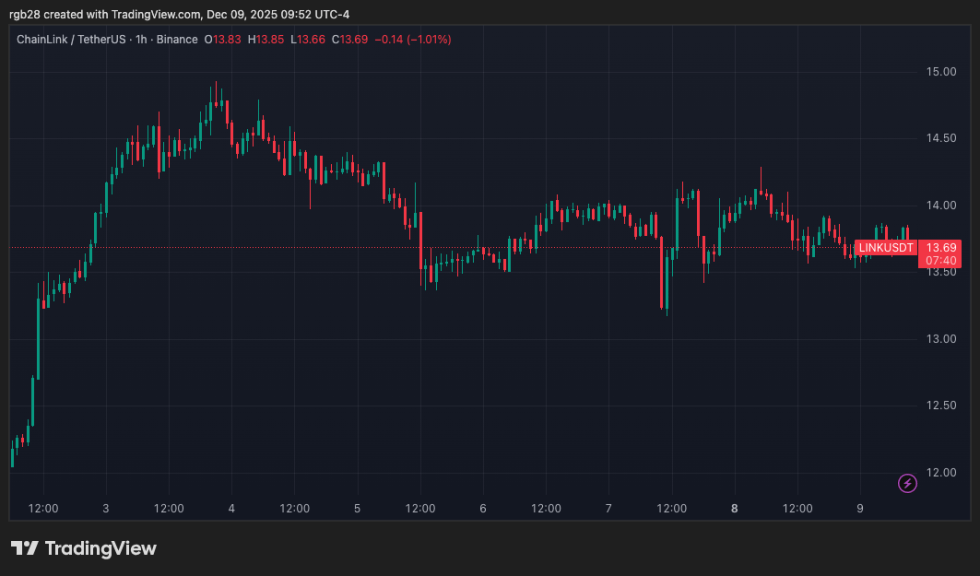
LINK trades at $13.69 in the one-week chart. Source: LINKUSDT on TradingView

Related Reads

From Gatekeeper to Gravedigger: JPMorgan Bets on Physical Precious Metals, Shorts Dollar Credit

JPMorgan Chase, a long-standing guardian of the U.S. dollar-centric financial system, is reportedly shifting its core precious metals trading team to Singapore—a move interpreted as a strategic pivot away from Western dollar hegemony. The bank has reclassified approximately 169 million ounces of silver in COMEX vaults from “deliverable” to “non-deliverable,” effectively locking down nearly 10% of global annual supply. This signals a broader bet on physical metal accumulation and a loss of confidence in paper-based derivatives. The London and New York systems, built on leveraged paper contracts (with claims far exceeding physical metal), are showing strain. Central banks are accelerating gold repatriation, while industrial demand—especially for silver in green technology—is draining physical inventories. Extreme backwardation in silver and extended delivery wait times at the Bank of England suggest a structural rupture between paper markets and physical reality. Meanwhile, Shanghai has emerged as the world’s largest physical gold exchange, emphasizing full physical settlement and rejecting the Western paper-gold model. China’s industrial demand and central bank purchasing are pulling vast metal volumes eastward, reshaping global liquidity and pricing power. Singapore is positioning itself as a neutral hub with tax-free private vaults, attracting Western institutions like JPMorgan seeking a safe, politically acceptable base near Asian demand centers. Yet it remains caught between dollar liquidity and yuan-driven physical trade anchored in Shanghai. JPMorgan’s maneuver reflects a deeper shift: the end of financial alchemy based on unlimited paper leverage and the return to a tangible asset system where physical metal defines value and trust.

比推8m ago

From Gatekeeper to Gravedigger: JPMorgan Bets on Physical Precious Metals, Shorts Dollar Credit

比推8m ago

Trump in Web3 Games: Temporary Hype or Trend?

The article "Trump in Web3 Games: Temporary Hype or Trend?" discusses the growing integration of political brands, particularly Donald Trump’s, into the crypto industry—especially within Web3 gaming. It highlights the recent launch of the 3D game *Trump Billionaires Club*, which features an in-game economy tied to the $TRUMP memecoin and user engagement mechanics. The piece argues that while political and media-driven narratives can generate initial user interest, they often fail to retain players without clear, sustainable incentives. Many gaming tokenomics rely on short-term emotional appeal rather than long-term engagement. In response, projects like PEPENODE are emerging with simplified, routine-based reward systems—such as virtual "mining" nodes—that require no technical knowledge or hardware. PEPENODE, promoted as the "first memecoin mine-to-earn" platform, allows users to buy and upgrade virtual mining nodes to earn rewards, including memecoins like PEPE and Fartcoin. Early data shows significant pre-sale interest, with $2.3 million raised and a token price of $0.001192. The project aims to combine meme-driven engagement with predictable, recurring action—a trend gaining traction as Web3 games seek broader, more consistent user bases beyond one-time hype. The article concludes that while politically themed games attract attention, their long-term success depends on transitioning from viral momentum to habitual use through clear mechanics and recurring value.

bitcoinist32m ago

Trump in Web3 Games: Temporary Hype or Trend?

bitcoinist32m ago

Trading

Spot
Futures
活动图片