The Right Way to Use Skills: 5 Reflections After Anthropic Publicly Shared Its Internal Methodology

marsbitPublished on 2026-06-08Last updated on 2026-06-08

Abstract

A deep dive into Anthropic's internal methodology for building effective AI "Skills" reveals five key insights for maximizing their value. First, Skills should focus on capturing "Gotchas" and tacit organizational knowledge—like common pitfalls and undocumented rules—rather than restating general information the AI already knows. Second, think of Skills as a form of "Context Engineering"; they are best structured as folders, not monolithic documents. A core `SKILL.md` file should act as a navigational index, progressively pulling in detailed references, examples, and assets only as needed to avoid overwhelming the model's context window. Third, whenever possible, automate repetitive tasks with scripts. This preserves the model's reasoning capacity for judgment and analysis, while scripts reliably handle the execution, saving tokens and improving accuracy. Instructions within a Skill provide the "why" and the expert judgment, while scripts provide the concrete "how." Fourth, a Skill's description is critical and often misunderstood. It should not be a list of features but a routing rule that clearly signals *when* the Skill should be triggered based on user intent and common phrasing. Finally, as Skills scale from personal tools to team-wide assets, management is crucial. Anthropic advocates for a lightweight, organic approach: let new Skills spread organically within small groups first. Those that prove genuinely useful through adoption naturally graduate to a formal marke...

Author: AI Product Aying

I read a blog post by the Anthropic team titled "Lessons from building Claude Code: How we use skills." This is probably the most in-depth practical summary I've seen about Skills so far.

Skills aren't that complicated, but doing them well isn't that easy either.

I remember when Skills first became popular, everyone loved making all kinds of writing style Skills, composition Skills. It seemed like as long as you stuffed your writing style into it, the model could consistently output in that style.

But later, after trying a bunch myself, I found it often just didn't work.

Because a writing style Skill might stuff in thousands or even tens of thousands of words. Once the Skill loads, it eats up a big chunk of the context. When the context gets heavy, the model's reasoning ability actually tends to drop.

You often end up with this situation: the style is learned, but the content becomes shallow, and the analytical ability weakens.

There's another common scenario.

When many people write Skills, they love stuffing them with various operation instructions. Step one do this, step two do that, step three do this. When you run it, you'll find the model's execution isn't stable.

Later I slowly understood that a lot of this repetitive execution work is actually more suitable to be solidified into a Script, rather than written as long Instructions.

After reading this Anthropic article, my biggest takeaway is that many people are actually using Skills, but they might not truly understand Skills.

Skill is essentially about Context Engineering. There's a lot of experience involved in deciding when knowledge should go into a Skill, when it should be split into References, when it should be written as a Script, and when Gotchas should be used to constrain the model.

After understanding how Skills work, looking back at those excellent Skills, you'll find they're never solving prompt problems; they're solving problems related to context, experience accumulation, and capability reuse.

If you want to deeply research Skills, I highly recommend reading two articles:

https://claude.com/blog/lessons-from-building-claude-code-how-we-use-skills

https://research.perplexity.ai/articles/designing-refining-and-maintaining-agent-skills-at-perplexity

#01 Don't Write Nonsense

Skills are essentially about accumulating "tacit knowledge" within an organization. So, don't repeat common sense the model already knows in a Skill. What's truly valuable is the information the model fundamentally doesn't know.

Anthropic internally often emphasizes that what Skills really need to document are the Gotchas, the common pitfalls.

For example:

1. This table cannot be sorted by `created_at`

2. Staging returning 200 doesn't mean success

3. `request_id` and `trace_id` are the same thing

Because this kind of information often exists in employees' experience. So you must remember what a Skill essentially is.

Skill = Writing down the experienced master's knowledge.

Through Skills, you accumulate the experience originally scattered in different people's minds.

#02 Skill is Actually Context Engineering

This might be one of Anthropic's most profound points.

A Skill is not a markdown file; it's a folder. For people who have used Skills, this sounds like stating the obvious.

But I've been mulling it over these past few days and slowly realized: they precisely want to use the folder form to express the concept of Context Engineering.

Let's look again at a typical Skill structure:

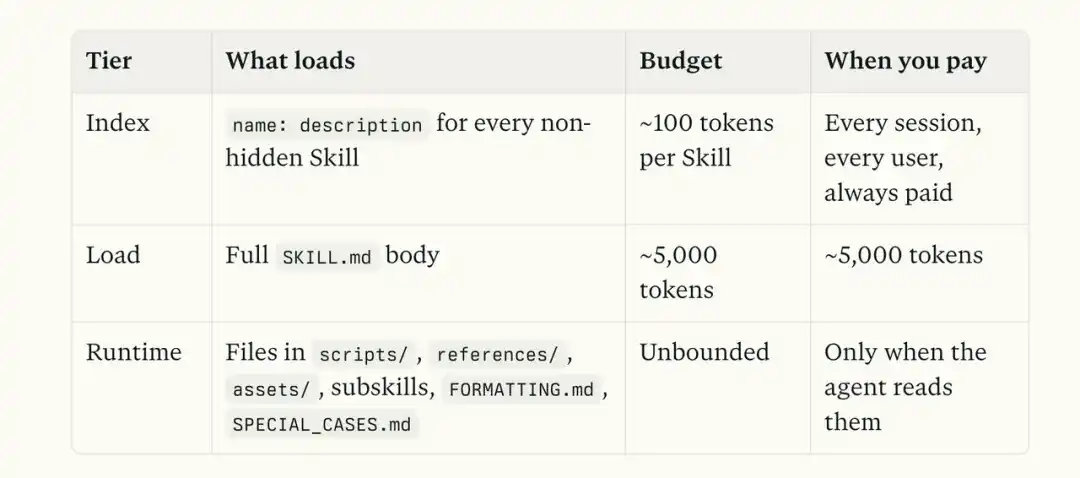
skill/ ├── SKILL.md ├── references/ - place detailed instructions, API references, edge cases ├── scripts/ - place executable scripts ├── examples/ - place examples ├── assets/ - place templates, images, fixed materials

When a Skill is invoked, the model first reads SKILL.md. If we cram all information into this file, context will explode very quickly.

Assume this is a payment troubleshooting Skill, containing Stripe error code explanations, historical failure cases, troubleshooting scripts, and final report templates.

If all this content is piled into SKILL.md, every time the Skill is invoked, Claude has to read it all again.

Even if the user just wants to confirm the meaning of one error code, even if they just want to check why a payment status hasn't updated. A large amount of completely unnecessary information also gets shoved into the context.

Anthropic's approach is completely different.

SKILL.md is more like a navigation page. Its job is to tell the model, when encountering a Stripe error, go to `references` to find the corresponding explanation.

When needing to reference historical cases, go to `examples` to check similar issues; when needing to actually execute troubleshooting actions, run the script in `scripts`; finally, when generating the troubleshooting report, use the template in `assets`.

The whole process is a gradual exposure.

I strongly suggest you save the image below.
#03 Use Scripts Whenever Possible

Don't let the model waste its limited context and reasoning power on repetitive labor. Hand these tasks over to scripts.

For example. When many people write Skills, they write like this:

1. Query registration data; 2. Query payment data; 3. Calculate conversion rate; 4. Analyze root causes.

This way of writing is fine, of course. The model can complete it. But every time it executes, it has to run through the entire analysis process from the beginning.

Querying data, organizing data, handling various edge cases — this work is all repetitive.

Since these capabilities have been verified countless times. Why make the model reinvent it each time? Just provide the concrete scripts directly.

And through scripts, Skill execution becomes more accurate and also saves tokens.

From this perspective, the Scripts in a Skill are actually solidifying organizational capability. Behind each script is often the best practice summarized by the team after countless past pitfalls.

After solidifying these capabilities, Claude can work based on this accumulated experience every time, instead of starting from scratch again and again.

So I increasingly feel that within a Skill, Instructions and Scripts solve problems at two different levels.

Instructions provide experience and judgment; Scripts provide capability and execution.

For example, a payment troubleshooting Skill might have this line:

If Stripe returns 200, don't assume payment success directly; you need to further check the `payment_events` table.

This belongs to Instructions. Because it's experience. Whereas `check_payment_events()` belongs to Script, because it's execution capability.

If you only have the Script, the model knows *how* to check, but may not know *why* to check.

If you only have Instructions, the model knows it *should* check. But has to re-implement it every time. Both are indispensable.

#04 Description is More Like a Routing Rule

The way many people write Skill Descriptions is inherently wrong.

Because people are used to writing them as feature introductions. For example: PR Management Skill helps users monitor PR status, handle CI issues, automatically complete Merges.

But the problem is, the model doesn't find Skills by their functionality. When Claude Code starts up, it first scans the names and Descriptions of all Skills.

Then, based on the user's current question, it decides which Skill should be loaded.

So the most important information in the Description is not what this Skill can *do*, but under what circumstances it *should* be loaded.

The Description actually handles the routing work for the entire Skill.

In the real world, few people say "help me invoke a PR management tool." People are more likely to say: "help me keep an eye on this PR," "the CI is down again," and so on.

So a good Description should try to describe the user's *intent*, not list features.

I even think you can use a very simple method to check.

After writing the Description, delete the entire Skill, keeping only this one line Description. Then ask yourself: after the model sees the user's question, can it know when to load this Skill?

If it can't, you probably need to keep revising.

#05 Skill Management and Distribution

Another point is about Skill management.

When one person uses Skills, it's pretty simple. Write a few Skills yourself, maintain them yourself, upgrade them yourself. But I believe most teams will eventually face the same problem.

When Skills grow from a few to dozens, or even hundreds, how should these Skills be managed? How should they be upgraded? How should they be distributed to team members?

I think Anthropic's experience in this area is quite worth referencing.

When the team size is relatively small, Skills can travel directly with the code repository. Just put them in the project's .claude/skills directory. Everyone shares the same set of Skills and the same working methods.

But as the number of Skills increases, a new problem appears.

When Claude Code starts up, it scans the names and Descriptions of all Skills, then decides which Skill should be invoked for the current task. The more Skills there are, the higher the routing cost.

This is also why Anthropic later started making a Marketplace. But what's even more interesting is how they manage the Marketplace.

When many companies encounter this problem, their first reaction is often to establish an approval process. Whoever writes a Skill submits an application first; after approval, it enters the official Skill library. We did this internally before too, but it's very heavy. Managing for the sake of management.

I found Anthropic's organization is very lightweight.

Let new Skills spread in a small scope first; let colleagues install and try them themselves.

If more and more people start using it, it shows this Skill truly solves a real problem. At this stage, the author can then submit it to the formal Marketplace.

So they don't first debate whether a Skill is valuable; they first let it be tested in real usage scenarios. If many people use it, it naturally enters the formal system. The Skills that remain this way are basically the ones the team truly needs.


Related Questions

QAccording to the article, what is the fundamental purpose of a Skill in AI systems like Claude?

AThe fundamental purpose of a Skill is to be a form of Context Engineering. It aims to capture and codify the 'tacit knowledge' or 'experienced master's knowledge' within an organization, such as gotchas, common pitfalls, and specific operational insights that the AI model wouldn't inherently know. It's about solving problems related to context, experience accumulation, and capability reuse, rather than just being a lengthy prompt or instruction set.

QBased on Anthropic's methodology, what is the key structural concept for organizing a Skill to avoid context overload?

AThe key structural concept is to treat a Skill not as a single markdown file, but as a folder with organized subdirectories. A typical Skill folder includes `SKILL.md` (acting as a navigation page), `references/` for detailed documentation, `scripts/` for executable scripts, `examples/` for case studies, and `assets/` for templates. This structure allows for progressive exposure of information, where only the necessary components are loaded into the context as needed, preventing 'context explosion' and preserving the model's reasoning capabilities.

QWhat is the recommended distinction between 'Instructions' and 'Scripts' within a Skill, and why is it important?

AInstructions and Scripts solve problems at different levels. Instructions provide 'experience and judgment'—they tell the AI *what* to do and *why*, based on accumulated knowledge (e.g., 'If Stripe returns 200, don't assume success; check the payment_events table'). Scripts provide 'capability and execution'—they are concrete, reusable pieces of code that perform repetitive tasks (e.g., a `check_payment_events()` function). This distinction is important because scripts prevent the model from wasting context and reasoning power on re-implementing verified actions, making execution more accurate and token-efficient, while instructions ensure the model applies the correct logic and understanding.

QWhat is the primary function of a Skill's Description, and what common mistake do people make when writing it?

AThe primary function of a Skill's Description is to act as a routing rule. It should clearly indicate *when* the Skill should be loaded based on the user's intent or the problem context, not just list the Skill's features. The common mistake is writing it as a feature introduction (e.g., 'This Skill helps monitor PR status...'). Instead, it should describe user intent (e.g., phrases users might say like 'help me watch this PR' or 'the CI is broken again') so the AI can accurately decide which Skill to invoke for a given query.

QHow does Anthropic manage the distribution and evolution of Skills within a team as their number grows, according to the article?

AAnthropic employs a lightweight, usage-driven approach. Initially, Skills are shared within a project's `.claude/skills` directory. For broader distribution and management (like in a Marketplace), they avoid heavy approval processes. Instead, new Skills are first shared informally among colleagues for installation and trial. If a Skill gains organic adoption and proves useful by solving a real problem for many users, the author can then submit it to the official Marketplace. This method ensures that only genuinely valuable and tested Skills become part of the formal system.

Related Reads

IOSG: From Hot Storage to Cold Memory – Decentralized Storage in the AI Era's Storage Boom

This article explores the stark contrast between the booming AI storage sector and the currently undervalued decentralized storage market. It argues their core value propositions differ fundamentally: AI storage is a "hot data efficiency" system designed to maximize computational throughput, GPU utilization, and business monetization by accelerating data flow into processors. In contrast, decentralized storage represents a "cold data trust" system, prioritizing data immutability, censorship resistance, and the preservation of long-term human memory. The analysis details the multi-layered AI storage architecture, from high-bandwidth memory (HBM) and enterprise SSDs for high-performance needs to data lakes for capacity. It highlights how AI has repositioned storage from a cost center to a critical efficiency engine. Decentralized storage, exemplified by Filecoin and Arweave, is examined for its distinct philosophies and current challenges, including product-market fit, retrieval latency, and enterprise adoption hurdles. Despite its current quiet phase, the article posits that decentralized storage holds unique future value for AI data provenance, public dataset archiving, compliance, and safeguarding civilizational records against censorship. The conclusion suggests that while the market currently rewards efficiency, the need for trusted, permanent data layers may eventually lead to a revaluation of decentralized storage's role.

marsbit4m ago

IOSG: From Hot Storage to Cold Memory – Decentralized Storage in the AI Era's Storage Boom

marsbit4m ago

Exploring ChangXin Technology's Hefei Headquarters: The Rising Campus Ignites Changgang CBD, Grassroots Employees 'Witness' Wealth Creation Myth

"On-the-Ground Visit to CXMT's Hefei Headquarters: Campus Boom Ignites Changgang 'CBD,' While Rank-and-File Employees Watch Wealth Creation Myth from the Sidelines." Following CXMT's (ChangXin Memory Technologies Inc., 688825.SH) explosive stock market debut on July 27, where its share price surged over fivefold, a site visit to its Hefei headquarters reveals a stark contrast. While the company's市值 soared, making it A-share's most valuable firm,基层员工 indicate the wealth creation has largely bypassed them. Employees reveal that股权激励 is restricted to managerial levels (Grade 9科长 and above), with most普通员工 at Grades 11 or 12. Salaries, while considered high for Hefei at around 200,000 RMB annually, fall short of the millions speculated online. Work routines remain demanding, with long hours, phone confiscation in sensitive areas, and strict保密 protocols forbidding unauthorized external communication. Simultaneously, CXMT's expansion is visibly transforming the once-rural Changgang area. Ongoing construction includes multiple new phases, with an industrial chain of supporting companies集聚 around the campus. This growth has spurred local development: housing prices initially skyrocketed, and a vibrant commercial district dubbed "Changgang CBD" now thrives, catering to the潮汐效应 of shift workers. The area has evolved from construction sites to a bustling hub, though the company's stringent安保, including high-voltage perimeter fencing, underscores its sensitive nature. The report concludes that while CXMT's rise fuels regional economic activity, the immediate financial rewards of its上市 are not shared by its frontline workforce.

marsbit5m ago

Exploring ChangXin Technology's Hefei Headquarters: The Rising Campus Ignites Changgang CBD, Grassroots Employees 'Witness' Wealth Creation Myth

marsbit5m ago

Huang Xiaoming, Li Bin, Lei Jun, Liang Wenfeng... Changxin IPO Feast, Who's the Biggest Winner?

Changxin Technology's IPO on the Shanghai STAR Market created significant wealth for its stakeholders. Founder Zhu Yiming and his family saw their wealth surge nearly 300%, with his stake in Changxin alone valued at approximately 80 billion RMB. Over 6700 employees benefited, creating at least 237 new millionaires. Several prominent figures also profited. Liang Wenfeng, founder of Deepseek, saw a paper gain of 827 million RMB through his funds' participation. Kong Jianping, founder of Nano Labs, holds an indirect stake worth around 940 million RMB, representing a roughly 44x return on his 2020 investment. Former Midea executive Huang Xiaoming gained approximately 503 million RMB. Strategic investors included industry partners. Nio, represented by founder William Li, pledged 158 million RMB for shares now showing a paper gain of about 740 million RMB. Similarly, a Xiaomi subsidiary acquired shares resulting in an over 736 million RMB gain, though the company clarified this is a corporate investment, not directly attributable to founder Lei Jun's personal wealth. Founder Zhu Yiming further plans to donate shares worth over 37.6 billion RMB for future employee incentives. The IPO solidified Changxin's position as a leading domestic memory chip maker, triggering a widespread wealth creation event for its network of founders, employees, and investors.

Odaily星球日报20m ago

Huang Xiaoming, Li Bin, Lei Jun, Liang Wenfeng... Changxin IPO Feast, Who's the Biggest Winner?

Odaily星球日报20m ago

Aave's Stable Vault

This article explores Aave's recently launched "Stable Vaults," a product designed to bridge the gap between traditional finance users and DeFi yield. It argues that while DeFi offers transparency and potentially higher returns, its complexity and volatility are major barriers for mainstream adoption. The core problem is that users pay for convenience and simplicity, often accepting lower returns to avoid decision-making and technical hurdles. Stable Vaults allow fintech apps, neobanks, or payment platforms (operators) to integrate with Aave's lending markets once and offer their users a "savings account" with a fixed, predictable yield (e.g., 4%). The operator absorbs the underlying market volatility; if Aave's pool pays 6%, the operator pockets the 2% difference, but if it pays only 2%, the operator covers the shortfall to maintain the promised 4% for users. The piece analyzes this model from three perspectives: 1. **The User:** Gains simplicity, a fixed rate, and familiar app features (customer support, account recovery). However, they lose potential upside, accept a lower fixed yield, and take on new counterparty risks from the operator and its proprietary backend systems. 2. **The Operator (e.g., a neobank):** Can monetize idle user balances easily, generating significant fee income (the spread between the fixed rate and the actual yield) with minimal integration effort, turning a cost center into revenue. 3. **Aave:** Gains "sticky," loyalty-based deposits that are less likely to flee during minor yield fluctuations, securing a stable revenue stream crucial for its tokenomics (like buybacks). It becomes a back-end infrastructure provider for the broader consumer finance ecosystem. The author acknowledges that while sophisticated users can access higher yields directly on Aave, most people prefer convenience and security over optimization. They reference behavioral studies showing that too many choices lead to inaction. Therefore, Stable Vaults represent an acceptance of human nature—prioritizing safety, predictability, and ease—and a strategic move for Aave to capture stable, large-scale deposits from mainstream finance applications. Examples like Rise (payroll) and Kraken are already using similar embedded yield models.

marsbit25m ago

Aave's Stable Vault

marsbit25m ago

Trading

Spot
活动图片