December 10: BTC, ETH, SOL, MERL, ZEC Market Analysis

金色财经Published on 2025-12-10Last updated on 2025-12-10

Abstract

On December 10, Bitcoin (BTC) experienced a sharp rally during U.S. trading hours, reaching a high of $94,640 before pulling back to around $92,000. Continued Coinbase premium suggests strong institutional accumulation. Analysts note that retail sentiment remains weak and may only recover if BTC reclaims $100,000. Technically, BTC has broken out of a descending trendline on the daily chart with increasing volume. A retest of support levels around $92,000 or $90,540 could offer long opportunities, with a break below $90,540 invalidating the bullish structure. Key resistance lies near $98,000. Ethereum (ETH) shows stronger momentum with four consecutive bullish daily closes, breaking above $3,260. However, the 4-hour chart suggests a pullback may be due. Resistance is seen at $3,380 and $3,480, while supports are at $3,230, $3,150, and $3,060. Solana (SOL) has been relatively weak, struggling to break $147. A decisive move above $147.50 could open the path toward $154–$158, provided it holds above $138.85. Both long and short opportunities are possible around key levels. MERL remains in a clear downtrend, with repeated rejections near $0.50. The critical level to watch is $0.20, which aligns with project cost bases and retail psychological support. A break below could trigger further declines. ZEC is showing signs of a potential short-term correction with a 1-hour rising wedge and M-top pattern. Long positions are advised to take profit around $440 levels due to emerging b...

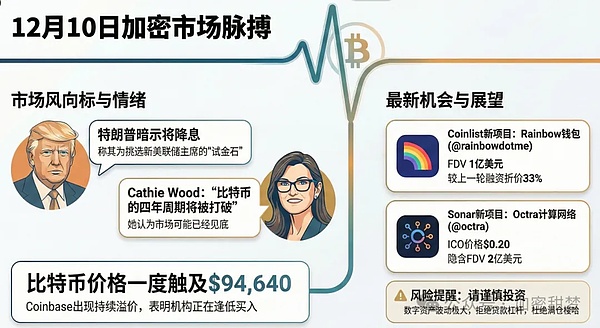
Bitcoin suddenly surged during U.S. stock market hours last night, reaching a high of $94,640, before being pushed back down to around $92,000. The persistent premium effect on Coinbase has reappeared, indicating that institutions are aggressively buying the dip.

Recently, figures like Cathie Wood and CZ have stated that the four-year cycle has ended. Currently, mainstream institutional confidence is significantly boosted, but retail investor confidence remains weak. The only way to restore retail confidence is through a price surge, pushing Bitcoin back above $100,000. At that point, retail investors will likely become frenzied again.
BTC

From a daily chart perspective, BTC has broken through the upward trend line on high volume, forming a pattern that suggests a decline is over. Pullbacks can be used to go long again. The MACD indicator is about to cross above the zero axis, indicating potential for further rebound. The high-volume surge shows increased buying power; short sellers should be more cautious. The nearest resistance is around $98,000.

The four-hour breakout is complete. After the breakout, the two key levels for a pullback are the middle band of the ascending channel and the previous resistance-turned-support level (both are marked on the chart).

Two key levels: $92,000 and $90,540. If it breaks below the key level of $90,540, avoid going long in the short term. Both of these levels are suitable for light long positions, with a stop-loss if the level is broken.

ETH

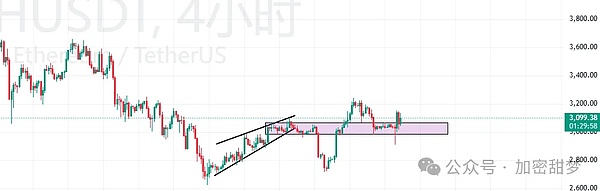
Ethereum's daily chart is even stronger, showing four consecutive bullish candles and breaking through $3,260. The current price is around $3,320, near the upper Bollinger Band. On the four-hour chart, it surged and then pulled back, indicating a need for a correction.

The intraday strategy remains focused on shorting at highs. If you missed the long trade, avoid chasing the pump at high levels. Key resistance levels to watch for shorting are around $3,380 and $3,480. If a pullback occurs, focus on these levels for short positions.

Support levels below are at $3,230, $3,150, and $3,060. A break below $3,000 would open the door to further declines towards $2,900, $2,820, $2,730, and even $2,620.
SOL

SOL has been relatively weak for a while, failing to break above $147. Previously, SOL tended to pivot before BTC, but this time ETH was the first to break through key resistance. It's likely that SOL will follow suit and attempt a breakout tonight. If it can break above $147.5 and maintain a pullback above $141.85-$138.85 (i.e., holding above $138), it could potentially test $154-$158 in the coming days.

On the three-day chart, SOL's rebound hasn't fully materialized yet. A push upward tonight could trigger it. However, it will still pull back upon reaching resistance. Going long at lows can be profitable, and shorting at highs is also viable—just know when to take profits on the pullback before potentially flipping long again.

$MERL

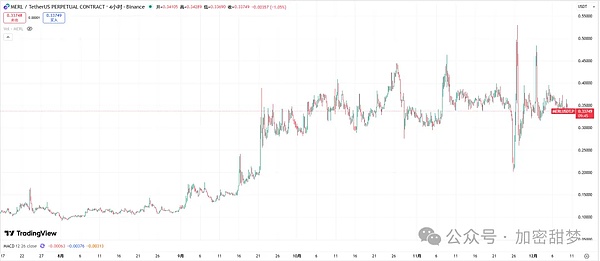
MERL has tested the $0.50 level three times in the past month, each time getting rejected hard. The pump volume might look impressive, but it's largely artificial—buying pressure simply isn't sustaining. The highs are getting lower, and the bounces are becoming weaker, clearly indicating a bearish structure.

I'm closely watching the $0.20 level for three main reasons:

1. The project team's cost basis is roughly in the $0.18-$0.22 range. They typically won't just sit idle if the price drops here.

2. This is also a psychological support level for retail investors. Holding here might provide some breathing room; breaking it could trigger panic selling.

3. It's a critical trend level: holding here would suggest bearish momentum is waning, while breaking it could lead to a free fall with ample downside.

So, don’t rush to buy the dip now, and don’t expect any sudden independent rally. MERL's bearish trend remains intact. Avoid taking long positions before $0.20. Wait until it approaches $0.20 to see if it continues to drop or shows signs of a bounce—the price action will give the signal. Hold cash, trade with the trend, don’t fight it.
ZEC

It's time to take profits and close all long positions. The 1-hour chart shows a rising wedge pattern and a potential double top, suggesting a short-term correction is likely. Additionally, there's a bearish divergence. Considering profit protection, it's advisable to close all long trades. The profit is already substantial—our entry was at $359, and the current price is $440. Don’t get greedy for the last bit.

If you find our content valuable, please share our public account with your friends! Welcome to follow and stay updated with the latest crypto news! Every major crash is followed by vast opportunities. If you're feeling lost about future market strategies, follow Tianmeng. Contact on WeChat: RFGH8689


Related Questions

QWhat is the current technical outlook for Bitcoin (BTC) according to the analysis?

ABitcoin has broken out of a downtrend with a surge to $94,640, showing strong institutional buying. The daily chart indicates a breakout above the trendline, with a potential for further upside as MACD is about to cross above zero. Key support levels for long positions are at $92,000 and $90,540, with resistance near $98,000.

QWhat is the recommended trading strategy for Ethereum (ETH) based on the article?

AThe strategy for Ethereum is to avoid chasing the pump and instead focus on shorting at higher levels. Key resistance levels for short positions are at $3,380 and $3,480. Support levels to watch are $3,230, $3,150, and $3,060, with a break below $3,000 potentially leading to further declines.

QWhat key level must Solana (SOL) break to indicate a potential upward move?

ASolana needs to break above $147.5 to indicate a potential upward move. If it breaks and holds above $138.85-$141.85, it could target $154-$158 in the following days.

QWhy is the $0.20 level critical for MERL according to the analysis?

AThe $0.20 level is critical for MERL because it represents the project team's cost area (around $0.18-$0.22), acts as a psychological support level for retail traders, and serves as a key trend determinant. A break below could lead to panic selling, while holding might indicate weakening selling pressure.

QWhat is the suggested action for ZEC holders based on the current market signals?

AThe analysis recommends taking profits on all long positions for ZEC, as the 1-hour chart shows a rising wedge pattern, a potential M-top, and a bearish divergence, indicating a likely short-term correction.

Related Reads

Understanding the New Economic Model of Tokenization

Understanding the New Token Economics Model The commercialization of AI applications is evolving from selling software and subscriptions to selling token call capacity. Tokens, the fundamental unit of information processing for large language models (LLMs), have become the basis for API billing and consumption. With call volumes exploding, tokens themselves are now being traded—procured, routed, split, and resold—forming a new intermediary market. This layer connects upstream LLM providers with downstream developers and enterprises, acting as a global wholesale-to-retail liquidity network. The rise of this business is fueled by a massive surge in China's daily token call volume—growing over a thousandfold from 100 billion in early 2024 to over 140 trillion by March 2026—and significant improvements in domestic LLM capabilities, which are now competitive globally. The core value of token distribution platforms extends beyond simple arbitrage. Key functions include aggregating multiple models (like GPT, Claude, and domestic models such as Kimi and DeepSeek) under a unified API, lowering network and payment barriers, and providing enterprise services like model selection, prompt engineering, and system integration. Profit models are diversifying: (1) resale margins; (2) technical premiums from proprietary inference acceleration (e.g., reducing costs to 1/10 of the industry standard); and (3) enterprise value-added services. High-consumption scenarios like marketing, short-form video, gaming, and e-commerce are primary drivers. Investment opportunities are seen in both companies with strong model capabilities (e.g., Alibaba, Tencent, MiniMax) and those with high-consumption client scenarios (e.g., marketing agencies with overseas reach). However, risks are significant: low entry barriers leading to intense competition, capital requirements and bad debt risks from advance payments, and dependency on policy changes from upstream LLM providers who control API pricing and access.

marsbit40m ago

Understanding the New Economic Model of Tokenization

marsbit40m ago

Farewell to the Copper Era: Understanding the Logic of the AI Silicon Photonics Industry Chain and Key US Stock Players

**Summary: The Era of Silicon Photonics and Key AI Infrastructure Stocks** The article delves into the transition from copper-based interconnects to silicon photonics (SiPh) as a critical enabler for next-generation AI data centers. It explains that copper faces fundamental physical limits—the bandwidth wall, density wall, and power wall—at high data rates (1.6T+), making a material shift essential. Silicon photonics, which integrates components like lasers, modulators, and detectors onto a silicon chip, offers a solution by leveraging mature CMOS manufacturing for cost-effective, high-volume production. A key challenge is that silicon itself is not an efficient light source, making Indium Phosphide (InP) lasers a critical and supply-constrained component. A major industry catalyst was NVIDIA's 2025 GTC announcement, declaring optical interconnects a "standard" from its Rubin platform onward, followed by strategic investments to secure the supply chain. The industry is structured in four key layers: 1. **Foundries:** TSMC leads with its COUPE platform, while Tower Semiconductor (specialized SiPh foundry) and GlobalFoundries are major players. 2. **Core Component Suppliers:** Lumentum is highlighted as the sole volume manufacturer of the crucial 200G/lane EML laser, with orders locked by NVIDIA through 2027. 3. **Module & System Manufacturers:** Coherent holds significant market share, with Chinese manufacturers like InnoLight also noted for scale. 4. **System Integrators:** NVIDIA, Broadcom, and Marvell dominate this layer, setting standards and integrating technology. The article identifies core public investment targets: **NVIDIA (NVDA)** as the ecosystem driver; **Broadcom (AVGO)** and **Marvell (MRVL)** in networking/switching chips; **Lumentum (LITE)** and **Coherent (COHR)** for critical components; and foundries **TSMC (TSM)** and **Tower Semiconductor (TSEM)**. Private companies Lightmatter and Ayar Labs are noted as key IPO candidates. The silicon photonics shift is driving a re-rating of company valuations, moving them from traditional telecom/industrial metrics to premium AI infrastructure multiples. The industry features high barriers to entry (e.g., multi-year lead times for InP laser capacity, complex 3D integration/thermal management, and lengthy customer qualification cycles), suggesting a "winner-takes-most" dynamic. Risks include dependence on hyperscaler capex cycles, potential technology disruption among competing optical approaches (LPO, CPO, OCS, Optical I/O), and a timeline where widespread CPO deployment may not occur until ~2028, with LPO serving as a transitional technology. The conclusion advises that betting on the overall industry trend may be safer than betting on any single company.

marsbit1h ago

Farewell to the Copper Era: Understanding the Logic of the AI Silicon Photonics Industry Chain and Key US Stock Players

marsbit1h ago

Trading

Spot
Futures

Hot Articles

What is $BITCOIN

DIGITAL GOLD ($BITCOIN): A Comprehensive Analysis Introduction to DIGITAL GOLD ($BITCOIN) DIGITAL GOLD ($BITCOIN) is a blockchain-based project operating on the Solana network, which aims to combine the characteristics of traditional precious metals with the innovation of decentralized technologies. While it shares a name with Bitcoin, often referred to as “digital gold” due to its perception as a store of value, DIGITAL GOLD is a separate token designed to create a unique ecosystem within the Web3 landscape. Its goal is to position itself as a viable alternative digital asset, although specifics regarding its applications and functionalities are still developing. What is DIGITAL GOLD ($BITCOIN)? DIGITAL GOLD ($BITCOIN) is a cryptocurrency token explicitly designed for use on the Solana blockchain. In contrast to Bitcoin, which provides a widely recognized value storage role, this token appears to focus on broader applications and characteristics. Notable aspects include: Blockchain Infrastructure: The token is built on the Solana blockchain, known for its capacity to handle high-speed and low-cost transactions. Supply Dynamics: DIGITAL GOLD has a maximum supply capped at 100 quadrillion tokens (100P $BITCOIN), although details regarding its circulating supply are currently undisclosed. Utility: While precise functionalities are not explicitly outlined, there are indications that the token could be utilized for various applications, potentially involving decentralized applications (dApps) or asset tokenization strategies. Who is the Creator of DIGITAL GOLD ($BITCOIN)? At present, the identity of the creators and development team behind DIGITAL GOLD ($BITCOIN) remains unknown. This situation is typical among many innovative projects within the blockchain space, particularly those aligning with decentralized finance and meme coin phenomena. While such anonymity may foster a community-driven culture, it intensifies concerns about governance and accountability. Who are the Investors of DIGITAL GOLD ($BITCOIN)? The available information indicates that DIGITAL GOLD ($BITCOIN) does not have any known institutional backers or prominent venture capital investments. The project seems to operate on a peer-to-peer model focused on community support and adoption rather than traditional funding routes. Its activity and liquidity are primarily situated on decentralized exchanges (DEXs), such as PumpSwap, rather than established centralized trading platforms, further highlighting its grassroots approach. How DIGITAL GOLD ($BITCOIN) Works The operational mechanics of DIGITAL GOLD ($BITCOIN) can be elaborated on based on its blockchain design and network attributes: Consensus Mechanism: By leveraging Solana’s unique proof-of-history (PoH) combined with a proof-of-stake (PoS) model, the project ensures efficient transaction validation contributing to the network's high performance. Tokenomics: While specific deflationary mechanisms have not been extensively detailed, the vast maximum token supply implies that it may cater to microtransactions or niche use cases that are still to be defined. Interoperability: There exists the potential for integration with Solana’s broader ecosystem, including various decentralized finance (DeFi) platforms. However, the details regarding specific integrations remain unspecified. Timeline of Key Events Here is a timeline that highlights significant milestones concerning DIGITAL GOLD ($BITCOIN): 2023: The initial deployment of the token occurs on the Solana blockchain, marked by its contract address. 2024: DIGITAL GOLD gains visibility as it becomes available for trading on decentralized exchanges like PumpSwap, allowing users to trade it against SOL. 2025: The project witnesses sporadic trading activity and potential interest in community-led engagements, although no noteworthy partnerships or technical advancements have been documented as of yet. Critical Analysis Strengths Scalability: The underlying Solana infrastructure supports high transaction volumes, which could enhance the utility of $BITCOIN in various transaction scenarios. Accessibility: The potential low trading price per token could attract retail investors, facilitating wider participation due to fractional ownership opportunities. Risks Lack of Transparency: The absence of publicly known backers, developers, or an audit process may yield skepticism regarding the project's sustainability and trustworthiness. Market Volatility: The trading activity is heavily reliant on speculative behavior, which can result in significant price volatility and uncertainty for investors. Conclusion DIGITAL GOLD ($BITCOIN) emerges as an intriguing yet ambiguous project within the rapidly evolving Solana ecosystem. While it attempts to leverage the “digital gold” narrative, its departure from Bitcoin's established role as a store of value underscores the need for a clearer differentiation of its intended utility and governance structure. Future acceptance and adoption will likely depend on addressing the current opacity and defining its operational and economic strategies more explicitly. Note: This report encompasses synthesised information available as of October 2023, and developments may have transpired beyond the research period.

363 Total ViewsPublished 2025.05.13Updated 2025.05.13

What is $BITCOIN

Discussions

Welcome to the HTX Community. Here, you can stay informed about the latest platform developments and gain access to professional market insights. Users' opinions on the price of BTC (BTC) are presented below.

活动图片