On July 30 US time, Amazon announced its second-quarter results. Total revenue reached $200.6 billion, still maintaining year-over-year growth according to the company press release. Retail, third-party seller services, advertising, and cloud computing all continued to move forward, making the entire report card appear to have no obvious weaknesses.
What easily catches the eye is net income. It reached $62.6 billion, while operating income for the same period was only $27.5 billion. According to Amazon's disclosure, the difference did not come from a suddenly booming new business, but rather a massive investment-related gain below the operating income line on the income statement.
This gain makes the earnings report read like a sprint to profitability, pushing the truly worth-watching questions to the forefront. What exactly did Amazon earn money from this quarter, and how much of that money remained on the cash ledger?
Where did the $62.6 billion actually come from?
According to Amazon's consolidated income statement, operating income is the collective result left by businesses like retail, advertising, and AWS at the operating level. Below the operating income line, there are interest and other income, with the most notable being $53.4 billion in non-operating other income before taxes. The company's press release only provided one layer of clarification: it primarily stems from its investment in the large model company Anthropic.
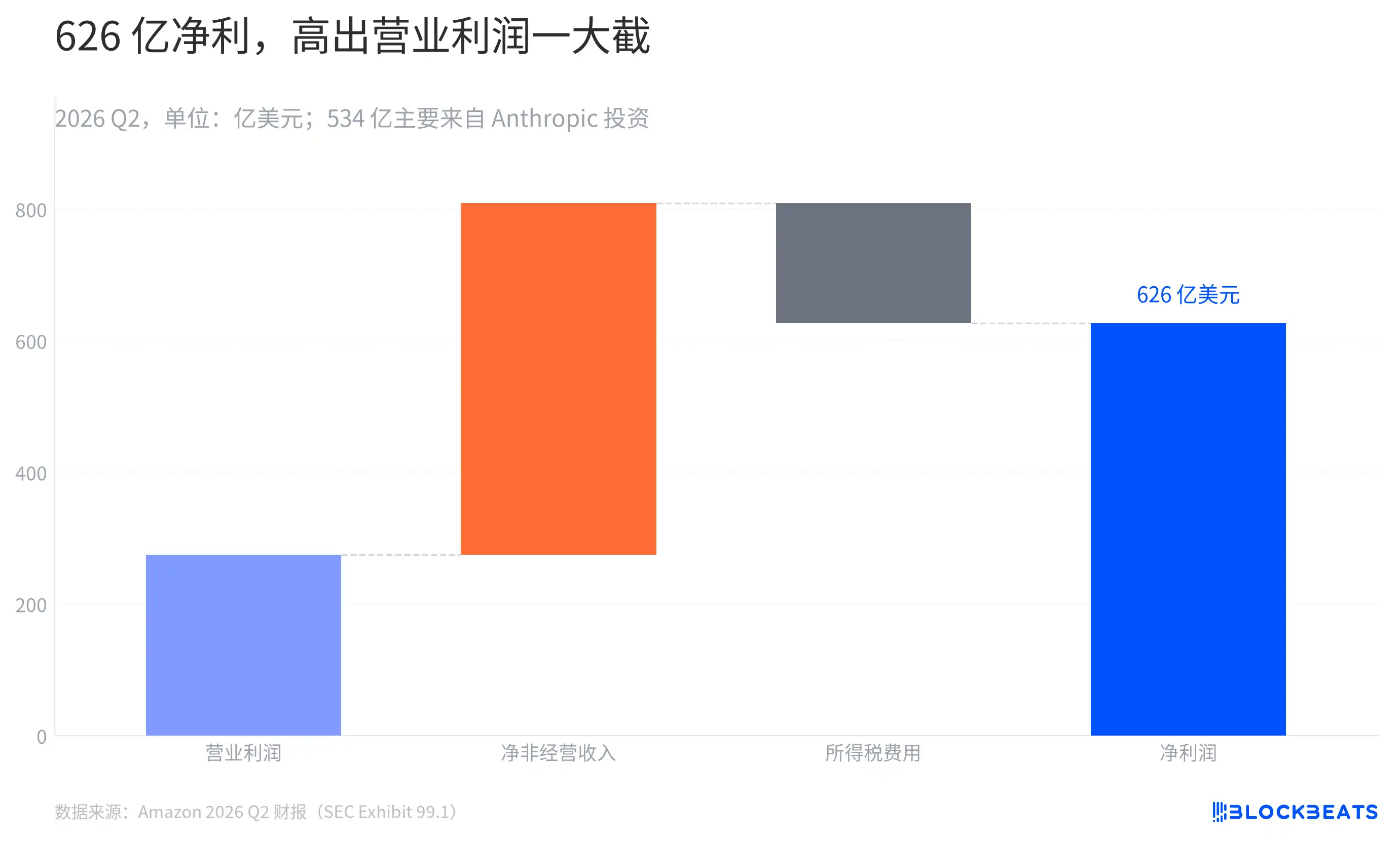
This chart aims to correct not the number itself, but how to interpret it. The $53.4 billion is not extra cloud services sold by AWS during the quarter, nor is it costs saved from retail operations. It occurred after operating income and belongs to non-operating items related to investments.
This also explains why it cannot be simply deducted from net income to declare a "Net Income excluding Anthropic." This income is reported on a pre-tax basis, and Amazon has not separately disclosed its tax burden. Rather than manually calculating backwards, a more stable operational benchmark is the $27.5 billion in operating income, which is directly linked to the performance of each segment.
Why AWS can support operating profit
Setting aside investment-related gains for a moment, the acceleration of the cloud computing business AWS is still eye-catching. Based on revenue recalculated from figures disclosed in the financial tables, AWS grew 36.8% year-over-year this quarter.
According to the same earnings report, AWS's operating profit reached $16.6 billion, nearly two-thirds higher than the same period last year.
Based on segment profits for North America, International, and AWS listed in the report, AWS alone contributed 60.5% of the company's operating profit in the latest quarter.
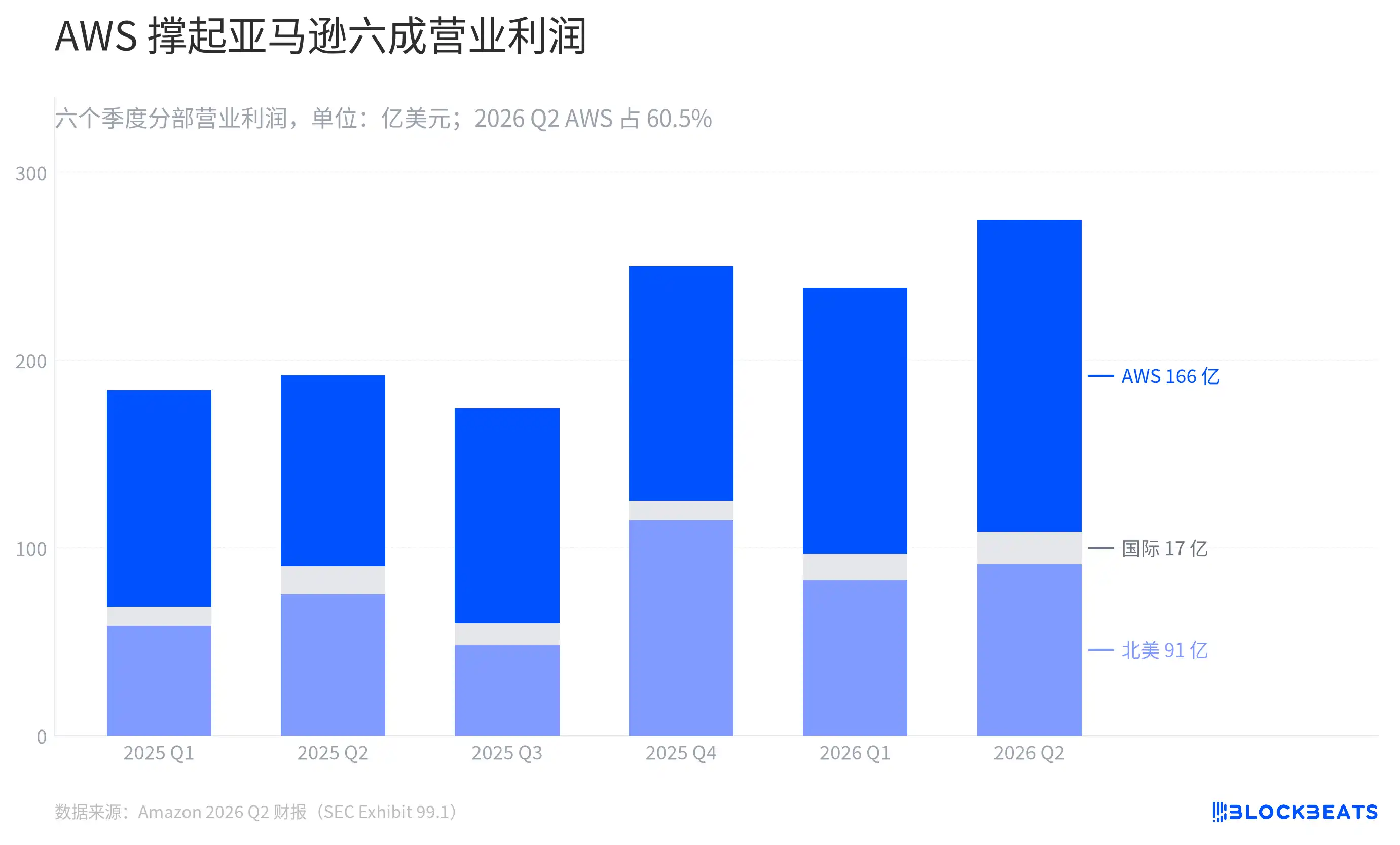
The changes in the chart are more intuitive than a simple revenue table. Amazon's largest revenue plate is still North American retail, but the blue portion has consistently been a critical load-bearing wall on the income statement, and the absolute profit in the latest quarter has risen another notch. The International business is consistently profitable, and the North American business is also improving, preventing AWS from bearing all the pressure alone. However, once the focus shifts to profit rather than sales, AWS's position becomes difficult to ignore.
This is the most practical significance of the cloud business for Amazon. It not only provides a faster-growing segment for the AI narrative but also leaves a thicker operating buffer for simultaneous investments in the retail network, delivery capabilities, and data centers.
Why the money earned isn't staying in free cash flow
Thicker operating profit does not mean cash accumulates proportionally. Another table in Amazon's press release discusses where the money went over the trailing twelve months (TTM), not just expenditures for a single quarter.
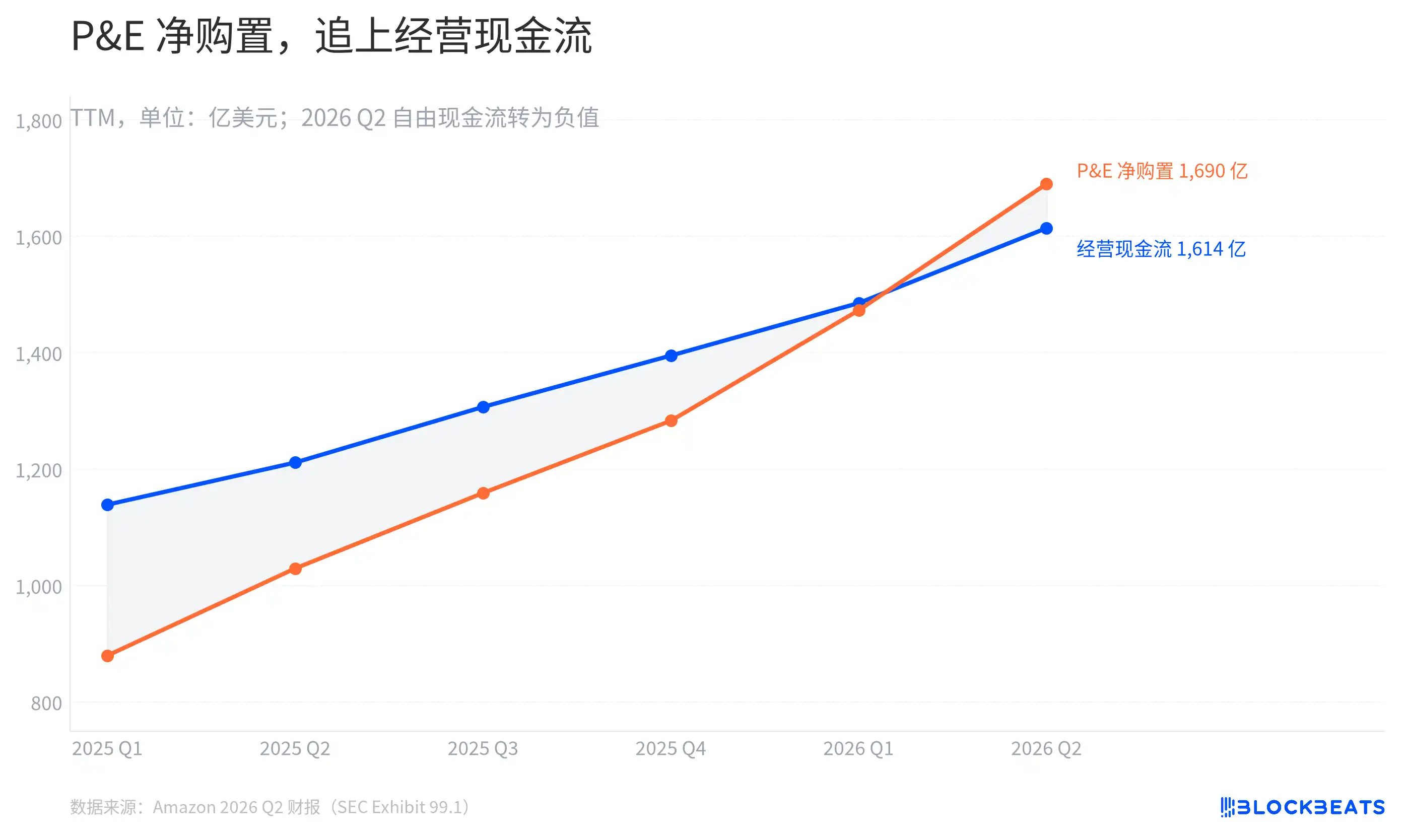
For the twelve months ended Q2 2026, according to the company press release, Amazon's operating cash flow was $161.4 billion, while net purchases of property and equipment were $169.0 billion. The two TTM lines crossed at this point in time, and TTM free cash flow turned negative.
Here, "net purchases of property and equipment" is not just an abstract capital expenditure figure. It includes investments in data centers, servers, and other long-term assets, net of proceeds from sales and incentives. The company stated that the year-over-year increase in this expenditure primarily reflects investments in AI. However, equating it entirely with AI would actually narrow the reading of the earnings report.
This contrast adds another layer to the $62.6 billion. On the income statement, investment gains inflated net income. On the cash flow statement, infrastructure investments are rapidly consuming cash generated from operations. Both things can be true simultaneously, yet they answer two completely different questions.
Beyond AWS, the core foundation is also accelerating
If one only focuses on AWS, it's easy to portray Amazon as a cloud computing company. According to the company's revenue category table, AWS's year-over-year growth rate has increased from 17.5% to 36.8%.
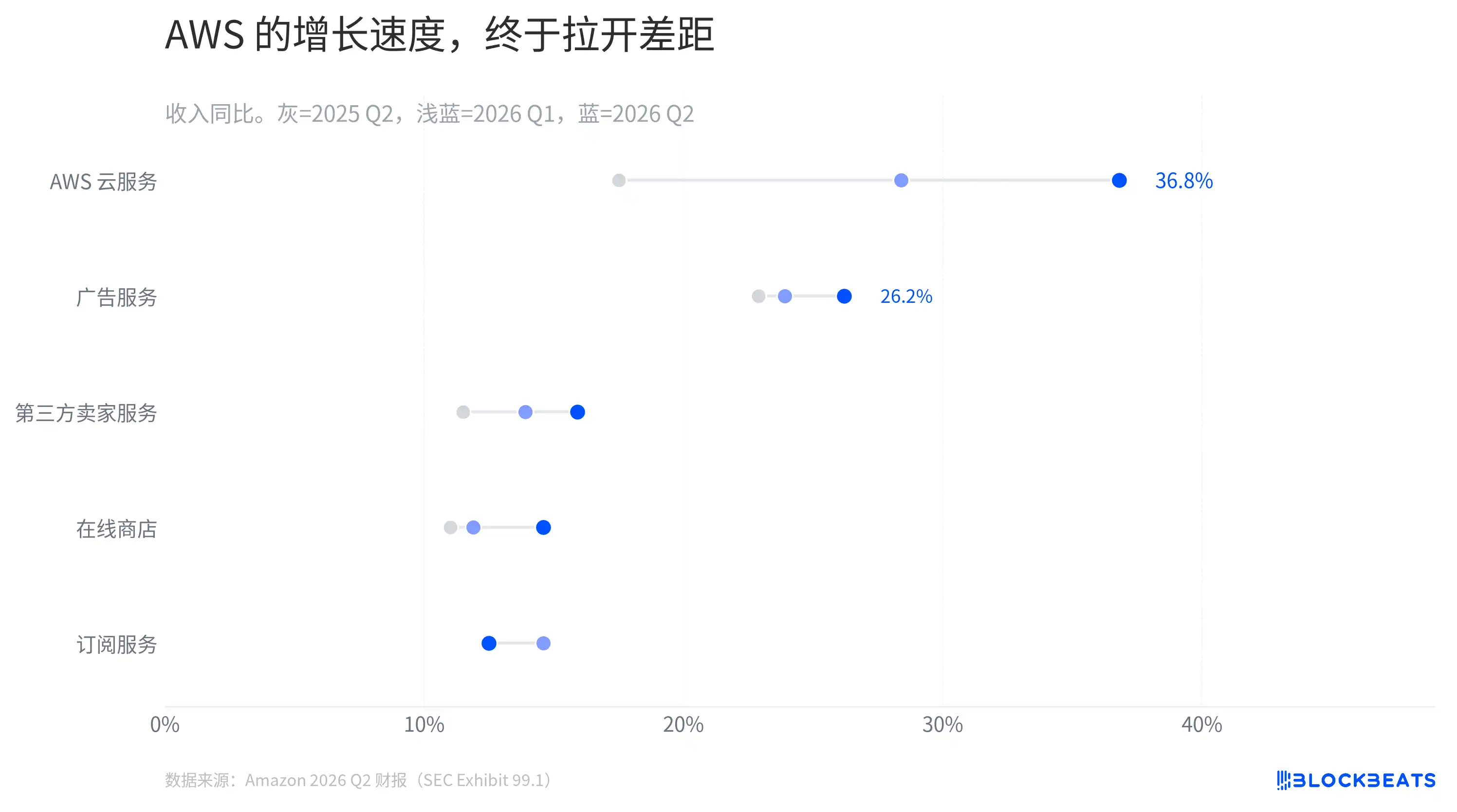
According to the same revenue category table, the advertising services segment still grew 26.2% year-over-year this quarter. While third-party seller services and online stores aren't growing as fast as AWS, they are both moving faster than a year ago. Together, they determine whether the retail foundation can continue to bear the costs of delivery, fulfillment, and user acquisition.
The blue bar for AWS, the non-operating other income primarily from the Anthropic investment, and the equipment investments on the cash flow statement all appear in the same quarterly report.