AI Giants Queueing Up for IPOs: Is This the 'Last Dance' for the U.S. Stock Market?

marsbitPublished on 2026-05-25Last updated on 2026-05-25

Abstract

A massive wave of IPOs from AI giants like OpenAI, Anthropic, and SpaceX is taking shape, potentially reshaping the U.S. stock market. OpenAI is reportedly preparing for a historic IPO, targeting a valuation over $1 trillion and raising roughly $60 billion, which would dwarf previous records. Anthropic is also advancing its own IPO plans, projecting significant revenue growth and achieving quarterly operating profit. However, their financial profiles starkly differ. While Anthropic is nearing profitability with a focus on enterprise clients, OpenAI continues to report substantial losses, with a negative operating margin and expectations for positive cash flow only by 2029-2030. Analysts warn these listings could trigger a major "passive fund reshuffle," forcing index funds to sell holdings in established tech giants to make room for the new entrants, potentially pressuring the broader market. Some observers view the IPO rush as a "risk transfer," allowing early private investors to cash out at peak valuations while passing future financial uncertainty to public market investors. The divergent paths of Anthropic's near-term profitability versus OpenAI's long-term, high-cost growth narrative present a critical choice for investors. The outcome of these IPOs is seen as a major swing factor for risk assets in 2026, testing whether this surge marks a new cycle or a potential peak.

Author: Dong Jing

Source: Wall Street News

An IPO feast comparable to the peak of the dot-com bubble is taking shape. AI giants OpenAI, Anthropic, and SpaceX are racing towards the public markets, each targeting a trillion-dollar valuation. Their combined scale is enough to reshape the landscape of the U.S. stock market. This unprecedented wave of listings is both the ultimate stress test for AI investment logic and the biggest variable for the direction of risky assets this year.

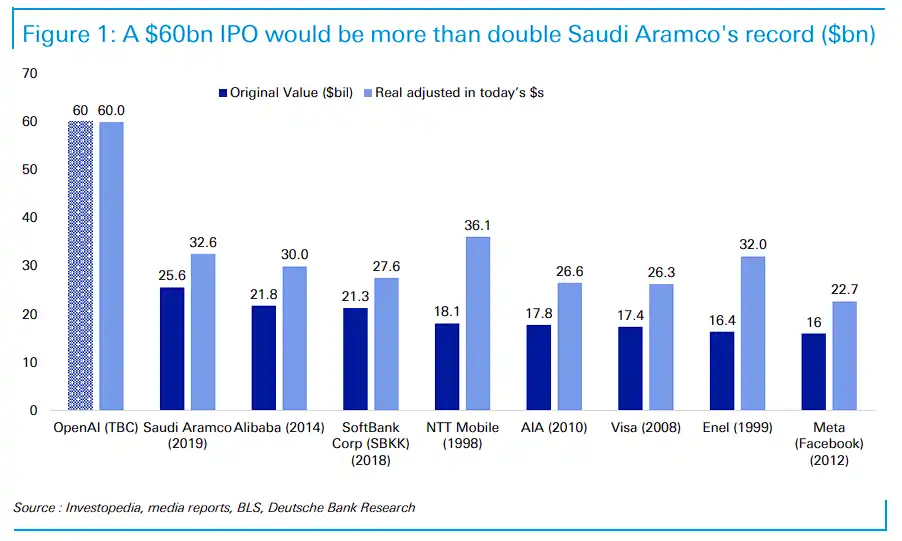
On May 22, according to a Wall Street News article, OpenAI has prepared to confidentially file its IPO application with regulators. The listing could happen as early as September this year, targeting a valuation exceeding $1 trillion and aiming to raise approximately $60 billion. This would more than double the $25.6 billion IPO record set by Saudi Aramco in 2019.

Meanwhile, rival Anthropic is also advancing its own listing plans and disclosed that its Q2 revenue is expected to double sequentially to $10.9 billion, potentially achieving quarterly operating profitability for the first time. Deutsche Bank noted in a research report that the landing of these two IPOs "is likely to become a major swing factor for the direction of risky assets this year," and is a macro theme that must be closely watched.

However, beneath the glossy valuations, the two companies' financial fundamentals are starkly different. OpenAI's Q1 revenue was $5.7 billion, but its adjusted operating profit margin was -122%, meaning it lost $1.22 for every dollar of revenue generated. It is not expected to achieve positive cash flow until 2029 or 2030 at the earliest. Anthropic's revenue was $4.8 billion in the same quarter and is projected to jump to $10.9 billion in Q2, with an expected operating profit of about $559 million, having already touched the threshold of profitability.

Analysis points out that these two companies are competing on the same stage but present vastly different business logics, presenting public market investors with a rare dilemma.

The Largest IPO in History: How Shocking Are the Numbers?

Deutsche Bank noted in a research report that the scale of either OpenAI's or Anthropic's single IPO would exceed twice the fundraising amount of Saudi Aramco's 2019 IPO. Even after inflation adjustment, it would easily become the largest IPO in history.
Deutsche Bank stated in another report that if OpenAI achieves its target valuation of over $1 trillion, it would become the world's 14th largest company by market capitalization, trailing only Berkshire Hathaway and surpassing Eli Lilly.
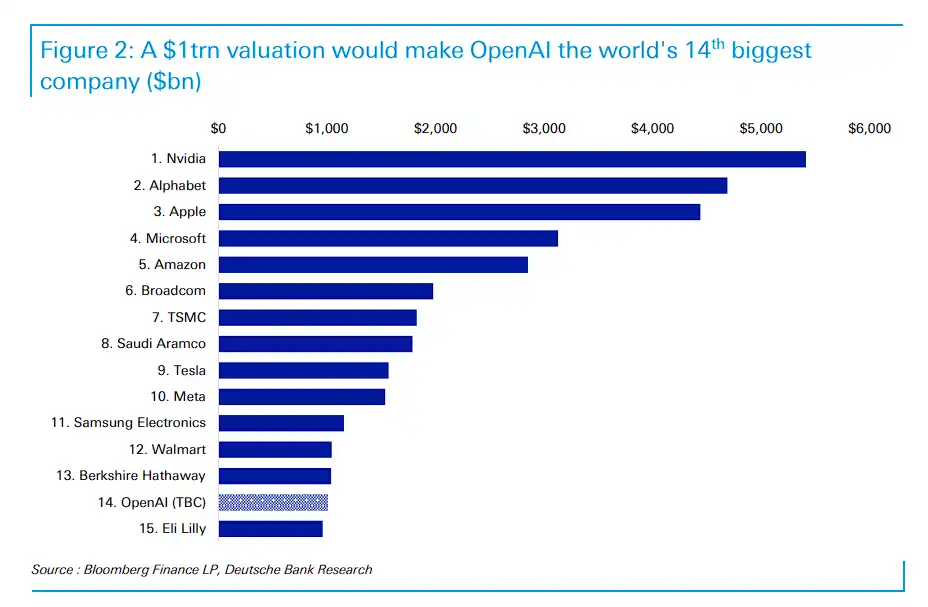
For comparison, Berkshire's revenue last year exceeded $370 billion with a net profit of $67 billion; Eli Lilly's sales exceeded $65 billion with a profit of $21 billion. In contrast, OpenAI is not yet profitable, has an annualized revenue of about $30 billion, and only has thousands of employees.

From a market capacity perspective, Deutsche Bank believes the current total U.S. stock market capitalization is about $70 trillion, five times that of the peak of the dot-com bubble. The market's digestion capacity is far stronger than in the late 1990s.

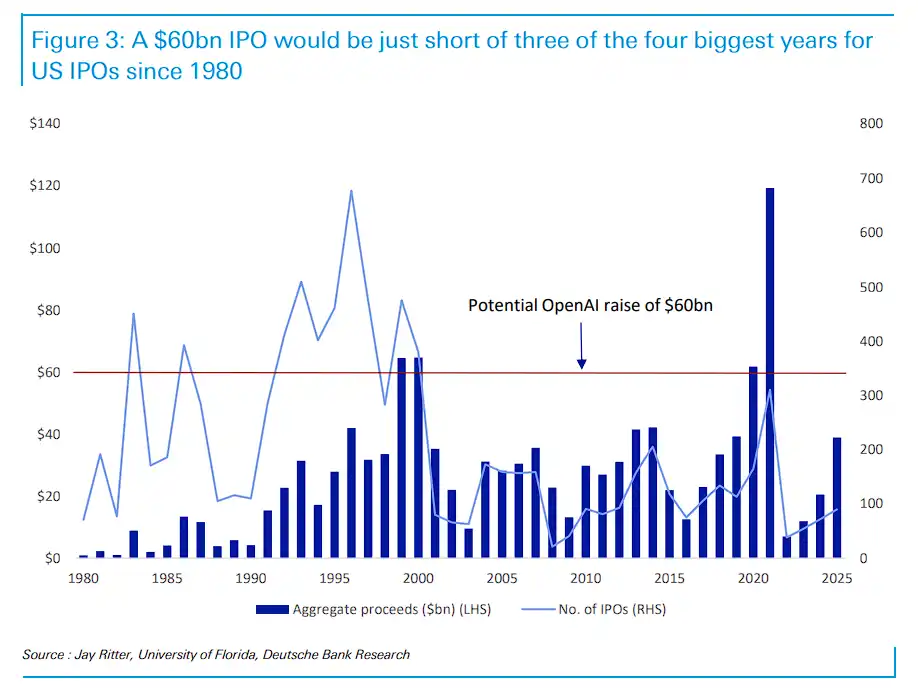
Back then, there were nearly 500 IPOs annually on average, whereas this decade averages only about 120, and today's listed companies are generally more mature.

Furthermore, a single $60 billion IPO is slightly less than the total fundraising for all U.S. IPOs in both 1999 and 2000 (each around $65 billion), equivalent to half of the record $119 billion set in 2021.
The 'Siphoning Effect' of the Behemoths and the Massive Passive Fund Reallocation

As these giants move towards public markets, their potential liquidity drainage effect on the U.S. stock market has already raised high alert on Wall Street.

The clustering of SpaceX, OpenAI, and Anthropic listings, combined with Nasdaq's newly introduced "fast inclusion" mechanism, is brewing an unprecedented massive reallocation of passive funds—the siphoning effect of the AI behemoths.

As mentioned in a Wall Street News article, JPMorgan Chase estimates that if SpaceX targets a $2 trillion valuation and ultimately achieves a 50% free float, passive funds would have to sell approximately $95 billion of their holdings in the current eight major Wall Street tech stocks (Nvidia, Apple, Microsoft, Amazon, Google, Broadcom, Meta, Tesla) to make room for the new entries.

Todd Sohn, Chief ETF Strategist at Strategas, points out that since the initial public float of an IPO is typically only 5%, while ETFs track trillions in assets, this extreme supply-demand imbalance will make the index inclusion process "slightly crazy." Passive investors may have no choice but to buy at high prices.

Valérie Noël, Head of Trading at Syz Group, stated that the market has already begun betting on downward pressure on existing large-cap stocks.

According to information disclosed on March 28 this year, OpenAI's public listing will be a substantial referendum on the entire AI investment logic. That information showed that OpenAI's revenue reached $13.1 billion in 2025, but its net loss in 2026 is projected to be $14 billion.

Simultaneously, OpenAI has committed to investing approximately $1.4 trillion in infrastructure construction before 2033. If S&P Global, FTSE Russell, and Nasdaq adopt fast-inclusion rules, they could force passive funds to buy around $24 billion to $48 billion immediately after the listing.

Faced with such a massive fund restructuring, ordinary investors, whether active or not, will see their portfolios passively reshaped as rules change.

Deutsche Bank noted in its report that the landing method of these IPOs will be a major swing factor for the direction of risky assets this year. PitchBook's analysis is more blunt:

There has been a "systematic quality inversion" in the private market—the companies with the highest valuations score lowest on the business quality metrics that truly matter for pricing in the public market.

For ordinary investors holding index funds or ETFs, it's hard to stay out of this game: whether active or not, their investment portfolios will be passively reshaped as index rules change.

For active investors, once the S-1 filings are public and all financial secrets are laid bare, the market will face a clear choice: to believe in a company that has already found a profitable model, or a giant asking the market for several more years and hundreds of billions of dollars to explore profitability?

The answer will determine whether this frenzy marks the start of a new cycle or the last dance before the party ends.

A Tale of Two Extremes: Anthropic Profits vs. OpenAI's Huge Losses

Despite soaring valuations, the financial conditions of the two AI leaders present starkly different pictures. Anthropic has begun to turn a profit, challenging the traditional notion that massive spending by AI companies would hinder near-term profitability.

According to a Wall Street News article, on Wednesday local time, The Wall Street Journal reported that Anthropic's Q2 revenue is expected to more than double to $10.9 billion and achieve an operating profit of approximately $559 million.

Anthropic's gross margin has jumped from 38% to over 70%. Its CEO, Dario Amodei, once joked that revenue growth had become "too difficult to handle."

The company's success is largely attributed to explosive demand from enterprise clients for its programming tools. About 85% of its revenue comes from enterprise and developer customers, a model with clear willingness to pay and relatively lower service costs.

In contrast, OpenAI is still losing money.

As mentioned in a Wall Street News article, data shows OpenAI's Q1 revenue was $5.7 billion, but its adjusted operating profit margin was -122%, meaning it loses $1.22 for every dollar earned.

Approximately 85% of OpenAI's revenue is related to ChatGPT consumer subscriptions. Despite having 55 million paying users, it supports a vast pool of over 900 million weekly active users, creating a massive cost black hole due to inference expenses for the free users.

OpenAI is not expected to achieve positive cash flow until 2029 or 2030. Its CEO Sam Altman and Head of Applied Business Fidji Simo are trying to shift focus towards commercial clients who can directly generate revenue.

At the IPO narrative level, the two companies are telling entirely different stories. Anthropic, armed with verified quarterly profitability data, tells a story comparable to Salesforce or ServiceNow—the logic of an enterprise software company.

OpenAI needs to convince the market to believe that AI agents, image generation, and even advertising businesses will eventually turn its massive consumer traffic into profit.

In Sam Altman's plan, the ChatGPT advertising business might bring in about $102 billion in revenue by 2030. But this requires time, and time is precisely the most scarce resource for OpenAI as it trades losses for growth.

AI Giants Rushing to IPO: Essentially Passing the 'Hot Potato' to Retail Investors?

According to a Wall Street News article, in the view of Joachim Klement, Managing Director at Panmure Liberum, this wave of AI giant IPOs is essentially a "risk transfer"—a large-scale offloading of early-stage investment risks onto retail investors, pension funds, and other institutions.

He believes that companies like OpenAI and Anthropic are accelerating their listings while investor sentiment is high, aiming to cash in at high valuations before the hype fades. Early institutional investors can exit entirely in the public market, while the retail investors and pension funds that take over will directly face the risk of financial logic eventually returning to reality.

He directly characterized this process as "the action of transferring investment risk on a massive scale from current holders to those willing to pay for the story."

Klement referenced Alan Greenspan's 1996 "irrational exuberance" warning as a benchmark—it was three years before the bubble burst. He judged that the AI hype in 2026 could still persist, and the likelihood of hyperscale cloud providers cutting investments is not high. However, the "impossible math" will eventually return to reality, "perhaps not in 2026, but 2027 or 2028 might see it arrive."

Related Questions

QAccording to the article, what is the estimated target valuation for OpenAI's upcoming IPO?

AOpenAI's target valuation for its upcoming IPO is over $1 trillion (more than 1 trillion US dollars).

QWhich AI company is highlighted as achieving operational profitability ahead of OpenAI?

AAnthropic is the AI company highlighted as achieving operational profitability ahead of OpenAI, expecting about $5.59 billion in operating profit for Q2.

QWhat significant financial risk is associated with OpenAI's current business model according to the article?

AA significant financial risk for OpenAI is its negative adjusted operating margin of -122%, meaning it loses $1.22 for every dollar of revenue it generates.

QWhat potential market impact does the article suggest could result from the massive IPOs of AI giants like SpaceX and OpenAI?

AThe article suggests a potential 'siphoning effect' or massive passive fund reallocation, where passive funds might need to sell significant holdings in existing large tech stocks to make room for the new giants, potentially putting downward pressure on those stocks.

QHow does Joachim Klement from Panmure Liberum characterize the wave of AI giant IPOs?

AJoachim Klement characterizes the AI giant IPO wave as essentially a 'risk transfer', a large-scale shifting of early-stage investment risks from current holders to retail investors, pension funds, and other institutions willing to buy into the narrative.

Related Reads

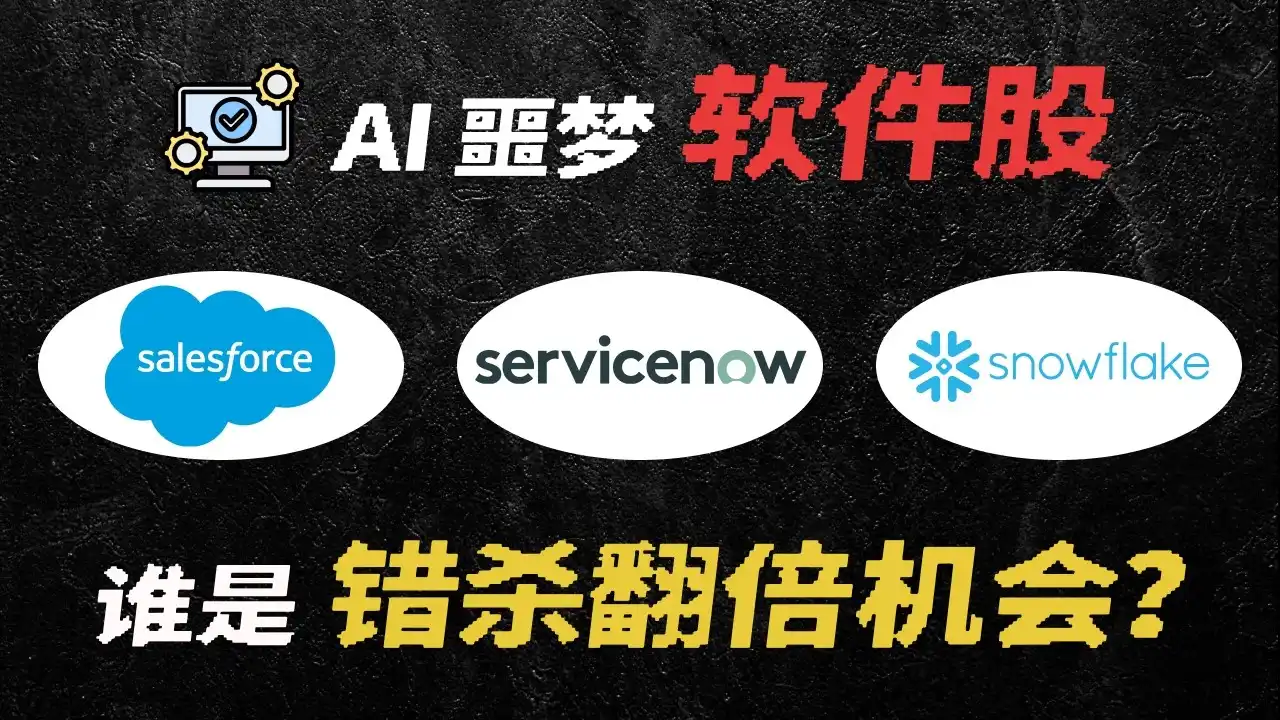
AI Impact on SaaS Software Stocks: Deconstructing the Bottom-Fishing Logic of Salesforce, ServiceNow, and Snowflake

"AI Nightmare for SaaS Stocks: Unpacking the Bottom-Fishing Logic for Salesforce, ServiceNow, and Snowflake" A deep dive analysis argues that the recent collapse in SaaS software stocks, dubbed the "SaaS Doom," presents a contrarian buying opportunity. The market panic, triggered by fears that AI will disrupt traditional per-user subscription models through "seat compression" and AI agents bypassing software UIs, has led to extreme selling in the software sector. The analysis evaluates three major players under a unified framework: 1. **Salesforce (CRM):** Positioned as a "margin of safety" play. Trading at historically low valuations (13-14x forward P/E), with strong cash flow and a massive buyback, it offers value. Its key challenge is transitioning from a "seat economy" to an AI-driven "task economy" with its Agentforce platform. 2. **ServiceNow (NOW):** The "clearest AI narrative" play. Its "AI Control Tower" strategy aims to become the governance and orchestration layer for enterprise AI agents, benefiting from AI proliferation. Backed by Nvidia's CEO, it trades at a relatively low valuation post-correction. 3. **Snowflake (SNOW):** The "high-risk, high-reward" bet. Its consumption-based model aligns with rising AI workloads, and its RPO growth is strong. However, it faces intense competition (e.g., Databricks), is not yet GAAP profitable, and carries the highest valuation. The conclusion counters the simplified "AI kills software" narrative. AI is eliminating software that sells only functional interfaces but rewarding platforms that provide essential infrastructure, data, and governance. The current sell-off may have created a buying opportunity for resilient software leaders positioned as future AI infrastructure platforms.

marsbit12m ago

AI Impact on SaaS Software Stocks: Deconstructing the Bottom-Fishing Logic of Salesforce, ServiceNow, and Snowflake

marsbit12m ago

Just Now, Ilya Drops Another Mind-Blowing Image ‘The Thinker’: What’s on His Mind in the Ocean of AI Chips?

Shortly after going quiet, Ilya Sutskever, AI's enigmatic spiritual leader, posted a mysterious sketch titled "The Thinker" on Instagram. The drawing depicts Rodin's iconic sculpture perched on a cliff, contemplating a vast, purple microscopic universe made of transistors and digital circuits—a chip die shot—signed "IS 2026." This cryptic image, saying "nothing yet everything," ignited widespread speculation in Silicon Valley. Some see it as a search for sacred meaning in silicon, others as a silent critique of brute-force compute scaling. It echoes Ilya's past influence, like the original OpenAI logo he once doodled on a wall. The post coincided with a triple announcement from OpenAI, intensifying the frenzy. First, an internal reasoning model discovered new geometric constructions, challenging a long-standing conjecture and impressing Fields Medalist Tim Gowers. Second, Codex for Mac introduced "Appshots," allowing it to access application windows—even text outside the view—and gained features like Goal Mode, a built-in browser, and plugin capabilities, evolving from a coding assistant into a persistent "resident engineer." Third, reports surfaced that OpenAI is preparing for a confidential IPO filing with banks like Goldman Sachs and Morgan Stanley, potentially eyeing a fall public listing. Together, these moves signal that AGI (Artificial General Intelligence) is not a distant slogan but an active force reshaping science, software engineering, and capital markets. Ilya's art hints at a paradigm shift where the boundary between human thought and silicon computation blurs. As OpenAI insiders excitedly say, "Feel the AGI," it suggests a tangible breakthrough may be imminent—one our generation is likely to witness.

marsbit31m ago

Just Now, Ilya Drops Another Mind-Blowing Image ‘The Thinker’: What’s on His Mind in the Ocean of AI Chips?

marsbit31m ago

Vitalik on the Future of the Ethereum Foundation: A Smaller, More Distinct, but Longer-Lasting Ship

Vitalik discusses the future direction of the Ethereum Foundation (EF), emphasizing a shift towards a smaller, more focused, and longer-lasting organization. He clarifies this is his personal view and that his own influence within EF is diminishing, which he welcomes. The key driver is aligning EF's actions with its stated values of decentralization, privacy, and being a "sanctuary technology," addressing criticism that its operations haven't fully reflected these ideals. He argues that EF should not be the "center" of Ethereum but one node among many with a specific mandate. With limited resources (holding only ~0.16% of all ETH), EF must focus its remaining efforts on long-term, mission-critical activities that wouldn't happen without its push, particularly those reinforcing Ethereum's core CROPS values (Censorship-Resistance, Resilience, Openness, Privacy, Security). This means making hard choices, potentially spinning out even respected projects to attract external capital, and cultivating a distinct cultural stance. The core technical vision is for Ethereum to be "amazing" not by chasing maximal throughput, but by excelling in the CROPS dimension. Key goals include: a provably bug-free Ethereum via AI-assisted formal verification; high-availability chain consensus combining the best of BFT and Bitcoin-style security; and minimization of intermediaries in transaction sending and user experience. These "unreasonable" ambitions aim to make Ethereum profoundly impressive in its core values, which also support ETH as a robust asset. The future EF will be a smaller, more opinionated ship built for longevity and meaningful impact.

链捕手38m ago

Vitalik on the Future of the Ethereum Foundation: A Smaller, More Distinct, but Longer-Lasting Ship

链捕手38m ago

Leading Players in Large Models Drain the Primary Market

The AI industry is witnessing an unprecedented concentration of capital into a handful of leading players, signaling what insiders call the "eve of a final shakeout." A staggering funding surge exceeding $7 billion hit just three Chinese companies in May alone—Kimi, StepFun (接近完成融资), and DeepSeek—with the latter's valuation reaching $45-$50 billion. Globally, giants like OpenAI, Anthropic, and SpaceX (set to merge with xAI) are preparing for public listings, collectively eyeing valuations over $3 trillion. This capital is no longer fueling a broad "hundred-model war" but is being funneled to "refuel" the final few contenders, following a sector-wide attrition rate exceeding 90%. This frenzy is driven by a fundamental shift in industry logic. The focus has moved from比拼模型智商 (competing on model intelligence) to "token factory economics." The explosion of long-context AI agents has massively increased token consumption per task. With token supply constrained by bottlenecks in HBM memory and power infrastructure—key factors in production costs—dominance now hinges on owning and efficiently operating large-scale compute resources. Major tech firms are investing hundreds of billions annually in this AI "power grid." Consequently, competition pivots to three core areas: 1) **Monetization** as the "AGI premium" cools, forcing a shift from user growth to revenue; 2) **Cost efficiency**, where reducing inference costs becomes the ultimate KPI as model capabilities commoditize; and 3) **Strategic path divergence** between enterprise-focused AI (prioritizing integration and reliability) and consumer-facing applications (betting on scale and user engagement). The message is clear: the final capital injections are determining the endgame lineup. Success will depend not just on technical prowess, but on transforming technology into a sustainable, profitable business model with demonstrable return on massive compute investments.

marsbit47m ago

Leading Players in Large Models Drain the Primary Market

marsbit47m ago

Trading

Spot
Futures
活动图片