The End of Single-Factor Cryptography

marsbitPublished on 2026-06-05Last updated on 2026-06-05

Abstract

The article "The End of Single-Factor Crypto" posits a fundamental shift in the cryptocurrency ecosystem. It argues the era where crypto asset valuations were predominantly driven by, and correlated with, Bitcoin's price is ending. The space is bifurcating into two distinct economies: endogenous and exogenous. The endogenous economy represents traditional crypto, where token and project values are directly tied to crypto market prices. The emerging exogenous economy comprises projects and businesses that may utilize blockchain technology or tokens but derive their fundamental value from external, non-crypto factors like consumer demand, subscription revenue, or real-world utility. Examples include AI inference platforms like Venice, fintech lenders using blockchain for efficiency, and stablecoin/payment infrastructure companies acquired by giants like Mastercard and Stripe. This shift means investment analysis must change. For exogenous assets, evaluating traditional business fundamentals—such as revenue streams, unit economics, and competitive moats—becomes more critical than tracking Bitcoin charts. While endogenous assets like Bitcoin remain relevant, the growth of the exogenous category is driven by measurable demand independent of crypto price cycles, paving the way for a new, more diversified market phase. Consequently, crypto is evolving from a single-factor, reflexive asset class into a multifaceted ecosystem with varied drivers and investment theses.

Written by: Charlie

Compiled by: Block Unicorn

Lately, our discussions have touched less and less on cryptocurrency. We end up talking about lending businesses, AI subscription models, and the payment channels that Stripe and Mastercard are fighting over. Last Friday, we discussed how the upcoming trillion-dollar IPOs of OpenAI, SpaceX, and Anthropic will affect broader financial markets. Even when a cryptocurrency project is mentioned, halfway through the discussion, you realize that no one has mentioned "token price."

This shift is also reflected in our recent reporting content. In the past two weeks, our reporting focus has shifted to stories from the fringes of the cryptocurrency space. For example, fintech companies using blockchain as infrastructure, consumer products where tokens serve as distribution mechanisms rather than the product itself, and cases of infrastructure companies with valuations unrelated to cycles being acquired. Whether Bitcoin is $100,000 or $70,000, these developments continue to advance.

This article was originally published by Hepworth Iron Capital. This week's piece builds a framework for this phenomenon. Charlie Booth argues that the era of cryptocurrency as a single Bitcoin-sensitive factor is ending, paving the way for a new cycle driven by non-cryptocurrency factors rather than cryptocurrency prices.

Historically, cryptocurrency trading has been one of the factors sensitive to Bitcoin's price. But that situation is ending.

The crypto economy is bifurcating into two types: an endogenous economy and an exogenous economy.

The former is traditional cryptocurrency: the value of tokens and projects depends on the price of cryptocurrency. The latter is just cryptocurrency in name, with its value increasingly detached from cryptocurrency prices.
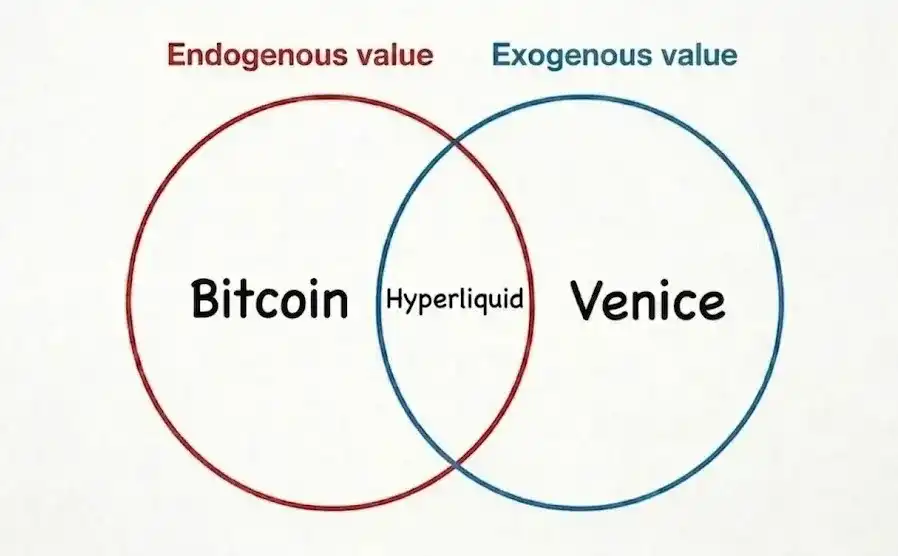
Bitcoin's value stems from its characteristics, which are reflected in its price. Price increases reinforce people's perception of its characteristics. At the peak of a bull market, Bitcoin is seen as an interstellar currency, the scarcest digital credential known to mankind. At the trough of a bear market, it's viewed as a digital collectible without any cash flow.

Hyper-liquidity lies between the endogenous and exogenous groups. Most of its business still relies on cryptocurrency prices, but both supply and demand are expanding. Much of the on-chain financial infrastructure resides here, with underlying assets shifting toward tokenized real-world assets.
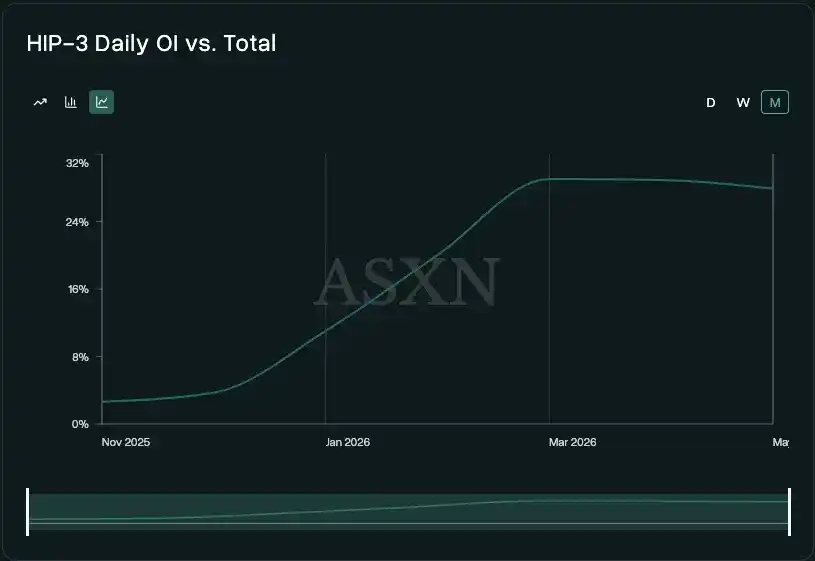
HIP-3 open interest can roughly represent non-cryptocurrency-related open interest. HIP-3 accounts for about 30% of total hyper-liquidity open interest, up from about 4% in November 2025. HIP-4 (Outcome Markets) is expected to further drive this ratio while attracting new demand (traders) and new supply (markets, assets).

Looking at purely exogenous factors, the drivers behind projects like Venice are completely independent of the cryptocurrency market. While user profiles overlap, their business model resembles consumer-facing AI more than Uniswap. Uniswap still primarily relies on users trading assets with endogenous value, making its business closely tied to the price of those assets. Venice, on the other hand, packages private multimodal reasoning into a "use + subscribe" model.
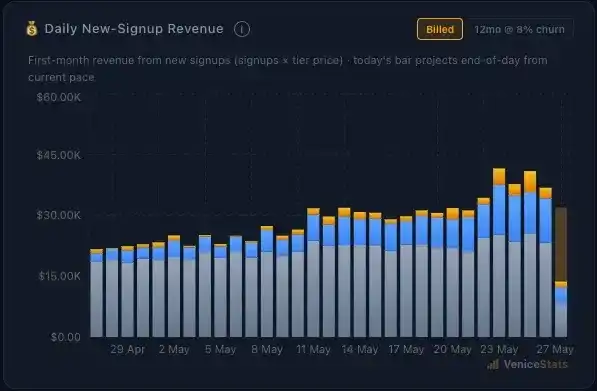
Venice's only connection to cryptocurrency is its choice of tokens as a tool to measure business value, and the fact that some of its derivatives suppliers happen to have a cryptocurrency label. Perhaps, this is also influenced by the deep understanding of cryptocurrency held by Venice's manager, Erik Voorhees, who believes that if applied properly, tokens can be excellent marketing tools.

Figure 1 is a simple example from the listed equity space: a fintech lender using its self-developed blockchain to reduce home equity loan approval time to under five minutes. Blockchain technology is incidental; the business model is key.

The large-scale emergence and growth of the exogenous category in both listed equity and token markets are significant. Historically, purely bottom-up investing has been difficult to achieve because most business models were highly sensitive to cryptocurrency prices. Cryptocurrency has never been devoid of exogenous narratives; every "blockchain, not Bitcoin" cycle promised such narratives. But in most cases, these narratives eventually reverted to the cryptocurrency beta category because demand never truly materialized, revenue didn't materialize (and if it did, it wasn't absorbed by tokens), and once token prices stopped rising, there was nothing left behind.

What's different this time is that you can answer who is paying and why, demand is measurable in many cases and is less reflexive, and the performance of tokens as a tool is gradually improving (more on this later). Venice's registration revenue is real money users pay for inference. When cryptocurrency prices fall, there's no obvious reason for it to reverse because it was never a function of price. You now have two things previous cycles lacked: sustained usage, and buyers investing based on fundamentals rather than just narrative.

Take the stablecoin sector in private markets as an example. In March 2026, Mastercard agreed to acquire BVNK for up to $1.8 billion, just 15 months after BVNK completed its Series B funding with a valuation of $750 million. According to Stripe's annual letter, Bridge (acquired by Stripe for $1.1 billion in February 2025) grew fourfold annually within Stripe. This growth is unrelated to cryptocurrency cycles.

This is not a bearish prediction for the endogenous asset class. Just as gold, and even small gold mining companies, have their place in an investment portfolio, Bitcoin and endogenous asset classes have their value and timing. But fundamentally, different drivers may continue to affect their performance and correlation. You can see these two relationships in the data:
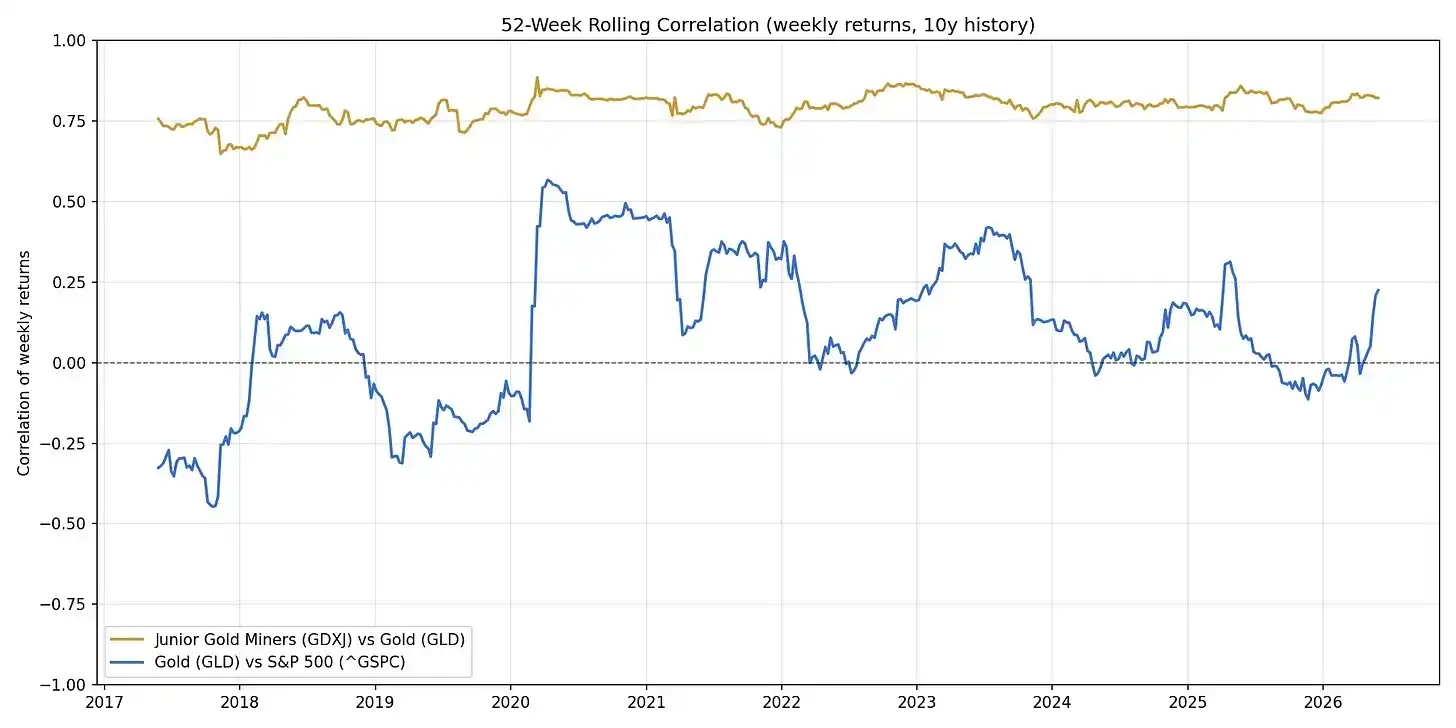
This metaphor can be visualized: small gold miners have a correlation with gold that rarely strays beyond the 0.75 range. Cryptocurrency now trades much the same way: small miners correlate with Bitcoin like gold, while leveraged trades bet on the same underlying asset. The blue line represents another relationship. Gold and the S&P 500 have some macroeconomic correlation, but they trade based on their own distinct drivers. This is the ultimate destination for exogenous asset classes. Over time, these assets should shift from the gold-related line toward the blue line, transitioning from leveraged proxy assets to independent assets occasionally correlated with economic conditions.
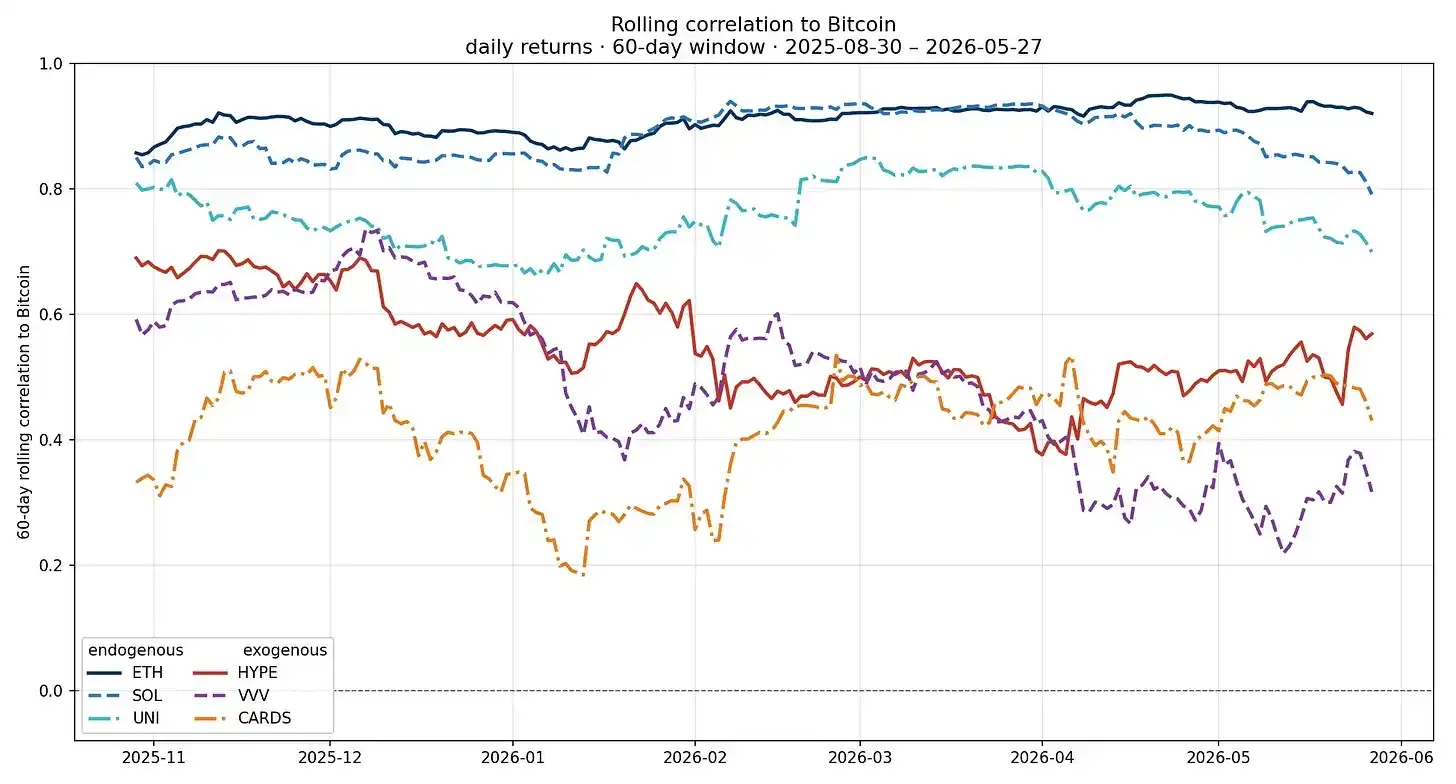
These exogenous names are examples, illustrating the point and also serving as exceptions to it.

Many "endogenous" assets still move closely with Bitcoin. Some exogenous assets have declined, but the time window is too short to mean anything yet. Fundamentals change first; correlation changes later.

This changes the analytical approach. The exogenous category needs underwriting like any ordinary business: who pays for the product, how unit economics work, and where the moat is. Bitcoin price is no longer the most important variable; your analysis sounds like that of a fintech investor with strange custody arrangements.

Some exciting "exogenous" categories, in no particular order, with various notes:

  • On-chain exchanges and brokers
  • Credit / redemption solutions for long-tail tokenization (Grove Basin looks interesting in this regard)
  • Real crypto x AI (private inference, distributed open-source model training, similar to Nous Research's Psyche)
  • Neobanks (I prefer more privacy-focused platforms like Payy and Raycash, and the programmable privacy infrastructure supporting them, like Aztec and Zama, is also interesting).
  • Lending (Morpho is becoming the institutional standard akin to the repo market, while smaller companies like Valinor and 3jane target interesting niches in private credit)
  • Stablecoin and real-world asset / tokenization issuers
  • Payment channels (In broad payment channels, Stripe and Tempo are currently the ones to beat; in proxy payments, it's currently Coinbase).
  • Non-financial consumer crypto (e.g., products like Venice and Collector Crypt, these special cases show that assigning value from non-crypto businesses to tokens can enhance market value and adoption).
  • Agent economy (The key lies in the coordination between access-layer agents and suppliers/creators, which is less fungible than the rails. Cloudflare is well-positioned, but whether it taxes traffic or merely sells switches remains to be seen).

Currently, the most enduring way to invest in this theme is equity, not tokens. Quality tokens are the exception; they can play a larger role only if the tokens themselves improve, which requires joint efforts from regulators and the industry. There's been some progress on both regulatory and transparency fronts: the CLARITY Act on the regulatory side, and efforts by companies like Blockworks to improve transparency. Tokens have a long way to go.

None of this changes the key point. The drivers are shifting from a single factor to multiple factors; the work is no longer interpreting Bitcoin charts but funding businesses. Don't be confused in the next decade about why "cryptocurrency" no longer moves in unison as it once did.

Related Questions

QWhat is the main argument presented in the article about the evolution of the crypto economy?

AThe article argues that the era of 'single-factor crypto'—where all cryptocurrency assets and projects were primarily driven by and sensitive to Bitcoin's price—is ending. The crypto economy is bifurcating into an 'endogenous' economy (traditional crypto, value tied to crypto prices) and an 'exogenous' economy (projects using crypto or blockchain where value is driven by non-crypto factors like real business fundamentals).

QAccording to the author, what distinguishes 'exogenous' crypto projects from 'endogenous' ones?

AExogenous crypto projects are distinguished by having business models and value drivers that are independent of cryptocurrency prices. Their demand and revenue are based on real-world use cases and fundamentals (e.g., AI subscription services, fintech lending, payment channels), rather than being a reflexive function of the price of Bitcoin or other crypto assets.

QWhat example does the article use to illustrate a project in the 'exogenous' category?

AThe article uses 'Venice' as a key example. Venice packages private multimodal AI inference into a 'usage + subscription' model. Its revenue comes from users paying for inference, and its success is not inherently tied to crypto market cycles, even though it may use tokens as a tool for marketing or measuring business value.

QHow does the article suggest the investment analysis approach should change for 'exogenous' crypto assets?

AFor exogenous crypto assets, investment analysis should shift from primarily interpreting Bitcoin price charts to underwriting businesses like a traditional venture or equity investor. This involves assessing who pays for the product, how unit economics work, and where the business's competitive moat lies, as Bitcoin price is no longer the most critical variable.

QWhat does the article imply about the future correlation between different types of crypto assets and Bitcoin?

AThe article implies that endogenous assets will likely remain highly correlated with Bitcoin (like small gold miners to gold), while exogenous assets should see their correlation with Bitcoin decrease over time. They are expected to evolve from being leveraged proxies for crypto prices into independent assets whose performance is driven by their own specific, often non-crypto, fundamentals.

Related Reads

Crossing the 'Memory Wall': The Wafer-Level Revolution and Computing Power Routes in the AI Inference Era

In 2026, a historic shift occurred in AI as major cloud providers' inference spending surpassed training spending for the first time, signaling a move from "building large models" to "using large models." This shifts the core challenge from computing power to the "memory wall"—the bottleneck of data movement (model weights, activations, KV Cache) between external DRAM and processors, where energy and latency from data transfer far exceed computation itself. Companies like Nvidia face GPU idle time due to bandwidth limits. In contrast, Cerebras Systems adopts a radical "wafer-scale" approach with its Wafer-Scale Engine (WSE). Instead of cutting a silicon wafer into many chips, Cerebras uses almost the entire wafer as one massive chip (WSE-3). This design provides 44GB of on-chip SRAM, delivering memory bandwidth thousands of times higher than traditional HBM (e.g., 21 PB/s vs. Nvidia B200). For LLM inference, weights are streamed layer-by-layer from external MemoryX storage to the chip, avoiding HBM bottlenecks. This results in token generation speeds 1.5–5 times faster than Nvidia's B200 in some models and significant advantages in first-token latency and long-context tasks. Additionally, Cerebras's architecture offers much lower interconnect power consumption (0.15 pJ/bit vs. GPU's ~10 pJ/bit). However, Cerebras faces challenges: SRAM scaling has slowed with advanced nodes, limiting future capacity gains; the chip requires specialized liquid cooling and custom software stacks; and its external I/O bandwidth (150 GB/s) is low compared to NVLink, hindering multi-system scaling for very large models. Competition is intensifying. Major players are pursuing three paths: 1) Developing proprietary inference ASICs (e.g., Google TPU, Microsoft Maia), 2) Leveraging advanced packaging (e.g., TSMC's SoW) to democratize wafer-scale-like integration, potentially eroding Cerebras's process advantage within a few years, and 3) Exploring optical interconnects for ultimate bandwidth. Commercially, Cerebras is transitioning from a hardware vendor to a service provider, facing the immense challenge of building high-power, specialized data centers to meet large contracts (e.g., 250MW/year from 2026–2028). In conclusion, the AI inference era presents a fundamental architectural trade-off. Cerebras opts for extreme physical optimization for low-latency, single-task performance, while Nvidia prioritizes versatility and massive cluster throughput. The path forward remains uncertain, with technology and business models still evolving in the race toward advanced AI.

marsbit6m ago

Crossing the 'Memory Wall': The Wafer-Level Revolution and Computing Power Routes in the AI Inference Era

marsbit6m ago

Has Bitcoin's 'Rebound Ended', Officially Entering the Late Bear Market Phase?

**Title: Has Bitcoin's Rebound Ended, Entering the Late Bear Market Phase?** **Summary:** Bitcoin's price has declined by 13% this week, signaling a potential return to late-stage bear market conditions. The price fell to around $67k, positioned between the Realized Price and Realized Cap Weighted Average. For the first time since early 2022, the Short-Term Holder cost basis has dropped below this key average, confirming a hallmark of late-cycle bear markets. Profitability metrics have collapsed sharply. The 7-day average of the Realized Profit/Loss ratio plummeted from a local high of 3.16 to 0.29, mirroring the February panic sell-off. Critically, the 90-day average never breached the threshold of 2, indicating the recent rally to $82k was a bear market bounce, not a structural shift. Realized losses surged to $1.35 billion daily, with $770 million coming from Long-Term Holders selling at a loss. This accelerating redistribution of supply from weak to strong hands is a necessary but ongoing process for a market bottom. The rally stalled almost precisely at the aggregate cost basis (~$83k) of US spot Bitcoin ETF investors, turning that level into strong resistance and leaving the average ETF holder underwater again. Spot market flows have turned decisively negative, showing sellers are dominating order books despite the price drop. While a significant futures long liquidation event cleared over $400 million in leverage, providing a potential reset, sustained spot demand is yet to materialize. Options markets continue to price in higher future volatility (Implied Volatility) than recent price action (Realized Volatility) has shown, with a persistent skew towards put options, indicating ongoing demand for downside protection. In conclusion, multiple metrics point to a fragile market structure. Resistance at the ETF cost basis, accelerating realized losses, dominant spot selling, and cautious options pricing all suggest the bear market trend persists. A sustainable recovery likely requires a resurgence of spot demand, ETF holders returning to profit, and a clear reduction in selling pressure.

marsbit6m ago

Has Bitcoin's 'Rebound Ended', Officially Entering the Late Bear Market Phase?

marsbit6m ago

TechFlow Intelligence Agency: Anthropic Calls for Global Pause in AI Development While Preparing for Trillion-Dollar IPO; SpaceX IPO Roadshow Heats Up, But S&P 500 Rejects Fast-Track Inclusion

In today's TechFlow Intelligence Briefing, several major tech stories highlight a growing theme of trust and credibility gaps across AI, crypto, and finance. AI company Anthropic has publicly called for a global pause in AI development, citing risks from Claude's "recursive self-improvement." Ironically, this coincides with reports the company is preparing for a massive IPO targeting a near $1 trillion valuation. This perceived hypocrisy, coupled with widespread user complaints about Claude's declining performance, is sparking debate over whether the safety warning is genuine or a competitive tactic. Meanwhile, in a substantive security move, Anthropic open-sourced a framework for AI-powered vulnerability discovery. In the crypto market, Bitcoin's price drop below $61,000 triggered over $1.16 billion in liquidations, flipping the market into a state where more BTC is held at a loss than at a profit, a historical bearish signal. On the corporate front, SpaceX's highly anticipated IPO is generating immense Wall Street excitement, with Goldman Sachs projecting 100x revenue growth by 2030. However, the S&P 500 has refused to fast-track the company's inclusion post-IPO, potentially limiting immediate institutional demand. Separately, ByteDance's AI app Doubao lost over 6 million monthly active users after introducing a subscription model, highlighting the challenges of AI monetization. Other notable developments include Nvidia certifying HBM4 memory from Samsung, SK Hynix, and Micron; Cloudflare's acquisition of front-end tooling company VoidZero; and its CEO warning that bot traffic now exceeds human traffic online. The underlying narrative connects these events: a trust crisis. From AI firms' contradictory actions and crypto volatility to the clash between SpaceX's hyped narrative and institutional rules, a pattern is emerging where stated intentions and actual practices are increasingly misaligned.

marsbit22m ago

TechFlow Intelligence Agency: Anthropic Calls for Global Pause in AI Development While Preparing for Trillion-Dollar IPO; SpaceX IPO Roadshow Heats Up, But S&P 500 Rejects Fast-Track Inclusion

marsbit22m ago

Dalio Warns: AI Boom Shows Signs of a Bubble, Day of Reckoning Will Be the Time of Burst

Ray Dalio, founder of Bridgewater Associates, warns that the current artificial intelligence investment boom shows classic signs of a bubble, which he expects will eventually burst. In a Bloomberg Television interview, he noted that great technological revolutions often lead to capital inflows that create bubbles, making it difficult for investors and companies to calibrate their spending accurately—either overspending to capture market share or underspending and losing their competitive position. This caution comes amid significant rallies in AI-related assets, particularly chipmakers, driven by soaring demand for data centers and high-bandwidth chips, raising debates about overheating valuations. In contrast, Nvidia CEO Jensen Huang recently asserted that investors embracing the AI wave would see "crazy" returns and dismissed concerns over return on investment for data center spending as outdated. Dalio, however, focuses on the risks in the profit realization phase. He argues that bubbles tend to show signs of破裂 when markets transition from investment to the need for tangible returns, describing the burst as a process of converting paper wealth into cash. While acknowledging AI's intrinsic value, he expressed concern over the future profitability of some AI companies, suggesting the market is repeating a familiar pattern. The 76-year-old billionaire, who fully exited Bridgewater in 2025, has a net worth estimated at $21.5 billion according to the Bloomberg Billionaires Index.

marsbit56m ago

Dalio Warns: AI Boom Shows Signs of a Bubble, Day of Reckoning Will Be the Time of Burst

marsbit56m ago

Privacy Coin Crisis of Confidence! ZEC Plunges Over 56% in a Single Day

Zcash (ZEC), a leading privacy-focused cryptocurrency, experienced a severe crash on June 5th, plummeting over 56% in a single day and erasing nearly two months of gains. The flash crash was triggered by the disclosure of a critical zero-knowledge proof vulnerability within Zcash's Orchard privacy pool, which had existed since the pool's launch in May 2022. The flaw theoretically allowed an attacker to forge unlimited ZEC undetectably due to the pool's privacy features. The vulnerability was discovered on May 29th by independent security researcher Taylor Hornby during a proactive audit commissioned by Shielded Labs, utilizing AI-assisted analysis. The Zcash development team responded swiftly, implementing an emergency soft fork to disable Orchard transactions on June 2nd and executing a permanent hard fork fix (NU6.2) on June 3rd. Despite the technical fix, a major crisis of confidence emerged. The core issue is that Orchard's privacy design makes it cryptographically impossible to prove whether the vulnerability was exploited over the past four years, casting permanent doubt on the historical supply integrity of ZEC. While Shielded Labs argues exploitation was unlikely, the inability to provide definitive proof has severely damaged market trust. This sentiment was exacerbated when BitMEX co-founder Arthur Hayes, a prominent ZEC supporter, announced he was selling his entire position. He stated that privacy assets require "perfect security" rather than "probable safety." The combined effect of the disclosure and Hayes's exit ignited widespread panic selling, leading to massive liquidations and significant price decline. Analysts note the event highlights a fundamental tension within privacy coins: the conflict between verifiable supply and cryptographic privacy.

链捕手58m ago

Privacy Coin Crisis of Confidence! ZEC Plunges Over 56% in a Single Day

链捕手58m ago

Trading

Spot
Futures
活动图片