Has the Crypto Market Bottomed? Here's What Institutions Think

marsbitPublished on 2026-06-17Last updated on 2026-06-17

Abstract

The crypto market is in a period of significant debate, with leading institutions offering differing views on whether a bottom has been reached. Three prominent firms have published detailed analyses: * **Galaxy Digital** argues Bitcoin has **not yet bottomed**. Their analysis of 13 historical indicators across six dimensions (valuation, profit-taking, miner pressure, etc.) shows only four are fully met. They project a potential bottom range between $30k and $54k. * **NYDIG** states a bottom is **possible but not likely**. While metrics are close to historic bear market extremes, they note the absence of a classic panic-selling event. They also suggest increased institutional adoption may have structurally altered the market cycle, potentially leading to a shallower downturn. * **Standard Chartered Bank** asserts the **bottom has already occurred** at around $59k. They cite two key factors: potential US-Iran diplomatic progress and the anticipated SpaceX IPO, which they believe absorbed capital and caused ETF selling pressure that is now subsiding. They forecast a year-end price target of $100k. Despite the surface-level disagreement, the reports share critical common ground more valuable for long-term investors: 1. All three believe the market bottom will form **within this year**. 2. All agree the current price is **closer to the bottom than to previous highs**. 3. All maintain a **bullish long-term outlook** for Bitcoin and a new cycle. The core takeaway is tha...

Author: Matt Hougan, Chief Investment Officer, Bitwise

Compiled by: Chopper, Foresight News

Over the past two weeks, three crypto research institutions I follow closely—other than Bitwise—have all published in-depth reports addressing the same question: Has the crypto market bottomed?

  • Galaxy Digital: Bitcoin Has Not Bottomed, Data Points to a Potential Bottom Range
  • NYDIG: What Factors Are Suppressing Bitcoin's Price Action
  • Standard Chartered: The Market Bottom Has Already Occurred

These three reports are comprehensive, containing vast amounts of data and complete logical reasoning, and are worth reading in full. However, if you are looking for a simple, unified answer, you might be disappointed: the judgments given by these three authoritative institutions are completely different.

Has the Market Bottomed?

  • Galaxy Digital: No
  • NYDIG: Possibly, but unlikely
  • Standard Chartered: Already bottomed

Let's now break down the core logic of each institution one by one.

Three Institutions, Three Views

Galaxy Digital

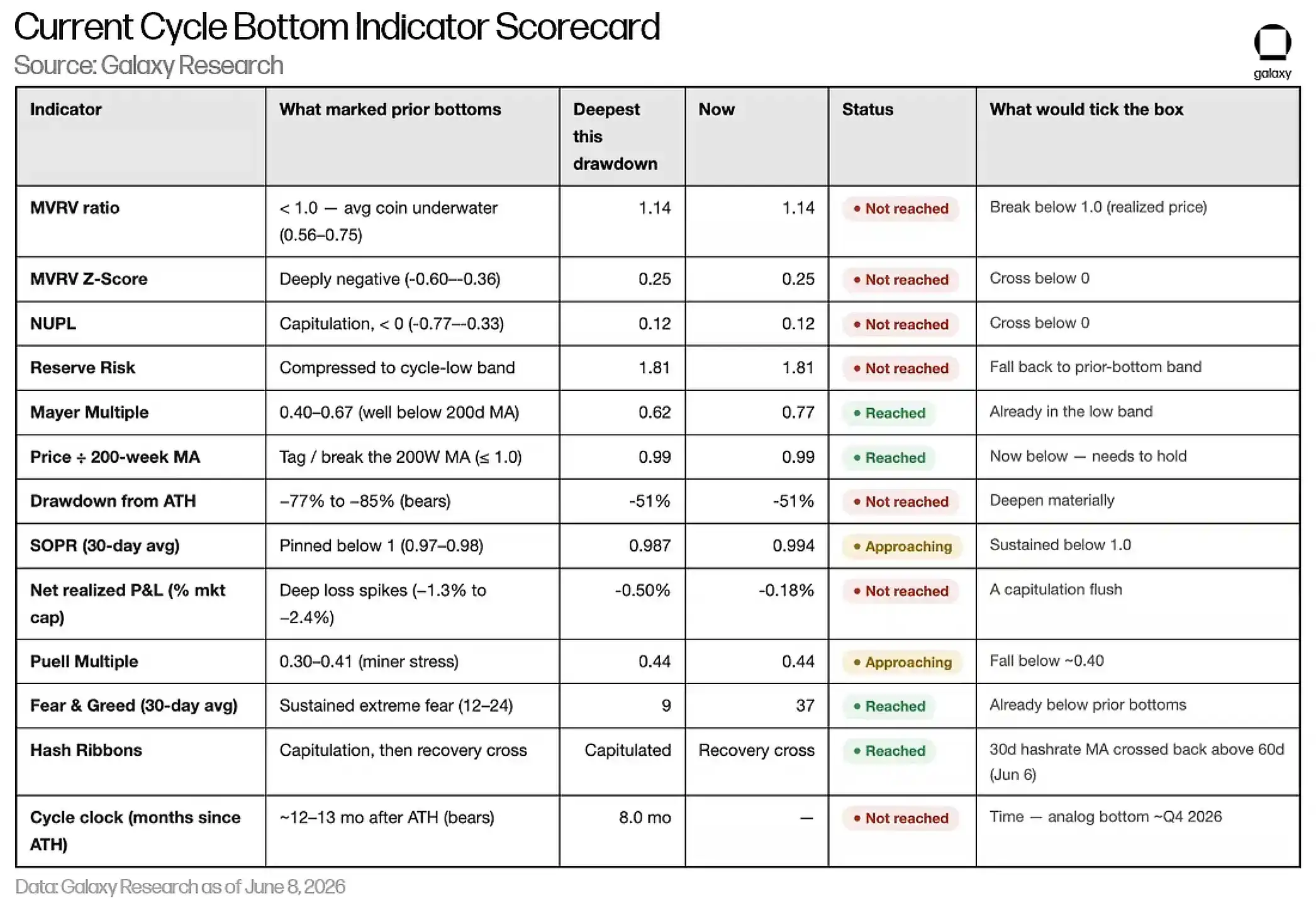
Galaxy Digital reviewed Bitcoin's complete 17-year price history and summarized 13 indicators that tend to appear simultaneously when the market truly bottoms out. These indicators cover six dimensions: valuation, profit-taking sell-offs, miner pressure, trend, bull/bear cycles, and market sentiment. Long-term Bitcoin investors will be familiar with these indicators, including the 200-week moving average, the Fear & Greed Index, and the Mayer Multiple.

Galaxy found that currently only 4 indicators are fully met, 2 are partially met, and the remaining 7 have not triggered bottom signals. The report concludes that Bitcoin's bottom range for this cycle is between $30,000 and $54,000, with a neutral baseline bottom between $40,000 and $46,000.
NYDIG

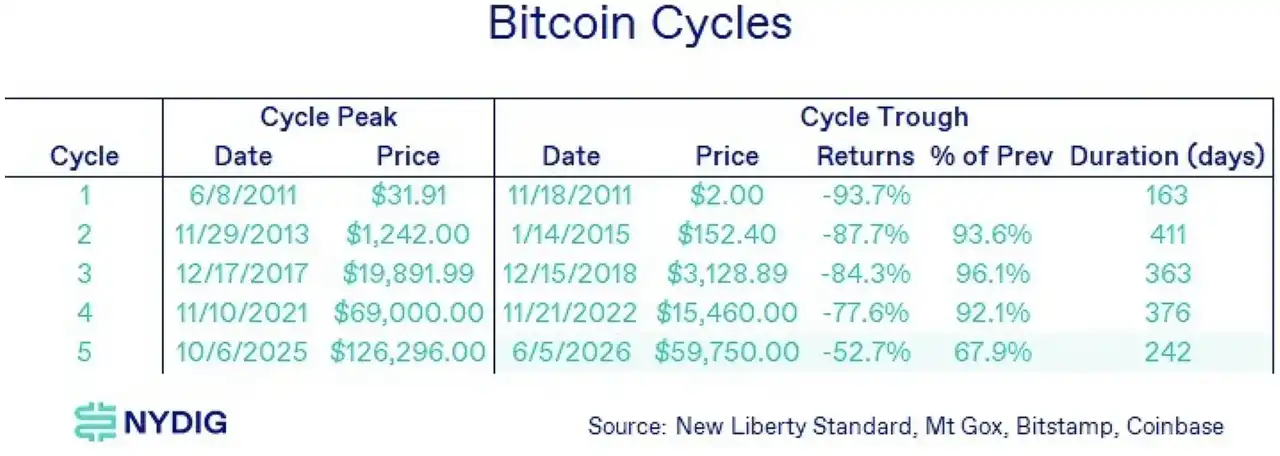
NYDIG also employs a multi-indicator comprehensive analysis framework, comparing the current market with historical cycles and evaluating the market state from dimensions such as the duration of the maximum drawdown and holder profit/loss (known to Bitcoin users as 'MVRV', the ratio of market capitalization to realized value).

NYDIG believes that current indicators are very close to the extreme ranges seen at historical major bottoms, but the hallmark comprehensive panic sell-off seen in previous major bear markets has not yet occurred. At the same time, the report introduces a variable: institutional capital inflows have fundamentally changed Bitcoin's cycle logic from the ground up. This cycle's correction might be shallower than historical bear markets. From this perspective, the bottom may have already occurred.
Standard Chartered

Standard Chartered is not uniformly bullish on Bitcoin. Back in February when Bitcoin was at $67,000, the bank lowered its full-year price forecast, warning that prices could fall to $50,000, citing weaker macroeconomics and continuous selling pressure from Bitcoin ETFs.

However, last Friday Standard Chartered updated its view, identifying $59,000 as the bottom for this price action. The two main logics supporting this view are: the potential for a U.S. diplomatic agreement with Iran; and the highly anticipated SpaceX IPO. Standard Chartered believes that a significant number of ETF holders sold Bitcoin earlier to raise funds for participating in SpaceX's listing, and this selling pressure will gradually subside. Standard Chartered's latest forecast is that Bitcoin will challenge $100,000 within the year.

The Consensus Among the Three Reports Far Outweighs the Divergence

You might wonder what effective information can be extracted from three reports with completely opposing views. In fact, the underlying consensus among the three reports far outweighs the surface divergence. For long-term investors, the conclusions on which they agree are far more valuable than their disagreements:

  • All three judge that the market bottom for this cycle will occur within this year;
  • All three believe the current price is closer to the bottom than to the previous highs;
  • All three are consistently optimistic that Bitcoin will experience another bull market in the future.

At the time of writing, Bitcoin's price is around $67,000. One report claims the $59,000 bottom has already occurred, one sees a potential drop to $50,000, and another gives a neutral baseline bottom of $43,000. But the core conclusion is highly unified: the bottom will definitely be reached this year.

This is the key point long-term investors should focus on most. Whether the bottom lands at $40,000, $50,000, or $60,000, the difference is actually limited; what truly matters is whether Bitcoin can subsequently surge to $100,000, $200,000, or even a million dollars. As long as it reaches those levels, entering a long-term position at current prices offers considerable profit potential.

A highly ironic phenomenon in the current market is that everyone is obsessing over whether the market has bottomed, while overlooking a more important question—whether the top has already appeared. In my view, as long as the peak has not yet arrived, Bitcoin holds value for long-term allocation.

The core logic supporting Bitcoin's long-term value not only remains intact but is continuously strengthening: government debt continues to accumulate worldwide with no effective solution in sight; inflation constantly erodes the real purchasing power of wealth; public trust in centralized institutions like governments and banks continues to decline; the global digitalization process keeps accelerating; Bitcoin's trading and investment channels are continuously improving; the early crypto-native generation is aging, with their assets and industry influence growing simultaneously.

Of course, potential risks remain in the market, including threats from quantum computing and tightening global regulation. But overall, the current situation is better than during any previous crypto winter.


Related Questions

QWhat are the three different views on whether the crypto market has bottomed, according to the research reports mentioned in the article?

AGalaxy Digital believes Bitcoin has not yet bottomed. NYDIG sees a possibility but thinks it's unlikely. Standard Chartered Bank states the market bottom has already occurred.

QWhat is the core logical framework Galaxy Digital uses to assess if the market has bottomed?

AGalaxy Digital uses a framework of 13 indicators across six dimensions: valuation, profit-taking sales, miner stress, price trends, bull/bear cycles, and market sentiment, such as the 200-week moving average, Fear & Greed Index, and Mayer Multiple.

QWhat specific price range does Galaxy Digital identify as the potential bottom for Bitcoin in this cycle?

AGalaxy Digital identifies the potential bottom range for Bitcoin as $30,000 to $54,000, with a neutral base case bottom of $40,000 to $46,000.

QWhat key reason does Standard Chartered Bank give for reversing its earlier bearish view and now claiming the bottom has been reached?

AStandard Chartered Bank's reversal is based on two key logics: the potential for a US diplomatic agreement with Iran, and the anticipated SpaceX IPO, which they believe caused selling pressure from ETF holders that is expected to subside.

QDespite their differing views on the exact bottom, what major consensus do all three research reports share?

AAll three reports agree that the market bottom will occur within the current year, that current prices are closer to the bottom than the previous highs, and that Bitcoin will experience a new bull market in the future.

Related Reads

Under the Shock of Oil Prices and Inflation, Which Country Will Be the First to Sell Off Its Gold Reserves?

The article draws a parallel between the 2003 North American blackout and the potential collapse of the global financial system, framing the US dollar and Treasury market as the world's economic "power grid." It argues that the closure of the Strait of Hormuz is creating a shockwave, starting with oil-importing emerging markets like Turkey, India, and Indonesia. As oil prices rise, these nations are forced to sell dollar-denominated assets—first US Treasuries, then potentially their gold reserves—to afford fuel. Turkey is highlighted as a key case, having sold nearly 90% of its Treasuries and begun tapping gold reserves when oil was between $70-$105/barrel. The article warns that if prices spike to $150-$160/barrel, global buffers like oil inventories and strategic reserves will be depleted. This could trigger a cascade: vulnerable nations, having exhausted assets, could face economic and political collapse (like Sri Lanka in 2022). Their forced asset sales would drive US Treasury yields higher, potentially past a critical threshold (around 5%), forcing the US to choose between a bond market crash or hyperinflation through massive money printing. Ultimately, the piece posits that the dollar's long-term decline is inevitable. The first domino to fall will likely be a fragile emerging market, signaling the start of a chain reaction that eventually threatens the core of the dollar system. The conclusion advises holding tangible assets like gold and energy, which cannot be printed, as a hedge against currency devaluation.

marsbit5m ago

Under the Shock of Oil Prices and Inflation, Which Country Will Be the First to Sell Off Its Gold Reserves?

marsbit5m ago

Behind HYPE's Repeated Record Highs, the 'Minions' in the Ecosystem Can't Keep Up

While HYPE, the native token of the Hyperliquid ecosystem, surges to new all-time highs above $76 and attracts significant institutional ETF inflows, a starkly different reality unfolds within its HyperEVM application layer. Multiple core DeFi protocols across lending, NFTs, stablecoins, and DEXs have announced shutdowns between May and June. The article argues HYPE functions more like an "application stock" than a traditional ecosystem token. Its value is anchored to the trading fees from Hyperliquid's core perpetual contracts platform (HyperCore), which boasts a diversified revenue stream from crypto, commodities, and indices. Approximately 97% of protocol fees fund buybacks and burns of HYPE. This means HYPE's price is largely decoupled from the health of projects built on HyperEVM. The closures of significant projects like lending protocol HypurrFi (peak TVL >$300M) and NFT marketplace Drip.Trade highlight a structural tension. Hyperliquid's minimalist philosophy offers infrastructure without official grants, liquidity support, or marketing coordination for HyperEVM projects. This forces protocols into a fiercely competitive environment from day one. Furthermore, the success of HyperCore creates a liquidity vacuum, and mechanisms like HIP-3 (allowing direct perpetual market deployment) divert user attention and capital away from application-layer projects. The stronger the core perpetual trading business becomes, the more difficult it is for peripheral "DeFi lego" projects to survive and capture value, despite the flagship token's rising price.

Foresight News59m ago

Behind HYPE's Repeated Record Highs, the 'Minions' in the Ecosystem Can't Keep Up

Foresight News59m ago

Conversation with Arthur Hayes: AI Has Drained Market Liquidity, BTC Will Be Below 100k by Year-End

In this June 2026 podcast interview, BitMEX co-founder Arthur Hayes explains his decision to sell his major crypto holdings (HYPE, NEAR, Worldcoin, Zcash). His rationale is based on a macro view linking oil prices, the Iran conflict, US politics, and an impending AI bubble burst. Hayes argues that high oil prices, driven by the ongoing war, will pressure domestic US inflation. To salvage the Republican Party's chances in the midterm elections, he believes Donald Trump may pivot to a populist, anti-AI stance—advocating for taxes and regulation—which would deflate the AI investment narrative. He sees the AI sector, particularly massive capital expenditure on data centers, as having absorbed nearly all excess market liquidity (around $1.5 trillion in debt issuance since 2025), starving other assets like Bitcoin. He highlights the upcoming SpaceX IPO at a ~$1.8 trillion valuation and 100x price-to-sales ratio as a potential tipping point. If these hyped IPOs underperform, it could shatter market confidence in AI. In such a scenario, all risk assets, including crypto, would fall together as correlations converge to 1 during a broad correction. Hayes has moved his portfolio into Treasuries and energy stocks (like ExxonMobil), predicting Bitcoin will be below $100k by year-end. He sees a potential crypto bull market only after the AI frenzy cools, liquidity stops flowing exclusively into AI, and possibly after a significant market downturn prompts new monetary stimulus.

marsbit1h ago

Conversation with Arthur Hayes: AI Has Drained Market Liquidity, BTC Will Be Below 100k by Year-End

marsbit1h ago

Trading

Spot
Futures
活动图片