Optical Modules Soar, Why Is NOK the Second Leader After MRVL?

marsbitPublished on 2026-06-03Last updated on 2026-06-03

Abstract

Nokia's stock has surged nearly 170% to around $16.8 since Nvidia's $1 billion investment and AI-RAN partnership in October 2025, reflecting a market re-rating from a cyclical telecom equipment provider to an AI infrastructure player. This rise, adding roughly $60 billion in market cap, is driven by AI capex expansion into telecom edge, RAN, and optical networks. The company's Q1 2026 results showed strong momentum, with AI & Cloud net sales up 49% and 10 billion euros in new orders, prompting Nokia to raise its AI & Cloud market growth forecast to a 27% CAGR (2025-2028). Optical network growth of 20% further strengthens its position in connecting AI data centers. Recent tests with operators like T-Mobile and the opening of an AI Networking Innovation Lab demonstrate progress from concept to early commercial deployment. Nokia's strategy integrates Nvidia GPUs into its network hardware, enabling concurrent AI processing and RAN tasks for real-time optimization and new edge services. However, with a trailing P/E nearing 100x and consensus price targets lagging the current stock price, significant future growth is already priced in. The key constraint now is the pace and scale of large-scale operator deployments. While execution signals remain positive and the company's position in AI edge infrastructure is established, high valuation leaves limited room for error, making tangible commercial contracts the critical factor for further stock performance.

Nokia's share price is currently around $16.8, having accumulated an increase of nearly 170% since Nvidia's subscription to new shares at $6.01 in October 2025. Its market capitalization has increased by approximately $60 billion, reaching a 16-year high. The market no longer views it merely as a cyclical telecom equipment supplier but is rapidly re-rating it as an AI network and edge infrastructure player. Nvidia's equity investment and technical collaboration have been the most direct catalyst.

Behind this is the major trend of AI capital expenditure shifting from core data centers to the telecom edge, wireless access networks, and optical networks. The question is, how far has this re-rating progressed, and how much support can future actual implementation provide for the stock price?

Nokia's Stock Price Has Completed the AI Infrastructure Re-rating

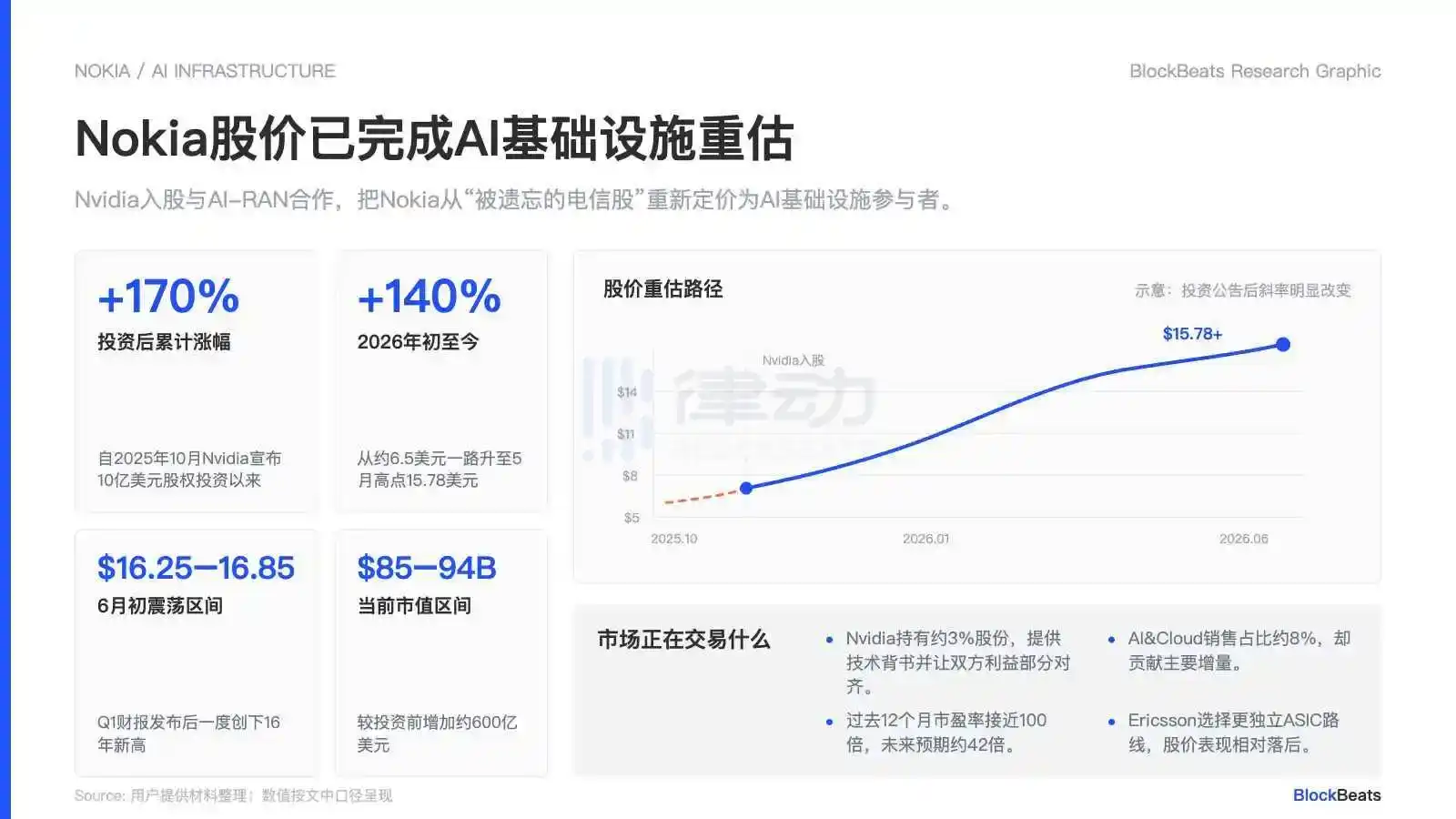
Since Nvidia announced a $1 billion equity investment and reached an AI-RAN strategic cooperation agreement in October 2025, Nokia's share price has accumulated gains of nearly 170%. Year-to-date in 2026, the increase exceeds 140%, rising from around $6.5 to a peak of $15.78 in May, and fluctuating in the $16.25-$16.85 range in early June. Following the Q1 earnings release, it once hit a 16-year high.

The current market capitalization is approximately $85-94 billion, an increase of about $60 billion from pre-investment. The AI&Cloud business accounts for about 8% of group sales but contributes the majority of the incremental value. The trailing twelve-month P/E ratio is close to 100 times, while the forward P/E ratio is about 42 times, significantly higher than traditional telecom peers but still lower than pure-play AI infrastructure companies. In contrast, Ericsson's share price performance lags due to its choice of a more independent ASIC chip strategy.

These changes indicate that the market is already trading on Nokia's transformation from a "forgotten telecom stock" to an AI infrastructure participant. Nvidia holds approximately 3% of the shares, providing both technical endorsement and partially aligning interests. Coupled with the narrative of the U.S. pushing to regain leadership in the telecom field, this has collectively accelerated this round of re-rating.

However, after significantly outperforming, what actual business progress is the market truly trading on?
Q1 Orders and Guidance Raise Validate Accelerated Transformation

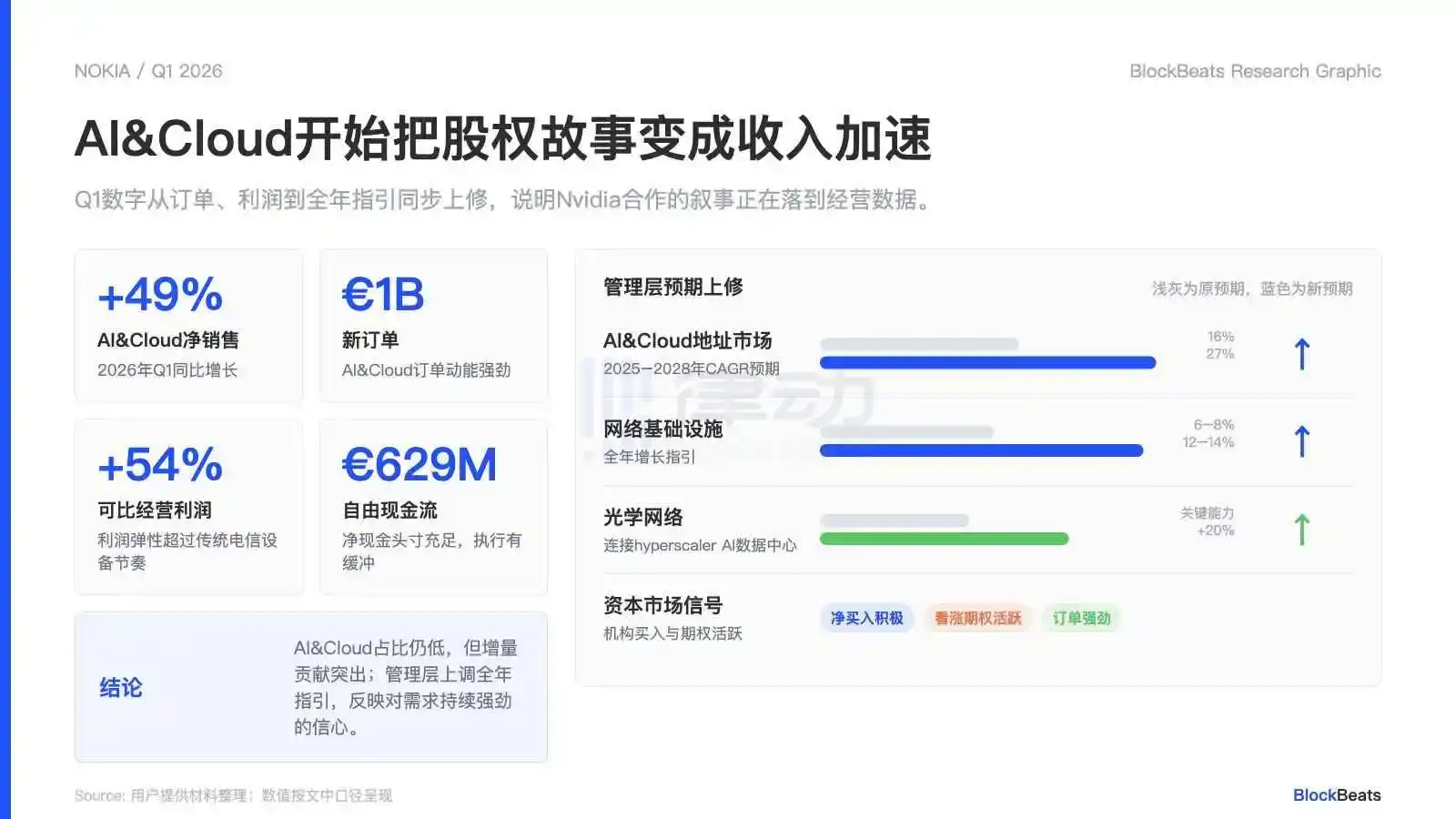
In the Q1 2026 earnings report, Nokia's AI&Cloud net sales increased by 49% year-over-year, securing €1 billion in new orders, with comparable operating profit surging by 54%. Consequently, the company raised its expected annual compound growth rate for the AI&Cloud addressable market from 16% to 27% for 2025-2028, and its full-year growth guidance for network infrastructure from 6-8% to 12-14%.

Optical network business grew by 20% during the same period, becoming a key part of connecting hyperscaler AI data centers. This capability was further strengthened following the acquisition of Infinera. New order intake is strong, free cash flow reached €629 million, and the net cash position is ample, providing a buffer for future execution.

These figures indicate that the cooperation with Nvidia is shifting from an equity story to visible revenue acceleration. Although AI&Cloud still represents a low proportion, its incremental contribution is prominent. The company's raised full-year guidance reflects management's confidence in sustained strong demand. Institutions have been net buyers over the past 12 months, and call option activity is higher than normal levels, further supporting this assessment.
MWC Tests and Innovation Lab Confirm Early Commercial Pathway

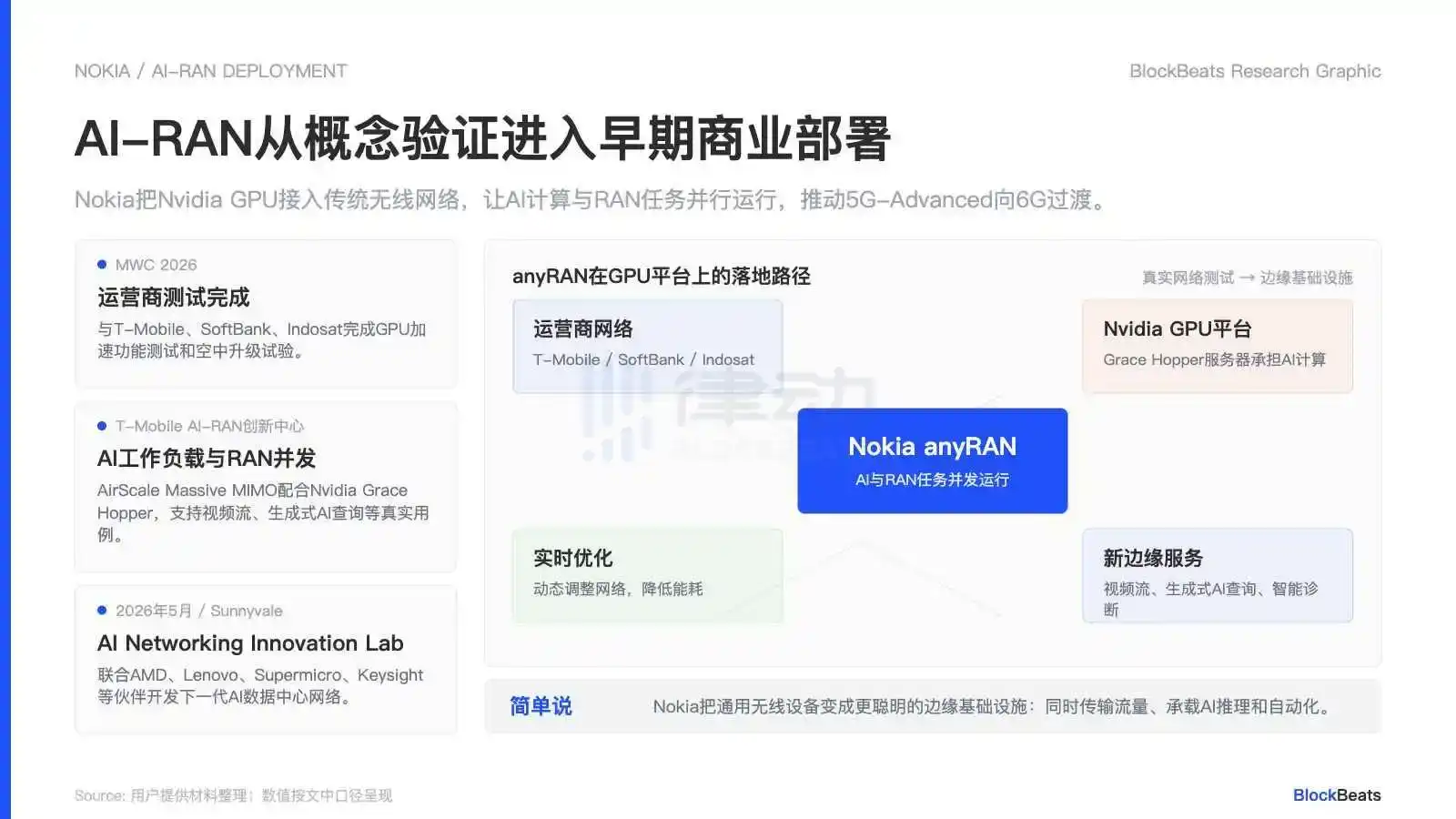
During MWC 2026, Nokia completed functional tests and over-the-air upgrade trials with operators like T-Mobile, SoftBank, and Indosat. At T-Mobile's AI-RAN Innovation Center, they used Nokia's AirScale Massive MIMO radio equipment alongside Nvidia Grace Hopper servers, successfully running AI workloads concurrently with RAN (Radio Access Network) tasks, supporting practical use cases like video streaming and generative AI queries.

In May 2026, Nokia opened the AI Networking Innovation Lab in Sunnyvale, California, collaborating with partners like AMD, Lenovo, Supermicro, and Keysight to develop next-generation AI data center networks. Concurrently, it introduced AI agent features for fixed broadband products, helping operators diagnose problems automatically, reduce costs, and accelerate fiber deployment.

These developments show that the acceleration path for Nokia's anyRAN software on Nvidia GPU platforms is now implementable. AI-RAN (using AI to optimize wireless access networks) is no longer just a concept but can deliver real-time optimization, reduce energy consumption, and generate new edge services within actual operator networks, providing a viable path for the transition from 5G-Advanced to 6G. Nokia CEO Justin Hotard stated that the cooperation is moving from validation to early commercial deployment.

Simply put, Nokia is applying Nvidia GPUs to traditional wireless network hardware, enabling AI computing and network transmission tasks to run in parallel. This allows for real-time network adjustments, saves power, and facilitates the development of new services. This approach turns general-purpose equipment into smarter edge infrastructure.
Deployment Scale Becomes the Biggest Constraint Under High Valuation

Although Q1 data, test results, and ecosystem partner expansion are relatively positive, the current P/E ratio is close to 100 times. Analyst consensus target prices are around €9.4-€12 (some investment banks have raised to around €12-€14), significantly lagging the current stock price. This indicates that the market has already priced in considerable optimism for long-term AI-RAN penetration and the 27% growth expectation, leaving a significantly compressed margin for error.

Over the next 12-24 months, the conversion speed of actual deployment contracts from major operators, the overall pace of AI capital expenditure, and differences in approach compared to Ericsson (which insists on independent ASICs, avoiding deep ties to a single GPU supplier) will become the core variables. If subsequent orders fall short of expectations or AI spending slows, the risk of a pullback will significantly increase.

Institutional net buying and bullish option preferences currently still support share price momentum, but these ultimately need to be validated by execution. Nokia's position as a representative AI edge infrastructure player has gained recognition, and the combination of optical networks with wireless access networks expands the overall market opportunity. However, there is a noticeable distance from current early orders to truly commercial deployment at hyperscaler scale.

It is still in the early acceleration phase, with overall execution signals being positive. However, the high valuation has already tightened the margin for error considerably. Investors should focus next on actual large-scale deployment progress rather than new demonstrations to gauge how much further this trend of AI expanding to the telecom edge can go.


Related Questions

QAccording to the article, why has Nokia's stock price experienced a significant revaluation recently?

ANokia's stock price has been revalued because the market is no longer viewing it just as a cyclical telecom equipment vendor, but as an AI network and edge infrastructure player. This shift was catalyzed by a strategic investment and AI-RAN collaboration with Nvidia, aligning with the trend of AI capital expenditure moving from core data centers into telecom edges and optical networks.

QWhat were the key performance highlights for Nokia's AI & Cloud business in Q1 2026?

AIn Q1 2026, Nokia's AI & Cloud business saw net sales grow by 49% year-over-year, secured 1 billion euros in new orders, and comparable operating profit increased by 54%. Due to this strong performance, the company raised its growth expectations for the AI & Cloud addressable market.

QWhat practical demonstrations at MWC 2026 validated Nokia's AI-RAN path?

AAt MWC 2026, Nokia conducted functional tests and over-the-air upgrade trials with operators like T-Mobile, SoftBank, and Indosat. A key test at T-Mobile's AI-RAN Innovation Center successfully ran AI workloads concurrently with RAN tasks using Nokia's AirScale Massive MIMO hardware and Nvidia Grace Hopper servers, supporting real use cases like video streaming and generative AI queries.

QWhat is a major constraint for Nokia's stock mentioned in the article, given its current valuation?

AA major constraint is the high valuation, with a trailing P/E close to 100x. This high valuation reflects significant market optimism upfront, leaving little room for error. The key variable now is the conversion speed of large-scale operator deployment contracts and the overall pace of AI capital expenditure over the next 12-24 months.

QHow does Nokia's strategic approach differ from its competitor Ericsson's according to the article?

ANokia's strategy involves a deep technical collaboration and equity investment from Nvidia, integrating Nvidia's GPU technology into its telecom hardware. In contrast, Ericsson is pursuing a more independent ASIC chip route, avoiding deep binding to a single GPU vendor like Nvidia.

Related Reads

CRCL 暴涨暴跌,COIN 跟着跳水:CLARITY Act 背后真正的利益战争

A recent draft of the CLARITY Act sparked market volatility, with Circle (CRCL) and Coinbase (COIN) stocks plunging. The core issue is Section 404 of the draft, which proposes prohibiting digital asset service providers from paying interest or rewards *solely* for holding payment stablecoins. The article argues this is not merely a technical debate over rewards, but a fundamental battle over the future role of stablecoins: Will they remain purely payment/transaction tools, or evolve into on-chain savings accounts that compete with bank deposits? US banks, fearing deposit outflow, have lobbied heavily for such restrictions. While Circle and Coinbase were both hit, their exposures differ. Circle's direct revenue primarily comes from reserve earnings, so the draft impacts its future growth narrative. Coinbase, however, relies heavily on USDC rewards and balances as part of its "Everything Exchange" platform strategy, making its growth engine more directly vulnerable. The analysis identifies three deeper layers often missed: 1) The political economy of preventing stablecoins from becoming savings substitutes. 2) The distinct impact on issuers (Circle) versus distributors/platforms (Coinbase). 3) The migration of yield demand to other tokenized securities (like MMFs) regulated under existing frameworks, as hinted in Section 505 of the same draft. In essence, three major battles are underway: banks defending their deposit base, Coinbase fighting for user entry and distribution rights, and Wall Street aiming to control the compliant path for tokenization. While a short-term headwind for crypto-native platforms, the article suggests this regulatory push could force the industry to build more sustainable value in real payment and B2B infrastructure.

marsbit33m ago

CRCL 暴涨暴跌,COIN 跟着跳水:CLARITY Act 背后真正的利益战争

marsbit33m ago

Tom Lee充值信仰:加密春天已至,ETH会涨到25万美元

Tom Lee, Chairman of BitMine (NYSE: BMNR), asserts that "Crypto Spring" has arrived and predicts ETH could reach $250,000. In his speech at "Proof of Talk 2026," he outlines five macro catalysts: the end of the Iran war reducing oil-price inflation, the likely passing of pro-crypto US legislation (the Clarity Act), a supportive White House, a crypto-friendly new Fed Chair (Kevin Warsh), and strong demographic-driven equity market growth. Lee argues that two key trends will drive ETH's value: Agentic AI/robotics, which will require blockchain for control and payments, and the massive tokenization of real-world assets (potentially a $300 trillion market). He believes Ethereum is poised to become a future monetary unit, with its price closely linked to software stocks that are already benefiting from AI. He notes the evolving role of the Ethereum Foundation, whose ETH holdings have shrunk to 0.1% of supply. He positions public treasury companies like BitMine—which holds 4.47% of ETH's circulating supply—as the new key ecosystem funders and validators. Finally, Lee promotes BitMine as a leveraged play on ETH's rise. He highlights BitMine's investments in AI/identity (via Eightco/ORBS), its massive ETH staking operation generating ~$1M daily, its stake in content creator MrBeast, and its upcoming inclusion in the Russell 1000 index, which could drive significant institutional buying. He concludes that if ETH reaches $25,000, BitMine's stock could rise dramatically from its current ~$18 price.

Odaily星球日报50m ago

Tom Lee充值信仰:加密春天已至,ETH会涨到25万美元

Odaily星球日报50m ago

Trading

Spot
Futures
活动图片