Ethereum "Cooling Off" to Build Momentum? ETF Funds Quietly Flow Back, Is the Historic Rally Script About to Play Out Again?

marsbitPublished on 2025-12-12Last updated on 2025-12-12

Abstract

Ethereum's price has been consolidating near $3,200 after facing resistance between $3,350 and $3,650, a zone reinforced by the 200-day EMA. Despite this, signs of recovery are emerging in spot ETF flows. Since November 21, ETH ETF assets under management have increased by 28%, from $16.8 billion to $21.5 billion, indicating a gradual return of buyer interest. Although net flows remain negative at -$138 million, this marks a significant improvement from October’s -$500 million, suggesting weakening selling pressure. The 30-day moving average of net active buying is also rising, resembling a pattern seen in early 2025 that preceded a major price surge. On the 4-hour chart, ETH is testing a key demand zone between $3,100 and $3,180. A hold above this level could lead to a retest of the 200-day EMA and a breakout toward $3,900. However, a breakdown may trigger a drop toward $3,000. Derivatives data shows neutral sentiment with mild funding rates and open interest, indicating cautious optimism. The key for Ethereum’s next major move depends on sustained defense at current support levels, coupled with growing ETF inflows and active buying momentum.

Ethereum's price action has flattened this week, encountering significant resistance in the supply zone between $3,650 and $3,350. The token is currently consolidating near $3,200. This resistance level roughly coincides with the 200-day Exponential Moving Average (EMA), further reinforcing the overhead pressure in this area. Notably, just as this is happening, spot Exchange Traded Fund (ETF) flows are beginning to show initial signs of recovery.

Key Points:

  • Since November 21st, the Assets Under Management (AUM) for spot Ethereum ETFs have increased from $16.8 billion to $21.5 billion, a gain of 28%.
  • Net active buying volume is showing an upward trend, indicating that the previously strong selling pressure is weakening, while buying power is gradually returning.
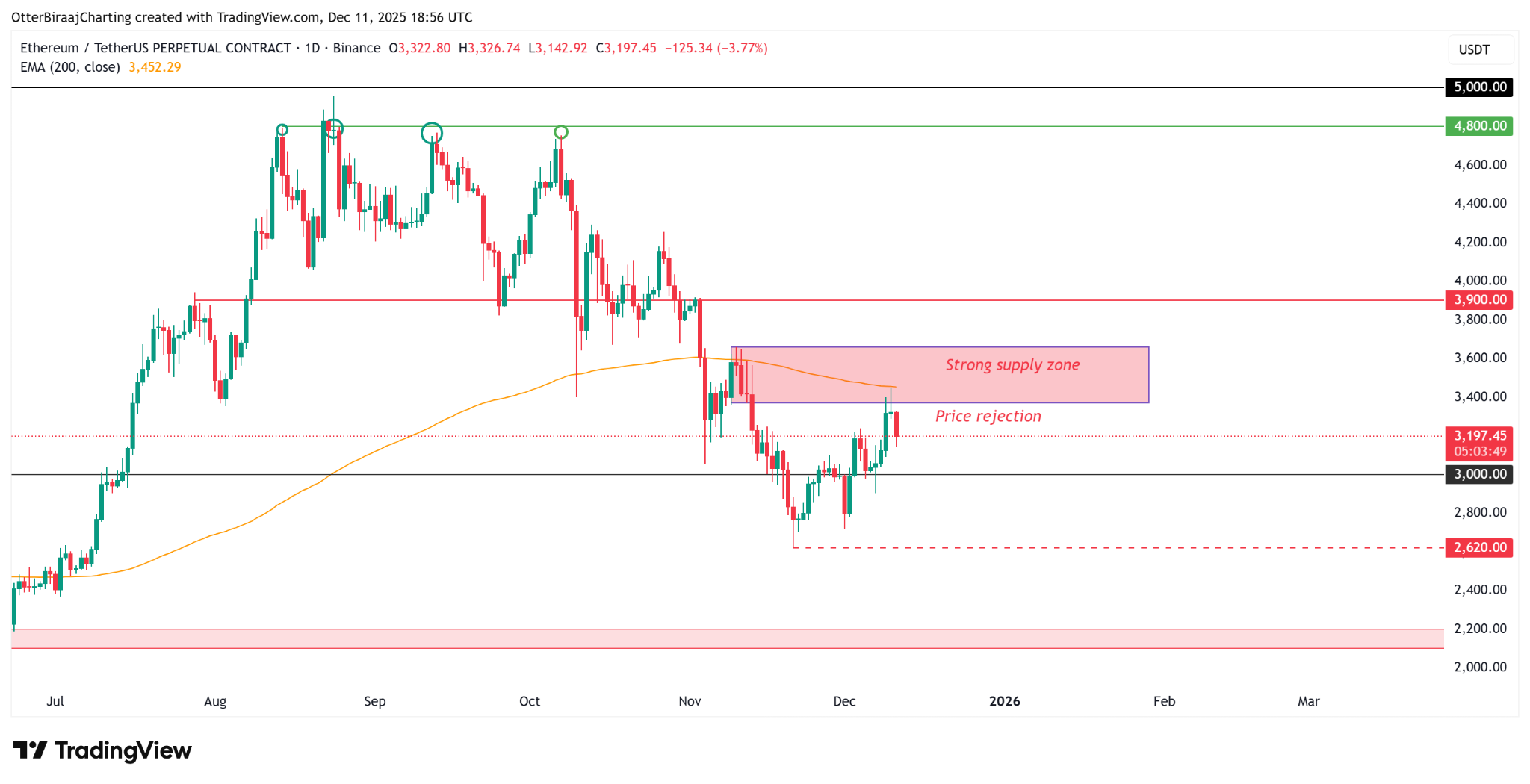
Ethereum Daily Chart. Source: TradingView


ETF Inflows Resume, But Charts Reflect Lingering Investor Caution

According to data from Glassnode, after weeks of consecutive outflows, spot ETH ETFs are finally showing initial "signs of recovery." Since November 21st, ETF net asset values have rebounded by 28%, suggesting potential improvement in market demand before year-end. However, compared to the peak of $32 billion in early October, the magnitude of this rebound remains modest, indicating that institutional confidence has not yet fully recovered.
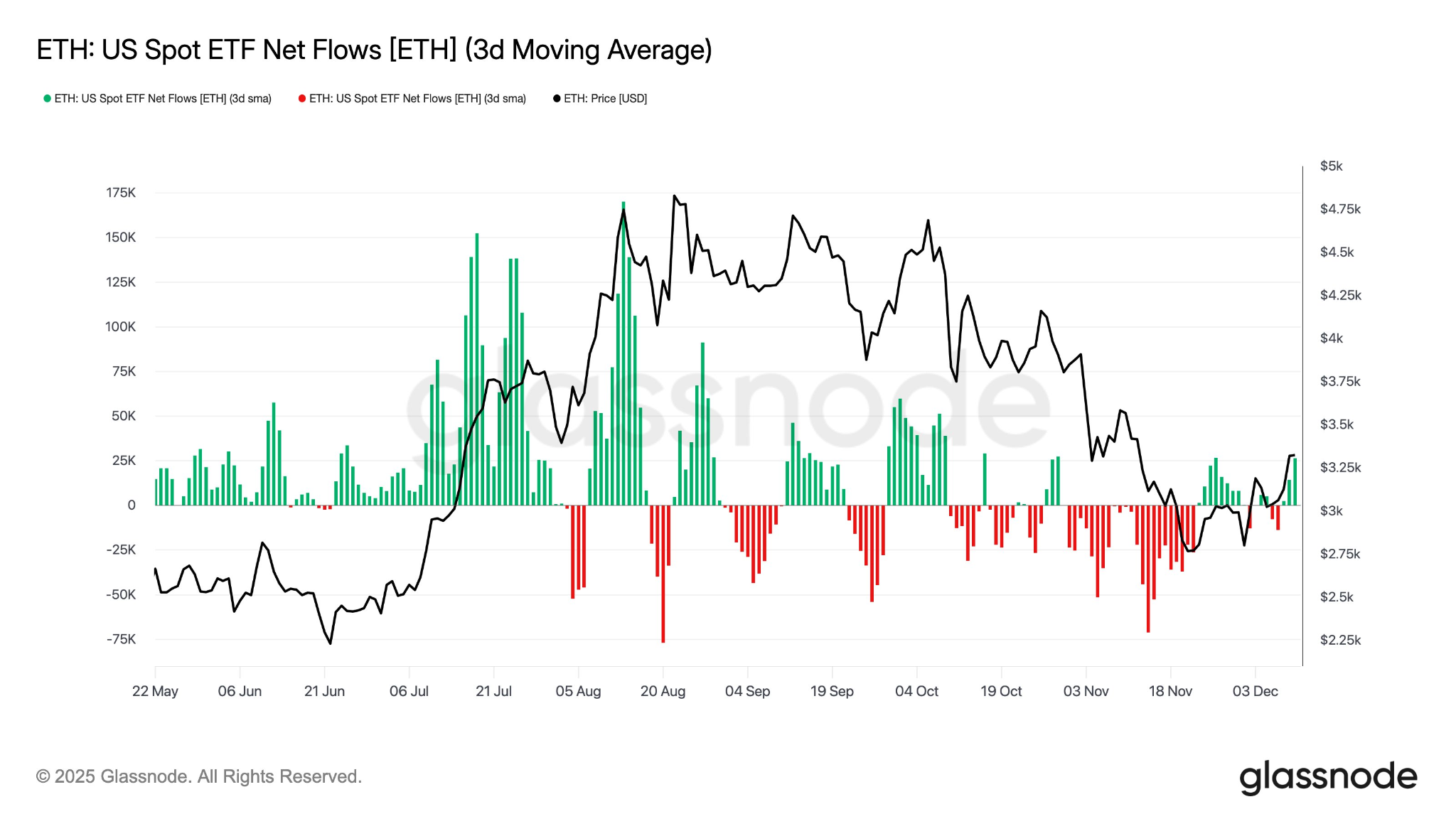
Spot ETH ETF Net Flow. Source: Glassnode

Data from CryptoQuant further supports this assessment. Although the net flow remains negative (-$138 million), it has improved significantly from the -$500 million seen in October, marking a structural shift. During the correction phase from September to October, the market was dominated by active selling, but this trend is gradually subsiding.

The 30-day moving average of net active buying volume is also showing a pattern of rising lows. A similar structure appeared in early 2025, after which the Ethereum price achieved a nearly 3-fold increase and reached a new all-time high.

If the current trend continues, this positive shift in active buying activity could become a key catalyst driving Ethereum to break out upward again in the coming weeks.
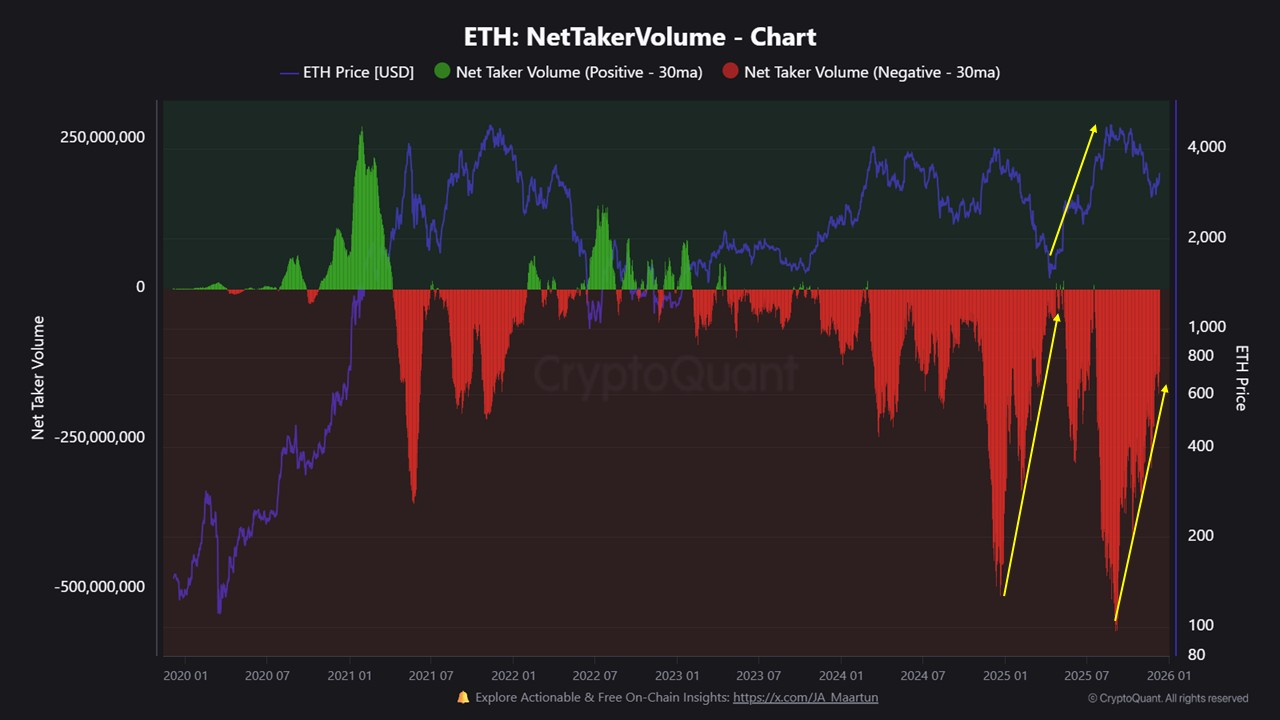

Ethereum On-Chain Flow Data. Source: CryptoQuant


ETH Price Consolidates in Support Zone, Derivatives Market Cools Off

The current Ethereum price is testing the order block density zone between $3,100 and $3,180 on the 4-hour chart, an area that could transform into near-term demand support. Although the ETH price remains within an ascending channel, the upward momentum has noticeably weakened. The market is in a structural decision-making phase regarding its direction.
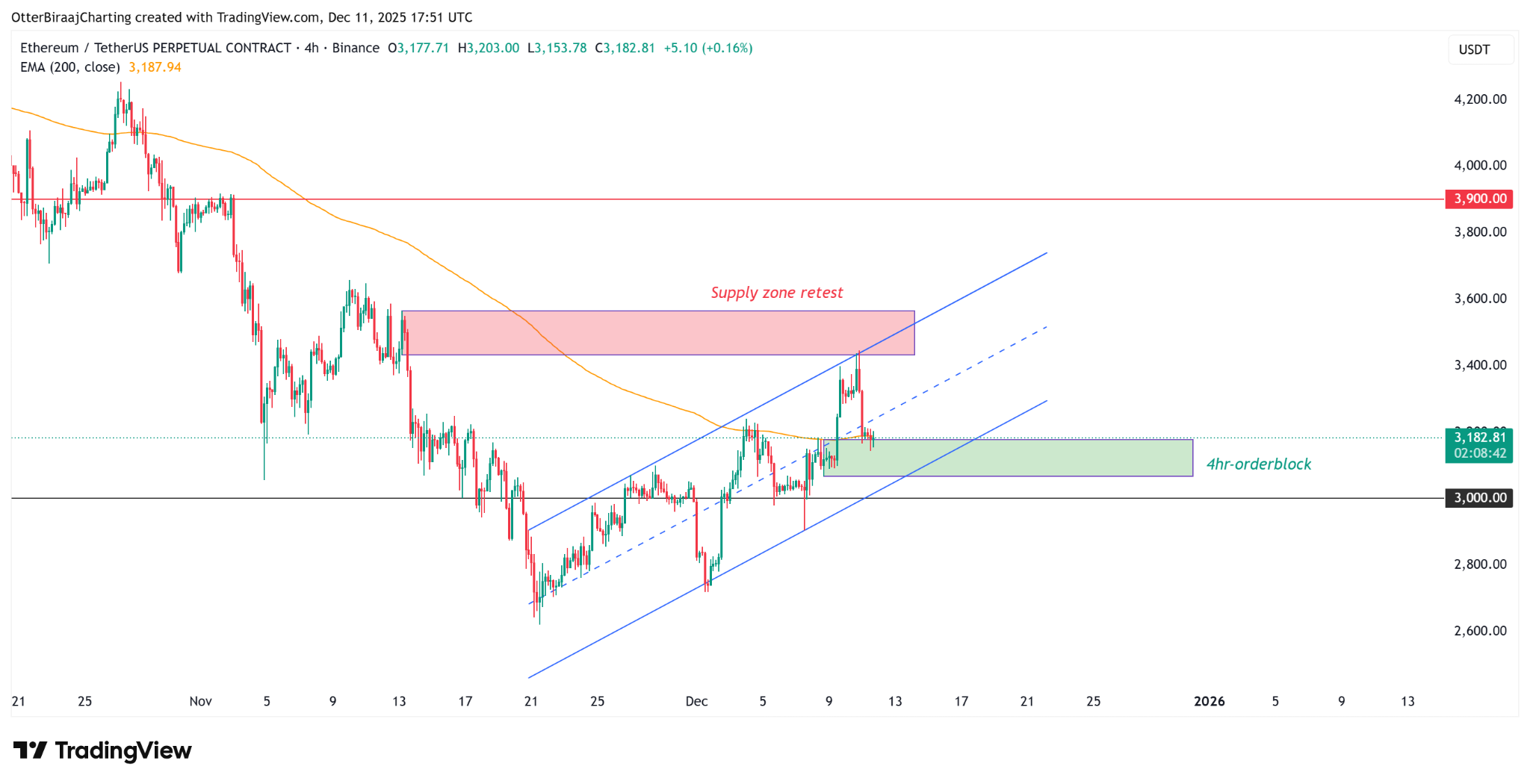

4-Hour Price Chart. Source: TradingView

From a bullish perspective, if the price can hold above this demand zone and the channel support, ETH could potentially attack the daily 200-day EMA again. A clear break above $3,450 would invalidate the previously formed resistance and open the path for the price to test the $3,900 resistance level.

From a bearish viewpoint, a break below the lower trendline of the current ascending channel would constitute a bearish signal, potentially leading the price to test the key $3,000 support level.

Data from Hyblock shows the Ethereum derivatives market presents a neutral yet fragile landscape. After the price met resistance, the Total Open Interest (OI) slightly declined. Funding rates are positive but not significantly high, and the buy-sell ratio is also near neutral, indicating that spot investors have not yet formed a consensus bullish expectation.
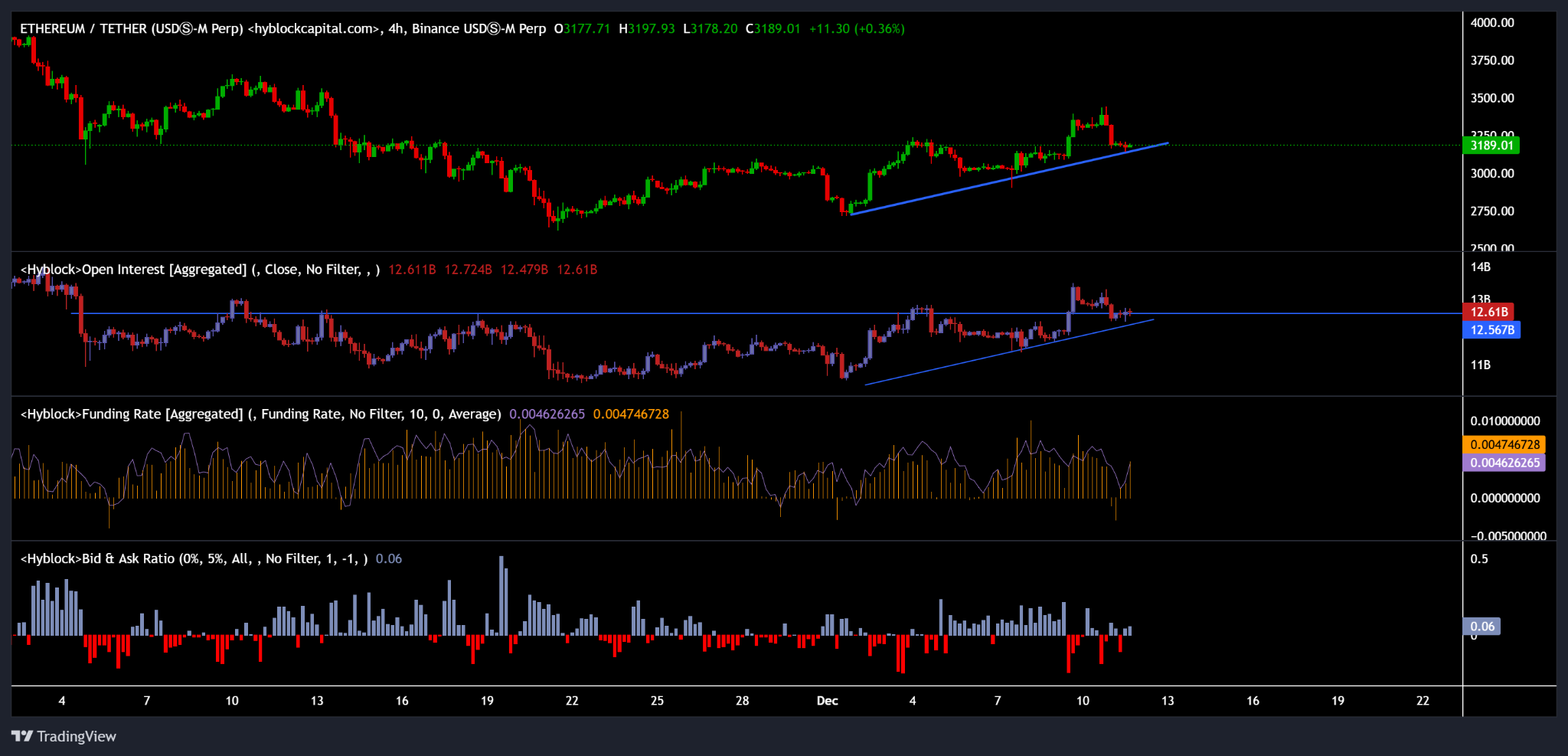
Ethereum Futures Market Data. Source: Hyblock Capital

Summary: The key to Ethereum's subsequent price action lies in whether the bulls can sustain their defense in the demand support area, thereby catalyzing a virtuous cycle between active buying flows and ETF demand, ultimately translating into sustained upward momentum.

Related Questions

QWhat is the current price range where Ethereum is consolidating, and what key resistance level is it facing?

AEthereum is currently consolidating around $3200, facing significant resistance in the $3650 to $3350 supply zone, which aligns with the 200-day Exponential Moving Average (EMA).

QHow much has the assets under management (AUM) for spot Ethereum ETFs increased since November 21, and what does this indicate?

ASince November 21, the AUM for spot Ethereum ETFs has increased by 28%, from $16.8 billion to $21.5 billion, indicating a potential recovery in market demand and a shift from strong selling pressure to returning buyer interest.

QWhat key on-chain metric from CryptoQuant shows a structural shift in market dynamics, and how has it improved?

AThe net flow metric, while still negative at -$138 million, has improved significantly from -$500 million in October, indicating a structural shift where the previously dominant active selling pressure is diminishing.

QWhat is the critical support zone on the 4-hour chart that Ethereum is testing, and what are the potential price targets for a bullish breakout?

AEthereum is testing the order block support zone between $3100 and $3180 on the 4-hour chart. A bullish breakout above the 200-day EMA and a clear break above $3450 could open the path for a move towards the $3900 resistance level.

QWhat does the data from Hyblock Capital indicate about the current sentiment in the Ethereum derivatives market?

AHyblock Capital data shows a neutral but fragile sentiment in the derivatives market. Open Interest (OI) has slightly decreased, funding rates are positive but not excessively high, and the buy-sell ratio is near neutral, indicating that spot investors have not yet formed a strong, unified bullish consensus.

Related Reads

From Airdrop Myth to King of Derivatives: A Look Back at Hyperliquid's 2025 Conquest

Reviewing crypto's growth in 2025, Hyperliquid stands out. It began the year with an epic airdrop and strong price performance, capturing attention. By year's end, it transformed into a top-four revenue-generating platform in crypto, earning over $650M and at one point capturing 70% of all perp trading volume. Its success was no accident. In Q1, it solidified its reputation by being first to list new assets like the TRUMP perp and launched HyperEVM, a smart contract layer. Q2 saw explosive growth: HYPE token surged 4x from April lows, and HyperEVM's TVL grew from $350M to $1.8B. The platform gained mainstream media coverage. In Q3, major wallets like Phantom and MetaMask integrated via Hyperliquid's builder codes, routing $158B in volume and earning partners nearly $50M. A high-profile stablecoin bid war was won by Native Markets, aligning with Hyperliquid's bootstrapped ethos. However, new competitors like Aster and Lighter emerged with aggressive airdrops. Q4 brought permissionless listings via HIP-3, enabling new markets like stock perps and yield-bearing collateral. Yet, HYPE fell nearly 50% from its September peak due to market conditions, a rare ADL event during a crash, and the start of team token unlocks. As perps go mainstream in 2026, Hyperliquid's true test begins. Its success came from building a superior product and ecosystem without shortcuts. Maintaining leadership will require doing it all over again in a crowded field.

marsbit13m ago

From Airdrop Myth to King of Derivatives: A Look Back at Hyperliquid's 2025 Conquest

marsbit13m ago

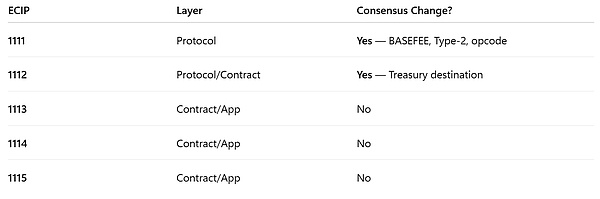
ETC Olympia Development Part 1: Implementing ECIP-1111 and ECIP-1112

ETC Olympia Development Series Part 1: Implementing ECIP-1111 and ECIP-1112 This article introduces the first part of the Ethereum Classic Olympia development series, focusing on the implementation of ECIP-1111 and ECIP-1112. These two proposals are the only components within the broader Olympia framework that modify consensus behavior. ECIP-1111 modernizes the fee market by introducing an EIP-1559-style mechanism with a base fee and optional priority tip (miner tip). A key difference from Ethereum is that the base fee is not burned but is instead redirected to a treasury address defined by ECIP-1112. It also adds support for Type-2 transactions and the BASEFEE opcode (0x48), ensuring compatibility with modern EVM tooling and wallets. Crucially, it does not change miner rewards, monetary policy, or existing transaction types. ECIP-1112 defines an immutable, deterministic treasury smart contract that will receive the redirected base fees. This vault is designed to be receive-only upon activation, meaning it can accumulate value but cannot distribute funds until a separate, subsequent governance layer (defined in other ECIPs) is deployed and activated on the contract layer. The article emphasizes the modular architecture of Olympia. While the suite includes five ECIPs (1111-1115), only these two affect consensus. This separation ensures that the core protocol remains minimal and auditable, while future governance and funding mechanisms can evolve independently at the contract level without requiring further hard forks. The implementation is currently in the draft stage per the ECIP-1000 process. Any decision to move forward with mainnet activation will require extensive testing on the Mordor testnet and full community review.

金色财经18m ago

ETC Olympia Development Part 1: Implementing ECIP-1111 and ECIP-1112

金色财经18m ago

Trading

Spot
Futures
活动图片