2026 Crypto Funding Reshuffle: Game and DePIN Are Dead, Prediction Market Duo Takes 18% of All Year's Funding with Two Deals

marsbitPublished on 2026-05-08Last updated on 2026-05-08

Abstract

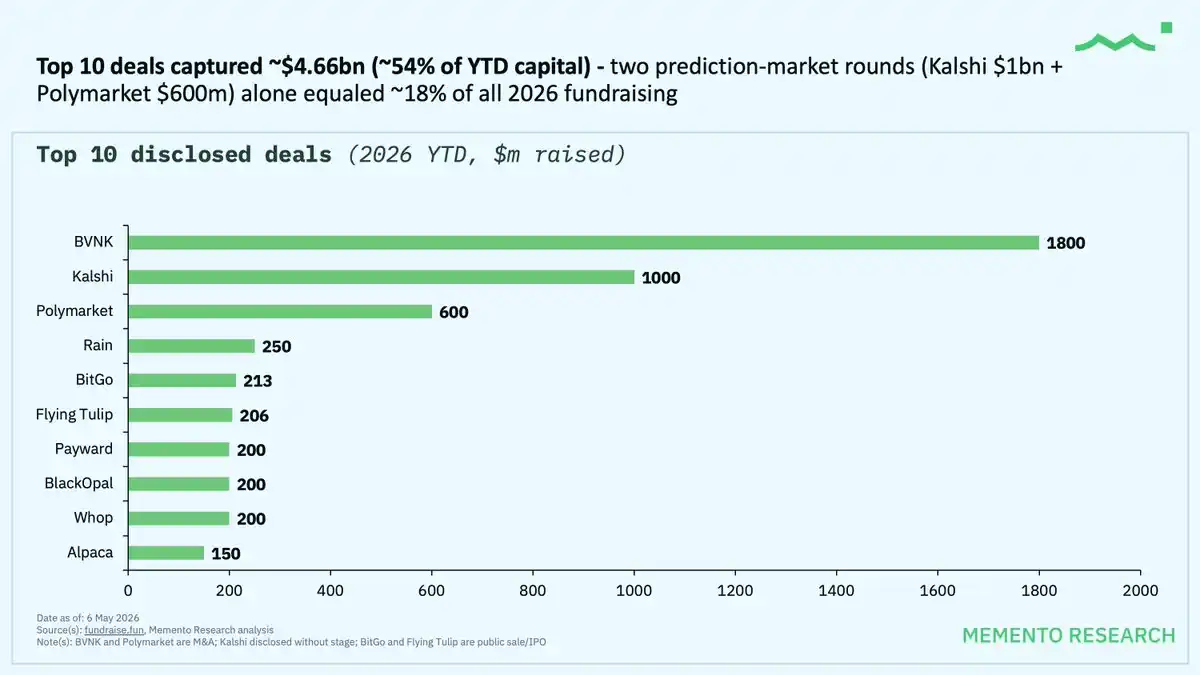
Cryptocurrency Funding in 2026: Gaming & DePIN Falter as Prediction Markets Dominate Data from the first four months of 2026 reveals a stark shift in crypto venture funding. The gaming and DePIN (Decentralized Physical Infrastructure Networks) sectors have seen capital nearly dry up. In contrast, the "Consumer" category, led by two massive deals for prediction market platforms Kalshi ($1B) and Polymarket ($600M), captured a significant share. These two deals alone accounted for 18% of the year's total $8.65 billion raised and exceeded the combined funding of all 47 DeFi projects. Overall, the $8.65B across 305 deals is misleading. A March surge to $4.57B was largely due to two major acquisitions (BVNK at $1.8B and Kalshi). Excluding these, the underlying monthly funding rate is approximately $1B, indicating continued softness. The "Payments" and "Consumer" sectors together consumed 72% of all capital. Another notable trend is the rise of mergers and acquisitions (M&A), with 48 deals nearly matching the 57 seed-round investments. This signals a market pivot from funding new ideas to consolidating around established leaders. The most active investors so far in 2026 are Coinbase Ventures (18 deals), Tether (13 deals), Animoca Brands (11 deals), and GSR (11 deals). Notably, a16z's pace has slowed significantly compared to previous years.

Author:Memento Research

Compiled by: Deep Tide TechFlow

Deep Tide TechFlow Introduction: Crypto funding data for the first four months of 2026 reveals a harsh reality: the Game and DePIN sectors are nearly starved of capital, while Kalshi and Polymarket, two prediction market companies, have taken more money than all DeFi projects combined for the entire year. More alarmingly, the number of M&A deals has already matched seed rounds, indicating a shift in capital from betting on new ideas to acquiring existing leaders.

Funding Overview: March's Surge Was an Illusion

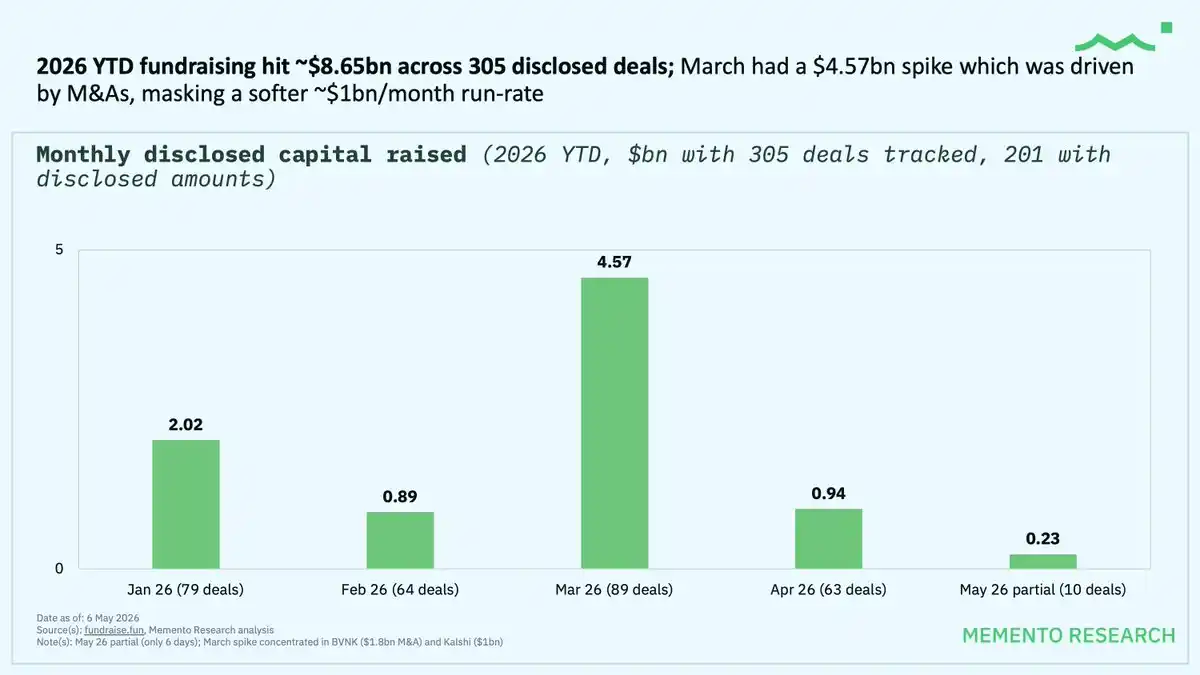
From January 1st to May 6th, 2026, the crypto industry completed 305 funding rounds, totaling $8.65 billion. However, the "surge" to $4.57 billion in March was actually just two massive M&A deals: BVNK's $1.8 billion and Kalshi's $1.0 billion.

Excluding these two deals, the real funding pace is about $1 billion per month, even weaker than at the end of 2025.

Capital Flow: Payments and Consumer Absorb 72%

By sector breakdown:

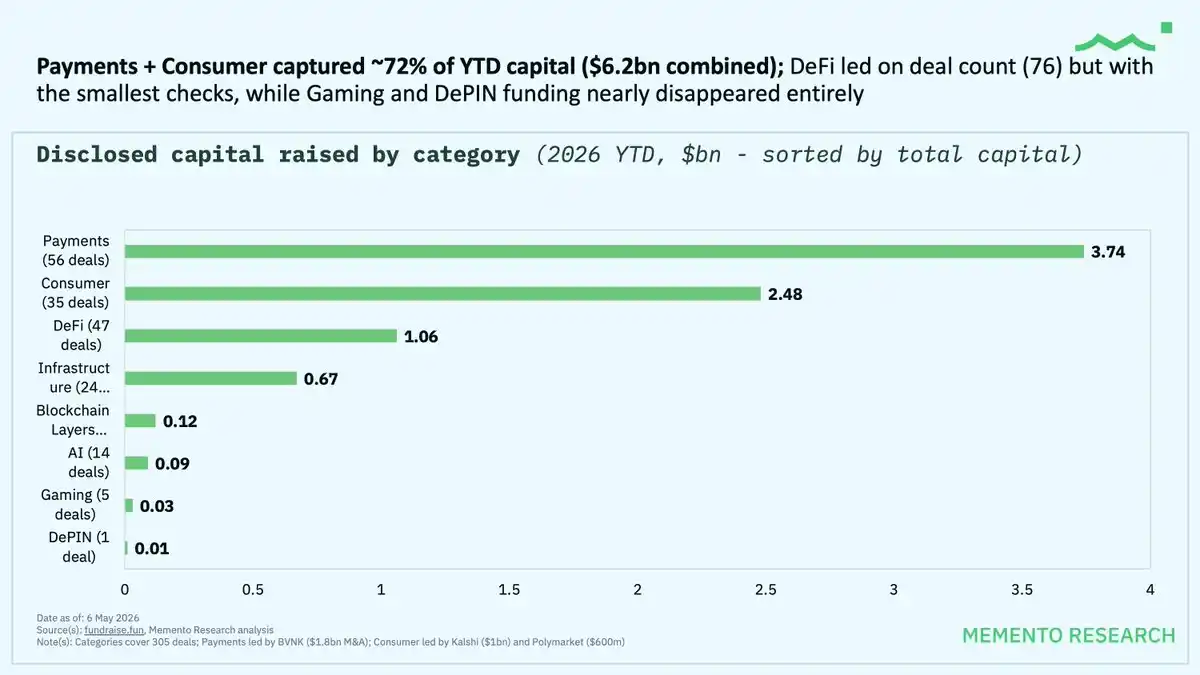
Payments: $3.74 billion (56 deals)

Consumer: $2.48 billion (35 deals)

DeFi: $1.06 billion (47 deals, the highest number of transactions)

The Payments and Consumer sectors combined account for 72% of the year's total funding. Funding for Game and DePIN has nearly vanished.

Prediction Markets Dominate the Consumer Sector

Two prediction market companies accounted for 18% of the year's total funding:

Kalshi: $1.0 billion

Polymarket: $600 million

These two deals totaling $1.6 billion exceed the sum of all 47 DeFi funding rounds.

M&A Becomes Mainstream

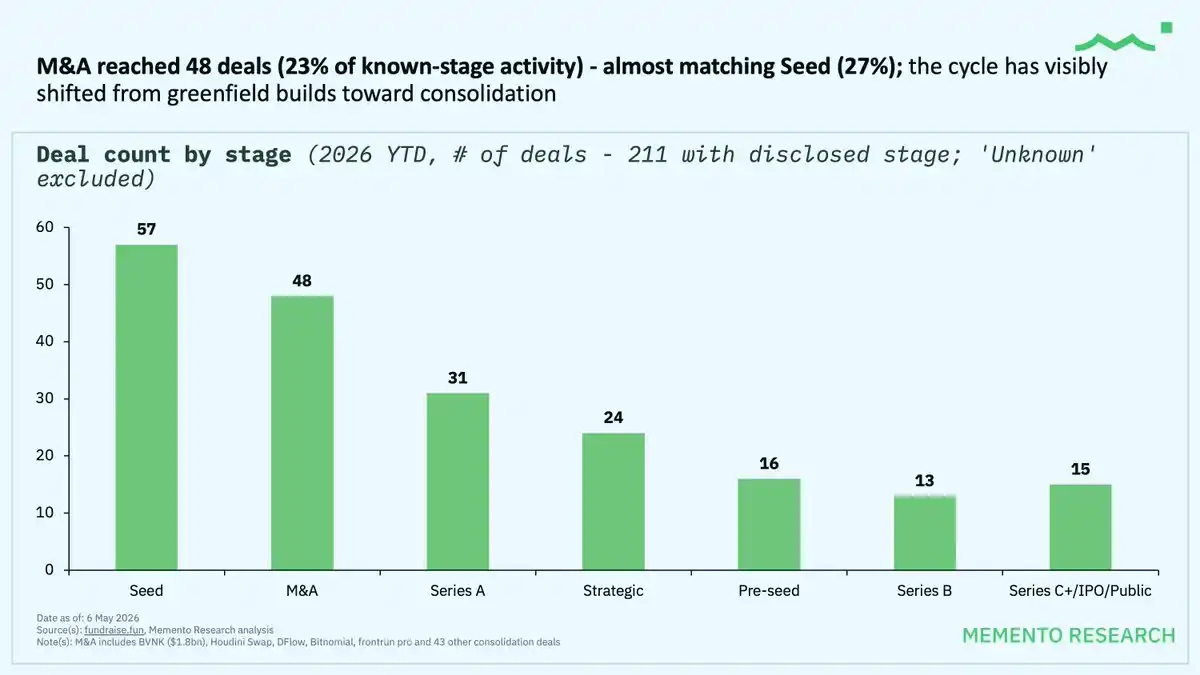
M&A deals reached 48 (accounting for 23% of known-stage transactions), nearly matching the 57 seed rounds (27%). This cycle has shifted from investing in new ideas in early stages to acquiring industry leaders.
Investor Rankings Reshuffled

Most active funds in 2026:

Coinbase Ventures: 18 deals (ranked second during 2021-26 period)

Tether: 13 deals (new top lead investor)

Animoca Brands: 11 deals (ranked first during 2021-26 period)

GSR: 11 deals

a16z: 7 deals (a significant drop compared to ~200 deals during 2021-26 period)

Related Questions

QAccording to the article, which two sectors took the majority of crypto funding in early 2026?

AThe Payments and Consumer sectors took the majority of crypto funding, together accounting for 72% of the total capital raised.

QWhat significant trend does the data reveal about mergers and acquisitions (M&A) compared to seed funding?

AThe data shows that M&A deals reached 48 (23% of known-stage deals), almost catching up to seed rounds at 57 deals (27%). This indicates a shift in the investment cycle from funding new ideas to acquiring established industry leaders.

QWhy was the spike in funding for March 2026 described as an 'illusion'?

AThe spike to $4.57 billion in March was largely an illusion because it was driven by just two mega-deals: an $1.8 billion acquisition of BVNK and a $1 billion deal with Kalshi. Removing these two transactions reveals a slower, more sluggish monthly funding pace of around $1 billion.

QHow did the funding for prediction market companies compare to the total funding for all DeFi projects in the period covered?

AThe two prediction market companies, Kalshi ($1 billion) and Polymarket ($600 million), together raised a combined $1.6 billion. This amount exceeded the total raised by all 47 DeFi projects, which was $1.06 billion.

QWhich investment firms were the most active in terms of deal count during early 2026, and how did this compare to their historical activity?

AIn early 2026, the most active investors by deal count were Coinbase Ventures (18 deals, historically ranked 2nd from 2021-26), Tether (13 deals, new top investor), Animoca Brands (11 deals, historically ranked 1st), GSR (11 deals), and a16z (7 deals, showing a significant decline from its historical ~200 deals between 2021-26).

Related Reads

Why Does the Term 'Year of AI Computing Power Realization' Have Pitfalls? —Understanding the Four Hurdles from Policy Signals to Actual Orders in One Article

This article critiques the phrase "The First Year of AI Computing Power Cashing In," arguing it oversimplifies a complex, multi-stage process. It proposes a "Four Gates" framework to assess the true commercialization of domestic AI computing power (like Huawei's Ascend chips): 1. **Policy Procurement:** Widely open in 2026. Significant government funding and large bulk orders from tech giants like Alibaba and Tencent exist. However, purchasing hardware is not the same as deploying it for real use. 2. **Real Deployment:** A crack has opened. The key evidence is DeepSeek V4, a top-tier AI model fully migrating from NVIDIA's CUDA to domestic computing platforms. This proves the capability for real, high-level tasks, but widespread adoption beyond leading tech firms is still nascent. 3. **Mature Software Ecosystem:** A narrow crack has opened. While frameworks like Huawei's CANN are progressing, they lag far behind NVIDIA's vast, established CUDA ecosystem in terms of supported models and developer ease-of-use. Building this middle-to-downstream developer environment is estimated to need 1-2 more years. 4. **Scalable Replication:** Essentially closed. This final gate, where thousands of mid-sized enterprises across various industries can easily adopt the technology without major migration costs, is not expected before 2027-2028. The core risk is conflating these stages. While 2026 marks a real turning point in policy-driven procurement and proving technical viability (Gates 1 & 2), the phrase "cashing in" is premature for the full industry. True, large-scale value realization depends on the later, slower-to-open gates of software maturity and scalable replication to the broader market. DeepSeek V4's shift is identified as the most critical 2026 signal, changing the narrative from "can it work?" to "when will supply meet demand?"

marsbit27m ago

Why Does the Term 'Year of AI Computing Power Realization' Have Pitfalls? —Understanding the Four Hurdles from Policy Signals to Actual Orders in One Article

marsbit27m ago

Trading

Spot
Futures
活动图片