Author: Pink Brains
Compiled by: AididiaoJP, Foresight News
Over the past three years, we have collaborated with more than 35 leading DeFi projects on their marketing initiatives. We found that the most effective marketing campaigns are not designed from the project's perspective, but from the user's perspective: how users discover products, how they build trust, and how they genuinely engage.
Note: Pink Brains is a marketing studio focused on DeFi, providing services like KOL marketing and content creation (threads, analyses) for DeFi projects.
The logic of most crypto marketing guides goes like this: select KOLs, allocate budget, launch campaign, track exposure.
We've completely flipped this process. Instead of starting with tactics, we first study user behavior: How do DeFi users discover new protocols? What convinces them to try? What makes them stay?
How Do DeFi Users Discover New Protocols?
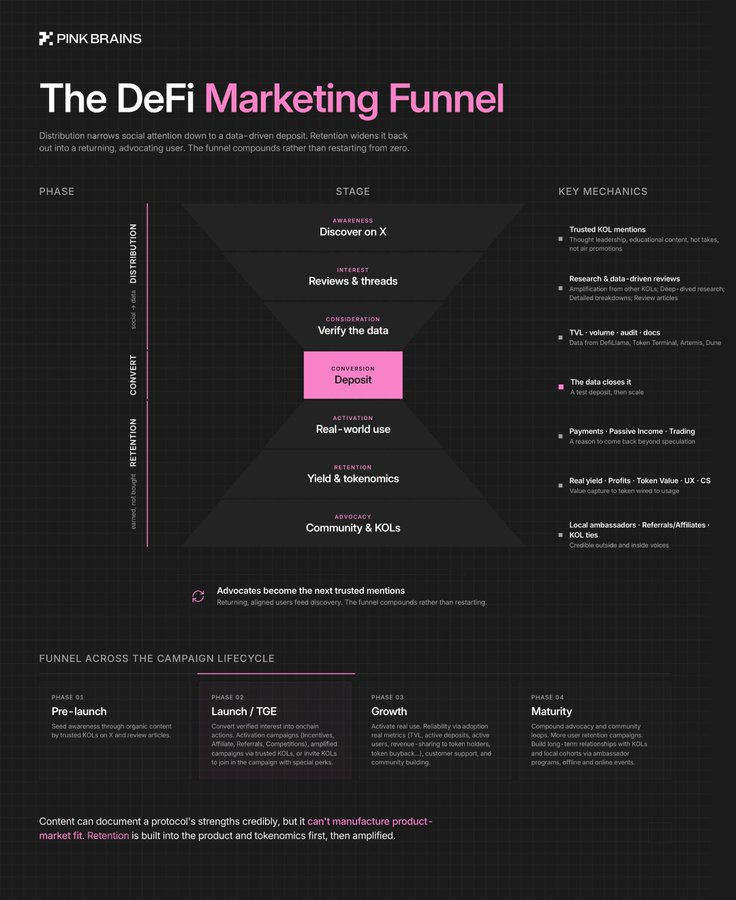
Crypto users typically spot opportunities on Twitter first, then go to platforms like DefiLlama, DeBank, Artemis, Token Terminal, Moni to verify data, check the protocol's official documentation, and finally consider depositing funds.
The discovery process is socially driven, but the decision-making process is data-driven.
The actual path usually looks like this:
A trusted account posts about a new perpetual DEX—this post rarely triggers an immediate deposit.
The user will first check the project's official account, browse posts and reviews from other KOLs, look at data like trading volume, TVL, incentive programs, skim the documentation and guides, and finally deposit a small test amount.
That X post merely introduces the protocol to the user, but what truly drives the decision is the KOL's content and verifiable data.
This is why X remains the core battleground for DeFi: it's where narratives form, vulnerabilities are exposed in real-time, and founders and researchers fiercely debate in the comments.
The practical takeaway for protocol teams is: The goal in the discovery phase is not virality, but to be mentioned by accounts already trusted by data-driven users, and for all data to hold up when users go to verify. A powerful X mention paired with thin TVL or a weak audit page cannot convert truly valuable users.
What Are DeFi Users Focusing on in 2026?
This year, DeFi users are primarily drawn to several clear themes:
- New DeFi trends (tokenization, perpetual contracts, RWAs, pre-IPO perps, and the crypto×AI wave)
- Airdrops that require real contribution but carry higher risks
- Yields backed by real revenue
- Value-capturing tokens directly linked to product usage
- New types of trading venues
The common thread is: verifiable mechanisms, not marketing speak.
New Narratives: Perpetual Contracts, RWAs, Crypto×AI
What people are trading is changing.
Hyperliquid's HIP-3 upgrade enabled permissionless perpetual listings, leading to over 100 RWA markets (stocks, commodities, indices, forex, even pre-IPO assets) with a cumulative trading volume exceeding $130 billion. By the end of Q1 2026, RWA markets accounted for over 90% of HIP-3 open interest.
@Ostium (a dedicated RWA perpetual DEX on Arbitrum) proposed the 'perpification' theory: a perpetual contract only needs a price oracle and a liquidity pool, not a full tokenization stack. This brings traditional market exposure on-chain faster than tokenized spot markets.
@tradexyz and @ventuals focus on commodities and forex on Hyperliquid; Trade.xyz's Cerebras pre-IPO perpetual contract almost perfectly 'priced' the stock hours before its Nasdaq debut.
Another major narrative is crypto×AI. Users care not about the narrative, but about agentic payments and token incentive mechanisms aligned with AI.
- @opentensor ($TAO) completed its first halving in late 2025, now runs 120+ active subnets, and generates real revenue demand.
- @virtuals_io (VIRTUAL) reported over $400 million in agent GDP and $60 million in protocol revenue in Q1 2026, deployed 17,000+ agents, and co-authored a cross-chain agent commerce standard with the Ethereum Foundation.
- @NEAR Protocol and @AskVenice occupy core positions in private inference and data sovereignty.
Additionally, early connections in crypto×robotics (like @xmaquina, Robotics Capital Markets) are emerging.
This sector is volatile with many low-quality projects, but what users truly care about is revenue and actual usage of the leading projects.
Airdrops, but the Bar is Much Higher Now
Airdrops remain a significant driver, with many airdrop hunters still seeking the next HYPE, but the easy days are over.
Projects increasingly demand real contributions: sustainable trading, genuine liquidity provision, community education content, etc. Sybil filtering is now standard, and tokens often face immediate selling pressure post-TGE.
Points programs value generated fees more than locked capital; testnet rewards emphasize sustained, qualitative participation over mere transaction count.
Real Yield
Users now clearly distinguish between 'yield generated from real revenue' and 'yield printed via inflation,' strongly preferring the former.
Real yield takes many forms, but only a few are meaningful: fees from economic activities like trading, lending, funding rates, liquidations; infrastructure usage fees; and yield backed by RWAs.
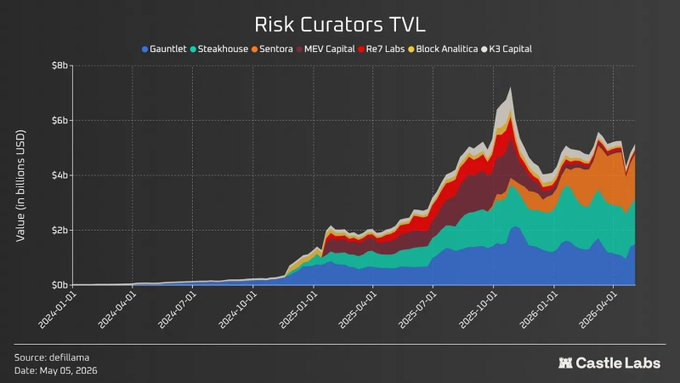
Yield trading platforms like @pendle_fi, vaults managed by risk managers like @veda_labs, @gauntlet_xyz, @MEVCapital, @SteakhouseFi, and on-chain capital allocators like @sparkdotfi have become main entry points for capital deployment, channeling liquidity into fixed-income strategies based on real yield sources.
For example, @ethena's sUSDe generates yield through delta-neutral basis trading, with a supply nearing $5.8 billion.
@SkyEcosystem's sUSDS pays ~4-4.5% yield, backed by RWA collateral and stability fees—S&P even issued its first credit rating to a DeFi protocol, Sky.
The overall trend is moving from a market that 'creates yield via inflation' to one that 'imports and allocates yield from real sources.'
Value-Capturing Tokenomics
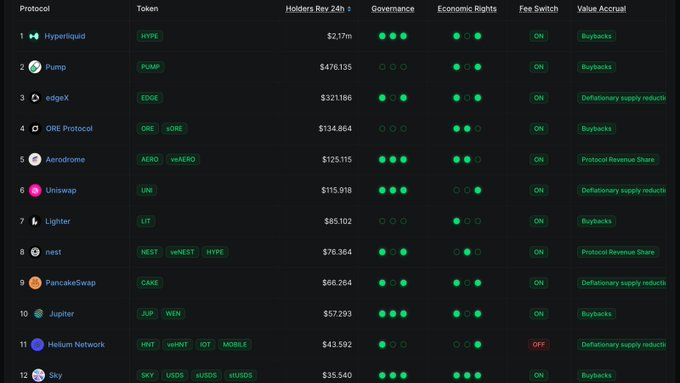
Beyond yield, users increasingly favor tokens whose value is directly linked to product adoption—often through buybacks, buyback-and-burn, supply deflation, protocol revenue sharing, etc.
Hyperliquid's HYPE is a classic case: its Assistance Fund uses ~99% of trading fee revenue for open market buybacks, totaling over $1.16 billion. Since TGE, 4.45% of the total supply has been bought back and burned.
Venice's VVV ties demand to staked AI inference compute; part of the protocol revenue is used to buy back and burn VVV, with ~40% of the supply burned so far, and the price up 400% YTD.
Bittensor's TAO adopts a Bitcoin-like halving mechanism, shifting from inflation to scarcity.
The pattern users look for is the same: the token must be tightly coupled with the actual activity the product generates, where increased activity adds value, not dilutes it.
New Types of Trading Venues
Finally, attention is spreading to new types of trading venues:
- Prediction markets (Polymarket and Kalshi had massive cumulative volume in 2025)
- Physical card and collectible trading markets
- Crypto-enabled gamification (Crypto iGaming)
These are more speculative but do bring real trading volume and revenue.
Logan Paul publicly stated his portfolio holds no stocks, only Pokémon cards. The Pokémon card market reached $75 billion in 2026 (compared to under $15 billion in 2016).
@Collector_Crypt (a card trading market on Solana) has become the second-largest revenue dApp on Solana, with $1.9M in daily revenue.
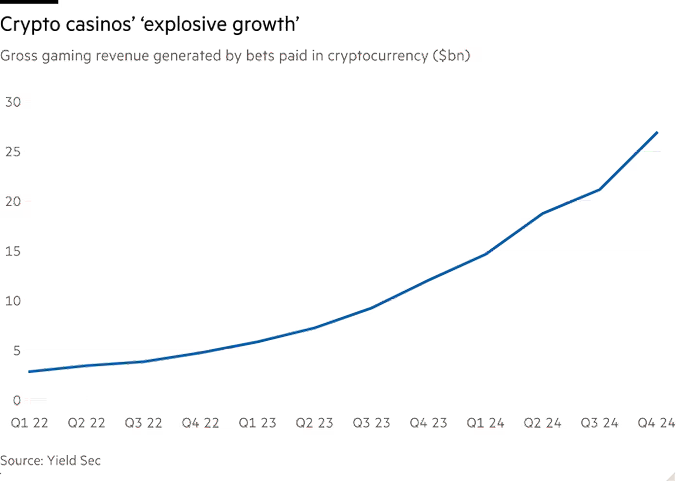
GameFi is passé, but GambleFi is quietly exploding. Crypto gambling revenue reached $81.4B in 2024, a 5x increase from 2022. In Q1 2025 alone, crypto betting volume hit $26B, almost double year-over-year. Non-KYC, global reach, and provably fair mechanisms are driving a new wave of on-chain gamification.
Centralized crypto iGaming like @Stake, @shufflecom, and provably fair on-chain iGaming like @nardotbet, though rarely mentioned by DeFi KOLs, see very strong real trading.
The commonality across these areas: users can independently verify their appeal. Interest stems from the mechanisms themselves, not marketing language.
What Makes DeFi Users Stay?
DeFi users stick with a protocol when it is genuinely useful in real life, generates profits, and creates value for token holders. Simultaneously, it must remain reliable through market ups and downs.
The key differentiator is: protocols that retain capital do so through trust, distribution, and reliability, not temporary APY or TVL.
Real-World Use Cases
The strongest reason for users to stay is simple: the protocol is genuinely useful in daily life. Products like crypto cards, neobanks, and vaults give users a reason beyond speculation to remain in the ecosystem.
Ether.fi Cash is a good example: users earn cashback on spending while also earning staking rewards. The specific rates matter less than the fact that 'daily financial activity itself becomes a reason to stay in the ecosystem.'
The same logic applies to crypto neobanks and capital allocators: they are embedded in users' regular financial habits, not just places users occasionally visit for yield.
Tokenomics Reflecting the Real Product
Users are more willing to stay when tokens genuinely capture the value generated by the product, rather than relying on narratives.
The 2026 textbook case is HYPE. Its Assistance Fund uses 99% of trading fee revenue for open market buybacks. The Bitwise CIO stated plainly: this token's design means that platform activity growth directly benefits holders. This is a value loop users can verify themselves, thus sustaining attention, not just short-term market attention at launch.
@AskVenice's VVV is another concrete model: staking VVV grants a proportional share of the platform's daily AI inference compute, which can be locked to mint DIEM (representing $1 of daily API credit). Venice has burned over 42% of the initial supply and drastically cut inflation. Demand is purely from real usage.
Airdrops and Incentives, but Not Empty Promises
Airdrops can still bring users back, but the easy days are largely over. Projects increasingly reward real usage and rigorously filter Sybils.
@monad skipped traditional points programs entirely, opting to reward real contributors. Its testnet airdrop was based on 5 contributor tracks with strong anti-Sybil measures, ultimately rewarding only 5,500 wallets for community building, support, content creation, and ecosystem growth.
Points programs remain difficult to get right. A recent example is MegaETH's Terminal program: launched with TGE in April 2026 as an 8-week rewards campaign, it was terminated early just 3 weeks later (May 21).
Even well-designed programs struggle to convert short-term activity into long-term retained users.
How Do DeFi Projects Retain Users?
DeFi retention relies on four elements working together:
- A product experience good enough for daily use
- Responsive customer support
- Tokenomics aligned with community interests long-term
- Community building beyond TG and Discord (product experience, support, tokenomics, strategic community building)
Types of KOLs DeFi Projects Should Collaborate With
DeFi KOLs roughly fall into four categories: Educators, Content Creators, Airdrop Practitioners, and Vertical Experts.
Each type suits different stages of the user journey. Treating them as interchangeable 'exposure tools' is a common and costly mistake.
What Kind of DeFi KOL Content Performs Best?
Top-performing DeFi content is typically specific and verifiable: on-chain proofs, step-by-step strategy threads, balanced protocol analyses, and timely breakdowns of exploits or new mechanisms.
Poor-performing content is often vague, undisclosed, or unverifiable.
Common Mistakes in DeFi KOL Marketing
- Using creators who don't understand the product
- Generic content (hollow terms like 'revolutionary,' 'game-changing')
- Audience mismatch
- Over-reliance on a few top KOLs (concentration risk)
- Fake exposure metrics
- One-off promotions instead of building long-term relationships
- Ignoring product readiness
Conclusion
The most effective DeFi marketing plans are those that truly mirror actual user behavior: discovery comes from trusted voices, interest comes from verifiable mechanisms, retention comes from strong tokenomics and product design—not mere marketing talk.
The best-performing protocols don't rely solely on internal marketing. KOLs bring awareness, research validates the thesis, users share real results, and ultimately, enduring on-chain data proves the product's value far exceeds incentives.