Report Analysis: What Is Coherent Planning as CPO Booms?

marsbitPublished on 2026-06-24Last updated on 2026-06-24

Abstract

Title: Report Interpretation: What Moves Is Coherent Making Amid the CPO Boom? Summary: JP Morgan analyst Samik Chatterjee reiterates an Overweight rating on Coherent (COHR), citing undervalued growth potential across three core areas: data center optical transceivers, co-packaged optics (CPO) chips, and industrial lasers/thermal management. COHR's 1.6T data center transceivers are in high demand, with pricing remaining firm. The rise of CPO is seen not as a threat but as a catalyst, creating higher demand for sophisticated optical components, an area where COHR holds a competitive edge with its comprehensive portfolio (lasers, isolators, VCSELs, thermoelectric coolers). Each CPO chip offers significantly greater revenue potential than traditional transceivers. Furthermore, its Optical Circuit Switch (OCS) technology targets a potential $4B market with reliability and power advantages. The company is expanding its InP (Indium Phosphide) device capacity fourfold within two years, securing substrate supply and transitioning to more cost-effective 6-inch wafers. As one of only two major suppliers of high-quality pump lasers—currently in severe shortage—COHR can now move up the value chain from components to complete line cards/systems, boosting ASP over tenfold. Gross margin targets (>42%) may be revised upward due to high-end product premiums, cost improvements from the wafer transition, and contributions from new high-margin products like CPO and OCS. Its efficient thermad...

Author: Rita

TideGuide

J.P. Morgan analyst Samik Chatterjee recently reiterated his Overweight rating on Coherent (stock code COHR) at an investor conference. The company manufactures optical communication chips and components, and the market underestimates its growth potential. The core logic revolves around three product lines: optical transceivers for data centers, Co-Packaged Optics (CPO) chips, and industrial lasers and thermal solutions.

Data Communication Transceivers, Demand Continues to Rise

First, look at the most mature business line. COHR's 1.6T transceivers are now standard in data centers, and supply remains tight. Demand for 1.6T is already present, the pricing environment is healthy, with no significant pressure observed. Some worry that CPO might cannibalize traditional transceiver business, but the analyst believes the opposite is true. CPO integrates optical and electrical chips, which will actually increase demand for high-end optical components rather than replace them.

CPO and OCS, An Underestimated Opportunity

CPO is currently a major industry focus, with all major chip manufacturers involved. COHR's competitive advantage lies in providing a comprehensive portfolio of optical components. It can supply lasers, isolators, VCSELs, and thermoelectric coolers. COHR covers nearly all the optical components required in a CPO system. This means the value COHR can capture per CPO chip is far greater than with traditional transceivers.

The target market size for Optical Circuit Switches (OCS) is $4 billion, and its application scenarios are expanding. From internal data center traffic optimization, it extends to data center interconnects and even Scale-Up scenarios. COHR uses Liquid Crystal technology, competing against MEMS-based solutions, offering clear advantages in reliability and power consumption.

InP Capacity, The Foundation for Upstream Integration

COHR plans to increase its InP (Indium Phosphide) device capacity fourfold within two years. The transition to 6-inch wafers is underway, with yields exceeding those of mature processes. The company has signed agreements with five substrate suppliers to secure supply, addressing the primary bottleneck for capacity expansion.

Pump lasers are currently in particularly short supply. COHR is one of only two global high-quality suppliers, holding about 70% share for certain models. This tight supply environment presents a strategic opportunity: vertical integration. Moving beyond selling just laser components to selling complete line cards or systems. The average selling price per solution can increase by more than tenfold.

Raising Gross Margin Targets, Cost Structure Improving

The company reaffirmed its gross margin target of greater than 42%, hinting at potential future increases. The drivers come from three aspects: premium pricing for high-end products, cost improvements from the transition to 6-inch wafers, and volume ramp-up of high-margin new products like CPO and OCS. The efficiency of the thermal management material "thermadite" is 2 to 5 times that of copper-based solutions, representing another long-term growth driver.

The Industrial Segment, An Overlooked Growth Point
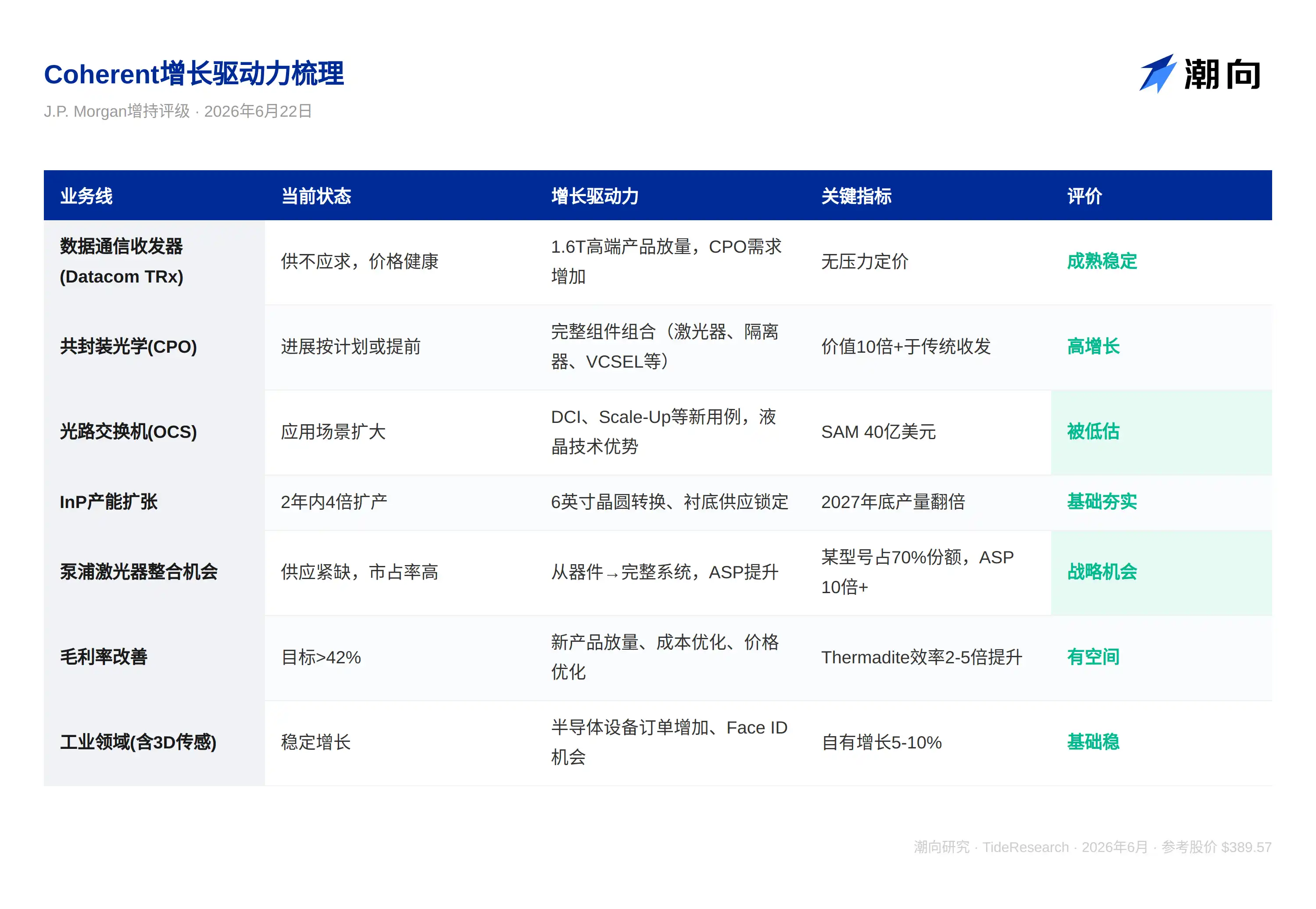
Organic growth in industrial revenue remains steady at 5% to 10%. Semiconductor manufacturing equipment orders are growing. In 3D sensing, Apple's next-generation Face ID might adopt a new protocol, presenting a re-competition opportunity for suppliers.

Optical communication chips are the underlying infrastructure for data centers. AI is driving higher computing power demands, which in turn increases the need for high-speed optical interconnects. COHR holds a critical position in this supply chain. The new opportunities in CPO and OCS, stable growth in the industrial segment, and room for gross margin improvement all support the Overweight rating.

Disclaimer

This article is TideResearch's analysis and interpretation of a third-party brokerage research report. The ratings, price targets, earnings forecasts, and related judgments cited herein are the views of the J.P. Morgan analyst, representing only the stance of their affiliated institution. They do not represent TideResearch's views and do not constitute any investment advice.

Please note three points while reading: First, ratings are analysts' comprehensive judgments on a company's prospects and are subject to frequent adjustments based on performance and market conditions. Second, sell-side research reports are inherently bullish, and some covered companies may have investment banking relationships with the brokerage. Third, the value of research reports lies in their core logic and underlying assumptions, not just a specific price target. Focus on the logic, not just the rating.

Markets involve risks, and investment decisions should be made independently. This article should not be used as a basis for trading any securities.

Data Source: Coherent Corp Investor Conference Minutes (J.P. Morgan, Samik Chatterjee, June 22, 2026)

TideResearch · June 2026

Related Questions

QAccording to J.P. Morgan's analysis, what are the three core growth drivers for Coherent (COHR) mentioned in the article?

AThe three core growth drivers are: 1) Data center optical transceivers, 2) Co-packaged optics (CPO) chips, and 3) Industrial lasers and thermal management.

QWhat is the analyst's view on the relationship between the demand for traditional optical transceivers and the rise of CPO technology?

AThe analyst believes that CPO technology will not replace or cannibalize demand for traditional optical transceivers. Instead, it will increase the demand for high-end optical components, as CPO integrates optical and electrical chips together.

QWhat are Coherent's specific advantages in the CPO market, as highlighted in the report?

ACoherent's competitive advantage lies in providing a complete portfolio of optical components, including lasers, isolators, VCSELs, and thermoelectric coolers, which are essential for CPO systems. This allows them to capture significantly more value per CPO chip compared to traditional transceivers.

QWhat strategic opportunity is presented by the current tight supply of pump lasers for Coherent?

AThe tight supply of pump lasers, where Coherent is one of only two high-quality global suppliers, presents a strategic opportunity for vertical integration. Instead of just selling laser components, the company can now sell complete line cards or systems, increasing the average selling price per solution by more than tenfold.

QWhat three factors are driving the company's target for gross margins to exceed 42%?

AThe three driving factors are: 1) Premium pricing power for high-end products, 2) Cost improvements from the transition to 6-inch InP wafers, and 3) The ramp-up of new high-margin products like CPO and Optical Circuit Switches (OCS).

Related Reads

EF's Epic Reorganization: 20% Layoffs, Budget Halved, Is Ethereum Gearing Up for a Leaner Future?

The Ethereum Foundation (EF) has announced a major organizational restructuring, involving a 20% staff reduction (approx. 54 employees) and a division into functional clusters like Protocol, Access, User, Community, and Institutional layers. Co-founder Vitalik Buterin further revealed plans to cut the EF's budget by around 40% over the coming years, aiming to reduce its annual spending rate from about 15% to roughly 5% by 2030, transitioning to an endowment-driven model. This overhaul is seen as a long-overdue correction to the EF's ambiguous role. As Ethereum grew, the foundation faced persistent criticism over ETH sales, perceived lack of execution, and unclear strategy, often becoming a focal point for community frustration amid ETH's price stagnation. The reform aims to redefine the EF's boundaries, narrowing its focus to core protocol research, public goods funding, and ecosystem coordination, while offloading more applied development work to the broader market. Concurrently, ecosystem forces like the newly formed Ethlabs (founded by ex-EF researchers) and other independent groups are stepping in to fill the space, signaling a shift from a centralized model to a more distributed, collaborative ecosystem structure. The move was notably praised by Solana co-founder toly, who viewed a "leaner" EF as potentially more decisive and agile.

Odaily星球日报24m ago

EF's Epic Reorganization: 20% Layoffs, Budget Halved, Is Ethereum Gearing Up for a Leaner Future?

Odaily星球日报24m ago

Dragonfly Partner Haseeb: The Fastest-Growing Companies of the Future May All Get Stuck at 149 Employees

Dragonfly partner Haseeb explores the distorted economics of AI model pricing, drawing parallels to tax policy. He notes that startups and small teams (under 150 users) enjoy heavily subsidized, fixed-price AI subscriptions (like Claude Code), where the marginal cost of an additional token is effectively zero. This creates a powerful incentive for them to maximize token usage ("token-maxxing") and innovate aggressively with AI automation. In contrast, large enterprises (over 150 users) are forced onto "Enterprise" plans, paying per-token API fees with high (~75%) markups. This acts like a steep "tax" on AI-powered labor, disincentivizing marginal automation and experimental use, and encouraging them to retain more human workers. Haseeb argues this pricing creates a "150-person cliff," a regulatory notch similar to labor laws in France that discourage firms from growing past 50 employees. He predicts the fastest-growing future companies may deliberately cap their headcount at 149 to avoid the punitive enterprise pricing. This would foster an "AI-first" management philosophy obsessed with automation and outsourcing to stay lean. While not intentionally designed, this bifurcated pricing could become one of the most influential de facto tax policies, shaping how AI replaces labor—not through mass layoffs at big firms, but through agile, AI-native startups outcompeting them.

marsbit36m ago

Dragonfly Partner Haseeb: The Fastest-Growing Companies of the Future May All Get Stuck at 149 Employees

marsbit36m ago

How xBubble Breaks Through in the VC-Heavily-Backed OPC Economy

xBubble: Addressing the Structural Gap in the VC-Backed OPC Economy The concept of OPC (One Person Company) is evolving from a buzzword to a significant AI-driven market. While AI coding tools like Replit and Lovable have validated demand from non-technical users wanting to build applications, a key gap remains: the leap from creating a demo to running a stable, evolving business. These tools still require users to manage the development process, including technical judgments for integrations, modifications, and deployments—a major hurdle for OPCs. xBubble, by DAPPOS, tackles this by shifting from "Prompt-to-Code" to "SOP-to-Business." Instead of generating code from instructions, its core is a system of pre-organized SOPs (Standard Operating Procedures) that translate business goals—like "sell World Cup merchandise"—into complete, executable workflows. This includes generating cohesive assets, pages, payment systems, and backend logic. The platform is augmented by a network of third-party service providers who handle infrastructure (hosting, domains, payment setup), acting like "on-site service engineers." Users can pay for these services directly with xBubble credits, simplifying onboarding. This ecosystem aims to deliver not just an app, but a complete, modifiable business launch path. xBubble targets a clear OPC segment: small commercial nodes (e.g., creators, merchants) with existing products, customers, or channels, but for whom a full tech team is unjustifiable. Its potential lies in SOPs accumulating expertise from real cases, improving reliability and reducing delivery costs over time. Additionally, its native support for crypto payments caters to global or digital-native OPCs. In summary, as AI democratizes software creation, xBubble's opportunity is to prove that "SOP-to-Business" provides more immediate value for launching a real, operational business than a powerful but unstructured AI coding tool.

链捕手38m ago

How xBubble Breaks Through in the VC-Heavily-Backed OPC Economy

链捕手38m ago

If It's Not a Clear Yes, It's a No: A Nine-Year Retrospective by a VC Who Survived Four Cycles

**"Invest Only When Certain": A Nine-Year Retrospective from a VC Across Four Cycles** IOSG founder Jocy shares hard-earned lessons from nine years and over a hundred investments in Web3. The core challenge isn't identifying successful founders, but understanding why talented founders with solid ideas still fail. Through building a "failed founder database," IOSG identified six recurring failure patterns. **Founder Trait Red Flags:** 1. **Emotionally Unstable:** Founders who react defensively to criticism or publicly lash out under pressure (e.g., 80% drawdowns) often fail. Resilience is key. 2. **Lacking Hunger / Having a Fallback:** Founders with significant safety nets (family wealth, cushy fallback jobs) may lack the "do-or-die" commitment needed to survive crypto's brutal cycles. 3. **Unchecked Ego:** Includes "polished execution machines" who excel in known frameworks but struggle when paradigms shift, and "professor-types" who are technically brilliant but resistant to commercial feedback or coaching. **Project Structure Red Flags:** 4. **Token-First, Not Product-First:** Treating the token solely as a fundraising tool with no real utility or connection to product value is a major warning sign. The project should have value even if the token goes to zero. 5. **No Day-1 Exit Thesis:** Founders must have a clear, staged capital strategy from the start, understanding what each funding round needs to prove to unlock the next. "Exit before entry" is crucial. 6. **No Full-Cycle Experience:** Founders who haven't lived through a complete crypto bull/bear cycle (e.g., 2018, 2022) often underestimate their vulnerability. IOSG limits initial checks for such teams to $250k, sizing for risk. **The Positive Flipside: Desirable Founder Traits** The ideal candidate exhibits: obsessive problem-depth, being a second-time founder with a non-consensus vision, strong communication skills with *controlled* ego, relentless perseverance, and a global perspective with agency and taste (increasingly vital in the AI era). **Three Survival Tips for Founders:** 1. **Cash Flow Over Narrative:** Real revenue is what sustains projects, not vanity metrics. 2. **Tokens Are a Liability:** Avoid issuing a token unless absolutely necessary. The hidden costs (market making, liquidity, compliance) are immense, often a multi-million-dollar burden. 3. **Respect Liquidity:** Sell during peaks to build treasury, buy back to support the protocol during troughs. Be realistic about valuations and your ability to deliver for the next round. The final principle is simple yet paramount: **"If it's a borderline 'yes' or 'no,' don't invest."** In an industry that reinvents itself every few years, the discipline to consistently say "no" is the ultimate secret to longevity.

Foresight News1h ago

If It's Not a Clear Yes, It's a No: A Nine-Year Retrospective by a VC Who Survived Four Cycles

Foresight News1h ago

Trading

Spot
Futures
活动图片