Has the Cryptocurrency Market Hit Bottom? Here's What Institutions Think

Foresight NewsPublished on 2026-06-16Last updated on 2026-06-16

Abstract

"Has the crypto market bottomed out? Major institutions are divided on the outlook, according to a recent analysis by Matt Hougan, Chief Investment Officer of Bitwise. Three prominent research firms published in-depth reports on the topic with differing conclusions. Galaxy Digital argues Bitcoin has not yet found its bottom, pointing to only 4 out of 13 historical bottoming indicators being met. Their analysis suggests a potential bottom range of $30,000 to $54,000. NYDIG adopts a more cautious stance, noting that while metrics are close to historical bear market lows, a classic panic-selling capitulation event is missing. They acknowledge the possibility of a bottom but consider it unlikely, citing structural changes from institutional adoption. In contrast, Standard Chartered Bank asserts the bottom is already in at around $59,000. Their revised bullish view, predicting a year-end target of $100,000, hinges on anticipated reductions in ETF selling pressure linked to events like a potential SpaceX IPO. Despite the surface-level disagreement on the exact price floor, the reports share significant common ground crucial for long-term investors. All three institutions agree that a market bottom will likely form within the current year, that current prices are closer to the bottom than to previous cycle highs, and that Bitcoin is poised for another major bull cycle in the future. The core takeaway is that while the precise bottom level remains debated, the long-term value prop...


Authored by: Matt Hougan, Chief Investment Officer, Bitwise

Compiled by: Chopper, Foresight News


Over the past two weeks, three cryptocurrency research firms I have long followed—other than Bitwise—have published in-depth reports addressing the same issue: Has the cryptocurrency market reached its bottom?


  • Galaxy Digital: Bitcoin has not bottomed yet; data points to a potential bottoming zone.
  • NYDIG: What factors are currently suppressing Bitcoin's price performance?
  • Standard Chartered: The market bottom has already occurred.


The three reports are detailed, containing a wealth of data and complete logical reasoning, and are worth reading in full. However, if you're looking for a simple, unified answer, you might be disappointed: the judgments given by these three authoritative institutions are completely different.


Has the Market Bottomed?


  • Galaxy Digital: No
  • NYDIG: Possibly, but not very likely
  • Standard Chartered: Yes


Below, we break down the core logic of each institution one by one.


Three Institutions, Three Views


Galaxy Digital


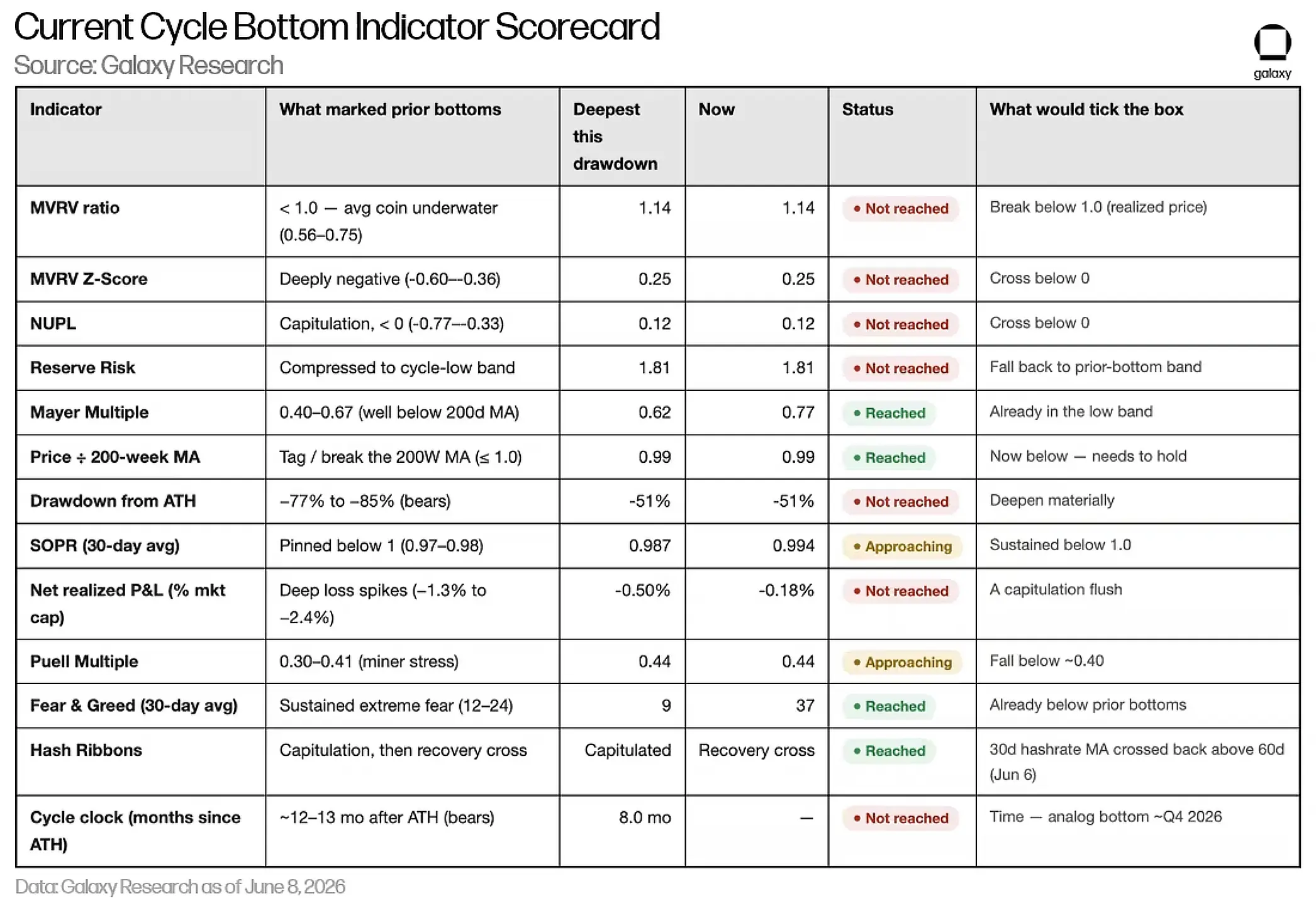
Galaxy Digital reviewed Bitcoin's full 17-year price history and summarized 13 indicators that typically appear simultaneously when the market truly bottoms out. These cover six dimensions: valuation, profit-taking, miner pressure, price trends, bull/bear cycles, and market sentiment. Long-term Bitcoin investors are familiar with these indicators, including the 200-week moving average, Fear & Greed Index, Mayer Multiple, etc.


Galaxy found that currently only 4 indicators fully meet the criteria, 2 are partially met, and the remaining 7 have not triggered a bottom signal. The report concludes that the bottom range for this Bitcoin cycle is between $30,000 and $54,000, with a neutral baseline bottom of $40,000 to $46,000.


NYDIG


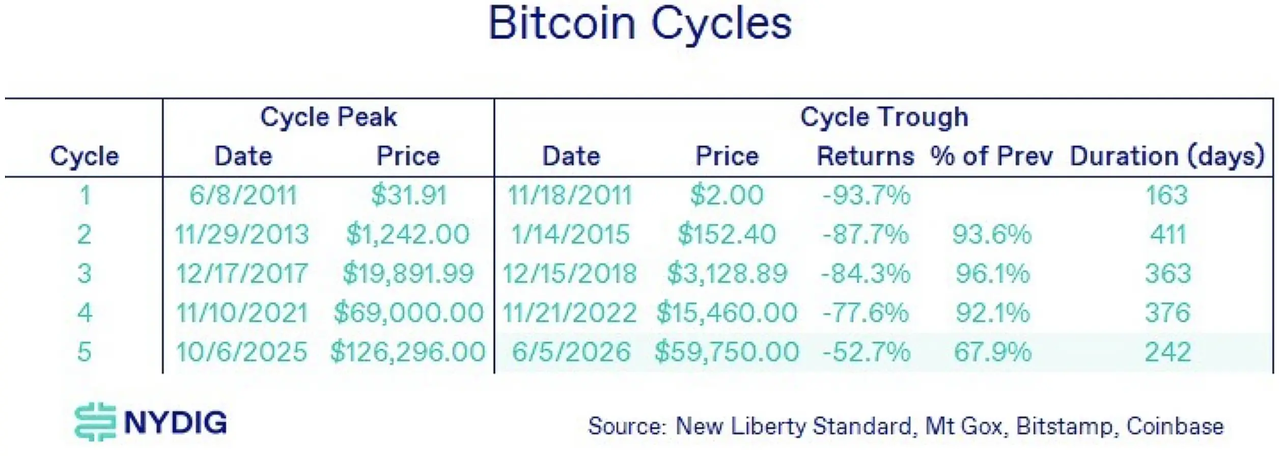
NYDIG also adopts a multi-indicator comprehensive analysis framework, comparing the current market with historical cycles, assessing the market status from dimensions such as the duration of maximum drawdown and holder profit/loss (what Bitcoin users call 'MVRV,' or the market value to realized value ratio).


NYDIG believes that current indicators are very close to the extreme ranges of historical major bottoms, but the hallmark widespread panic selling seen in past major bear markets has not yet occurred. However, the report introduces a variable: the entry of institutional funds has fundamentally changed Bitcoin's cycle logic. The magnitude of this correction might be smaller than in historical bear markets. From this perspective, the bottom might also have already appeared.


Standard Chartered


Standard Chartered is not unwaveringly bullish on Bitcoin. Back in February when Bitcoin was at $67,000, the bank lowered its full-year price forecast, warning that the price could fall to $50,000, citing a weaker macroeconomic environment and sustained selling pressure from Bitcoin ETFs.


But last Friday, Standard Chartered updated its view, identifying $59,000 as the bottom of this cycle. The two main logics supporting this view are: a potential diplomatic agreement between the US and Iran, and the highly anticipated upcoming SpaceX IPO. Standard Chartered believes that the substantial selling by ETF holders was to raise funds for participating in the SpaceX listing, and this selling pressure will gradually subside. Standard Chartered's latest forecast is that Bitcoin will challenge $100,000 within the year.


Consensus Far Outweighs Differences in the Three Reports


You might wonder, what useful information can be extracted from three reports with seemingly opposing views? In fact, the underlying consensus in these three reports far outweighs the surface differences. For long-term investors, the conclusions they agree on are far more valuable than their disagreements:


  • All three judge that the market bottom for this cycle will occur within this year.
  • All three believe the current price is closer to the bottom than to the previous high.
  • All three unanimously remain bullish, expecting Bitcoin to usher in a new bull market in the future.


At the time of writing this article, Bitcoin is trading around $67,000. One report claims the bottom at $59,000 has already occurred, one sees a potential drop to $50,000, and another a neutral baseline bottom of $43,000. But the core conclusion is highly unified: a bottom will definitely be reached within the year.


This is the key point long-term investors should focus on. Whether the bottom is at $40,000, $50,000, or $60,000, the difference is actually limited. What truly matters is whether Bitcoin can subsequently surge to $100,000, $200,000, or even $1 million. As long as it reaches those levels, entering and holding long-term at the current price offers considerable upside potential.


A rather ironic phenomenon in the current market is that everyone is obsessing over whether the market has bottomed, while overlooking a more important question—has the top already appeared? In my view, as long as the peak has not arrived, Bitcoin retains its long-term allocation value.


The core logic supporting Bitcoin's long-term value has not only persisted but continues to strengthen: government debt continues to accumulate worldwide with no effective resolution in sight; inflation constantly erodes the real purchasing power of wealth; public trust in centralized institutions like governments and banks continues to decline; the global digitalization process keeps accelerating; Bitcoin's trading and investment channels are constantly improving; and the early crypto-native demographic is aging, with their assets and industry influence growing simultaneously.


Of course, potential risks remain in the market, including threats from quantum computing and tightening global regulation. However, on balance, the current situation looks better than in any previous crypto winter.


Related Questions

QWhat are the three major research institutions mentioned in the article and their respective views on whether the crypto market has bottomed?

AThe three institutions are Galaxy Digital, NYDIG, and Standard Chartered. Their views are: Galaxy Digital believes the market has not bottomed yet. NYDIG considers it possible but unlikely that the bottom has been reached. Standard Chartered asserts that the bottom has already appeared at $59,000.

QAccording to Galaxy Digital, how many out of its 13 identified bottoming indicators are currently signaling a market bottom?

AAccording to Galaxy Digital's analysis, only 4 of the 13 indicators are fully met, 2 are partially met, and 7 have not yet signaled a bottom.

QWhat is the core consensus shared by the three research reports despite their differing views on the exact bottom price?

AThe core consensus is threefold: 1) The market bottom will occur within this year. 2) The current price is closer to the bottom than to the previous all-time high. 3) All three institutions are optimistic that Bitcoin will experience a new bull market in the future.

QWhat two specific reasons did Standard Chartered give for revising its view and declaring that the market bottomed at $59,000?

AStandard Chartered based its revised view on two primary reasons: 1) A potential diplomatic agreement between the US and Iran. 2) The upcoming, highly anticipated SpaceX IPO, which they believe led to ETF selling pressure as investors raised funds to participate, and this pressure is expected to subside.

QWhat does Matt Hougan, the author and Bitwise CIO, suggest is a more important question for long-term investors than whether the market has bottomed?

AMatt Hougan suggests that a more important question for long-term investors is whether the market top has already appeared. He argues that as long as the peak has not been reached, Bitcoin retains its value as a long-term investment.

Related Reads

M&A Deals in the Crypto Market Are Unusually Active

Title: M&A Activity in Crypto Market Becomes Unusually Active A rare signal is emerging in the crypto primary market: mergers and acquisitions (M&A) are nearing half of all financing deals. According to RootData, this month, M&A cases in the crypto industry reached 10, while financing rounds numbered only 14, meaning M&A accounts for approximately 42% of primary market transactions—the highest level in history. This does not signal a sudden industry boom. Instead, the rapid rise in M&A share primarily reflects the continued downturn in the financing market. Since November 2024, monthly crypto M&A deals have remained between 10-20, while financing deals have plummeted from around 100 to about 50, possibly hitting a new low this month. For project teams, this means the traditional path of relying on narratives, token expectations, and ecosystem subsidies to maintain valuations is narrowing. For leading companies, it presents a rare window to acquire teams, licenses, technology, liquidity, and market access at lower prices, with less competition and stronger bargaining power. Key active buyers include Coinbase, Kraken, Ripple, MoonPay, Polymarket, Kaiko, Sol Strategies, GSR, Keyrock, Jupiter, Paxos, and Ondo Finance. Their M&A logic is consistent: acquiring key capabilities at lower costs during the industry downturn. This is driven by more attractive valuations, reduced time and trial-and-error costs, the acquisition of licenses and compliance resources, and the integration of industry upstream and downstream segments. Current M&A focuses are concentrated in four areas: trading infrastructure (e.g., Coinbase acquiring Deribit, Kraken acquiring NinjaTrader), payments and stablecoins (e.g., MoonPay, Ripple expanding payment networks), compliance licenses, and asset issuance/distribution (e.g., acquisitions related to RWA and token issuance platforms like Coinbase's purchases of Liquifi and Echo). The rise in M&A is altering the primary market's exit logic. It provides an alternative path to the token-dependent model, encouraging teams to build tangible products, revenue, and strategic value that can be integrated. This could inject confidence into the market, showing that asset buyers and exit possibilities still exist, albeit with a stricter focus on real utility. However, this trend also indicates the crypto industry is becoming more centralized. As asset issuance, trading, market-making, custody, payments, and data gradually consolidate in the hands of a few major players, the industry's initial emphasis on openness and anti-monopoly is being reshaped by commercial realities. Coupled with rising compliance barriers, this signals the end of the low-barrier era for crypto entrepreneurship.

链捕手20m ago

M&A Deals in the Crypto Market Are Unusually Active

链捕手20m ago

M&A Deals Are Exceptionally Active in the Crypto Market

Mergers and acquisitions (M&A) activity in the cryptocurrency primary market has reached a historic high, accounting for approximately 42% of total deals in the current month, nearly matching the number of financing rounds. This shift does not signal a new boom cycle but rather reflects a severe contraction in the venture capital funding environment. As financing dwindles, established industry giants—including major exchanges, payment firms, and infrastructure providers—are seizing the opportunity to acquire strategic assets at lower valuations. Key drivers behind the surge in M&A include depressed project valuations, the need to quickly acquire talent and technology to capture short market windows, the pursuit of crucial regulatory licenses, and the strategic expansion into adjacent business verticals such as derivatives, payments, stablecoins, and real-world asset (RWA) issuance. Major acquisitions, like Coinbase's purchase of Deribit and Kraken's acquisition of NinjaTrader, exemplify the push to expand into high-margin areas like derivatives and multi-asset trading. This trend is reshaping the industry's exit landscape, offering an alternative to token-based exits and incentivizing startups to build tangible products and revenue streams with inherent strategic value for acquisition. However, it also points toward increasing centralization, as critical functions—trading, custody, payments, compliance—become concentrated within a few large, well-capitalized platforms, potentially raising barriers to entry for new ventures.

marsbit21m ago

M&A Deals Are Exceptionally Active in the Crypto Market

marsbit21m ago

Solana Privacy Ecosystem Panorama: A Complete Privacy Stack from Compute to AI

**Title: The Solana Privacy Ecosystem: A Full-Stack View from Compute to AI** **Summary:** This article provides a comprehensive overview of the emerging privacy landscape on the Solana blockchain, characterizing it as still in early development. It identifies two primary verticals—Neobanks and Private DeFi—as key drivers, while noting gaps in tooling and user experience. The discussion centers on two main approaches to private computation: Arcium, which utilizes Multi-Party Computation (MPC) networks (Multi-Party eXecution Environments) to process encrypted data with final settlement on Solana; and Magic Block, which leverages Trusted Execution Environments (TEEs) via its Private Ephemeral Rollup (PER). Both enable confidential applications like dark pools and private DeFi with minimal code changes. Building on this infrastructure, projects are creating privacy-focused applications. Umbra, built on Arcium, offers Encrypted Token Accounts (ETAs) for private balances, transfers, and selective disclosure for compliance. Other wallets like Privacy Cash and Hush provide mixer-like functionality for SOL. For private trading, encifherio uses TEEs to encrypt swap details routed through Jupiter, while VanishTrade and Darklake focus on shielding transaction intent and liquidity routing, with Darklake introducing a "blind slippage pool" to prevent front-running. Further applications include private prediction markets (e.g., Melee Markets using Arcium's encrypted order books) and private AI. Loyal exemplifies the latter, using both Magic Block and Arcium to enable decentralized AI agents that store user data, conversations, and transactions confidentially on-chain. The article concludes by framing privacy not as a single technology but as an evolving "ultimate privacy stack," with experts like Helius's Mert envisioning a future combination of Fully Homomorphic Encryption (FHE) and Zero-Knowledge proofs (ZK). Helius Privacy itself is developing a ZK-based UTXO privacy layer for Solana.

Foresight News27m ago

Solana Privacy Ecosystem Panorama: A Complete Privacy Stack from Compute to AI

Foresight News27m ago

Trading

Spot
Futures
活动图片