GPU Rental Prices Drop 30% in Three Weeks: AI Value Chain Migrating from Nvidia to Memory Chips

marsbitPublished on 2026-06-23Last updated on 2026-06-23

Abstract

GPU rental prices for Nvidia's flagship B200 chip have fallen by approximately 30% over three weeks, dropping from a high of $6.11/hour to $4.22/hour. This decline signals a potential easing of the "compute scarcity" narrative that has long supported AI hardware valuations. Concurrently, the semiconductor market is witnessing a significant divergence: while the VanEck Semiconductor ETF (SMH) has risen 15% in the past month, with memory giants Micron and SanDisk each surging nearly 60%, Nvidia's stock has declined about 3% over the same period. Analysts suggest this shift indicates that the AI value chain's bottleneck and profits are migrating from compute (GPUs) to memory. Demand for high-bandwidth memory (HBM) remains intensely strong, with contract prices soaring over 100% in H1 2026, granting memory manufacturers significant pricing power. In contrast, increased B200 supply from improved manufacturing yields and competitive pressure from new cloud providers are softening GPU rental rates. While long-term contracts, like SpaceX's $30 billion deal with Google, show sustained large-scale demand for Nvidia hardware, the softening spot prices pressure the margins of cloud providers and could eventually impact Nvidia's order flow if chip prices don't adjust. The key takeaway for investors is not a weakening AI thesis, but a recalibration within the sector: pricing power appears to be strengthening for memory chipmakers while showing signs of strain for leading GPU suppliers.

Author: Claude, Shenchao TechFlow

Shenchao Insight: The rental price for Nvidia B200 chips has fallen from a late-May high of $6.11 per hour to $4.22 per hour, a drop of approximately 30% in three weeks. Meanwhile, a rare divergence has emerged in the semiconductor sector: the SMH Semiconductor ETF gained 15% over the past month, with Micron and SanDisk each soaring nearly 60%, while Nvidia declined by 3% during the same period. For those holding Nvidia stock or considering AI infrastructure investments, a crucial question arises: AI money isn't disappearing; it's just moving somewhere else.

Nvidia is still up about 12% year-to-date, but the market's attention seems to have shifted away from it for now.

Over the past month, the VanEck Semiconductor ETF (SMH) surged 15%, with Micron Technology and SanDisk each skyrocketing nearly 60%. Nvidia not only failed to keep pace but instead fell by about 3%. More tellingly, the B200 chip's cloud rental price, a core metric supporting Nvidia's valuation narrative, is also softening simultaneously.

According to GPU compute pricing platform Ornn, the hourly rental price for B200 chips hit a three-month high of $6.11 on May 30th, then declined continuously, dropping to $4.22 by last weekend, a decline of about 30%. Rich Privorotsky, Head of Goldman Sachs' One-Delta Trading Desk, directly addressed the topic last week: the myth of AI "compute scarcity" might be falling from its pedestal.

B200 Rental Price Drops 30% in Three Weeks, "Compute Scarcity" Narrative Under Pressure

The Nvidia B200 is the core compute chip for current hyperscale data centers, and its rental price is seen as a barometer for AI infrastructure supply and demand. Data from multiple third-party tracking platforms suggests B200 pricing is loosening.

Ornn data shows the hourly rental price for B200 chips fell from a May 30th high of $6.11, ending last weekend at $4.22. The monthly price index compiled by AIMultiple from 63 cloud service providers shows a median B200 price of $6.11/hour, but new cloud (neocloud) vendors are offering floor prices as low as $3.44. Data tracked by GetDeploying from 26 B200 cloud service providers is more extreme: an average price of $4.99/hour, with the lowest quote at only $2.25/hour (for a three-year reserved contract).
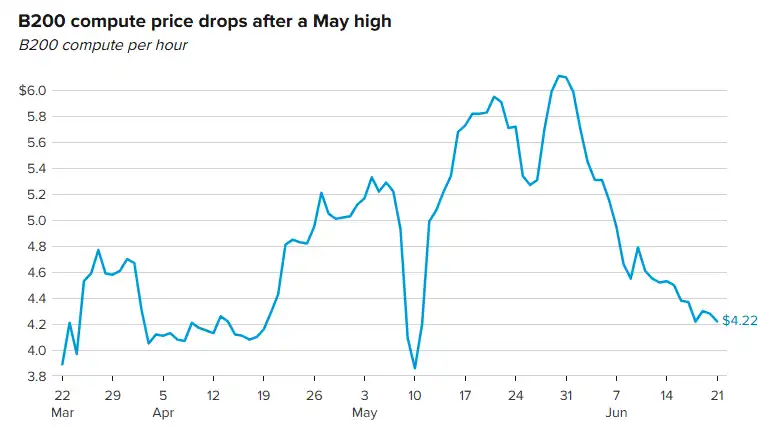
Three factors are driving the price decline: improved yield rates for TSMC's 4NP manufacturing process are lowering B200 production costs; HBM3e supply from SK Hynix and Micron has notably eased in Q2 2026; and more new cloud vendors have secured B200 inventory—RunPod, Lambda, Nebius, Spheron, etc., have all listed spot availability, increasing competition and pushing down overall prices.

Pressure will likely intensify in the second half of the year. As Nvidia's next-generation Blackwell Ultra B300 chips begin entering the spot pool, some B200 capacity will shift from on-demand to spot (bidding) mode. Spot prices for B300 have already seen quotes as low as $2.45/hour, cheaper than the lowest listed price for B200. Institutions like Spheron and Thunder Compute predict B200 on-demand prices may stabilize in the $2.50 to $3.00 range by Q4 2026.

For investors holding Nvidia stock, softening rental prices imply margin pressure for Nvidia's downstream customers (cloud providers, new cloud platforms). The purchasing willingness of these customers directly determines Nvidia's order cadence.

Major Divergence in Semiconductor Sector: Memory Soars, Nvidia Lags

The data for this divergence is quite stark.

Nvidia is up about 12% year-to-date in 2026 but down about 3% over the past month. During the same period, the SMH Semiconductor ETF is up 84% year-to-date and gained 15% over the past month. Micron Technology surged nearly 60% over the past month, its stock price hitting a historical high of around $1,089, with a cumulative year-to-date gain exceeding 700% and market cap breaking $1.2 trillion. SanDisk also surged nearly 60% over the past month, with a gain exceeding 4,400% over the past 52 weeks.

The market might not be losing faith in AI; it might simply believe the bottleneck in the AI value chain is shifting.

The previous logic was "GPU scarcity → Nvidia has pricing power → upstream makes the most money." The current logic seems to be: GPU supply is easing, but AI models' demand for high-bandwidth memory (HBM) and storage is exploding, making memory the new bottleneck.

Micron's latest quarterly earnings (Q2 2026) reported revenue of $23.8 billion, nearly tripling year-over-year (compared to $8 billion in the same quarter last year). After spinning off from Western Digital, SanDisk reported Q3 FY2026 revenue of $5.95 billion, a 97% year-over-year increase.

Data released by TrendForce on June 16th shows memory contract prices soared over 100% in the first half of 2026, with structural shortages expected to persist into the second half. Apple CEO Tim Cook acknowledged last week in an interview that Apple can no longer continue absorbing the pressure of rising memory costs. When even a buyer with Apple's bargaining power publicly states it "can't shoulder it anymore," the pricing power of memory manufacturers is evident.

Micron will report its third-quarter earnings after the market close tomorrow (June 24th), with widespread market expectations for another record-breaking report. This earnings report will be a key test for whether the "memory supercycle" can continue.

Goldman Sachs Trading Head: The Core Metric is Rental Price

Goldman Sachs One-Delta Trading Desk Head Rich Privorotsky outlined a clear analytical framework last week:

If compute resources are truly scarce, rental prices should remain firm, justifying continued capital expenditure. If supply increases and rental prices keep declining, the core assumption of "compute scarcity" underpinning the valuation of the entire AI hardware chain will be shaken.

He further noted that this pressure would first manifest at the hardware layer. The true beneficiaries are companies selling complete systems and monetizing through usage, not just those selling "picks and shovels" upstream. The greater risk lies in the upstream hardware and infrastructure stack, where valuations still rely on the premise of "persistent shortage."

The implication is clear: Nvidia's business model is selling chips (picks and shovels), not charging based on usage. If downstream customers' rental prices are falling while Nvidia's chip prices aren't, a margin squeeze emerges in the middle, ultimately translating into slower orders.

A recent "Tokenomics" report from Citadel Securities echoes a similar judgment: the core constraint for AI adoption has shifted from "model capability" to "cost and compute scarcity," with users accelerating migration to cheaper models. The token price index fell for seven consecutive days, marking its longest decline this year.

Santa Clara University Finance Professor Seoyoung Kim put it more bluntly: Most buyers don't know how much compute they'll need next year, suppliers don't know how many GPUs to order, and Nvidia doesn't know how many to produce. All three parties are guessing, and when the collective guess shifts from "won't be enough" to "might be too much," prices come under pressure.

SpaceX-Google's $30 Billion Mega-Contract: Long-Term Market Still Hot

While spot rental prices are falling, the long-term contract market tells a different story.

According to an SEC filing by SpaceX on June 5th, Google has agreed to pay SpaceX $920 million per month from October 2026 to June 2029 to lease approximately 110,000 Nvidia GPUs along with配套 processors, memory, and other components. The total contract value is about $30 billion. Earlier in May, Anthropic signed a similar agreement with SpaceX, paying $1.25 billion per month to lease all available compute power at its Colossus 1 data center in Memphis, with a total value nearing $45 billion.

The background for these contracts is that after SpaceX completed its merger with xAI in February 2026, it converted xAI's previously self-built Colossus supercomputing cluster into a commercial asset for external leasing, locking in massive revenue ahead of its IPO (targeting a $1.75 trillion valuation).

For Nvidia, this is a contradictory signal. On one hand, a long-term contract for 110,000 GPUs proves that major customers are still aggressively locking in compute capacity. RBC Capital Markets stated after the deal's announcement that Nvidia is "in the most favorable position among peers," suggesting these GPU leasing agreements can at least temporarily alleviate market concerns about ASICs eroding Nvidia's market share.

On the other hand, the reason Google needs to lease compute from SpaceX is precisely because its own build-out capacity can't keep up with demand. Google's 2026 capital expenditure is between $180 and $190 billion; SpaceX's monthly $920 million payment is less than 6% of Google's annual budget, essentially serving as "bridge capacity." As these super-customers' own data centers come online in 2027-2028, whether external leasing demand can maintain its current scale remains a question.

The contract also includes a 90-day notice period for early termination. This doesn't look like a clause negotiated under conditions of "extreme compute scarcity"; it more resembles a buyer leaving themselves an exit strategy.

Nvidia's Risk: Not on Demand Side, But on Pricing Power

Stringing these clues together, the issue Nvidia faces is the shifting profit distribution within the AI value chain.

On the GPU supply side, three factors—improved TSMC yields, more vendors securing inventory, and the imminent large-scale arrival of B300—are alleviating the extreme shortages of 2024-2025. On the demand side, super-customers are still purchasing en masse, but the nature of procurement is shifting from "scrambling for supply at any cost" to "price comparison, long-term contracts locking in volume, and retaining exit rights." On the profit side, downstream cloud vendors' rental prices are already falling. If Nvidia's own chip prices cannot decline synchronously, the profit squeeze in the middle will eventually undermine order volume.

The newfound popularity of memory chips is the other side of this value chain migration.

The larger the AI model and the more inference tasks, the more inelastic the demand for high-bandwidth memory becomes. GPUs can improve efficiency through architectural upgrades (e.g., B200's FP4 precision halves bytes per parameter), but memory bandwidth is a physical bottleneck with no shortcuts. Micron's HBM capacity is already sold out for all of 2026—a state of "can't buy even with money" that starkly contrasts with the declining B200 rental prices.

Micron's earnings report tomorrow will provide the next crucial data point. If revenue and guidance exceed expectations again, the narrative of "AI value chain migration from GPU to memory" will be further reinforced. For investors, this isn't about being bearish on AI; it's about needing to reconsider whose pricing power is strengthening and whose is weakening on the AI chain.


Related Questions

QAccording to the article, why has the rental price of NVIDIA's B200 GPU dropped by approximately 30% in three weeks?

AThe article cites three main factors driving the price decline: improved yields for TSMC's 4NP manufacturing process, which lowers the production cost of the B200; a looser supply of HBM3e from SK Hynix and Micron in Q2 2026; and increased competition as more new cloud providers have obtained B200 inventory and listed spot instances.

QWhat evidence does the article present to show a divergence within the semiconductor sector?

AThe article highlights a sharp divergence in stock performance: Over the past month, the SMH semiconductor ETF rose 15%, Micron surged nearly 60%, and SanDisk also surged nearly 60%. In stark contrast, NVIDIA's stock fell about 3% over the same period. This indicates that while memory chip companies are booming, NVIDIA is lagging.

QWhat key point does Goldman Sachs trading desk head Rich Privorotsky make about the AI hardware valuation narrative?

ARich Privorotsky argues that the core assumption supporting AI hardware valuations is 'compute scarcity.' He states that if compute resources were truly scarce, rental prices should remain firm. However, if supply increases and rental prices continue to fall, this foundational assumption of persistent shortage is undermined, posing a risk to upstream hardware and infrastructure valuations built on that premise.

QWhat is the significance of the $30 billion SpaceX-Google contract mentioned in the article, and what potential concern does it raise for NVIDIA?

AThe $30 billion long-term contract, where Google will rent about 110,000 NVIDIA GPUs from SpaceX, demonstrates that major customers still have massive demand for locking in compute capacity. However, the contract includes a 90-day termination clause, which suggests the buyer retained flexibility. The article notes that Google's move may be a 'bridge' solution until its own data centers come online in 2027-2028, raising a question about whether external rental demand will sustain at current levels long-term.

QAccording to the article's conclusion, where is the AI value chain's profit margin shifting from and to?

AThe article concludes that the profit allocation within the AI value chain is shifting. The 'pricing power' is moving away from GPUs (like NVIDIA's) as supply constraints ease and rental prices fall, and towards memory chips. This is because AI models' demand for high-bandwidth memory (HBM) is rigid and growing, with suppliers like Micron experiencing sold-out capacity, creating a new bottleneck and strengthening their pricing power.

Related Reads

Farewell to Speculation: The Graham Moment of the Crypto Industry

"Farewell to Speculation: The Graham Moment for the Crypto Industry" The article draws a parallel between today's cryptocurrency market and the speculative, unregulated US stock market of the 1920s. That era lacked mandatory corporate disclosure, enabling rampant manipulation and turning stocks into gambling tools. The 1929 crash led to foundational reforms: the Securities Acts of 1933/34 mandated transparent, audited financial reporting, and Benjamin Graham's "Security Analysis" provided a framework for fundamental valuation. Together, they created modern investing, requiring both reliable data and a methodology to value assets. Similarly, the crypto market is currently driven by narratives and speculation. However, it possesses a key advantage: unlike 1920s corporations, blockchain protocols have inherently transparent, on-chain data for revenue, treasury, and activity. The core obstacle is not transparency, but the lack of legal claim to that value. Due to regulatory uncertainty (primarily the Howey Test), most tokens are deliberately stripped of economic rights like profit-sharing to avoid being classified as securities. This creates a paradox where protocols generate revenue, but token holders have no right to it. The turning point, argues the author, is imminent US legislation. The already-passed GENIUS Act provides a framework for stablecoins. The crucial CLARITY Act, currently in advanced legislative stages, aims to clearly categorize digital assets and define their regulatory treatment (SEC vs. CFTC). This would allow developers to legally design tokens with enforceable economic rights, such as profit distribution. If passed, this would enable a shift from speculation to fundamental investment. Analysis would focus on protocol revenue sustainability, network effects, valuation multiples, and the specific rights encoded in a token's contract—mirroring traditional equity analysis. The article notes significant legislative hurdles and timelines (1-3 years for rulemaking post-passage), but emphasizes the direction is set. A deeper challenge remains: building decentralized, legally enforceable governance and ownership structures to protect token holder rights, akin to corporate law. This will be a core development focus. The transformation applies mainly to revenue-generating protocol tokens, not to assets like Bitcoin (digital gold). The article concludes that the industry's question has evolved from "can tokens create value?" to "who gets to allocate that value?". Solving the latter, as in the 1920s, will mark crypto's transition to a legitimate asset class for fundamental investment.

Foresight News8m ago

Farewell to Speculation: The Graham Moment of the Crypto Industry

Foresight News8m ago

Quantum Computing "Manhattan Project" Unveiled: Is the Encryption Industry at a Critical Turning Point?

"Quantum Computing 'Manhattan Project' Launched: Is the Crypto Industry at a Critical Juncture?" On June 22, former U.S. President Donald Trump signed two executive orders. The first mandates all federal agencies upgrade their cryptographic systems to new, quantum-resistant standards by 2030. The second orders the Department of Energy to lead the development of a national quantum computer, signaling a shift from laboratory research to a state-enforced national agenda. This creates a hard deadline. A powerful quantum computer could break current encryption. The threat is compounded by "harvest now, decrypt later" attacks, where encrypted data is stored today for future decryption. Federal agencies must appoint migration officers and complete post-quantum cryptography (PQC) upgrades for key establishment by 2030 and digital signatures by 2031. Procurement rules will also be changed, forcing government contractors to comply. The crypto industry faces a direct threat. Bitcoin's ECDSA signatures are theoretically vulnerable. Research indicates millions of Bitcoin with exposed public keys are at risk if quantum computers advance. While projects like Bitcoin Quantum testnets and efforts by Ethereum, Solana, NEAR, and Zcash are exploring quantum-resistant solutions, achieving consensus in decentralized networks remains a major challenge. The centralized U.S. government has started a 5-year countdown. For decentralized crypto networks, the real test is whether they can complete this anti-quantum upgrade before the theoretical threat becomes a practical reality.

Foresight News29m ago

Quantum Computing "Manhattan Project" Unveiled: Is the Encryption Industry at a Critical Turning Point?

Foresight News29m ago

Coin Stock Barometer丨BitMine's Total Assets and Investment Reach $10.7 Billion, Exceeding ~$9.3 Billion Floating Loss; Strategy Buys Only 520 BTC, Strive Adds Positions Against the Trend (June 23)

This article provides a weekly market update on "coin-equity" trends, focusing on listed companies holding major cryptocurrencies. Key highlights include: **General Market Trends:** Global equities, particularly in the US, Japan, and South Korea, faced significant sell-offs, led by large tech and AI-related stocks. Analysts cite profit-taking and a shift from hype-driven to performance-driven valuation for AI companies. Market focus is on upcoming Micron Technology's earnings. **Cryptocurrency Treasury Updates:** * **Bitcoin (BTC):** Net weekly BTC purchases by listed companies (excluding miners) totaled approximately $86 million, down 13.97% from the prior week. Strategy (formerly MicroStrategy) purchased only 520 BTC for ~$34.9 million, while Strive Asset Management increased its holdings by 759 BTC for ~$50 million. Other notable actions include Mara Holdings adding 1,000 BTC and Capital B shareholders approving a massive financing plan (up to ~$1.2 trillion) to potentially expand its Bitcoin reserves. * **Ethereum (ETH):** BitMine emerged as the largest corporate ETH treasury, holding 5.67 million ETH (4.7% of supply). It purchased an additional 52,203 ETH ($92 million) in the past week. Sharplink completed a $75 million private placement to fund further ETH accumulation and stock buybacks. * **Solana (SOL):** The top five listed companies hold over 15.7 million SOL combined. However, Solmate Infrastructure, a SOL treasury firm, faces a lawsuit from its largest external shareholder alleging board misconduct and self-dealing. * **Other:** Updates include Canton Strategic's $50 million stock buyback plan and Lite Strategy's $1 million strategic investment in LitVM, a Layer-2 network for Litecoin. The article notes that while crypto treasury firms continue fundraising and accumulation, their stocks may struggle to rise against the broader market downturn until Q4.

marsbit44m ago

Coin Stock Barometer丨BitMine's Total Assets and Investment Reach $10.7 Billion, Exceeding ~$9.3 Billion Floating Loss; Strategy Buys Only 520 BTC, Strive Adds Positions Against the Trend (June 23)

marsbit44m ago

Trading

Spot
Futures
活动图片