Bitcoin Soars Toward $70,000 Amid $1.3 Billion Short Squeeze

cryptonews.ruPublished on 2026-08-19Last updated on 2026-08-19

Abstract

Bitcoin surged sharply towards $70,000 amid a significant short squeeze. The price, previously stuck in a $61.5k-$65k range, broke out after the US Treasury announced plans to double its maximum purchase amount for long-term bonds to support liquidity. This news pushed down bond yields, making riskier assets like Bitcoin more attractive, and coincided with renewed inflows into US spot Bitcoin ETFs. The rapid price move above $66,000 triggered massive liquidations in the derivatives market, predominantly of leveraged short positions. Approximately $1.48 billion worth of positions were liquidated in an hour, with around $1.3 billion coming from shorts. These forced closures created a self-reinforcing buying cycle, accelerating the rally to levels not seen since early summer. The key question is whether the momentum can be sustained after the forced buying subsides. Maintaining the breakout likely requires continued spot market demand, indicated by ETF flows. The next major test is the $69,000-$70,000 resistance zone. As of Wednesday late morning ET, Bitcoin was trading around $68,468.

The move unfolded swiftly towards the end of the morning trading session in the US. Bitcoin had been largely stuck in a range between $61,500 and $65,000 for several weeks, leading to unusually low volatility and prompting traders to increasingly open positions betting on the continuation of this range.

Treasury Action Lit the Fuse

One catalyst was a statement from the US Treasury Department that it would at least double the maximum size of its long-term Treasury securities buyback operations to support liquidity, increasing it from $2 billion to at least $4 billion per operation. The changes are scheduled to take effect on September 9th.

This announcement was significant because the cost of long-term government borrowing had been rising sharply. The yield on 30-year Treasury bonds had reached approximately 5.33–5.34%, nearing a peak not seen in nearly two decades, before falling to around 5.2% on this news.
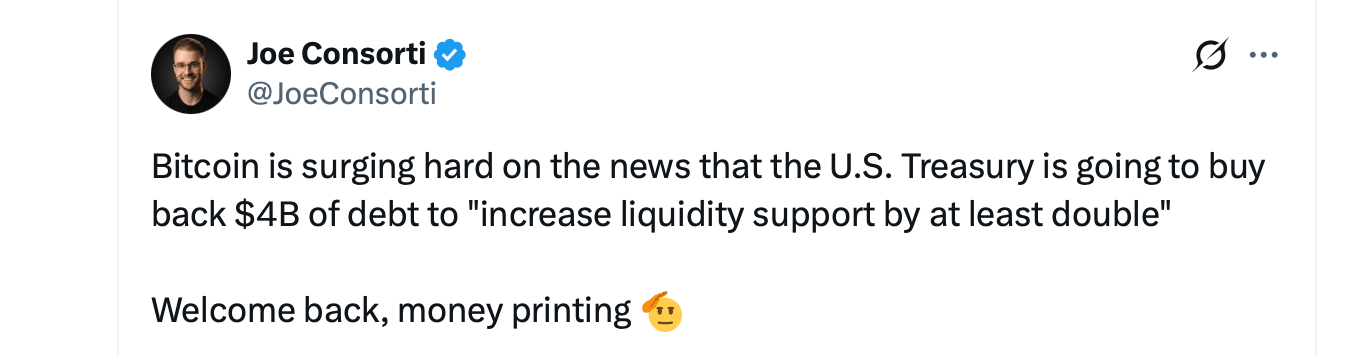
Image Source: X

Lower yields can make riskier investments more attractive by reducing the returns from government bonds. Stocks, gold, and bitcoin benefited from this, as traders interpreted the Fed's step as easing the pressure that had been building in bond markets.

Bitcoin's price also found another source of support. Earlier in the week, US spot bitcoin exchange-traded funds recorded an inflow of $297.6 million, with market data pointing to additional positive flows around August 19th.

Short Sellers Get Caught in a Liquidation Trap

The real acceleration occurred in the derivatives markets. As Bitcoin's price surpassed the $66,000 mark, leveraged traders betting on lower prices began to see their positions liquidated—exchanges automatically closed positions where there was insufficient collateral to cover the losses.

According to statistics from Coinglass.com, over a 60-minute period, liquidations of crypto short and long positions (predominantly shorts) amounted to roughly $1.48 billion. These forced closures compel short sellers to buy back their positions, creating additional demand just as prices are already rising.
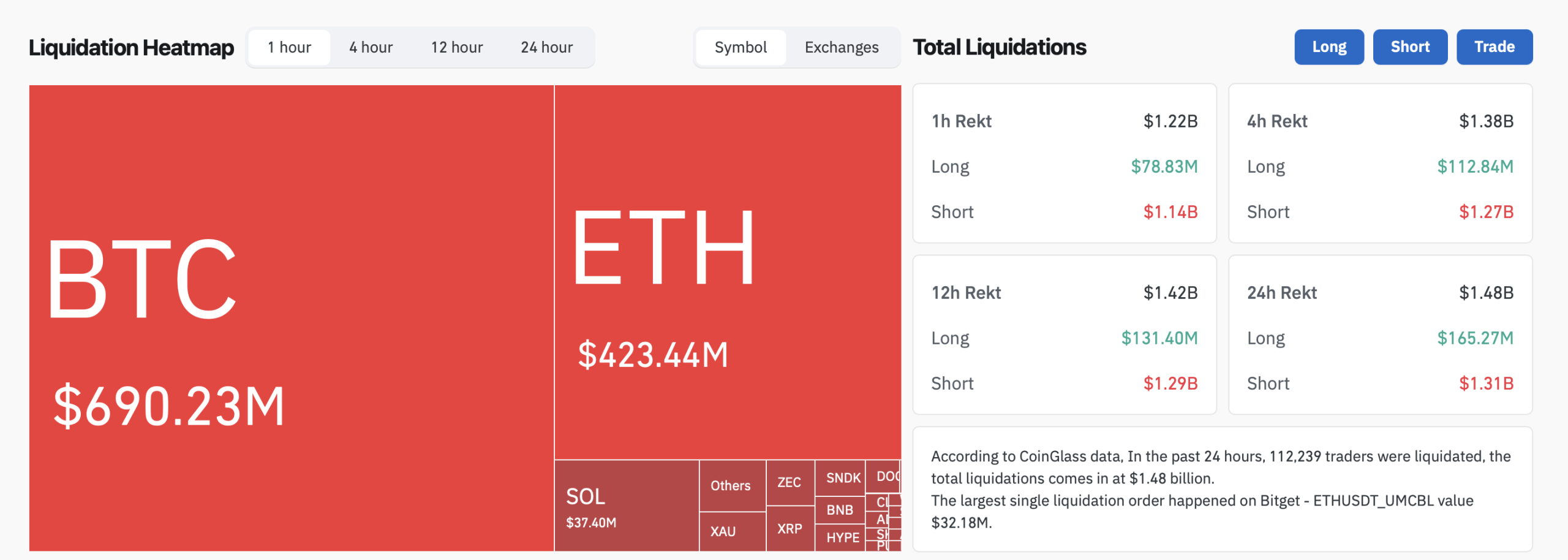
Crypto liquidations on Wednesday, according to coinglass.com statistics. Approximately $1.3 billion in liquidations came from short positions.

Leverage amplified this chain reaction. A trader using 20:1 or 40:1 leverage can lose their entire capital due to a relatively small price move against their position. Each liquidation can push prices higher, triggering the liquidation of the next set of short positions and creating a self-reinforcing squeeze. Over the past day, around 114,538 traders suffered complete losses.

The sharp surge in Bitcoin brought it to levels not seen since early summer. The speed of the move was particularly impressive: the most intense phase unfolded in roughly 15–60 minutes amid a surge in trading volume.

$70,000 – Bitcoin's Next Test

The question now is whether buyers can hold onto the gains after the forced buying subsides. Derivatives can create impressive candles, but sustaining a breakout typically requires steady demand in the spot market, where investors buy bitcoin directly, not through leveraged contracts.

ETF fund flows serve as one indicator of this demand. Continued inflows, stable or declining Treasury yields, and a pickup in spot trading could help bitcoin turn the former resistance area around $66,900 into support and achieve a more confident breakout from the multi-week range.

The danger lies in a trend reversal if leveraged traders start opening new long positions faster than underlying demand develops. The immediate test for bitcoin will be the $69,000 to $70,000 area, where traders will be watching to see if the August 19th spike becomes a sustained breakout or just another 'whipsaw' event fueled by leverage.

As of Wednesday at 11:50 AM Eastern Daylight Time (EDT), Bitcoin is trading at $68,468 per unit.

Related Questions

QWhat were the main factors that triggered Bitcoin's rapid rise towards $70,000?

AThe main factors were: 1) An announcement from the US Treasury Department to at least double the maximum size of its long-term Treasury buyback operations, which reduced bond yields and made riskier assets like Bitcoin more attractive. 2) A significant short squeeze in the derivatives market, where overleveraged short positions were forcibly liquidated as Bitcoin broke above $66,000, creating a self-reinforcing buying pressure. 3) Positive inflows into US spot Bitcoin ETFs prior to the move.

QWhat is the role of the 'short squeeze' described in the title and article?

AThe 'short squeeze' refers to the forced liquidation of approximately $1.3 billion in leveraged short positions. When Bitcoin's price rose above $66,000, traders who had bet on a price decline using leverage saw their positions automatically closed by exchanges due to insufficient collateral. These forced closures required the short sellers to buy back Bitcoin to cover their positions, creating a surge of additional demand that further accelerated the price increase.

QAccording to the article, what is the next key test for Bitcoin's price?

AThe next key test for Bitcoin is the resistance area between $69,000 and $70,000. The article states that traders will be watching to see if the surge on August 19th represents a sustainable breakout from the multi-week trading range or just another leverage-fueled spike that could reverse.

QWhy did the US Treasury's announcement about bond buybacks positively impact Bitcoin's price?

AThe Treasury's announcement to increase long-term Treasury bond buybacks helped push down bond yields (e.g., the 30-year yield fell from ~5.34% to ~5.2%). Lower yields on these safe-haven government bonds make riskier investments like stocks, gold, and Bitcoin relatively more attractive by comparison, as traders seek higher returns.

QWhat does the article suggest is needed for Bitcoin to maintain its breakout above the previous trading range?

AThe article suggests that to maintain the breakout, Bitcoin needs sustained demand in the spot market (where investors buy Bitcoin directly), not just leveraged derivatives trading. Continued inflows into spot Bitcoin ETFs, stable or declining Treasury yields, and active spot trading are cited as factors that could help turn the former resistance near $66,900 into support and solidify the breakout.

Related Reads

Famous Trader Speaks Out After Rally: "Bitcoin Needs Another Level for Further Growth"

After a period of dormancy, the crypto market showed a strong upward trend, with Bitcoin ($BTC) briefly surpassing $69,000 and Ethereum (ETH) rising above $2,100. Market capitalization grew to around $2.4 trillion. This surge has reignited speculation that Bitcoin's bear market may be nearing its end. Trader Killa, known for accurate bear market predictions, stated that BTC has begun recovering from its lows. He warned investors might miss the next rally by waiting for a "perfect bottom." Killa maintains a long-term Bitcoin target above $150,000 and suggested the traditional four-year market cycle might change. He identified the 200-day moving average near $69,500 as a critical level. A sustained break above it could confirm a return to a bull phase. Bitcoin recently faced resistance around this level, underscoring its technical importance. Institutional voices also express optimism. Matt Hougan, CIO of Bitwise, noted that blockchain-based yield-generating assets are being revalued, with some protocols poised for higher market caps. A Bitwise Europe report highlighted renewed institutional demand, citing inflows into ETPs, high long-term holder balances, and stable corporate treasury demand. Hougan further stated Bitcoin is becoming more resilient to negative news. He estimated that even a 1-2% allocation from major wealth managers like Morgan Stanley could channel hundreds of billions of dollars into the crypto sector.

cryptonews.ru41m ago

Famous Trader Speaks Out After Rally: "Bitcoin Needs Another Level for Further Growth"

cryptonews.ru41m ago

What to Expect from Bitcoin's Price After Today's Sharp Surge? Only One Hurdle Left to Overcome!

Bitcoin ($BTC) surged sharply after the U.S. Treasury Department announced expanded liquidity support for the long-term bond market, triggering one of the largest short liquidations since October 2020. According to Michael Nagye, founder of The DeFi Report, the timing of Bitcoin's jump followed the Treasury's announcement of enhanced long-term bond buyback operations starting in September. Nagye views this as a second "moderate quantitative easing" measure implemented recently to alleviate pressure on long-term Treasury yields. He noted that gold reacted first to the macroeconomic shift, followed by Bitcoin. However, a significant portion of Bitcoin's move was attributed to short liquidations and market positioning changes rather than new, sustained spot demand. As Bitcoin approaches the $68,000-$69,000 range, key technical levels are back in focus: $68,500 (short-term holder cost basis), $68,800 (21-week moving average), and $69,100 (200-day moving average). The current price action is seen as crucial in determining whether the uptrend will continue. While the rally is notable given the Treasury's actions, Nagye emphasized it remains largely liquidation-driven at this stage. The key question now is whether sustainable market demand will emerge to support further gains. If Bitcoin can break through and convert the $68,500-$69,100 resistance zone into support, it could pave the way for a new bullish rally.

cryptonews.ru1h ago

What to Expect from Bitcoin's Price After Today's Sharp Surge? Only One Hurdle Left to Overcome!

cryptonews.ru1h ago

Trading

Spot
活动图片