Ripple Lands Major Korea Deal With Top Insurance Giant Kyobo

bitcoinistPublished on 2026-04-16Last updated on 2026-04-16

Abstract

Ripple has partnered with Kyobo Life Insurance, one of Korea's largest insurers, to develop the country's first tokenized government bond settlement workflow on blockchain. The collaboration will utilize Ripple Custody to hold, transfer, and settle transactions within a regulated framework, aiming to replace manual process with on-chain execution that could compress the standard two-day settlement cycle to near real-time. This initiative is positioned as infrastructure for a broader institutional stack. Both companies aim to assess the technical and regulatory feasibility, reduce counterparty risk, and explore stablecoin-based payment rails for 24/7 transactions. Ripple described this as a strategic entry into Korea's institutional financial market and a signal that proven digital asset infrastructure is ready for deployment.

Ripple has struck a new partnership with Kyobo Life Insurance to explore what it says would be Korea’s first tokenized government bond settlement workflow on blockchain, extending the company’s institutional push in Asia into the country’s insurance sector.

The partnership is built around Ripple Custody, which will be used to hold, transfer, and settle tokenized government bond transactions within a regulated institutional framework. The firm said the setup is designed to replace fragmented, manual settlement processes with on-chain execution, potentially compressing the standard two-day settlement cycle into near real-time.

Ripple Signs First Tier-1 Korean Insurer for Custody Push

Kyobo, one of Korea’s largest and most established life insurers, will work with Ripple to assess both the technical and regulatory feasibility of tokenized Treasury settlement within Korea’s financial system. The custody layer sits at the center of that effort. Ripple described Ripple Custody as a bank-grade, fully integrated platform built for regulated financial institutions, supporting the secure transfer, settlement, and management of digital assets.

Notably, the announcement positions custody not as a standalone product, but as the first layer of a broader institutional stack that could later expand into tokenization, payments, liquidity, and treasury management. In other words, the bond-settlement pilot is being presented as infrastructure, not a one-off proof of concept.

Ripple also tied the partnership to a larger modernization argument around government bond markets. By settling transactions simultaneously on-chain, the companies say institutions could reduce counterparty risk and improve capital efficiency. Ripple added that it will also support Kyobo in exploring stablecoin-based payment rails, with the goal of enabling 24/7 transaction capability inside a compliant framework.

Fiona Murray, Ripple’s managing director for Asia Pacific, cast the agreement as both a Korea market entry point and a signal to other institutions watching from the sidelines. “Korea’s institutional financial market is at an inflection point, and we are privileged to be entering it alongside Kyobo Life Insurance—one of Korea’s most respected financial institutions and the first major insurer in the country to take this step with us,” Murray said. “This partnership is a signal to the broader market that institutional-grade digital asset infrastructure is no longer a future aspiration; it is available, proven, and ready to deploy in Korea today.”

She went further, describing the move as part of a broader regional commitment rather than a narrowly scoped pilot. “Ripple’s commitment to Korea is long-term and strategic. We see this as the beginning of a broad and enduring partnership, not only with Kyobo, but with the Korean institutional financial market as a whole,” Murray said.

Kyobo framed the initiative less as a bet on crypto markets than as a test of whether conventional financial products can function more efficiently on blockchain rails. “Our partnership with Ripple is not simply about digital assets — it’s about validating how traditional financial instruments can operate securely and efficiently on blockchain,” said Jin Ho Park, senior executive vice president at Kyobo Life Insurance. “We are proud to collaborate with Ripple to advance Korea’s financial market infrastructure and bring next-generation solutions to our customers.”

At press time, XRP traded at $1.3543.
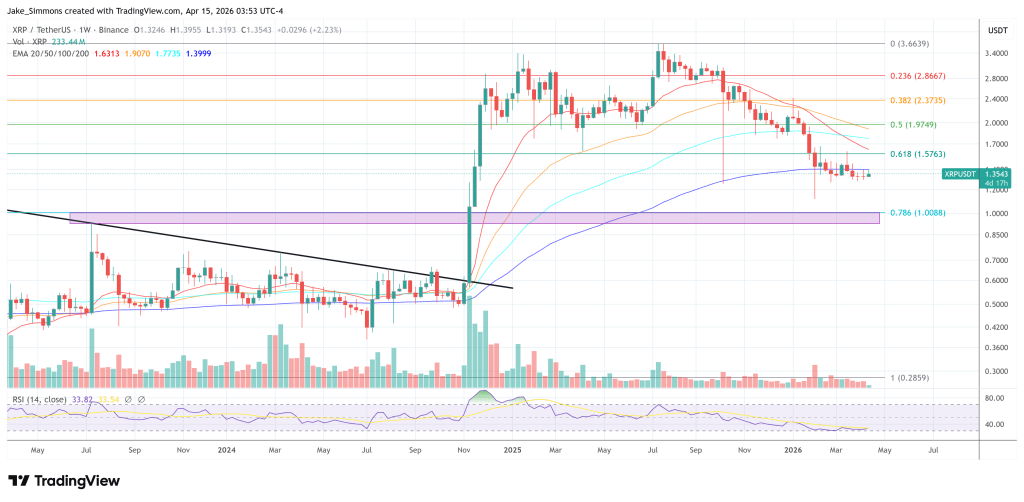
XRP must reclaim the 200-week EMA, 1-week chart | Source: XRPUSDT on TradingView.com

Related Questions

QWhat is the main purpose of the partnership between Ripple and Kyobo Life Insurance?

AThe partnership aims to explore Korea's first tokenized government bond settlement workflow on blockchain, using Ripple Custody to hold, transfer, and settle these transactions within a regulated framework.

QHow does Ripple claim its technology will improve the settlement process for government bonds?

ARipple claims the on-chain execution will replace fragmented, manual settlement processes, potentially compressing the standard two-day settlement cycle into near real-time, reducing counterparty risk and improving capital efficiency.

QWhat additional payment rails will Ripple support Kyobo in exploring?

ARipple will support Kyobo in exploring stablecoin-based payment rails to enable 24/7 transaction capability inside a compliant framework.

QHow did Fiona Murray, Ripple's managing director for Asia Pacific, characterize the significance of this partnership?

AShe characterized it as both a market entry point into Korea and a signal to other institutions that institutional-grade digital asset infrastructure is available, proven, and ready to deploy in Korea today.

QAccording to Kyobo's executive, what is the broader goal of this initiative beyond digital assets?

AThe broader goal is to validate how traditional financial instruments, like government bonds, can operate more securely and efficiently on blockchain technology to advance Korea's financial market infrastructure.

Related Reads

TechFlow Intelligence Bureau: KelpDAO Attack Causes Nearly $300 Million Loss, Triggers Aave Withdrawal Wave, RAVE Crashes 95% in a Single Day

China's AI firm DeepSeek is seeking external funding for the first time, with a valuation exceeding $10 billion, signaling intensifying competition and high R&D costs in the domestic large model sector. Meanwhile, OpenAI CEO Sam Altman faces scrutiny over potential conflicts of interest between his personal investments and OpenAI’s business ahead of a possible IPO. In Web3, KelpDAO suffered a $294 million attack due to forged cross-chain messages on LayerZero, leading to massive withdrawals from Aave and a resulting 18% drop in AAVE tokens. Separately, RAVE cryptocurrency collapsed by 95% in a single day amid suspected insider manipulation. Geopolitically, Iran is now demanding Bitcoin payments for transit through the Strait of Hormuz, reflecting both internal governmental discord and the growing adoption of crypto in tense regions. In semiconductors, Nvidia CEO Jensen Huang showed rare public frustration over questions regarding chip sales to China, while the industry faces renewed price hikes. Tesla continues expanding its Robotaxi service, and a Chinese humanoid robot outperformed humans in a half-marathon, marking a milestone in robotics. Despite Middle East tensions and market uncertainties, U.S. stocks continue to rise, prompting discussions about market optimism versus risk blindness. Overall, today’s developments highlight systemic vulnerabilities—in tech, finance, and geopolitics—while also showcasing innovation in crises.

marsbit6h ago

TechFlow Intelligence Bureau: KelpDAO Attack Causes Nearly $300 Million Loss, Triggers Aave Withdrawal Wave, RAVE Crashes 95% in a Single Day

marsbit6h ago

Trading

Spot
Futures
活动图片