Insurance Veteran Re-Entrepreneurship, Re Opens the Door to Reinsurance with On-Chain Protocols

Foresight NewsPublished on 2026-06-15Last updated on 2026-06-15

Abstract

Insurance veteran Karn Saroya leads Re, a protocol aiming to digitize the global reinsurance market by bridging it on-chain. It tackles high regulatory barriers by using a licensed reinsurer, Cover Re SPC, to handle compliant contracts, separating legal risk from the protocol layer. Users can deposit stablecoins into two tokenized tranches: reUSD (senior, principal-protected with fixed yield) and reUSDe (junior, higher-yield, first-loss). The protocol has secured $409 million in underlying premiums across low-volatility commercial lines like auto and workers' compensation. Re has raised $21 million from investors including Tribe Capital and Electric Capital. Its fixed-supply 1 billion RE governance token, part of an ongoing points program, is planned for a Coinbase listing. Re differentiates itself by offering non-correlated real-world asset yields, a compliant structure, and substantial scaled capital compared to peers like Nexus Mutual or Ensuro.


Author:angelilu,Foresight News


Reinsurance might be the last major financial market that has not yet been digitized. Last year, the global scale of RWA tokenization grew by more than 10 times, and the market value of stablecoins exceeded $320 billion, but the reinsurance sector has seen almost no substantial deployment of on-chain infrastructure.


One reason is the extremely high regulatory barriers. Reinsurance entities need to obtain licenses in jurisdictions, meet solvency requirements, and achieve segregated custody standards—which are difficult for ordinary DeFi teams to bypass.
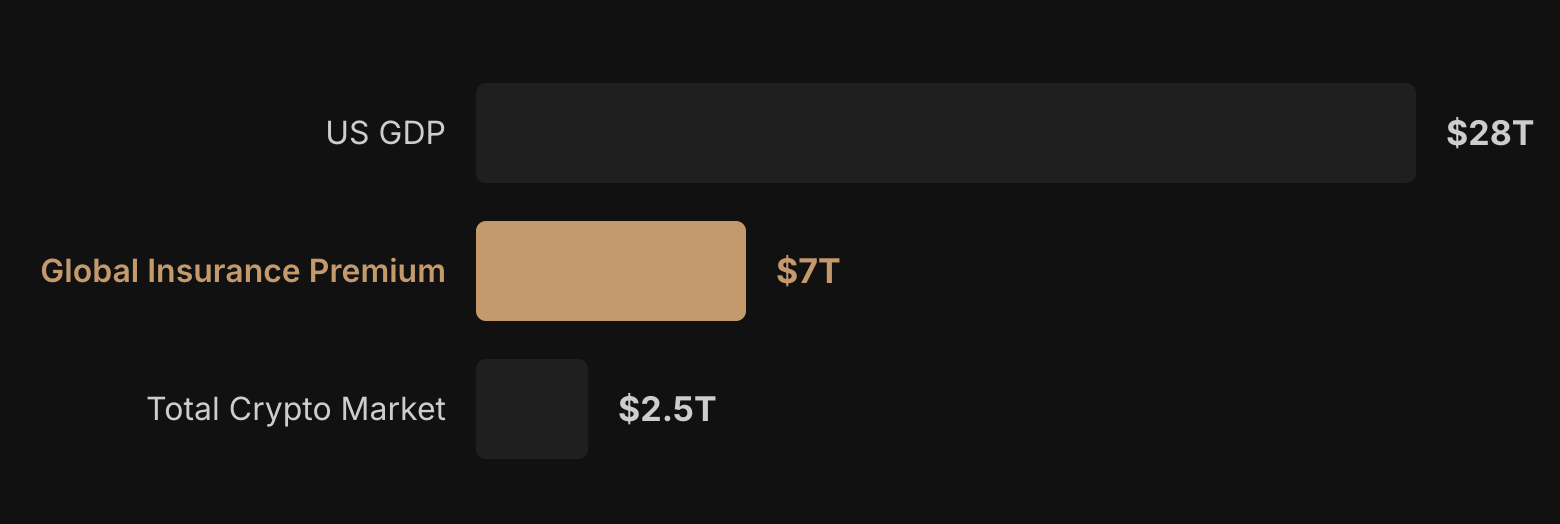


A team composed of insurance technology veterans and on-chain developers is prying open this door to the 'global reinsurance market'.


Moving Reinsurance Companies' Capital Pools On-Chain


The global reinsurance market is dominated by a few giants like Munich Re and Swiss Re, where external capital cannot enter, underwriting conditions are opaque, and solvency cannot be verified. What the Re protocol does is to move reinsurance companies' capital pools on-chain, allowing anyone to deposit money into them and earn premium income.


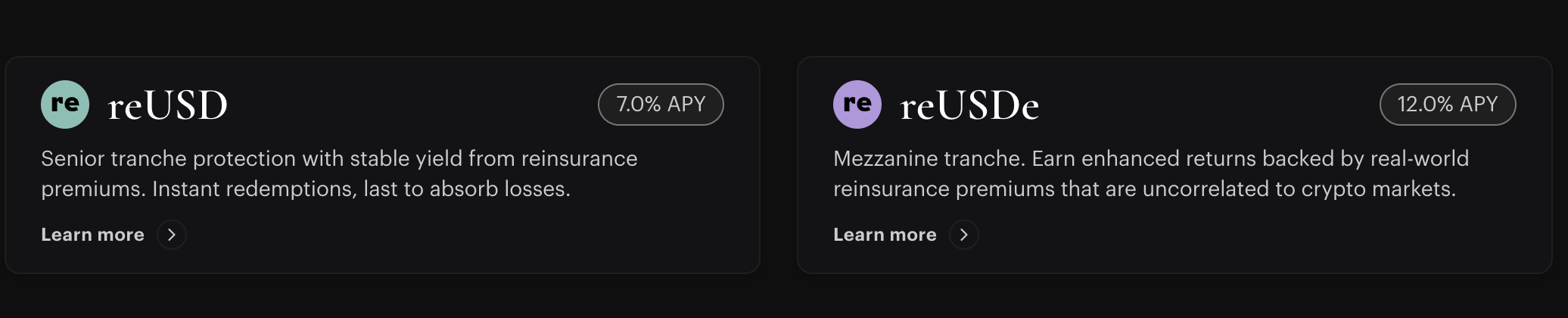
Its core model is not complicated: Insurance companies bundle part of their risks into reinsurance contracts, which are compliantly underwritten by their licensed reinsurance entity Cover Re. Decentralized liquidity providers can then deposit stablecoins into two types of tokenized tranches to earn insurance underwriting income, with the two product forms corresponding to different risk appetites:


reUSD is the senior (stable) tranche, offering principal-protected fixed income (benchmark rate + 250 basis points), with risks absorbed first by the junior tranche; reUSDe is the high-yield tranche, bearing first-loss risk, with a current highest annualized yield of about 23%. The loss absorption order is: first by reUSDe holders and Re Capital, then by reUSD.


To address the regulatory barriers, Re's solution is to separate the operation of the on-chain protocol from the licensed entity: Cover Re SPC (Cayman Islands) acts as an independent reinsurance entity to undertake compliant contracts, while the Resilience Foundation is responsible for issuing the governance token. This achieves legal separation of compliance risk from the technical risk at the protocol layer through an independent licensed entity.


Points and TGE


Re is about to launch its governance token RE. The core role of the token is to enable market participants to formulate protocol rules, but specific revenue, profits, or insurance fund flows are still operated by the licensed entity.


Re's points program aims to reward wallets that provide and store funds within the ecosystem. Its Season 1 points event recently concluded, with 7% of the total RE supply allocated to Season 1 participants. Specific claim windows and vesting mechanisms have not yet been announced. Season 2 started on June 1, 2026, currently with 2,904 active users and a total of 41.2 billion points.


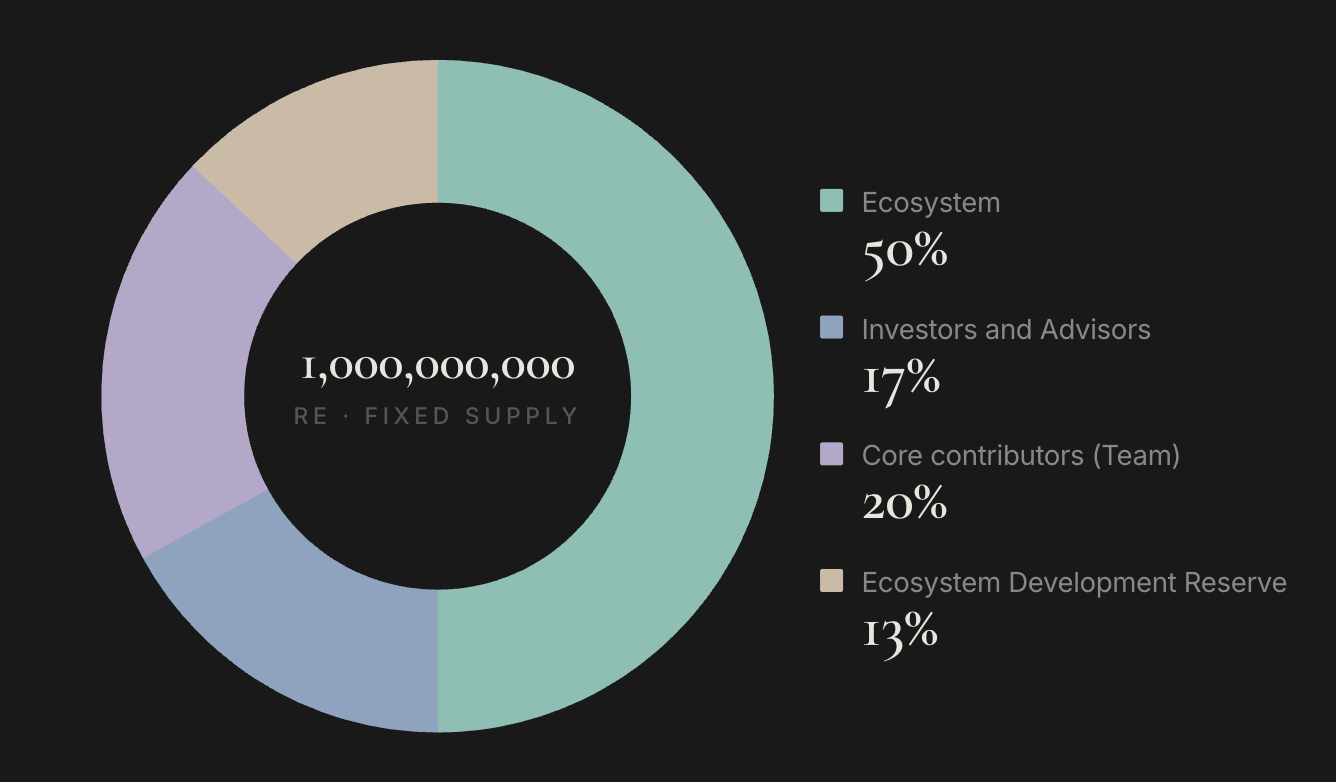
The total supply of RE is fixed at 1 billion tokens, divided into four parts:


  • Ecosystem 50%: 500 million tokens, for community incentives, points program redemptions, and other ecosystem allocations. The 7% supply for Season 1 is allocated from here.
  • Core Contributors / Team 20%: 200 million tokens, team allocation, typically with a vesting period; specific lock-up arrangements have not been announced.
  • Investors and Advisors 17%: 170 million tokens, corresponding to seed round and strategic round investors, also expected to have lock-up periods.
  • Ecosystem Development Reserve 13%: 130 million tokens, for future partnerships, protocol development, etc., managed by the foundation.


RE has been included in Coinbase's listing roadmap, but the specific TGE date has not been announced.


Re Reinsurance Data


Another major feature of Re is the low correlation of its assets. The income source of reinsurance comes from car accident rates, workplace injury occurrence rates, and property damage frequency—these numbers do not fluctuate with BTC price. When the crypto market oscillates repeatedly under geopolitical conflicts and macro policy pressures, the scarcity value of truly non-correlated assets is being repriced.


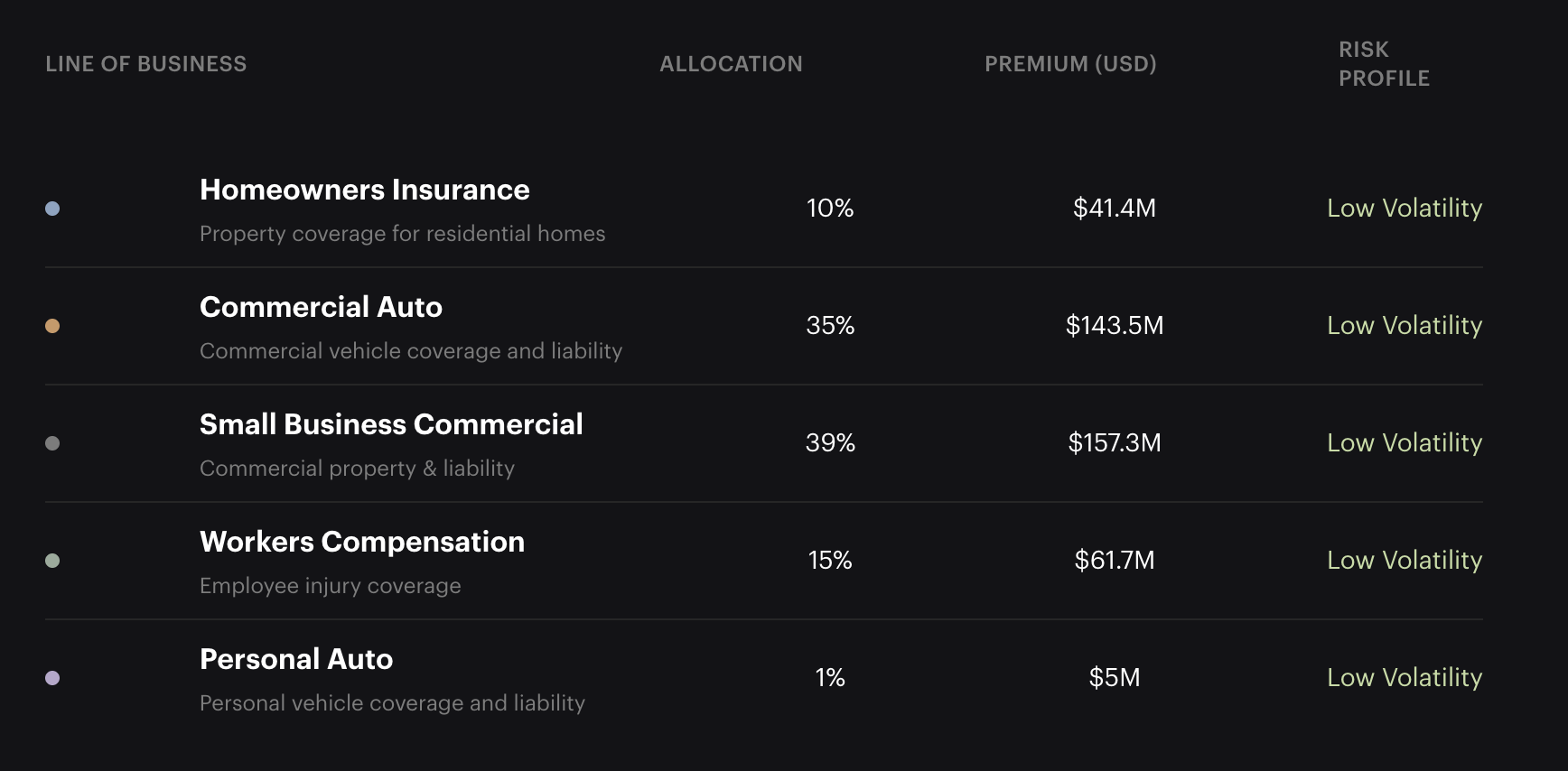
According to its official website data, as of early June 2026, its underlying underwriting portfolio totals $409 million, distributed across commercial auto insurance (35%), small business commercial insurance (39%), workers' compensation (15%), residential insurance (10%), and personal auto insurance (1%). All are in low-volatility daily insurance types, with no high-volatility catastrophic risk exposure. Each reinsurance contract is fully collateralized, with 100% cash or investment-grade assets deposited into segregated Regulation 114 trusts, and solvency can be verified on-chain.


Team and Funding


Re's CEO Karn Saroya has gone through a full round of entrepreneurial experience in the insurtech space. He previously co-founded the insurtech platform Cover, which launched in 2016, raised a total of $27 million from institutions like Exor and Tribe Capital, and later shut down due to business adjustments. Even earlier, he founded the fashion app Stylekick, which was acquired by Shopify.


Other co-founders include Anand Dhillon, Ben Aneesh, Cliff White, and Tribe Capital co-founder Arjun Sethi (the project started under the Tribe Capital crypto incubation system). The specific roles of team members have not been fully disclosed through official channels.


Re completed a $14 million seed round in September 2022, with investors including Tribe Capital, Framework Ventures, Morgan Creek Digital, global reinsurer SiriusPoint, Exor, and Stratos. Post-seed valuation was approximately $100 million. In May 2024, an additional $7 million strategic round was raised, led by Electric Capital, with participation from Nexus Mutual and Avalanche Labs, bringing total funding to about $21 million.


Competitors in the Sector


Comparable projects in the same sector have different directions.


Nexus Mutual is the longest-standing protocol in the on-chain insurance field, but it covers crypto-native risks like DeFi smart contract vulnerabilities and hacker attacks, not involving real-world insurance contracts.


Neptune Mutual focuses on parametric insurance (automatic payouts based on predefined trigger conditions), with a TVL of about $13 million. Its scale is significantly different from Re's, mainly targeting DeFi protocol security scenarios, and has not entered the real-world insurance market.


Ensuro's positioning is closest to Re's—obtaining a regulatory license in Bermuda, partnering with Nexus Mutual to connect on-chain capital with real insurance risks—but publicly disclosed scale data is limited, and it has not yet gained visibility in the mainstream market.


The core differences from the above three are: Re covers insurance types like commercial auto and workers' compensation, which have extremely low correlation with the crypto market; the compliant structure of the licensed reinsurance entity Cover Re allows institutional funds to enter legally; and the $400 million in already underwritten premium volume makes it the only on-chain protocol in this sector that has reached a real commercial scale.


Related Questions

QWhat is the main business model and value proposition of the Re protocol?

AThe Re protocol aims to digitize and open up the traditionally opaque global reinsurance market. Its core model involves transferring a reinsurance company's capital pool onto the blockchain. This allows anyone to deposit stablecoins to earn premium income from underwriting real-world insurance risks. It offers two tokenized positions: reUSD (senior/stable tranche with principal protection and fixed yield) and reUSDe (high-yield/junior tranche that absorbs first losses for higher returns). The protocol uses a licensed reinsurance entity, Cover Re SPC, to handle compliant contracts, separating regulatory risk from the protocol's technical layer.

QHow does Re protocol address the high regulatory barriers in the reinsurance industry?

ARe protocol addresses regulatory barriers by implementing a legal separation between its on-chain protocol and licensed operational entities. A licensed reinsurance entity, Cover Re SPC based in the Cayman Islands, independently underwrites compliant reinsurance contracts. The Resilience Foundation handles governance token issuance. This structure isolates the compliance and regulatory risks associated with the insurance business from the technical and operational risks of the decentralized protocol layer.

QWhat are the key characteristics of RE token's distribution and its planned use?

AThe total fixed supply of the RE governance token is 1 billion. It is distributed across four categories: 50% to the Ecosystem for community incentives and point program rewards; 20% to Core Contributors/Team; 17% to Investors and Advisors; and 13% to an Ecosystem Development Reserve managed by the foundation. Its core function is to allow market participants to govern protocol rules, while the actual insurance cash flows and income are managed by the separate, licensed operating entity. 7% of the total supply is allocated for Season 1 point program participants.

QAccording to the article, what makes the assets underlying Re protocol valuable, especially in the context of the crypto market?

AThe assets underlying Re protocol are valuable due to their low correlation with the crypto market. The protocol's yield is derived from real-world risk events like car accident rates, workplace injury frequency, and property damage—factors that do not fluctuate with Bitcoin's price. As of June 2026, its underwriting portfolio of $409 million is spread across low-volatility, everyday insurance lines like commercial auto, small business commercial, workers' compensation, and residential insurance, with no exposure to high-volatility catastrophe risks. This provides a source of non-correlated yield.

QHow does Re protocol compare to other projects in the on-chain insurance space, such as Nexus Mutual, Neptune Mutual, and Ensuro?

ARe protocol differs from competitors in several key ways: 1) It covers real-world, low-correlation insurance lines (e.g., commercial auto, workers' comp), unlike Nexus Mutual and Neptune Mutual which focus on crypto-native risks like smart contract exploits. 2) It operates through a licensed reinsurance entity (Cover Re SPC), enabling institutional participation. 3) With a $409 million underlying portfolio, it has achieved a significant commercial scale not yet seen by other protocols in this niche. Ensuro has a similar real-world insurance focus and a license, but Re currently has greater market visibility and scale.

Related Reads

Blockchain Has Finally Started to Sail into the Mainstream After 18 Years

Blockchain Finds Its True Path After 18 Years: Becoming the Financial Backbone for AI Agents and Autonomy This analysis explores a pivotal shift in the blockchain and crypto investment landscape, driven by the dominance of AI. Major venture capital firms, including Variant, Paradigm, Haun Ventures, and YZi Labs, are moving beyond pure "crypto" investment theses. They are expanding their focus to AI, robotics, and frontier tech, signaling that blockchain is no longer seen as a standalone sector but as an underlying infrastructure layer. The core argument is that blockchain's killer application may not be user-facing apps, but rather providing the economic rails for the coming wave of AI agents, autonomous robots, and automated systems. Key capabilities like self-custody wallets, programmable stablecoins for micropayments, on-chain identity, and verifiable smart contracts are positioned as essential for a future where machines conduct economic activity. The recent $1.4 billion investment by Tether (via its venture arm) in German robotics company NEURA Robotics exemplifies this, aiming to embed Tether's wallet tools directly into robots for autonomous transactions. While many "AI + Crypto" projects remain superficial, the article concludes that true value lies where crypto is a necessary component—enabling machine-to-machine payments, agent autonomy, verifiable data provenance, and open financial settlement for the AI era. For crypto venture capital, this convergence with AI represents both an adaptation to shifting capital flows and a potential path to unlocking the large-scale, non-speculative utility the industry has long sought.

marsbit14m ago

Blockchain Has Finally Started to Sail into the Mainstream After 18 Years

marsbit14m ago

Blockchain has finally begun sailing toward the main channel after 18 years

After 18 years of development, blockchain technology is beginning to move from a specialized niche into mainstream adoption, according to a recent industry analysis. The shift is reflected in the changing strategies of major crypto venture capital firms, which are expanding their focus beyond pure "digital ownership" towards broader themes like "autonomy." The report highlights that leading VC firms like Variant, Paradigm, Haun Ventures, and YZi Labs are broadening their investment mandates to include not only crypto but also artificial intelligence (AI), robotics, biotech, and other frontier technologies. This reflects a recognition that the isolated "crypto investment" narrative is losing appeal to limited partners (LPs) as capital and attention increasingly flow toward AI and other high-growth tech sectors. A key emerging thesis is that blockchain's most significant future application may not be as a consumer-facing product, but as the underlying economic and settlement infrastructure for the AI era. As AI agents and autonomous systems become more prevalent, they will require programmable, global, and low-cost payment networks (like stablecoins), verifiable digital identities, and secure wallets to manage transactions and assets on behalf of users. The investment by stablecoin issuer Tether into robotics company NEURA, with plans to integrate its wallet technology, is cited as a prime example of this convergence. However, the article cautions that simply labeling projects as "AI + Crypto" is insufficient. True value lies in integrations where blockchain technology is essential—such as enabling machine-to-machine micropayments, verifiable data provenance for AI, or transparent governance for autonomous organizations—rather than being a superficial marketing add-on. In conclusion, while AI currently dominates the tech narrative and capital flows, it may ultimately create the real-world, high-frequency demand that the crypto industry has long sought. For crypto VCs and projects, the path forward is to position blockchain not as a competing sector, but as a critical foundational layer powering autonomy and economic activity in an AI-driven future.

链捕手20m ago

Blockchain has finally begun sailing toward the main channel after 18 years

链捕手20m ago

Y Combinator Co-founder: How to Make a Billion Dollars?

The Y Combinator co-founder argues that becoming a billionaire by founding a successful startup is not only possible but demonstrably achievable without unfair or unethical practices. He disputes a politician's claim to the contrary, using the example of a founder whose company grew at 93% monthly solely through creating a product users loved and recommended. The core mechanism is exponential growth. A conservative 15% monthly growth rate compounds to a 4384x increase over five years, which can easily lead to billion-dollar valuations and founder wealth. The process depends on two key variables: the growth rate and the duration it can be sustained. A high growth rate stems from a great product that users naturally promote, while a long duration requires a large enough market. For aspiring founders, especially young ones, the simplest path is to build something they and their friends genuinely need. Young people's current needs often predict future mass-market trends. He advises against actively "searching" for ideas, as this tends to filter out unconventional but promising ones. Instead, inspiration should come from working on interesting projects with friends, as many iconic companies (e.g., Apple, Facebook) started this way. Ultimately, building a massively valuable startup is not about exploitation but empathy: deeply understanding a user group and building a product that significantly improves their lives. This, powered by exponential growth in a large market, is the legitimate path to immense wealth creation.

Foresight News23m ago

Y Combinator Co-founder: How to Make a Billion Dollars?

Foresight News23m ago

The 800V Voltage Standard Championed by Nvidia: Which Infrastructure Providers Stand to Benefit?

NVIDIA is actively promoting the 800VDC architecture as a key direction for its next-generation AI factories and high-power racks, particularly for the upcoming Rubin and Kyber platforms. The primary driver is the rapidly increasing power density of AI racks, with designs like GB200/GB300 NVL72 reaching 120-140kW and future systems potentially hitting 180-220kW. At such high power levels, traditional low-voltage power delivery becomes inefficient due to massive current, leading to significant copper use, cable bulk, heat, and power loss. The 800VDC standard aims to increase efficiency by transmitting power at higher voltage and lower current to the rack before stepping it down locally for GPUs. NVIDIA claims this can improve efficiency by up to 5%, reduce total cost of ownership (TCO) by up to 30%, and cut copper usage by approximately 45%. This shift redefines infrastructure roles, pushing power engineering to the forefront alongside GPU performance. Key beneficiaries and ecosystem partners highlighted include: 1. **Power Infrastructure Providers:** Companies like Vertiv, Schneider Electric, Delta Electronics (台达电), and Korean firms LS Electric and HD Hyundai Electric are involved in designing next-gen AI factory power distribution, rack power supplies, and backup systems. 2. **Power Semiconductors:** Suppliers of SiC/GaN devices, such as Infineon and STMicroelectronics, are better suited for high-voltage, high-efficiency conversion in this new architecture. 3. **Connectivity & Structure:** The focus shifts to high-reliability components like busbars, high-voltage connectors, and advanced PCBs that meet stricter insulation and safety requirements. 4. **Liquid Cooling & Rack ODM:** As power and heat density rise, liquid cooling becomes critical. Full-rack system integrators (e.g., Dell, Wiwynn, Wistron) must now demonstrate robust pre-delivery testing capabilities, including burn-in testing under full load, requiring significant power and cooling infrastructure in their factories. The transition is not immediate for all data centers but is targeted at high-density AI factories. NVIDIA’s 800VDC ecosystem is in a preparatory phase, with full-scale production expected to align with the 2027 launch of Kyber rack-scale systems. The investment thesis revolves around which companies can demonstrate proven product integration, customer validation, and reliable delivery of complete, high-power AI rack systems, making power, cooling, and testing capabilities new critical variables in the AI infrastructure value chain alongside GPUs.

marsbit43m ago

The 800V Voltage Standard Championed by Nvidia: Which Infrastructure Providers Stand to Benefit?

marsbit43m ago

Trading

Spot
Futures
活动图片