Author: Astronaut
Tokens are expensive, and burning through them is painful.
This isn't just the sentiment of those currently obsessed with Vibe Coding. Even the major Silicon Valley companies that were previously fervently preaching Tokenmaxxing have now started imposing token usage limits on their own employees.
But here's a counter-intuitive point: for those currently using AI subscriptions, the tokens you're consuming have already been subsidized by the major AI companies. The highest subsidy could be as much as 70 times the subscription fee itself!
What's more concerning is that both OpenAI and Anthropic, the two leading AI companies, are now entering their IPO sprint phases. After these companies go public, will they follow the post-subsidy-war playbook of the internet era, raising customer prices to bring token pricing back to a 'rational' level?
The good news is that this scenario might not happen. Recently, Google Ventures founder Bill Maris raised a question on the All-in podcast: What would happen if Google decided to slash token prices by another 80%? How would OpenAI and Anthropic respond?
Similarly, not long ago, the startup team Agnes AI explained the potential arrival of a 'Free Token Era' during a livestream with GeekPark.
So, will token prices rise or fall in the future? And what does this mean for those already addicted to AI?
01 The Token Subsidy War is Raging
Why is it said that current token prices aren't actually that expensive?
Because at least in the AI subscription model, the current prices offered by various AI companies are already 'rock-bottom' subsidized prices.
Recently, SemiAnalysis conducted a detailed evaluation comparing the actual token consumption value against the subscription fees under the subscription plans of OpenAI and Anthropic.
SemiAnalysis did something simple but effective: they practically used AI within the subscription plans of various AI platforms to complete different tasks, then reverse-calculated how much those tasks' tokens would cost using the API's public pricing. The results are as follows:
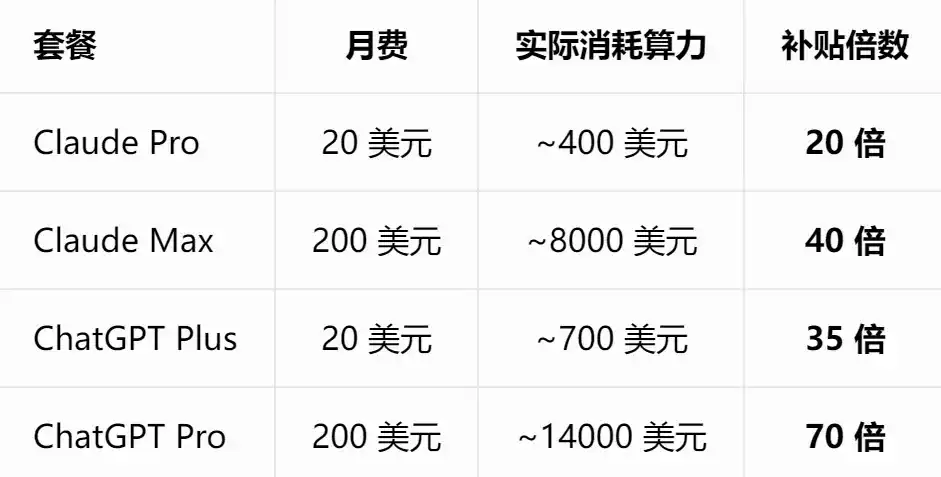
Notice a pattern: the more expensive the plan, the higher the subsidy multiple. This itself indicates these premium plans aren't meant for profit—they are a form of 'reverse pricing,' using the most aggressive losses to retain the most heavy-duty users. Because heavy users are developers, they are enterprise decision-makers. Once they are locked onto a platform, they can bring along entire teams and product lines.
Losing money to this extent, why still do it? The standard answer is: first burn money for scale, then raise prices to recoup once scale is achieved. That's how the mobile internet played out—Didi and Uber subsidized hundreds of billions in ride fares, and after subsidies ended, fares increased; Meituan subsidized countless meals, and after subsidies ended, delivery fees increased. This logic hinges on a key prerequisite: lock-in effect was established during the subsidy period.
Didi could raise prices because drivers couldn't leave the order flow on the platform, and passengers couldn't leave the drivers on the platform. Meituan could raise prices because merchants couldn't leave its traffic and delivery network. When subsidies ended, users were already 'locked' into the ecosystem, with extremely high switching costs.
But there's a fundamental difference between the AI war and the internet war—Tokens have almost no lock-in effect.
If Claude raises its prices, developers could migrate API calls to GPT or Gemini within a day—interfaces across providers are becoming increasingly standardized, and many development frameworks even have built-in multi-model switching capabilities. For regular users, it's even simpler: just switch to a different website. AI isn't like ride-hailing with a local driver network, nor like food delivery with a distribution system, nor like social media with a friend network. Tokens are just tokens; no matter who produces them, they are the same thing.
This means that once subsidies stop, users can vanish in an instant. Subsidies aren't 'building moats'; they are more like 'maintaining a heartbeat'—as long as someone offers a lower price, users run.
And this hasn't even accounted for a new variable that's making everyone's bills spin out of control: AI Agents.
When you chat with ChatGPT, a single conversation might consume a few thousand tokens. But when you task an AI Agent with a complex job—writing a piece of code and debugging it automatically, analyzing a dozens-page document and generating a report—a single round can consume 5 to 30 times more tokens than a regular conversation. Some developers have measured that on the $100 Claude Max plan, a single Agent programming session could burn through nearly $100 worth of tokens. Uber's CTO recently revealed the company burned through its entire 2026 AI budget in just four months.
The question is, can such a Token Subsidy War be sustained? Who might be the ones left standing when the chaotic fight is over?
Bill Maris believes the answer is clearly the traditional giants.
02 Token as a Weapon
To understand the true brutality of this subsidy war, one must first see a structural asymmetry—the ammunition sources for the various combatants are completely different.
Google's annual advertising revenue exceeds $300 billion. This isn't money from investors, nor is it money burned from fundraising; it's a money-printing machine running automatically every day. Billions of people worldwide open their search engine, watch YouTube, use Gmail, and advertising dollars automatically flow into its account. It doesn't need to do roadshows, doesn't need to please analysts, doesn't need to explain to anyone why it's spending this money.
Google using ad profits to subsidize AI tokens is like someone sitting on an oil well fighting a gas station price war—their oil comes bubbling up from their own land, while their opponents' oil is bought with bank loans.
OpenAI and Anthropic are precisely those buying oil with loans.
OpenAI has cumulatively raised over $180 billion, with the latest valuation exceeding $850 billion. Anthropic has raised over $130 billion. This money comes from venture capital and strategic investors—they aren't giving money out of charity; they expect these companies to go public, they expect hefty returns upon exit.
And after going public, the real trouble begins. An IPO means financial statements are public to the world. Every quarter, Wall Street analysts will scrutinize revenue, profit, customer acquisition cost, and marginal cost. When they calculate that you're actually losing $70 for every $1 of subscription fee received—no growth story, no matter how glorious, can support the stock price.
Bill Maris put this logic bluntly on the podcast. His exact words were: "If I were Google and decided to arbitrarily cut token prices by 80%, what would happen to OpenAI and Anthropic's business model?"
When the host asked how likely that was, Maris didn't hesitate: "100%. Capital as a weapon, tokens as a weapon."
This isn't speculation from an analyst. Bill Maris is the founder and CEO of Google Ventures, also a Google VP of Special Projects, having incubated Waymo and Google X. Everyone present understood: this wasn't a hypothetical; it was him having seen firsthand how Google fights wars.
The scenario he described is simple: Google announces an 80% price cut for the Gemini API. What would enterprise customers do? If the product quality is similar—and in many benchmark tests, Gemini is already comparable to Claude and GPT—but the price is four-fifths cheaper, would you continue using the expensive one?
Maris gave his own answer: "If you are a company and you can go to Google and Gemini and pay 80% less for basically the same product, why wouldn't you? And then the pressure on those companies becomes very severe."
And OpenAI and Anthropic have almost no symmetrical countermeasures. They can't match the price cut—they lack a money printer; every dollar is investor money. They also can't rely on a technology gap to maintain a premium—the gap between large models is closing rapidly. You might be ahead for three months today, but you'll be caught up in three months. It's not like the generational technological gap between the iPhone and Nokia. The moats between AI models are more like dykes built of sand, easily overrun when the tide rises.
In Bill's narrative, Google has a strong chance of winning. But in the AI world, can Google truly monopolize? Meta can open-source a free model at any time; China has DeepSeek and ByteDance; Amazon is pushing its own model. When you drive token prices down to dirt-cheap levels, competitors don't disappear—they are also lowering prices.
The AI war might have no winner.
03 The 'Infinite Game' of Tokens?
Even those unfamiliar with history can make the following judgments about the ultimate outcome of the current AI war:
The first is the 'Internet Service' script—the story of Didi, the story of Amazon: subsidize first, then monopolize, then raise prices to harvest. In this script, today's price war is just the prologue. Eventually, one or two winners will dominate most of the market and gain pricing power. If so, the massive losses today are a worthwhile investment—just like Amazon lost money for twenty years before ultimately becoming the dual champion of e-commerce and cloud computing.
The second is the 'Utility' script. Tokens become a standardized basic resource, like electricity, bandwidth, cloud storage. No one can maintain pricing power long-term because product differentiation is too small and switching costs are too low. Competition pushes prices infinitely towards the cost line, with profit margins approaching zero. Ultimately, governments might step in with regulation—just as they did with electricity and telecommunications a hundred years ago.
The difference between the two scripts hinges on one word:
Lock-in.
Didi could raise prices because passengers were locked into the driver network, and drivers were locked into the order flow. Amazon could raise prices because merchants were locked into its logistics and traffic ecosystem.
The lock-in effect is the cornerstone of the 'lose first, profit later' model.
But AI tokens—as argued repeatedly before—have almost no lock-in. APIs are standardized; switching costs are nearly zero. The core condition for the first script doesn't exist for the product of tokens.
If the second script, the 'utility' infrastructure endgame, is closer to reality, what we are witnessing is not a war that will eventually produce a victor, but a war of attrition with no end in sight.
Meituan founder Wang Xing once described this competitive state. His insight was: some competitions don't have a concept of 'winning.' The goal of the participants isn't to defeat opponents, but to ensure they remain at the table. Because as long as you are at the table, you can continue fundraising, hiring, and iterating. Leaving the table is the only way to lose.
Using this framework to re-examine today's AI landscape, many seemingly contradictory things suddenly become clear.
OpenAI's latest round valuation exceeds $800 billion, not because training models requires that much money. It needs that much money to continue the price war. Fundraising isn't to win; it's to 'qualify to keep fighting.'
Google preparing to cut token prices by 80% isn't to eliminate OpenAI and Anthropic. It's to ensure it remains a core player in the AI era—just as it once ensured it wasn't left off the mobile era table with free Android.
And Anthropic raising the API pricing for its latest flagship model Fable 5 to twice that of the previous generation—$10 per million tokens input, $50 per million output—seemingly 'raising prices,' is actually proactively filtering for enterprise customers willing to pay for high-end capabilities, because deep down it knows: it can't win the consumer-side subsidy war against Google.
Each round of price war expands the scale of AI usage. Expanded scale means more data, more scenarios, more developers flooding into the ecosystem. This in turn makes all participants' models stronger. Combatants use the war itself to attract resources to upgrade themselves—this isn't a zero-sum, life-or-death battle, but a process where everyone becomes stronger through competition, yet none are likely to reap massive profits.
Doesn't that sound exactly like how the electricity industry ultimately turned out?
140 years ago, both Edison and Westinghouse thought they were fighting for a winner-take-all market. They staked their entire fortunes, betting on 'whoever defines the standard for electricity, owns electricity.' But the fate of electricity tells us a simple truth:
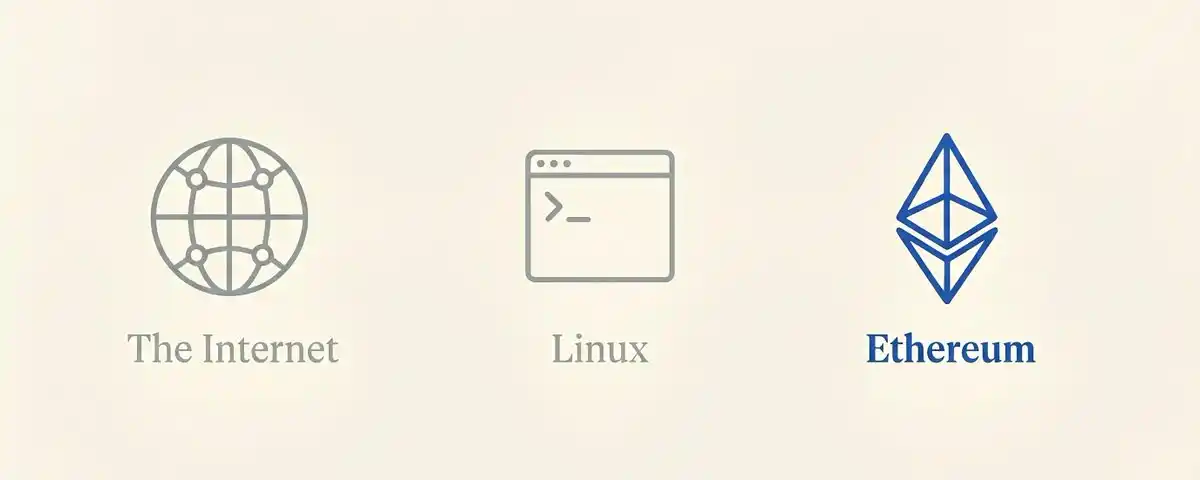
When a technology becomes sufficiently important, sufficiently universal, sufficiently standardized, it no longer belongs to any single company. It becomes infrastructure.
The AI competition, on the surface, appears to be Google vs. OpenAI vs. Anthropic, a contest of model capabilities, a battle of fundraising scale. But zooming the lens out, the true function of this competition is: it is accelerating the push of AI toward a level of infrastructure that no company can monopolize.
When Bill Maris says "100% will happen," he may not just be predicting that Google will lower prices. He may be, perhaps unconsciously, predicting a larger trend—in the world of AI, tokens will ultimately not belong to anyone. Just as no one 'owns' electricity today.
For OpenAI and Anthropic, this means something unsettling: even with technological leads, even after raising astronomical funds, the future they are chasing—'making big money from AI'—might not have existed from the very beginning. They aren't facing a temporary price war, but a structural destiny—the thing they are striving to build might, in essence, be the next generation's water, electricity, and roads.
And for users, to some extent, this might be good news. As long as the Token Subsidy War continues, people can still enjoy the 'good deal' of $400 worth of compute power for a $20 cost.