Cyclical Stock or Growth Stock? Coinbase's Q2 Earnings Report Reveals 'Valuation Disagreement'

Odaily星球日报Published on 2026-07-31Last updated on 2026-07-31

Abstract

Coinbase's Q2 2026 financial results revealed a mixed performance, reigniting debate over whether the company should be valued as a cyclical stock tied to crypto markets or a growth stock with future potential. Total revenue missed expectations at $1.22 billion, down 19% year-over-year. Transaction revenue fell to $599 million, with retail crypto spot trading revenue dropping 30% to $452 million, back to 2023 levels. The company reported a net loss of $359 million, marking its third consecutive quarterly loss. Despite CEO Brian Armstrong's positive commentary on metrics like a 10.3% overall crypto trading market share and 106% growth in prediction markets, the market reacted negatively, with shares dropping over 5% after-hours. A key issue is the decline in core retail trading. While Coinbase touted record market share, this figure includes derivatives and new products. Its traditional crypto spot trading share is likely shrinking. New ventures like prediction markets, while growing, contributed less than $30 million, insufficient to offset the core revenue decline. The valuation debate hinges on perspective. As a cyclical stock, Coinbase remains deeply tied to the crypto bear market, with user attrition and competitive pressures justifying a lower valuation. The company's strategy appears focused on surviving until the next bull cycle. Viewed as a growth stock, however, Coinbase shows promising diversification. Subscription and service revenue reached $555 million, nearl...

Original | Odaily Planet Daily (@OdailyChina)

Author | Golem (@web3_golem)
On July 31st, Coinbase announced its Q2 2026 financial report. Coinbase CEO Brian Armstrong posted on platform X, summarizing the quarter: "Despite a very difficult market environment in the second quarter, Coinbase continued to make steady progress amidst various headwinds." He highlighted Q2 achievements, such as over 90% of delegated stablecoin transaction volume concentrated on Base; crypto trading market share reached a new high of 10.3%; and prediction markets revenue doubled, growing 106% quarter-over-quarter, among others.

Overall, it was more about reporting the good news than the bad, which is Coinbase's consistent style. However, the market won't play along. Coinbase's Q2 2026 revenue still fell short of expectations.

The financial report shows that in Q2 2026, Coinbase's total revenue was $1.22 billion, a 19% year-over-year decrease and a 14% quarter-over-quarter decrease, missing market expectations ($1.29 billion); trading revenue was $599 million, also below the market expectation of $628 million; net loss reached $359 million. Coinbase has now achieved net losses for three consecutive quarters (Odaily note: Q4 2025 net loss was $666.7 million, Q1 2026 net loss was $394.1 million).

Affected by this, Coinbase (NASDAQ: COIN) fell over 5% in after-hours trading.

Market Share Hits New High, But Crypto Spot Trading Market Share Continues to Shrink

In the Q2 earnings call, Coinbase didn't even explain the reasons for this quarter's net loss, choosing instead to downplay the negative and focus on answering questions unrelated to its crypto brokerage business. In Q1 2026, Coinbase attributed the losses to weak crypto markets and crypto asset impairments, but Odaily Planet Daily previously analyzed that the essence of its net loss was due to continuous user attrition and a sharp decline in crypto trading revenue.(Related reading:Q1 Net Loss $394.1 Million, Coinbase Can Only Hold Tight to Circle's Leg)

By Q2, the situation had not improved; trading revenue continued to decline. The report shows that Coinbase's Q2 total trading revenue reached $599 million, of which the major contributor, retail trading revenue, was $452 million, down 30% year-over-year and 20% quarter-over-quarter, even falling back to 2023 revenue levels. According to the report, retail crypto spot trading volume has decreased by 24%.
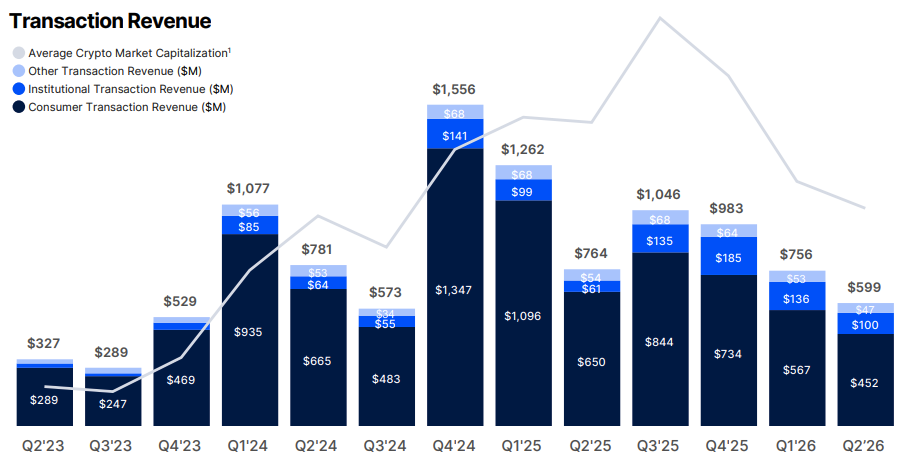
Coinbase 2026 Q2 Trading Revenue

Even with such dismal figures, retail-contributed trading revenue remained the largest single source of revenue in Coinbase's Q2 report. The second-largest source was stablecoin revenue, reaching $292 million. Since the report disclosed that Coinbase's crypto trading market share reached a new high of 10.3% in Q2, why is its trading revenue still declining sharply? Is it, as some analysts say, not due to user loss, but simply because of weak crypto sentiment reducing retail trading desire?

But the truth is that Coinbase played a word game. According to Coinbase's calculation method, this market share includes new products like derivatives trading, prediction markets, and tokenized stocks, not just cryptocurrency spot trading. Therefore, the 1% growth from 9.1% in Q1 to the current 10.3% in crypto trading market share was basically contributed by new business lines.
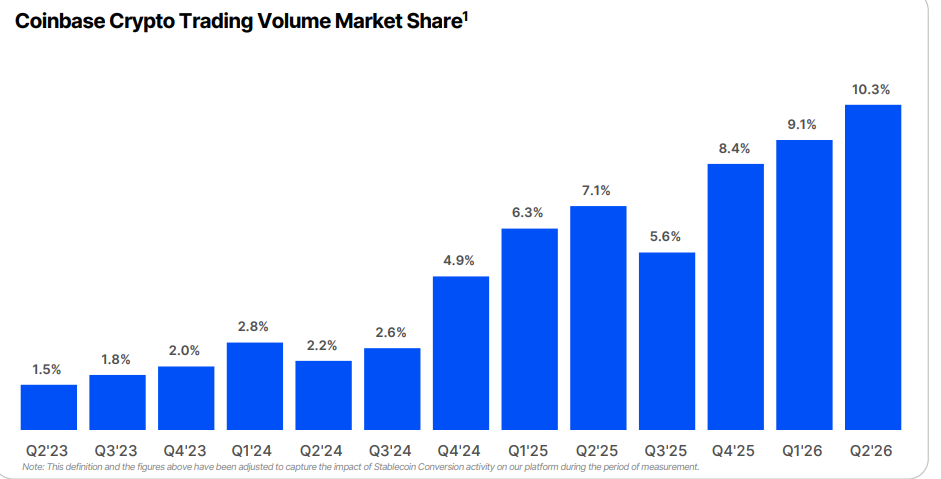
Quarterly Changes in Coinbase Crypto Trading Market Share

According to the report, growth in prediction markets has partially offset the impact of sluggish retail crypto spot trading volume on revenue. But by Coinbase's calculation, although prediction market revenue grew over 2 times quarter-over-quarter compared to Q1, its annualized revenue is only about $100 million, meaning actual revenue might be less than $30 million. Therefore, its offsetting effect on the loss of retail trading revenue can only be described as a drop in the bucket.

In summary, crypto spot trading remains the pillar of Coinbase's revenue. While Coinbase is doing its utmost to develop other businesses to create the so-called "Exchange for Everything," and has achieved growth, its growth rate and revenue levels have not satisfied the market and investors. In established market segments like prediction markets, crypto derivatives, and tokenized stock trading, Coinbase's competitiveness as a new entrant is relatively small. Its prospects for relying on new business lines for substantial growth and financial turnaround do not look optimistic at present.

Cyclical Stock or Growth Stock

However, to be fair, the current valuation of Coinbase depends on whether it is viewed as a cyclical stock or a growth stock.

If viewed as a cyclical stock, Coinbase's revenue is indeed constrained by the current crypto bear market cycle. New businesses have not freed it from cyclical limitations, and user attrition and declining competitiveness among exchanges are also obvious issues on the table.

Therefore, from this perspective, a decline in Coinbase's stock price is reasonable. In fact, everything Coinbase is doing now seems to be about surviving until the bull market cycle returns. Brian Armstrong also stated in the earnings call, "I believe Bitcoin will make a strong comeback; it has always gone through such cycles, and prices always go up and down. But we must have a strategy for diversified revenue; it is core to the exchange's operational strategy." The subtext is: when the bull market comes, everything will be fine.

If Coinbase is viewed as a future growth stock, then it is currently even undervalued.

First, looking at the revenue composition, although Coinbase has not yet achieved revenue diversification and crypto spot trading remains its main revenue source, the sources of revenue show a trend towards diversification. The report shows that Coinbase's current revenue is decoupled from Bitcoin trading fees, with 88% of net revenue coming from non-Bitcoin spot trading. In 2020, Bitcoin trading fees accounted for over 55% of revenue. Meanwhile, Coinbase's subscription and services revenue in this quarter reached $555 million, accounting for 48% of net revenue, almost on par with trading revenue ($599 million).
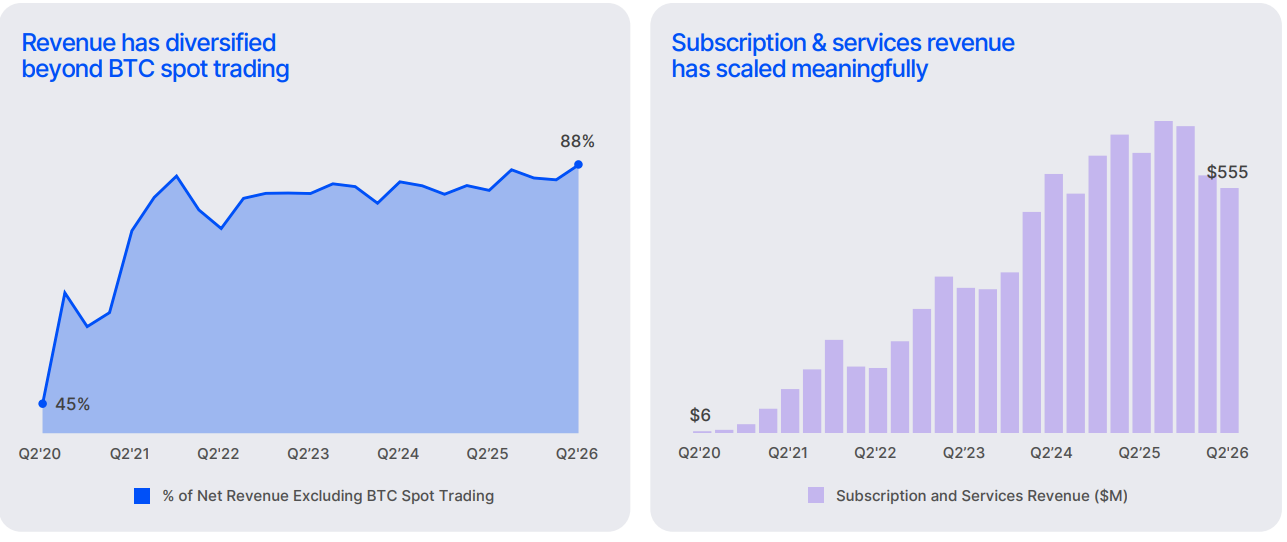
Coinbase Bitcoin Trading Fee Revenue Share & Quarterly Subscription and Services Revenue Growth

Furthermore, the number of paid users for Coinbase One hit a record high this quarter, with subscription fee revenue growing to $114 million. Crypto derivatives trading volume in Q2 did not decrease but remained largely flat with Q1 at $4.221 trillion. Coinbase has acquired Deribit and can now provide crypto derivatives trading for international users, potentially leading to another significant increase in market trading volume.
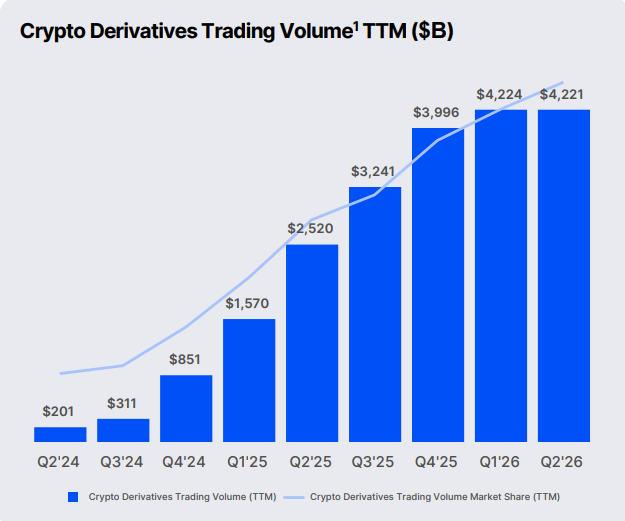
Therefore, from a developmental perspective, perhaps by Q3 2026 or Q1 2027, the total revenue from Coinbase's other businesses will replace the decisive role of crypto spot revenue in its overall revenue. The "Exchange for Everything" concept Coinbase aims to build does not necessarily mean it must excel in every field (like prediction markets, crypto derivatives, and tokenized stocks). Most investors don't have such expectations either; achieving profitability and diversified revenue would already meet expectations.

Because the future potential investors see in Coinbase lies mainly in its stablecoin business and the agent economy.

In the earnings call, CFO Alesia Haas again emphasized that Coinbase's revenue-sharing agreement with Circle will continue. Coinbase's Q2 2026 stablecoin revenue reached $292 million, still its second-largest revenue source. Meanwhile, USDC deposited on Coinbase platforms and products reached a new high, with over 30% of circulating USDC stored on Coinbase. Moreover, Coinbase disclosed in the report that over the past year, Coinbase has captured 50% of the total economic value of USDC, and broader on-chain collaboration and product integration will drive wider adoption of USDC in the future.

Simultaneously, Coinbase doesn't want to rely solely on USDC and is becoming a multi-stablecoin platform. Coinbase is a founding member of OUSD, and the variety of stablecoins supported on its platform is constantly increasing.

In the on-chain agent economy, Coinbase is a leader in the on-chain Agentic Finance (AIFi) field. Currently, according to the report, over 99% of on-chain agent transactions are completed using USDC, and over 90% of delegated stablecoin transactions are completed on Base. In Q2 2026, over 97% of on-chain agent transactions used Coinbase's x402 protocol.

Furthermore, Base's leading position in the agent economy won't be easily shaken by new market entrants competing on price because it is already cheap enough. Brian Armstrong stated in the earnings call, "Base's settlement price is below $0.01, with a settlement time under 1 second. From that perspective, it's highly competitive."

Although Base's leadership in the agent economy has not yet made a significant revenue contribution to Coinbase, this business segment holds immense future commercial value. The agent economy is widely recognized as the best intersection of blockchain and AI. Future agent economies will require payment settlement systems and identity systems, which is precisely where Base and the x402 protocol come into play. According to Coinbase's estimates, by 2030, agents will handle $3-5 trillion in agent transactions. If Base can capture 40% of this market share, even charging a 0.1% fee could generate tens of billions in revenue.

While Coinbase's current business situation is not optimistic, its future is not entirely bleak either. It depends on the perspective and investment horizon of the investor.


Related Questions

QWhat were the key financial results for Coinbase in Q2 2026, and how did the market react?

ACoinbase reported total revenue of $1.22 billion for Q2 2026, a 19% year-over-year decline, which missed market expectations of $1.29 billion. Trading revenue was $599 million, below the expected $628 million, and the net loss was $359 million. As a result, Coinbase's stock (NASDAQ: COIN) fell over 5% in after-hours trading.

QDespite claiming a record high in overall crypto trading market share, why did Coinbase's transaction revenue decline?

ACoinbase's reported 'crypto trading market share' of 10.3% includes new products like derivatives, prediction markets, and tokenized stocks, not just spot cryptocurrency trading. The core retail spot trading volume actually declined by 24%, leading to a 30% year-over-year drop in retail transaction revenue to $452 million. Therefore, the market share growth was driven by newer, smaller-scale businesses that did not offset the significant drop in core spot trading income.

QAccording to the article, what are the two main perspectives for valuing Coinbase's stock, and what is the core argument for each?

AThe two perspectives are viewing Coinbase as a cyclical stock or a growth stock. As a cyclical stock, its revenues are heavily tied to the crypto market cycle, and its current struggles with user retention and competition justify a lower valuation during a bear market. As a future growth stock, it is argued to be undervalued due to its progress in revenue diversification (e.g., subscription services now nearly matching transaction revenue), its dominant position in stablecoin revenue and the on-chain agent economy via Base and the x402 protocol, which hold significant long-term potential.

QWhat are Coinbase's two most promising future growth areas mentioned in the article?

AThe two most promising future growth areas are its stablecoin business and its leadership in the on-chain agent economy. For stablecoins, Coinbase earns significant revenue from USDC and is expanding to support multiple stablecoins. For the agent economy, over 90% of agent stablecoin transactions occur on Base, and over 97% use Coinbase's x402 protocol. The article cites an estimate that agents could handle $3-5 trillion in transactions by 2030, representing a massive potential revenue stream for Coinbase if Base maintains its leadership.

QHow has the composition of Coinbase's revenue changed, indicating a trend towards diversification?

ACoinbase's revenue has shown a clear trend towards diversification away from a heavy reliance on Bitcoin spot trading. In Q2 2026, 88% of net revenue came from sources other than Bitcoin spot trading fees, a significant shift from 2020 when Bitcoin fees accounted for over 55%. Furthermore, subscription and service revenue reached $555 million, accounting for 48% of net revenue, nearly equaling transaction revenue ($599 million). The number of Coinbase One paying users also hit a record high.

Related Reads

Analyzing the Impact of AI on Economic Growth and Productivity

**Title: Analyzing AI's Impact on Economic Growth and Productivity** This article examines three contrasting views on AI's influence on economic growth and productivity. **The Optimistic View** posits that AI, especially through automating R&D ("recursive self-improvement"), could dramatically accelerate growth, even triggering a technological "singularity" with explosive, potentially infinite, economic expansion. **The Moderate/Mainstream View** acknowledges AI's productivity benefits but emphasizes significant real-world constraints that could limit its impact. These include: limited cost savings per task, structural ceilings on which jobs and industries are "exposed" to AI, adoption bottlenecks (e.g., compute, energy, regulatory hurdles), and the "weak link" effect where non-automatable tasks cap overall gains. Consequently, the realized AI dividend may be far lower than optimistic projections, with estimates typically ranging from 0.1% to 1.3% annual productivity growth. **The Pessimistic View** stems from two strands. The first aligns with the moderate view but applies extremely conservative assumptions about task exposure and efficiency gains, yielding minimal projected impact. The second introduces a demand-side critique: if AI primarily replaces rather than augments labor, it could depress labor's share of income, weaken consumer demand, and create a "demand trap" that ultimately stifles growth, unless offset by redistribution policies. **The authors' assessment** is nuanced: * **Short-term (1-2 years):** AI will support growth primarily through investment spending, not significant productivity gains. * **Medium-term (3-5 years):** Three potential paths emerge based on AI demand and bottleneck severity: 1. **"Optimistic Path":** High demand, few bottlenecks. Rapid productivity gains but risk of major job displacement and social conflict without redistribution. 2. **"Moderate Path" (most likely):** High demand but significant, surmountable bottlenecks. Leads to moderate productivity gains, financial market volatility (K-shaped returns), and sectoral job losses. 3. **"Pessimistic Path":** Low demand or severe bottlenecks. Minimal productivity and growth impact, triggering financial market corrections but allowing a smoother societal transition with less labor disruption. * **Long-term:** AI holds potential for a major productivity revolution and prosperity. The conclusion stresses that no path is smooth. Technologically "optimistic" outcomes could be socially detrimental, while "pessimistic" technological diffusion might be more socially stable. Policymakers must monitor developments and prepare balanced responses to manage economic, financial, and social sustainability.

marsbit12m ago

Analyzing the Impact of AI on Economic Growth and Productivity

marsbit12m ago

The New Cold War is a Tech Stock War

The New Cold War is a Tech Stock War The article argues that the contemporary geopolitical and economic rivalry between the US and China represents a "New Cold War," but one fundamentally fought through technology and financial markets, not physical barriers or conventional trade. Historically, US dominance was secured through financial systems. The Soviet Union, reliant on the rigid "Transferable Ruble," was ultimately undermined by its dependency on the US dollar for oil trade. Later, Japan's semiconductor challenge was countered not just by tariffs (e.g., Plaza Accord, 301 investigations) but by binding it to US Treasury bonds. China presents a more complex, "embedded" challenger. While it holds vast dollar reserves and US debt like Japan, its industrial base is stronger and more diversified than the Soviet Union's. Surviving the initial 2018 trade war phase, the conflict has evolved into a "tech-financial war." The core battlefield is now the stock market. US tech stocks (AI, semiconductors) are treated as sovereign assets, buoyed by bipartisan national will. China is pushing to strengthen its own financial markets to convert industrial strength into financial power and fund its tech ambitions. Companies like ChangXin (semiconductors), Moonshot AI, and DJI compete not just for market share but as financial proxies for their respective systems. The new paradigm is moving from globally efficient monopolies (Apple, Google) towards companies that achieve monopolistic profits within their respective geopolitical spheres. This competition over "pricing power" and financial valuation in segmented markets defines the current era, making the stock market the primary arena for this tech-centric struggle.

marsbit21m ago

The New Cold War is a Tech Stock War

marsbit21m ago

RWA Weekly: Ten European Financial Institutions Establish Tokenized Asset Cooperative; Ondo Launches New Execution Network Ondo Network

RWA Weekly: European Banks Form Tokenized Asset Cooperative; Ondo Launches New Execution Network Ondo Network Covering July 24-31, 2026, the RWA sector saw a steady on-chain total value locked (TVL) of $36.8 billion, with holder count hitting a record high. However, stablecoin transfer volumes fell sharply (~30%), indicating low on-chain settlement demand. Key regulatory moves include South Korea advancing stablecoin legislation and a push to scrap crypto taxes, Kenya lowering capital requirements for stablecoin issuers, and Zimbabwe approving seven projects for its crypto sandbox. In project developments, BIS-led Project Agorá successfully tested cross-border payments with tokenized funds across six currencies. Ten major European financial institutions formed the RL1 blockchain cooperative to build tokenized asset infrastructure. Other notable updates: Aviva launched a tokenized dollar liquidity fund on XRPL, POSCO International tokenized commercial invoices on Injective, and a Brazilian farmer used tokenized cattle as collateral for a loan. Additional progress includes BNY Mellon migrating its core transfer agent operations to blockchain, Securitize gaining SEC investment advisor registration, and Tether’s compliant stablecoin USA₮ launching on Celo. Ondo Finance introduced Ondo Network, a new execution layer focused on speed and privacy, moving away from its initial chain plans. An analysis highlights that despite the growing scale of on-chain RWAs (~$32B), approximately 90% remain underutilized in DeFi, pointing to a critical challenge in unlocking liquidity and fostering real-world application beyond mere issuance.

marsbit21m ago

RWA Weekly: Ten European Financial Institutions Establish Tokenized Asset Cooperative; Ondo Launches New Execution Network Ondo Network

marsbit21m ago

South Korean Stock Market Sees Sharp Rebound After Forceful De-leveraging, SK Hynix Rises 30%

On July 31, South Korean stocks staged a historic rebound. The benchmark KOSPI index surged 18.27%, with chipmaker SK Hynix hitting a 30% gain limit. This followed a brutal, near-40% decline in the KOSPI over the previous month, driven largely by a deleveraging spiral involving leveraged ETFs. Analysts attributed the sharp sell-off to structural liquidity issues rather than deteriorating corporate fundamentals. The rally was triggered by a confluence of positive catalysts. Firstly, strong earnings from U.S. cloud giants Microsoft and Amazon alleviated fears of an "AI bubble burst," boosting global tech sentiment. Secondly, SK Group Chairman Chey Tae-won made a rare personal purchase of SK Hynix shares, seen as a strong vote of confidence. Thirdly, the South Korean government announced a 20 trillion won ($139 billion) AI investment fund. In response to the market turmoil, South Korean regulators are tightening controls on leveraged ETFs, admitting oversight shortcomings. Measures include raising minimum cash保证金 requirements for散户 investors and suspending new product launches. While the rebound signals eased liquidity pressure, analysts note deep structural issues remain. The market's future stability is seen as dependent on global tech capital expenditure trends and memory chip price cycles, with some viewing the surge as a technical correction rather than a definitive trend reversal.

marsbit42m ago

South Korean Stock Market Sees Sharp Rebound After Forceful De-leveraging, SK Hynix Rises 30%

marsbit42m ago

Trading

Spot
活动图片