$2.1B in Bitcoin Options Expire Today as Traders Watch Volatility And $BMIC’s Presale Narrative Builds

bitcoinistPublished on 2026-02-06Last updated on 2026-02-06

Abstract

A significant $2.15 billion in Bitcoin options and $408 million in Ethereum options are expiring on February 6, 2026, creating potential market volatility. The high put-to-call ratio of 1.42 indicates traders are hedging against downside risk. Bitcoin and Ethereum are experiencing volatility, trading around $66K and $1,920 respectively. Post-expiry, implied volatility may reset, influencing market direction. Amid this uncertainty, BMIC ($BMIC) is gaining attention as a quantum-secure wallet project on Ethereum. It aims to address security risks like "harvest now, decrypt later" attacks through zero public-key exposure, AI-enhanced threat detection, and post-quantum cryptography. The presale has raised over $437K, with tokens priced at $0.049474. The narrative aligns with increased risk-off sentiment, offering a hedge against security threats rather than price fluctuations.

Trusted Editorial content, reviewed by leading industry experts and seasoned editors. Ad Disclosure

Quick Facts:

  • ➡️ Bitcoin options notional around $2.15B expires Feb 6, 2026, with positioning skewed defensive via put-heavy ratios.
  • ➡️ $BTC and $ETH remain highly volatile; post-expiry dealer hedging shifts could change market behavior fast.
  • ➡️ ETF flow whiplash suggests institutions are tactically reallocating rather than steadily accumulating.
  • ➡️ BMIC’s quantum-secure wallet narrative targets ‘harvest now, decrypt later’ risk, a theme that resonates during risk-off regimes.

A massive derivatives pin hits the market this Friday, February 6, 2026.

Roughly $2.15B in Bitcoin options notional is expiring, with another ~$408M in Ethereum options riding shotgun, according to Deribit’s settlement calendar.

Why care? Weekly expiries tend to suck liquidity out of the room exactly when you need it most. If spot prices are already jumpy, dealers hedging large strike clusters can amplify intraday moves, especially when their positioning leans defensive.

Right now, the $BTC put-to-call ratio sits at a gloomy 1.42, implying traders are paying up for downside protection rather than betting on a moonshot.

The tape is already looking nervous. Bitcoin is hovering near $66K while Ether trades around $1,920 after some nasty risk-off swings.

Mainstream outlets are already calling this another ‘crypto winter, prices are halved from October 2025 highs, and sentiment is shaky (to put it mildly) as leveraged positions get rinsed.

But here’s the thing most headlines miss: settlement doesn’t just ’cause volatility, it re-prices it. Once the expiry clears, implied vol resets, gamma exposure shifts, and the market can finally pick a direction instead of chopping sideways. That’s why veteran traders obsess over these Fridays.

In this mess, capital starts hunting for asymmetric bets away from the crowded majors, specifically plays tied to infrastructure rather than just price action.

That’s the wedge BMIC ($BMIC) is driving into the conversation.

Options Expiry Meets ETF Whiplash: What Traders Watch Next

We’re entering this expiry on thin ice.

Bitcoin’s 24-hour range on CoinGecko has stretched from $64K to $66K, a brutal reminder that liquidity vanishes fast when everyone reaches for the exit at the same time.

Then there’s the ETF situation. U.S. spot Bitcoin ETFs have been erratic, swinging between sharp redemptions and the occasional bounce. MarketWatch flagged heavy damage in the ETF complex during the selloff, noting outflows often hit right as $BTC lost key technical levels.

The takeaway? Dip-buying exists, but it’s tactical. Not unconditional.

So, what happens after the bell?

If $BTC holds the mid-$60Ks, short-dated hedges can come off quickly, allowing spot prices to drift higher as dealer pressure eases.
If $BTC loses the recent lows, that defensive positioning turns into momentum selling as hedges pay out and risk desks cut exposure.

Either way, the risk is obvious: expiry is often the catalyst for a bigger move, not the move itself. Watch if volatility drops after settlement, or stubbornly stays high (usually a bad sign).

And then we have BMIC’s ($BMIC) quantum-security thesis.

Learn more about BMIC here.

BMIC Pushes ‘Quantum-Secure Finance Stack’ as a New Risk Hedge

BMIC ($BMIC) positions itself as a quantum-secure wallet project on Ethereum (ERC-20).

The pitch? ‘The only platform offering wallet + staking + payments protected by post-quantum cryptography.’

It’s a message tailored for a specific nightmare: ‘harvest now, decrypt later,’ where attackers hoard encrypted data today to crack it later with stronger compute.

That narrative is gaining traction precisely because macro structure is getting messy. When volatility spikes, operational security usually degrades, panic leads to sloppy key management, SIM swaps, and rushed transfers.

BMIC’s angle is to remove the weakest link: public-key exposure.

Its stack relies on a few distinct pillars:

  • Zero Public-Key Exposure (structural mitigation, not just a bolt-on feature)
  • AI-Enhanced Threat Detection (security that adapts rather than just authenticates)
  • Quantum Meta-Cloud (branding-heavy, sure, but signals an enterprise-grade layer)
  • ERC-4337 Smart Accounts, paired with Post-Quantum Cryptography

There’s a clear link to the options drama: when markets feel like a knife fight, smart money doesn’t just hedge price—they hedge custody risk.

Explore BMIC today.

BMIC Presale Numbers: Price, Raise, and the Setup

BMIC has raised over $437K so far, with tokens priced at $0.049474 on the official presale page.

Those figures matter because they define the starting line for liquidity and reveal how much hype is baked into the valuation.
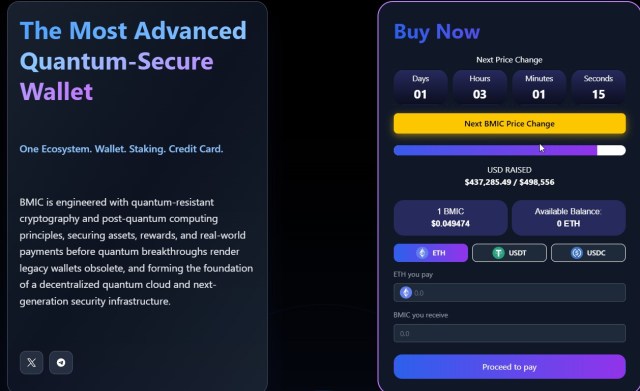
Unlike meme coins selling pure attention, BMIC is selling a security thesis and that tends to perform best when investors are actively worried about risk. Options expiry weeks do that. Sharp drawdowns do that.

The caveat? Big claims need big proof. Markets will eventually demand working product milestones and clarity on how ‘quantum-secure staking’ actually functions under the hood. But right now, the timing feels intentional.

In a week where $BTC’s derivatives calendar is the headline and spot is whipping around, BMIC offers a different kind of hedge: not against price, but against the future security model of crypto itself.

Buy your $BMIC here.

This article is not financial advice; crypto is volatile. Options expiry can distort prices, and early-stage tokens carry execution risk.

Editorial Process for bitcoinist is centered on delivering thoroughly researched, accurate, and unbiased content. We uphold strict sourcing standards, and each page undergoes diligent review by our team of top technology experts and seasoned editors. This process ensures the integrity, relevance, and value of our content for our readers.

patrubogdan

Follow

Full Profile

Related Posts

RWA Perpetuals Record $15B in Volume, Putting LiquidChain’s $LIQUID Presale in Focus

Solana ($SOL) Price Prediction 2026 Turns Bearish: Can It Recover, Or Should We Look at SUBBD Token?

Metaplanet Will Keep Buying Bitcoin, Says Gerovich, as $HYPER Hits $31M Presale Milestone

Bitcoin ETFs See $434M in Outflows as $BTC Tests $60K Support – Can Bitcoin Hyper Take Over?

Peter Brandt Says Bitcoin is Heading to $42K – Has $SUBBD’s Time Arrived?

Bitcoin’s Crash Triggered IBIT’s Biggest Trading Day, as $HYPER Keeps Pumping

Related Questions

QWhat is the total notional value of Bitcoin options expiring on February 6, 2026, and what does the put-to-call ratio indicate about trader sentiment?

AApproximately $2.15 billion in Bitcoin options are expiring. The put-to-call ratio of 1.42 indicates a defensive, bearish sentiment, as traders are purchasing more puts (downside protection) than calls (upside bets).

QHow can the expiration of these large options positions impact Bitcoin's price and market behavior in the short term?

AOptions expiration can suck liquidity from the market and amplify intraday price moves due to dealer hedging activity. After expiry, implied volatility resets and gamma exposure shifts, which can allow the market to pick a clearer directional move instead of chopping sideways.

QAccording to the article, what is the core security narrative being promoted by the BMIC ($BMIC) project?

ABMIC promotes a 'quantum-secure finance stack.' Its core narrative is mitigating the 'harvest now, decrypt later' risk by offering a wallet, staking, and payments platform protected by post-quantum cryptography, aiming to eliminate public-key exposure.

QWhat key technical levels for Bitcoin price are mentioned as critical to watch following the options expiry?

AThe mid-$60,000 level is cited as critical. Holding above it could lead to a drift higher as hedges are removed, while losing recent lows could trigger momentum selling as protective puts pay out and risk desks cut exposure.

QWhat does the erratic flow in U.S. spot Bitcoin ETFs suggest about institutional behavior, as described in the article?

AThe erratic flows, swinging between sharp redemptions and occasional bounces, suggest that institutional buying is tactical and conditional rather than representing steady, unconditional accumulation. They are reallocating based on market conditions and key technical levels.

Related Reads

70-Page Confidential Document's First Allegation: 'Lying', Altman Told the Board 'I Can't Change My Character'

In a major investigation, Pulitzer winner Ronan Farrow and Andrew Marantz reveal two previously undisclosed documents: a ~70-page confidential file compiled by former OpenAI chief scientist Ilya Sutskever and over 200 pages of internal notes by Anthropic CEO Dario Amodei from his time at OpenAI. Sutskever’s file, which opens with the accusation that Sam Altman exhibited a "pattern of lying," alleges he misled executives and the board on safety protocols and corporate matters. Amodei’s notes similarly claim “the problem at OpenAI is Sam himself,” citing instances like Altman denying agreed-upon terms in Microsoft’s $1 billion deal. Key revelations include: - No written report was produced from the post-reinstatement independent investigation into Altman. - OpenAI’s superalignment team received only 1-2% of the promised computing resources, mostly on outdated clusters. - In 2018, executives considered a "National Plan" to auction AI tech to nations including China and Russia. - Microsoft executives expressed strong distrust toward Altman, with one comparing his risk profile to figures like Bernie Madoff. During a board call after his firing, Altman reportedly said, "I can’t change my personality," which a director interpreted as an admission of persistent dishonesty. Altman denies intentional deception, attributing his behavior to "well-intentioned adaptation" and conflict avoidance.

marsbit58m ago

70-Page Confidential Document's First Allegation: 'Lying', Altman Told the Board 'I Can't Change My Character'

marsbit58m ago

Trading

Spot
Futures

Hot Articles

What is SONIC

Sonic: Pioneering the Future of Gaming in Web3 Introduction to Sonic In the ever-evolving landscape of Web3, the gaming industry stands out as one of the most dynamic and promising sectors. At the forefront of this revolution is Sonic, a project designed to amplify the gaming ecosystem on the Solana blockchain. Leveraging cutting-edge technology, Sonic aims to deliver an unparalleled gaming experience by efficiently processing millions of requests per second, ensuring that players enjoy seamless gameplay while maintaining low transaction costs. This article delves into the intricate details of Sonic, exploring its creators, funding sources, operational mechanics, and the timeline of significant events that have shaped its journey. What is Sonic? Sonic is an innovative layer-2 network that operates atop the Solana blockchain, specifically tailored to enhance the existing Solana gaming ecosystem. It accomplishes this through a customised, VM-agnostic game engine paired with a HyperGrid interpreter, facilitating sovereign game economies that roll up back to the Solana platform. The primary goals of Sonic include: Enhanced Gaming Experiences: Sonic is committed to offering lightning-fast on-chain gameplay, allowing players and developers to engage with games at previously unattainable speeds. Atomic Interoperability: This feature enables transactions to be executed within Sonic without the need to redeploy Solana programmes and accounts. This makes the process more efficient and directly benefits from Solana Layer1 services and liquidity. Seamless Deployment: Sonic allows developers to write for Ethereum Virtual Machine (EVM) based systems and execute them on Solana’s SVM infrastructure. This interoperability is crucial for attracting a broader range of dApps and decentralised applications to the platform. Support for Developers: By offering native composable gaming primitives and extensible data types - dining within the Entity-Component-System (ECS) framework - game creators can craft intricate business logic with ease. Overall, Sonic's unique approach not only caters to players but also provides an accessible and low-cost environment for developers to innovate and thrive. Creator of Sonic The information regarding the creator of Sonic is somewhat ambiguous. However, it is known that Sonic's SVM is owned by the company Mirror World. The absence of detailed information about the individuals behind Sonic reflects a common trend in several Web3 projects, where collective efforts and partnerships often overshadow individual contributions. Investors of Sonic Sonic has garnered considerable attention and support from various investors within the crypto and gaming sectors. Notably, the project raised an impressive $12 million during its Series A funding round. The round was led by BITKRAFT Ventures, with other notable investors including Galaxy, Okx Ventures, Interactive, Big Brain Holdings, and Mirana. This financial backing signifies the confidence that investment foundations have in Sonic’s potential to revolutionise the Web3 gaming landscape, further validating its innovative approaches and technologies. How Does Sonic Work? Sonic utilises the HyperGrid framework, a sophisticated parallel processing mechanism that enhances its scalability and customisability. Here are the core features that set Sonic apart: Lightning Speed at Low Costs: Sonic offers one of the fastest on-chain gaming experiences compared to other Layer-1 solutions, powered by the scalability of Solana’s virtual machine (SVM). Atomic Interoperability: Sonic enables transaction execution without redeployment of Solana programmes and accounts, effectively streamlining the interaction between users and the blockchain. EVM Compatibility: Developers can effortlessly migrate decentralised applications from EVM chains to the Solana environment using Sonic’s HyperGrid interpreter, increasing the accessibility and integration of various dApps. Ecosystem Support for Developers: By exposing native composable gaming primitives, Sonic facilitates a sandbox-like environment where developers can experiment and implement business logic, greatly enhancing the overall development experience. Monetisation Infrastructure: Sonic natively supports growth and monetisation efforts, providing frameworks for traffic generation, payments, and settlements, thereby ensuring that gaming projects are not only viable but also sustainable financially. Timeline of Sonic The evolution of Sonic has been marked by several key milestones. Below is a brief timeline highlighting critical events in the project's history: 2022: The Sonic cryptocurrency was officially launched, marking the beginning of its journey in the Web3 gaming arena. 2024: June: Sonic SVM successfully raised $12 million in a Series A funding round. This investment allowed Sonic to further develop its platform and expand its offerings. August: The launch of the Sonic Odyssey testnet provided users with the first opportunity to engage with the platform, offering interactive activities such as collecting rings—a nod to gaming nostalgia. October: SonicX, an innovative crypto game integrated with Solana, made its debut on TikTok, capturing the attention of over 120,000 users within a short span. This integration illustrated Sonic’s commitment to reaching a broader, global audience and showcased the potential of blockchain gaming. Key Points Sonic SVM is a revolutionary layer-2 network on Solana explicitly designed to enhance the GameFi landscape, demonstrating great potential for future development. HyperGrid Framework empowers Sonic by introducing horizontal scaling capabilities, ensuring that the network can handle the demands of Web3 gaming. Integration with Social Platforms: The successful launch of SonicX on TikTok displays Sonic’s strategy to leverage social media platforms to engage users, exponentially increasing the exposure and reach of its projects. Investment Confidence: The substantial funding from BITKRAFT Ventures, among others, emphasizes the robust backing Sonic has, paving the way for its ambitious future. In conclusion, Sonic encapsulates the essence of Web3 gaming innovation, striking a balance between cutting-edge technology, developer-centric tools, and community engagement. As the project continues to evolve, it is poised to redefine the gaming landscape, making it a notable entity for gamers and developers alike. As Sonic moves forward, it will undoubtedly attract greater interest and participation, solidifying its place within the broader narrative of blockchain gaming.

904 Total ViewsPublished 2024.04.04Updated 2024.12.03

What is SONIC

What is $S$

Understanding SPERO: A Comprehensive Overview Introduction to SPERO As the landscape of innovation continues to evolve, the emergence of web3 technologies and cryptocurrency projects plays a pivotal role in shaping the digital future. One project that has garnered attention in this dynamic field is SPERO, denoted as SPERO,$$s$. This article aims to gather and present detailed information about SPERO, to help enthusiasts and investors understand its foundations, objectives, and innovations within the web3 and crypto domains. What is SPERO,$$s$? SPERO,$$s$ is a unique project within the crypto space that seeks to leverage the principles of decentralisation and blockchain technology to create an ecosystem that promotes engagement, utility, and financial inclusion. The project is tailored to facilitate peer-to-peer interactions in new ways, providing users with innovative financial solutions and services. At its core, SPERO,$$s$ aims to empower individuals by providing tools and platforms that enhance user experience in the cryptocurrency space. This includes enabling more flexible transaction methods, fostering community-driven initiatives, and creating pathways for financial opportunities through decentralised applications (dApps). The underlying vision of SPERO,$$s$ revolves around inclusiveness, aiming to bridge gaps within traditional finance while harnessing the benefits of blockchain technology. Who is the Creator of SPERO,$$s$? The identity of the creator of SPERO,$$s$ remains somewhat obscure, as there are limited publicly available resources providing detailed background information on its founder(s). This lack of transparency can stem from the project's commitment to decentralisation—an ethos that many web3 projects share, prioritising collective contributions over individual recognition. By centring discussions around the community and its collective goals, SPERO,$$s$ embodies the essence of empowerment without singling out specific individuals. As such, understanding the ethos and mission of SPERO remains more important than identifying a singular creator. Who are the Investors of SPERO,$$s$? SPERO,$$s$ is supported by a diverse array of investors ranging from venture capitalists to angel investors dedicated to fostering innovation in the crypto sector. The focus of these investors generally aligns with SPERO's mission—prioritising projects that promise societal technological advancement, financial inclusivity, and decentralised governance. These investor foundations are typically interested in projects that not only offer innovative products but also contribute positively to the blockchain community and its ecosystems. The backing from these investors reinforces SPERO,$$s$ as a noteworthy contender in the rapidly evolving domain of crypto projects. How Does SPERO,$$s$ Work? SPERO,$$s$ employs a multi-faceted framework that distinguishes it from conventional cryptocurrency projects. Here are some of the key features that underline its uniqueness and innovation: Decentralised Governance: SPERO,$$s$ integrates decentralised governance models, empowering users to participate actively in decision-making processes regarding the project’s future. This approach fosters a sense of ownership and accountability among community members. Token Utility: SPERO,$$s$ utilises its own cryptocurrency token, designed to serve various functions within the ecosystem. These tokens enable transactions, rewards, and the facilitation of services offered on the platform, enhancing overall engagement and utility. Layered Architecture: The technical architecture of SPERO,$$s$ supports modularity and scalability, allowing for seamless integration of additional features and applications as the project evolves. This adaptability is paramount for sustaining relevance in the ever-changing crypto landscape. Community Engagement: The project emphasises community-driven initiatives, employing mechanisms that incentivise collaboration and feedback. By nurturing a strong community, SPERO,$$s$ can better address user needs and adapt to market trends. Focus on Inclusion: By offering low transaction fees and user-friendly interfaces, SPERO,$$s$ aims to attract a diverse user base, including individuals who may not previously have engaged in the crypto space. This commitment to inclusion aligns with its overarching mission of empowerment through accessibility. Timeline of SPERO,$$s$ Understanding a project's history provides crucial insights into its development trajectory and milestones. Below is a suggested timeline mapping significant events in the evolution of SPERO,$$s$: Conceptualisation and Ideation Phase: The initial ideas forming the basis of SPERO,$$s$ were conceived, aligning closely with the principles of decentralisation and community focus within the blockchain industry. Launch of Project Whitepaper: Following the conceptual phase, a comprehensive whitepaper detailing the vision, goals, and technological infrastructure of SPERO,$$s$ was released to garner community interest and feedback. Community Building and Early Engagements: Active outreach efforts were made to build a community of early adopters and potential investors, facilitating discussions around the project’s goals and garnering support. Token Generation Event: SPERO,$$s$ conducted a token generation event (TGE) to distribute its native tokens to early supporters and establish initial liquidity within the ecosystem. Launch of Initial dApp: The first decentralised application (dApp) associated with SPERO,$$s$ went live, allowing users to engage with the platform's core functionalities. Ongoing Development and Partnerships: Continuous updates and enhancements to the project's offerings, including strategic partnerships with other players in the blockchain space, have shaped SPERO,$$s$ into a competitive and evolving player in the crypto market. Conclusion SPERO,$$s$ stands as a testament to the potential of web3 and cryptocurrency to revolutionise financial systems and empower individuals. With a commitment to decentralised governance, community engagement, and innovatively designed functionalities, it paves the way toward a more inclusive financial landscape. As with any investment in the rapidly evolving crypto space, potential investors and users are encouraged to research thoroughly and engage thoughtfully with the ongoing developments within SPERO,$$s$. The project showcases the innovative spirit of the crypto industry, inviting further exploration into its myriad possibilities. While the journey of SPERO,$$s$ is still unfolding, its foundational principles may indeed influence the future of how we interact with technology, finance, and each other in interconnected digital ecosystems.

54 Total ViewsPublished 2024.12.17Updated 2024.12.17

What is $S$

What is AGENT S

Agent S: The Future of Autonomous Interaction in Web3 Introduction In the ever-evolving landscape of Web3 and cryptocurrency, innovations are constantly redefining how individuals interact with digital platforms. One such pioneering project, Agent S, promises to revolutionise human-computer interaction through its open agentic framework. By paving the way for autonomous interactions, Agent S aims to simplify complex tasks, offering transformative applications in artificial intelligence (AI). This detailed exploration will delve into the project's intricacies, its unique features, and the implications for the cryptocurrency domain. What is Agent S? Agent S stands as a groundbreaking open agentic framework, specifically designed to tackle three fundamental challenges in the automation of computer tasks: Acquiring Domain-Specific Knowledge: The framework intelligently learns from various external knowledge sources and internal experiences. This dual approach empowers it to build a rich repository of domain-specific knowledge, enhancing its performance in task execution. Planning Over Long Task Horizons: Agent S employs experience-augmented hierarchical planning, a strategic approach that facilitates efficient breakdown and execution of intricate tasks. This feature significantly enhances its ability to manage multiple subtasks efficiently and effectively. Handling Dynamic, Non-Uniform Interfaces: The project introduces the Agent-Computer Interface (ACI), an innovative solution that enhances the interaction between agents and users. Utilizing Multimodal Large Language Models (MLLMs), Agent S can navigate and manipulate diverse graphical user interfaces seamlessly. Through these pioneering features, Agent S provides a robust framework that addresses the complexities involved in automating human interaction with machines, setting the stage for myriad applications in AI and beyond. Who is the Creator of Agent S? While the concept of Agent S is fundamentally innovative, specific information about its creator remains elusive. The creator is currently unknown, which highlights either the nascent stage of the project or the strategic choice to keep founding members under wraps. Regardless of anonymity, the focus remains on the framework's capabilities and potential. Who are the Investors of Agent S? As Agent S is relatively new in the cryptographic ecosystem, detailed information regarding its investors and financial backers is not explicitly documented. The lack of publicly available insights into the investment foundations or organisations supporting the project raises questions about its funding structure and development roadmap. Understanding the backing is crucial for gauging the project's sustainability and potential market impact. How Does Agent S Work? At the core of Agent S lies cutting-edge technology that enables it to function effectively in diverse settings. Its operational model is built around several key features: Human-like Computer Interaction: The framework offers advanced AI planning, striving to make interactions with computers more intuitive. By mimicking human behaviour in tasks execution, it promises to elevate user experiences. Narrative Memory: Employed to leverage high-level experiences, Agent S utilises narrative memory to keep track of task histories, thereby enhancing its decision-making processes. Episodic Memory: This feature provides users with step-by-step guidance, allowing the framework to offer contextual support as tasks unfold. Support for OpenACI: With the ability to run locally, Agent S allows users to maintain control over their interactions and workflows, aligning with the decentralised ethos of Web3. Easy Integration with External APIs: Its versatility and compatibility with various AI platforms ensure that Agent S can fit seamlessly into existing technological ecosystems, making it an appealing choice for developers and organisations. These functionalities collectively contribute to Agent S's unique position within the crypto space, as it automates complex, multi-step tasks with minimal human intervention. As the project evolves, its potential applications in Web3 could redefine how digital interactions unfold. Timeline of Agent S The development and milestones of Agent S can be encapsulated in a timeline that highlights its significant events: September 27, 2024: The concept of Agent S was launched in a comprehensive research paper titled “An Open Agentic Framework that Uses Computers Like a Human,” showcasing the groundwork for the project. October 10, 2024: The research paper was made publicly available on arXiv, offering an in-depth exploration of the framework and its performance evaluation based on the OSWorld benchmark. October 12, 2024: A video presentation was released, providing a visual insight into the capabilities and features of Agent S, further engaging potential users and investors. These markers in the timeline not only illustrate the progress of Agent S but also indicate its commitment to transparency and community engagement. Key Points About Agent S As the Agent S framework continues to evolve, several key attributes stand out, underscoring its innovative nature and potential: Innovative Framework: Designed to provide an intuitive use of computers akin to human interaction, Agent S brings a novel approach to task automation. Autonomous Interaction: The ability to interact autonomously with computers through GUI signifies a leap towards more intelligent and efficient computing solutions. Complex Task Automation: With its robust methodology, it can automate complex, multi-step tasks, making processes faster and less error-prone. Continuous Improvement: The learning mechanisms enable Agent S to improve from past experiences, continually enhancing its performance and efficacy. Versatility: Its adaptability across different operating environments like OSWorld and WindowsAgentArena ensures that it can serve a broad range of applications. As Agent S positions itself in the Web3 and crypto landscape, its potential to enhance interaction capabilities and automate processes signifies a significant advancement in AI technologies. Through its innovative framework, Agent S exemplifies the future of digital interactions, promising a more seamless and efficient experience for users across various industries. Conclusion Agent S represents a bold leap forward in the marriage of AI and Web3, with the capacity to redefine how we interact with technology. While still in its early stages, the possibilities for its application are vast and compelling. Through its comprehensive framework addressing critical challenges, Agent S aims to bring autonomous interactions to the forefront of the digital experience. As we move deeper into the realms of cryptocurrency and decentralisation, projects like Agent S will undoubtedly play a crucial role in shaping the future of technology and human-computer collaboration.

450 Total ViewsPublished 2025.01.14Updated 2025.01.14

What is AGENT S

Discussions

Welcome to the HTX Community. Here, you can stay informed about the latest platform developments and gain access to professional market insights. Users' opinions on the price of S (S) are presented below.

活动图片