Author:Zhou, ChainCatcher
As the crypto market enters a correction window, the actions of Bitcoin treasury companies have shown a clear divergence. The giant MicroStrategy announced last week that it spent $962.7 million to purchase an additional 10,624 Bitcoin at an average price of $90,615. In contrast, the fourth-largest Bitcoin treasury company, Metaplanet, has abruptly stopped its pace, with no further purchases for the tenth consecutive week since September 30.
Metaplanet, this Japanese listed company hailed by the market as the "Asian version of MicroStrategy", was once an aggressive representative in the DAT (Digital Asset Treasury) field. Since initiating its reserve plan in April 2024, the company has rapidly accumulated over 30,000 Bitcoin, with a total value of approximately $2.75 billion.
However, since the fourth quarter, Bitcoin's price has corrected nearly 30% from its all-time high of $126,000. Just as the market widely expected treasury companies to buy the dip, Metaplanet unexpectedly pressed the pause button after completing its last purchase on September 29, shifting its short-term capital focus to stock buybacks instead.
DAT Shifts from Aggressive Accumulation to Risk Control Priority
Data shows the total market capitalization of digital asset treasury stocks shrank significantly from $150 billion to $73.5 billion in the fourth quarter, with the mNAV (Market NAV) of most companies falling below 1x. According to Bloomberg, the stock prices of crypto asset treasury (DAT) companies listed in the US and Canada have fallen sharply this year, with a median decline of 43%, and some companies have fallen more than 99%.
Galaxy warned that Bitcoin treasury companies are entering a "Darwinian phase", where stock premiums collapse, leverage turns into a downside, DAT stocks trade at a discount, and the core mechanisms of their once-thriving business models are breaking down.
Against this market backdrop, ETHZilla, another second-tier treasury company, recently announced it would early redeem convertible bonds totaling $516 million. This move is seen as a positive signal to simplify the capital structure, enhance financial flexibility, and reduce the risk of high-interest debt during the market downturn.
Metaplanet's actions echo this. Currently, the company's outstanding debt is $304 million. Theoretically, it has 9x its Bitcoin assets as repayment security, yet it still chose to suspend purchases. This behavior is highly consistent with the current industry trend in the DAT track shifting from aggressive accumulation to risk control priority.
Stock Price Pressure and Tactical Adjustment Under Conservative Accounting
Previously, influenced by its Bitcoin holding strategy, Metaplanet's stock price soared from $20 in April 2024 to a peak of $1,930 in June 2025. Although the stock price has fallen significantly by over 70% since the second half of the year, it still recorded an overall gain of over 20% for the year, currently stabilizing around $420, with a total market capitalization of approximately $3 billion.
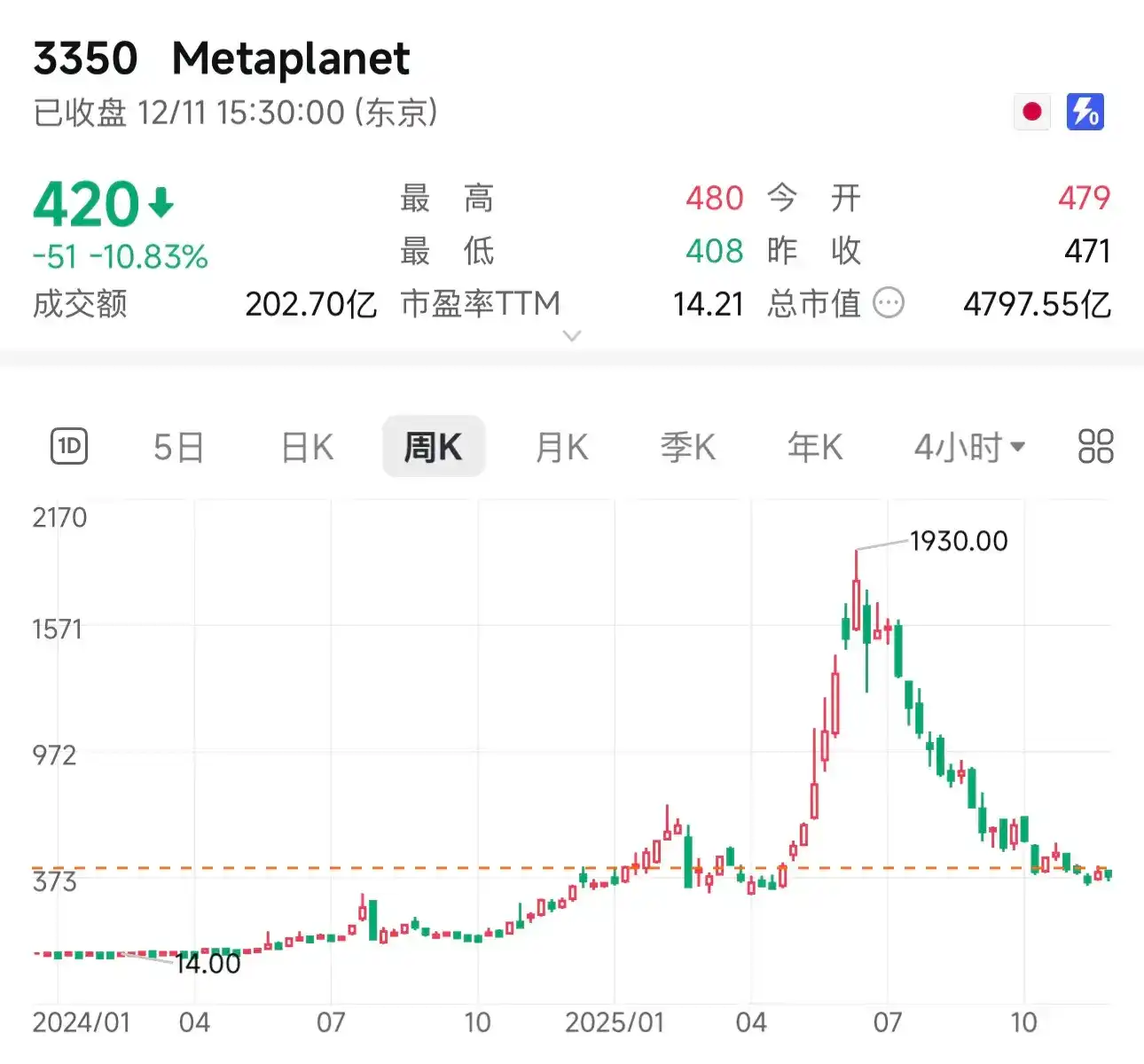
Faced with the continuous decline in stock price, Metaplanet CEO Simon Gerovich publicly responded to the stock volatility on October 2. He cited Amazon's case during the dot-com bubble, emphasizing that fundamentals and stock prices often diverge, and reiterated the company's commitment to continue accumulating Bitcoin.
Previously, in September, he stated that if the net asset value fell below the market capitalization (mNAV below 1x), issuing new shares would "destroy value mathematically" and be detrimental to the company's BTC yield. The company would prioritize evaluating options such as preferred shares and stock buybacks.
Therefore, when it faced a situation below net asset value in early October, Metaplanet quickly took action. It first announced authorization to repurchase up to 150 million shares and secured a $500 million credit line. Subsequently, it raised $100 million by pledging its Bitcoin assets to purchase more Bitcoin, expand revenue-generating businesses, and buy back shares. Part of the funds will also be used for yield-generating businesses. The company's mNAV has now recovered to above 1x.
From this perspective, the suspension of purchases is a tactical protection of its stock price and balance sheet health, prioritizing the value of existing shareholders rather than blindly expanding the balance sheet.
Furthermore, stopping purchases also avoids risks brought by Japan's conservative accounting standards. Given its average Bitcoin cost of approximately $108,000, the company has already accumulated over $500 million in unrealized losses on its books. To prevent excessive short-term impact on the income statement, it chose to proactively avoid exacerbating this book impairment risk.
Building an Asian "Moat" by Leveraging Low-Interest Advantages?
On the surface, suspending purchases is defensive. In reality, Metaplanet's true strategic intent may lie in upgrading and innovating its capital structure.
The company's Q3 financial report shows sales reached ¥2.401 billion, a 94% increase quarter-on-quarter; operating profit was ¥1.339 billion, up 64%; net profit was ¥12.7 billion; net assets were ¥532.9 billion, up 165%. Among these, the options business contributed $16.28 million in revenue, a 115% year-on-year increase. This revenue can cover daily operations and interest costs.
On this basis, Metaplanet is also trying to emulate MicroStrategy by planning to issue similar preferred shares like STRC to obtain capital more efficiently.
The company plans to launch two new digital credit instruments, "Mercury" and "Mars". "Mercury" will offer a 4.9% yield in Japanese Yen, approximately ten times the yield of Japanese bank deposits. 73% of the funds are designated for Bitcoin accumulation, including $107 million for direct purchases and $12 million for options trading. This allows the company to bypass equity dilution and turn to low-cost debt leverage, which is highly attractive to local investors.
Furthermore, since Japan does not allow at-the-market (ATM) offering mechanisms (similar to BitMine's current ATM model), which prevents listed companies from "dumping" shares in real-time on the secondary market, protecting investors from dilution shocks. Metaplanet uses a Moving Strike Warrant mechanism (MSW), cleverly bypassing this restriction while retaining the core advantage of flexible fundraising.
MSW is essentially a special stock acquisition warrant whose key feature is that the exercise price is not fixed but is dynamically adjusted periodically. Typically, every few trading days (early series of Metaplanet were every 3 trading days), the exercise price is reset to the average of the previous few days' closing prices, such as the simple moving average of the previous three days. Thus, when warrant holders choose to exercise their warrants, the company issues new common shares at a price close to the current market price, raising funds.
Later, the company may integrate this mechanism into the perpetual preferred share product Mercury: preferred shareholders could convert into common shares via conversion terms similar to MSW at a dynamic price, making the entire financing process smoother and more controllable.
Meanwhile, MicroStrategy Executive Chairman Michael Saylor has confirmed that the company will not launch similar products in Japan within the next 12 months. This time window provides Metaplanet with a valuable 12-month first-mover advantage.
The company successfully issued $150 million in Series B Perpetual Preferred Shares on November 20, indicating its financing strategy has begun to materialize. This series of actions shows that Metaplanet is leveraging Japan's low-interest-rate environment to build a unique financing "moat" for structural and sustainable expansion.
Local Advantages and MSCI Review
In fact, Metaplanet's core value lies in the unique Alpha provided by its Japanese ecosystem:
On one hand, the continuous depreciation of the Japanese Yen strengthens Bitcoin's role as an inflation hedge. Metaplanet's Bitcoin reserves provide Japanese domestic investors with an effective way to combat the decline in the Yen's purchasing power.
On the other hand, the tax-free advantage of Japan's Nippon Individual Savings Account (NISA) has attracted 63,000 Japanese domestic shareholders to Metaplanet. Compared to the 55% capital gains tax on directly holding crypto assets, investors can indirectly gain BTC exposure at a lower cost by buying Metaplanet stock through NISA.
Because of this, Metaplanet has gained recognition from international institutions. Capital Group increased its stake to 11.45%, becoming Metaplanet's largest shareholder. The current top five shareholders also include MMXX Capital, Vanguard, Evolution Capital, and Invesco Capital; Syz Capital partner Richard Byworth publicly divested from MicroStrategy and Bitcoin ETFs to invest in Metaplanet, believing the latter has lower financing costs and higher return elasticity.
An industry observer pointed out that companies like Metaplanet must prioritize ensuring financial resilience during downturns to maintain long-term accumulation goals.
However, although beneficial to structural health in the long run, Metaplanet still faces potential short-term selling pressure. For example, the MSCI index exclusion review affecting MicroStrategy has also impacted Metaplanet. It was included in the MSCI Japan Index this February. If excluded due to its high Bitcoin asset ratio, it could trigger a wave of selling by passive funds.
Conclusion
Overall, Metaplanet's suspension of Bitcoin purchases is not a failure of strategy or submission to the market. It can be seen as a strategic regrouping based on risk and efficiency considerations, also marking the maturation of the DAT track, shifting from aggressive accumulation to risk control priority.
Bitwise Chief Investment Officer Matt Hougan once stated that evaluating DAT companies using mNAV is incorrect because this valuation method does not consider the life cycle of listed companies. Most reasons for DAT trading at a discount are certain, while the reasons for premiums are often uncertain. Looking ahead, price differences among treasury companies will become more pronounced. Metaplanet might be reconstructing its valuation system.
Click to learn about open positions at ChainCatcher