Analysts Warn Bitcoin May Face Further Downside After Major Sell‑Off

bitcoinistPublished on 2026-02-06Last updated on 2026-02-06

Abstract

Bitcoin (BTC) briefly fell to around $60,000, a 17-month low, before recovering to $70,667. Analysts warn that selling pressure from large holders (whales) and significant outflows from spot Bitcoin ETFs are driving the decline. Concerns over a potential "Crypto Winter" are growing, with few signs of a bottom. While some analysts compare the drop to the post-FTX collapse period and warn of further downside, others suggest the market may be nearing "exhaustion" and entering a "peak fear" phase that could precede stabilization. BTC has since rebounded, gaining 10% in 24 hours.

Bitcoin (BTC) has staged a modest rebound after suffering a sharp sell‐off over recent days, but market analysts warn that the underlying pressures driving the decline remain firmly in place.

The world’s largest cryptocurrency plummeted momentarily to around $60,000 on Thursday, its lowest level in around 17 months, before rising modestly to current trade values of $70,667 as of Friday afternoon.

Crypto Winter Fears Grow

In comments shared with Fortune, Jefferies analyst Andrew Moss, the downturn is being fueled largely by selling from major holders. In a note to clients, Moss said that large Bitcoin investors, commonly referred to as whales, have been offloading their positions into market weakness.

He noted that these holders shifted to net sellers over the weekend after steadily accumulating Bitcoin since early January, suggesting a significant change in market behavior at the top end of ownership.
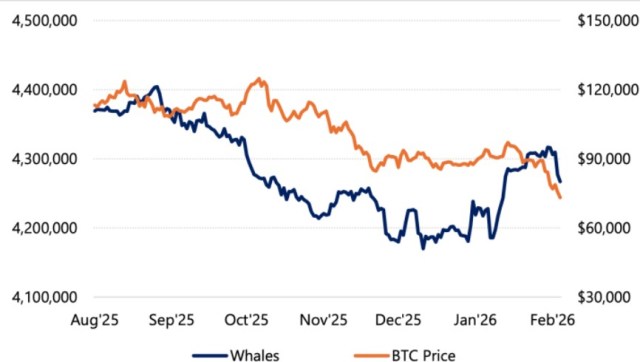
BTC whale activity during January. Source: Fortune

Selling pressure has also emerged from retail investors who gained exposure to Bitcoin through spot exchange‐traded funds (ETFs). Moss pointed out that net outflows from spot Bitcoin ETFs during the weeks of January 19 and January 26 ranked as the second‐ and third‐largest since those products were launched.

Those withdrawals were followed by another wave of substantial outflows on February 4, adding to downward pressure on prices, which coupled with ETF outflows, has reignited familiar concerns across the crypto market.

Moss said renewed talk of a “Crypto Winter” is spreading, warning that there are few convincing signs that Bitcoin is nearing a bottom. He added that the lack of buying activity from small‐ and medium‐sized holders suggests that dip‐buying sentiment remains weak, a factor that often signals further downside risk.

Analysts Divided On Bitcoin’s Next Move

Other analysts echoed the cautious outlook. Deutsche Bank strategist Henry Allen noted that Bitcoin’s recent drop marked its worst single‐day decline since November 2022.

That period coincided with the collapse of Sam Bankman‐Fried’s FTX exchange, an event that wiped out billions of dollars in customer funds and sent shockwaves through the digital asset industry.

Chevy Cassar, author of the Milk Road newsletter, described the current environment in stark terms, acknowledging that the downturn is painful and warning that conditions could deteriorate further.

Based on historical patterns, Cassar said crypto markets often take anywhere from one month to nearly a year to reach a true bottom after major declines.

Still, not all observers see the current moment as purely negative. Fabian Dori, chief investment officer at Sygnum Bank, said the market may be approaching a point of exhaustion.

Dori said sentiment appears to be entering what he described as “peak fear territory,” a phase that has historically preceded stabilization or recovery in past cycles.

The 1-D chart shows BTC’s recovery slightly above $70,000. Source: BTCUSDT on TradingView.com

At the time of writing, BTC has recovered to its current trading price of $70,667 and has seen a 10% surge within the last 24 hours.

Featured image from OpenArt, chart from TradingView.com

Related Questions

QWhat are the main factors driving Bitcoin's recent decline according to Jefferies analyst Andrew Moss?

AThe downturn is largely fueled by selling from major holders (whales) who shifted to net sellers after accumulating since early January, and significant net outflows from spot Bitcoin ETFs in recent weeks.

QWhat price did Bitcoin briefly drop to on Thursday, and what was its recovery value as of Friday afternoon?

ABitcoin plummeted momentarily to around $60,000 on Thursday, its lowest level in around 17 months, before rising modestly to $70,667 as of Friday afternoon.

QWhat historical event does Deutsche Bank strategist Henry Allen compare Bitcoin's recent drop to?

AHenry Allen noted that Bitcoin's recent drop marked its worst single-day decline since November 2022, a period that coincided with the collapse of Sam Bankman-Fried's FTX exchange.

QAccording to the Milk Road newsletter author Chevy Cassar, how long can it take for crypto markets to reach a true bottom after major declines?

ABased on historical patterns, Chevy Cassar said crypto markets often take anywhere from one month to nearly a year to reach a true bottom after major declines.

QWhat contrasting, more optimistic view does Fabian Dori, CIO of Sygnum Bank, offer on the current market sentiment?

AFabian Dori suggests the market may be approaching a point of exhaustion, with sentiment entering 'peak fear territory,' a phase that has historically preceded stabilization or recovery in past cycles.

Related Reads

Behind the 2000 BTC Incident: The Fundamental Problem of CEX Ledgers

On February 6, Bithumb, a South Korean cryptocurrency exchange, mistakenly distributed 2,000 BTC each to 249 users due to a unit error during a promotional event—intending to give away 2,000 KRW (≈$1.4) per user. The total erroneous distribution amounted to 62,000 BTC, worth approximately $41.5–44 billion. Although these assets existed only in Bithumb’s internal ledger and not on-chain, they were tradable on the platform, causing BTC/KRW prices to drop nearly 17% within minutes and triggering over $400 million in derivatives liquidations. Bithumb responded within 35 minutes, freezing affected accounts and recovering over 99% of the misallocated BTC. The remaining 1,788 BTC were covered by the exchange’s own funds. The incident exposed a fundamental flaw in centralized exchanges (CEXs): their reliance on internal accounting systems that allow rapid balance adjustments without corresponding on-chain assets. This creates systemic risk, as user balances are essentially IOU entries rather than real assets. The article draws parallels with historical failures like Mt.Gox and FTX, where discrepancies between internal ledgers and actual reserves led to catastrophic collapses. While Bithumb’s quick response limited damage, the event underscores the structural vulnerabilities of CEXs, prompting South Korean regulators to consider stricter oversight. The piece concludes that such incidents highlight the inherent trust asymmetry in CEX operations, where users rely on exchanges to honor ledger entries as real assets—a risk that remains ever-present.

比推25m ago

Behind the 2000 BTC Incident: The Fundamental Problem of CEX Ledgers

比推25m ago

Trading

Spot
Futures

Hot Articles

What is $BITCOIN

DIGITAL GOLD ($BITCOIN): A Comprehensive Analysis Introduction to DIGITAL GOLD ($BITCOIN) DIGITAL GOLD ($BITCOIN) is a blockchain-based project operating on the Solana network, which aims to combine the characteristics of traditional precious metals with the innovation of decentralized technologies. While it shares a name with Bitcoin, often referred to as “digital gold” due to its perception as a store of value, DIGITAL GOLD is a separate token designed to create a unique ecosystem within the Web3 landscape. Its goal is to position itself as a viable alternative digital asset, although specifics regarding its applications and functionalities are still developing. What is DIGITAL GOLD ($BITCOIN)? DIGITAL GOLD ($BITCOIN) is a cryptocurrency token explicitly designed for use on the Solana blockchain. In contrast to Bitcoin, which provides a widely recognized value storage role, this token appears to focus on broader applications and characteristics. Notable aspects include: Blockchain Infrastructure: The token is built on the Solana blockchain, known for its capacity to handle high-speed and low-cost transactions. Supply Dynamics: DIGITAL GOLD has a maximum supply capped at 100 quadrillion tokens (100P $BITCOIN), although details regarding its circulating supply are currently undisclosed. Utility: While precise functionalities are not explicitly outlined, there are indications that the token could be utilized for various applications, potentially involving decentralized applications (dApps) or asset tokenization strategies. Who is the Creator of DIGITAL GOLD ($BITCOIN)? At present, the identity of the creators and development team behind DIGITAL GOLD ($BITCOIN) remains unknown. This situation is typical among many innovative projects within the blockchain space, particularly those aligning with decentralized finance and meme coin phenomena. While such anonymity may foster a community-driven culture, it intensifies concerns about governance and accountability. Who are the Investors of DIGITAL GOLD ($BITCOIN)? The available information indicates that DIGITAL GOLD ($BITCOIN) does not have any known institutional backers or prominent venture capital investments. The project seems to operate on a peer-to-peer model focused on community support and adoption rather than traditional funding routes. Its activity and liquidity are primarily situated on decentralized exchanges (DEXs), such as PumpSwap, rather than established centralized trading platforms, further highlighting its grassroots approach. How DIGITAL GOLD ($BITCOIN) Works The operational mechanics of DIGITAL GOLD ($BITCOIN) can be elaborated on based on its blockchain design and network attributes: Consensus Mechanism: By leveraging Solana’s unique proof-of-history (PoH) combined with a proof-of-stake (PoS) model, the project ensures efficient transaction validation contributing to the network's high performance. Tokenomics: While specific deflationary mechanisms have not been extensively detailed, the vast maximum token supply implies that it may cater to microtransactions or niche use cases that are still to be defined. Interoperability: There exists the potential for integration with Solana’s broader ecosystem, including various decentralized finance (DeFi) platforms. However, the details regarding specific integrations remain unspecified. Timeline of Key Events Here is a timeline that highlights significant milestones concerning DIGITAL GOLD ($BITCOIN): 2023: The initial deployment of the token occurs on the Solana blockchain, marked by its contract address. 2024: DIGITAL GOLD gains visibility as it becomes available for trading on decentralized exchanges like PumpSwap, allowing users to trade it against SOL. 2025: The project witnesses sporadic trading activity and potential interest in community-led engagements, although no noteworthy partnerships or technical advancements have been documented as of yet. Critical Analysis Strengths Scalability: The underlying Solana infrastructure supports high transaction volumes, which could enhance the utility of $BITCOIN in various transaction scenarios. Accessibility: The potential low trading price per token could attract retail investors, facilitating wider participation due to fractional ownership opportunities. Risks Lack of Transparency: The absence of publicly known backers, developers, or an audit process may yield skepticism regarding the project's sustainability and trustworthiness. Market Volatility: The trading activity is heavily reliant on speculative behavior, which can result in significant price volatility and uncertainty for investors. Conclusion DIGITAL GOLD ($BITCOIN) emerges as an intriguing yet ambiguous project within the rapidly evolving Solana ecosystem. While it attempts to leverage the “digital gold” narrative, its departure from Bitcoin's established role as a store of value underscores the need for a clearer differentiation of its intended utility and governance structure. Future acceptance and adoption will likely depend on addressing the current opacity and defining its operational and economic strategies more explicitly. Note: This report encompasses synthesised information available as of October 2023, and developments may have transpired beyond the research period.

363 Total ViewsPublished 2025.05.13Updated 2025.05.13

Discussions

Welcome to the HTX Community. Here, you can stay informed about the latest platform developments and gain access to professional market insights. Users' opinions on the price of BTC (BTC) are presented below.

活动图片