Bitcoin’s Short-Term Holder Whales Sitting On Increasing Unrealized Losses – What’s Going On?

bitcoinistPublished on 2026-02-23Last updated on 2026-02-23

Abstract

Bitcoin's price remains below $70,000 amid ongoing market volatility, leading to significant unrealized losses for short-term holder whales. According to a CryptoQuant report by Darkfost, these large-scale recent investors are sitting on approximately $26 billion in paper losses, a level among the highest seen this year. This mounting financial pressure risks eroding confidence and triggering emotionally-driven selling during periods of volatility, potentially influencing Bitcoin's next major price movement. Despite short-lived speculative rallies, on-chain signals indicate that a genuine sustained rally has not yet begun. Analyst CW suggests that the current cycle—including the recent all-time high and subsequent pullback—is merely preparation for a much larger upward move. Comparing it to the 2017 bull run, CW anticipates an even stronger rally this time due to record levels of whale accumulation, predicting that the real rally is about to begin and will be substantial.

Bitcoin is still hampered by the ongoing volatility across the cryptocurrency market, keeping its price below the $70,000 level for the past few days. With BTC’s price steadily trending downwards, whale short-term holders are starting to feel the heat, as their unrealized losses sharply increase.

Unrealized Losses Climb For Bitcoin’s STH Whales

After a prolonged period of downside price performance, Bitcoin’s unrealized losses are spiking. A recent report from Darkfost, a market expert and author of the CryptoQuant platform, has linked this sharp increase in unrealized losses to whale short-term holders. On-chain data shows that the level of unrealized losses held by these new whales is rising to increasingly concerning levels, hinting at mounting stress among some of the market’s largest and most influential participants.

As Bitcoin tries to regain its upward momentum, these high-value wallets, which are frequently more sensitive to recent price changes, are currently sitting on substantial paper losses. At present, Darkfost has highlighted that the losses of these investors who entered the market within the past six months are valued at roughly $26 billion.
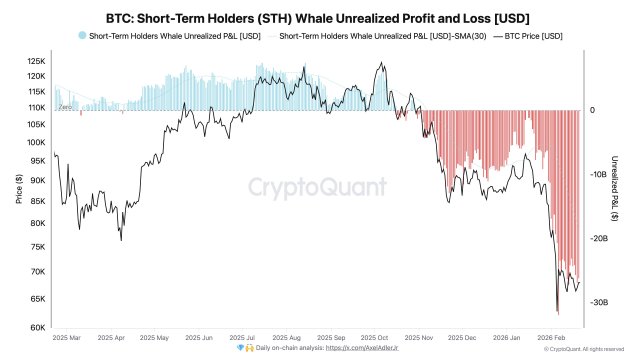
Source: Chart form Darkfost on X

Zooming in on the chart, this figure ranks among the most significant levels seen this year. The peak was recorded on February 6th, which coincided with the BTC’s price drop below the $60,000 level, expanding unrealized losses during the period to approximately $32 billion.

Darkfost noted that whales that joined the market later in the cycle are currently suffering the consequences of the current downward trend of the Bitcoin price. Although these investors holding positions at a loss is not necessarily constructive, it can erode confidence and bolster behavioral instability.

Such a trend has the potential to trigger emotionally driven decisions in periods of renewed market volatility. Given the mounting pressure beneath the surface, short-term whale behavior may have a significant impact on Bitcoin’s next significant move.

No Real Rally for BTC In Sight Yet

Key Bitcoin on-chain signals are revealing a conflicting signal about the current market cycle. In a post on the social media platform X, CW, a data analyst and crypto investor, the BTC On-chain Activity Strength Signal metric is showing that a real rally has not progressed in this cycle.

Short-lived increases have been triggered by speculative momentum, but there are still no underlying structural clues that usually indicate a real long-term rally. According to the expert, everything that has occurred so far, from the massive rally to an all-time high to the sharp pullback, is a preparation for an upcoming rally, which is expected to kick off soon.

CW has compared this impending massive upward move to the powerful rally experienced in the 2017 cycle. This time, the rally could be bigger due to the fact that whale accumulation is at an all-time high, adding that the real rally that is about to begin will be enormous.

BTC trading at $65,759 on the 1D chart | Source: BTCUSDT on Tradingview.com

Related Questions

QWhat is the current unrealized loss for Bitcoin's short-term holder whales, according to the article?

AThe unrealized losses for Bitcoin's short-term holder whales are currently valued at roughly $26 billion.

QWhich expert is cited as the source for the data on whale unrealized losses?

AThe data on whale unrealized losses is from a report by Darkfost, a market expert and author on the CryptoQuant platform.

QWhat was the peak level of unrealized losses for these whales this year, and when did it occur?

AThe peak level of unrealized losses was approximately $32 billion, recorded on February 6th when Bitcoin's price dropped below $60,000.

QAccording to analyst CW, what does the BTC On-chain Activity Strength Signal metric indicate about the current market cycle?

AThe BTC On-chain Activity Strength Signal metric indicates that a real rally has not yet progressed in this cycle, with short-lived increases being driven by speculative momentum rather than underlying structural clues.

QHow does the article suggest the behavior of short-term whale holders could impact Bitcoin's price?

AThe article suggests that the mounting pressure and unrealized losses could lead to emotionally driven decisions by short-term whale holders, which may have a significant impact on Bitcoin's next significant price move.

Related Reads

OpenAI Is Turning AI into a Nuclear Arms Race That Ordinary People Can't Afford

In a record-breaking funding round, OpenAI has secured $110 billion, raising its post-money valuation to $840 billion. This investment, led by Amazon, NVIDIA, and SoftBank, marks the largest-ever private tech funding and signals a new phase in the global AI race—one defined by extreme capital concentration and geopolitical significance. The scale of funding dwarfs the GDP of many mid-sized nations and equals nearly half of NVIDIA’s annual revenue. It also accounts for more than half of all AI startup funding in 2025, accelerating an industry-wide arms race in compute, talent, and model development. This capital influx, however, risks widening the gap between giants and smaller players, potentially stifling innovation and increasing market consolidation. Strategic investors are not merely providing capital: Amazon’s $50 billion commitment includes an eight-year, $100 billion cloud expansion deal. SoftBank’s $30 billion staged investment serves as both a hedge and a bridge for future sovereign wealth entrants. NVIDIA’s $30 billion replaces an earlier partnership promise and effectively locks up its advanced GPU supply, creating a closed loop that sidelines competitors. Despite ChatGPT reaching 900 million weekly active users and 50 million paid subscribers, OpenAI’s burn rate remains high. It spent $0.62 for every dollar earned in 2025, with cumulative cash burn projected to hit $1150 billion by 2029. At the same time, its market share is eroding amid rising competition from Google’s Gemini and Musk’s Grok. Facing mounting financial pressure, OpenAI is eyeing a potential IPO in Q4 2026. The offering could mark either the peak of the AI investment bubble or the beginning of the AGI era—but for now, the world watches as OpenAI races against capital, competition, and time.

marsbit7m ago

OpenAI Is Turning AI into a Nuclear Arms Race That Ordinary People Can't Afford

marsbit7m ago

Meta: Can Afford Trillion-Dollar Computing Power, But Can't Keep Key People

Meta's AI Ambition: A $135 Billion Bet on Chips, But Losing Key Talent In July 2025, Meta recruited top AI infrastructure engineer Ruoming Pang from Apple with a compensation package worth over $200 million. However, just seven months later, he left for OpenAI, forfeiting much of his unvested equity. This high-profile departure is part of a broader trend of key talent leaving Meta's AI division, including Chief AI Scientist Yann LeCun and other senior figures. The exodus is largely attributed to the fallout from the Llama 4 model's release in April 2025. The model was later revealed to have been benchmarked unethically, using different model versions to optimize scores on different tests, severely damaging trust within the developer community. This scandal led CEO Mark Zuckerberg to lose confidence in the team, resulting in a major reorganization. He appointed 28-year-old Scale AI CEO Alexandr Wang as Chief AI Officer, who now oversees the new Meta Superintelligent Lab (MSL). The planned flagship model, Llama 4 Behemoth, was indefinitely delayed. Compounding these software issues, Meta also canceled its most advanced in-house AI training chip project, a critical part of its plan to reduce reliance on Nvidia. This failure has triggered a panic-buying spree. In February 2026, Meta announced a capital expenditure budget of $115-$135 billion, nearly double the previous year's. Within ten days, it signed massive, multi-year chip deals: a multi-billion dollar agreement with Nvidia for Blackwell and Vera Rubin GPUs, a $60-$100 billion deal with AMD for MI450 GPUs (which included warrants for a 10% stake), and a multi-billion dollar deal to rent Google's TPU chips. This strategy of acquiring immense, diverse hardware from three different architectures (CUDA, ROCm, XLA/JAX) creates immense engineering complexity. Ironically, Meta is spending hundreds of billions on the world's most complex hardware while losing the rare engineers, like Pang, capable of building the cross-platform frameworks needed to make it all work. Zuckerberg's gamble mirrors his all-in bet on the metaverse: see a trend, spend heavily, reorganize frequently. The difference is that AI is a more tangible opportunity, and Meta's core advertising business generates massive cash flow to fund it. However, the article concludes that money can buy chips and算力, but it cannot guarantee the retention of top talent or the development of a winning model. If Meta's next model, codenamed "Avocado," fails to compete with GPT-5 and Gemini 3 Ultra, its massive expenditure will have only built expensive data centers full of underutilized hardware. The AI race is won by those who can build transformative models, not just those who can write the biggest checks.

marsbit2h ago

Meta: Can Afford Trillion-Dollar Computing Power, But Can't Keep Key People

marsbit2h ago

Trading

Spot
Futures

Hot Articles

What is $BITCOIN

DIGITAL GOLD ($BITCOIN): A Comprehensive Analysis Introduction to DIGITAL GOLD ($BITCOIN) DIGITAL GOLD ($BITCOIN) is a blockchain-based project operating on the Solana network, which aims to combine the characteristics of traditional precious metals with the innovation of decentralized technologies. While it shares a name with Bitcoin, often referred to as “digital gold” due to its perception as a store of value, DIGITAL GOLD is a separate token designed to create a unique ecosystem within the Web3 landscape. Its goal is to position itself as a viable alternative digital asset, although specifics regarding its applications and functionalities are still developing. What is DIGITAL GOLD ($BITCOIN)? DIGITAL GOLD ($BITCOIN) is a cryptocurrency token explicitly designed for use on the Solana blockchain. In contrast to Bitcoin, which provides a widely recognized value storage role, this token appears to focus on broader applications and characteristics. Notable aspects include: Blockchain Infrastructure: The token is built on the Solana blockchain, known for its capacity to handle high-speed and low-cost transactions. Supply Dynamics: DIGITAL GOLD has a maximum supply capped at 100 quadrillion tokens (100P $BITCOIN), although details regarding its circulating supply are currently undisclosed. Utility: While precise functionalities are not explicitly outlined, there are indications that the token could be utilized for various applications, potentially involving decentralized applications (dApps) or asset tokenization strategies. Who is the Creator of DIGITAL GOLD ($BITCOIN)? At present, the identity of the creators and development team behind DIGITAL GOLD ($BITCOIN) remains unknown. This situation is typical among many innovative projects within the blockchain space, particularly those aligning with decentralized finance and meme coin phenomena. While such anonymity may foster a community-driven culture, it intensifies concerns about governance and accountability. Who are the Investors of DIGITAL GOLD ($BITCOIN)? The available information indicates that DIGITAL GOLD ($BITCOIN) does not have any known institutional backers or prominent venture capital investments. The project seems to operate on a peer-to-peer model focused on community support and adoption rather than traditional funding routes. Its activity and liquidity are primarily situated on decentralized exchanges (DEXs), such as PumpSwap, rather than established centralized trading platforms, further highlighting its grassroots approach. How DIGITAL GOLD ($BITCOIN) Works The operational mechanics of DIGITAL GOLD ($BITCOIN) can be elaborated on based on its blockchain design and network attributes: Consensus Mechanism: By leveraging Solana’s unique proof-of-history (PoH) combined with a proof-of-stake (PoS) model, the project ensures efficient transaction validation contributing to the network's high performance. Tokenomics: While specific deflationary mechanisms have not been extensively detailed, the vast maximum token supply implies that it may cater to microtransactions or niche use cases that are still to be defined. Interoperability: There exists the potential for integration with Solana’s broader ecosystem, including various decentralized finance (DeFi) platforms. However, the details regarding specific integrations remain unspecified. Timeline of Key Events Here is a timeline that highlights significant milestones concerning DIGITAL GOLD ($BITCOIN): 2023: The initial deployment of the token occurs on the Solana blockchain, marked by its contract address. 2024: DIGITAL GOLD gains visibility as it becomes available for trading on decentralized exchanges like PumpSwap, allowing users to trade it against SOL. 2025: The project witnesses sporadic trading activity and potential interest in community-led engagements, although no noteworthy partnerships or technical advancements have been documented as of yet. Critical Analysis Strengths Scalability: The underlying Solana infrastructure supports high transaction volumes, which could enhance the utility of $BITCOIN in various transaction scenarios. Accessibility: The potential low trading price per token could attract retail investors, facilitating wider participation due to fractional ownership opportunities. Risks Lack of Transparency: The absence of publicly known backers, developers, or an audit process may yield skepticism regarding the project's sustainability and trustworthiness. Market Volatility: The trading activity is heavily reliant on speculative behavior, which can result in significant price volatility and uncertainty for investors. Conclusion DIGITAL GOLD ($BITCOIN) emerges as an intriguing yet ambiguous project within the rapidly evolving Solana ecosystem. While it attempts to leverage the “digital gold” narrative, its departure from Bitcoin's established role as a store of value underscores the need for a clearer differentiation of its intended utility and governance structure. Future acceptance and adoption will likely depend on addressing the current opacity and defining its operational and economic strategies more explicitly. Note: This report encompasses synthesised information available as of October 2023, and developments may have transpired beyond the research period.

363 Total ViewsPublished 2025.05.13Updated 2025.05.13

Discussions

Welcome to the HTX Community. Here, you can stay informed about the latest platform developments and gain access to professional market insights. Users' opinions on the price of BTC (BTC) are presented below.

活动图片