Bitwise: Why Bitcoin Is Destined to Reach $1 Million?

marsbitPublished on 2026-03-11Last updated on 2026-03-11

Abstract

In his article, Bitwise CIO Matt Hougan argues that Bitcoin is likely to reach $1 million per coin, a target he once considered unrealistic. He explains that the common mistake in evaluating Bitcoin’s potential is viewing the store-of-value market as static. Instead, he frames Bitcoin as a digital competitor to gold in the store-of-value market, which has grown significantly—from $2.5 trillion in 2004 to around $38 trillion today, with gold comprising $36 trillion and Bitcoin $1.4 trillion. Hougan projects that, if the store-of-value market continues growing at a 13% annual rate, it could reach $121 trillion in 10 years. In that scenario, Bitcoin would only need to capture 17% of the market—up from its current <4%—to achieve a $1 million valuation. He cites growing institutional adoption, the success of Bitcoin ETFs, and decreased long-term volatility as factors supporting this growth. While acknowledging risks like a potential slowdown in market expansion or Bitcoin’s failure to gain share, Hougan believes current trends make a $1 million Bitcoin plausible within a decade.

Author: Matt Hougan, Chief Investment Officer at Bitwise

Compiled by: Saoirse, Foresight News

A few days ago, a financial advisor asked me: "Matt, do you really think one Bitcoin can be worth $1 million? That number is just insane."

I understand his perspective. $1 million does sound outrageous. It would require Bitcoin to increase 14 times from its current price.

When I entered the crypto industry full-time in 2018, I would have laughed at such a statement. Back then, Bitcoin was around $4,000, and a $1 million target — even for me — seemed utterly absurd.

But I don't think that way anymore. The deeper I've researched this asset, the more I've realized: I, like my financial advisor friend, was making a very fundamental error in analyzing Bitcoin's potential.

In this week's memo, I want to explain that error and show how a set of fairly conservative assumptions can lead to a conclusion that Bitcoin could reach $1 million.

How to Estimate Bitcoin's Value

I view Bitcoin as an emerging store-of-value asset. It serves a similar function to gold — allowing people to hold wealth outside the traditional fiat currency and banking system, but in a digital form. It's more volatile and has a shorter history than gold, but it's competing for the same market.

Within this framework, the basic logic for estimating its value is straightforward:

  • Estimate the total size of the store-of-value market;
  • Estimate the share Bitcoin could capture;
  • Divide by 21 million (the maximum supply of Bitcoin).

This gives you its implied price.

Today, the store-of-value market is nearly $38 trillion:

  • Gold: $36 trillion
  • Bitcoin: $1.4 trillion

By this measure, Bitcoin currently holds less than 4% market share.

This is why many find "$1 million Bitcoin" unrealistic, and it's why I didn't believe it for years.

At the current market size, Bitcoin would need to capture over 50% of the store-of-value market to reach $1 million — an incredibly high bar.

But the key point most people miss is this: the store-of-value market is not static. In fact, it has expanded significantly over the past 20 years. And as concerns about fiat currency debasement spread, I believe this expansion will continue.

A Brief History of Gold

I first paid real attention to gold around the launch of the first US gold ETF in 2004. Back then, the entire gold market was worth about $2.5 trillion — not much larger than the Bitcoin market is today.

It has since grown to nearly $40 trillion, with a compound annual growth rate (CAGR) of 13%. The driving force has been rising concerns about government debt, geopolitical risks, loose monetary policies, and other issues.

Gold Market Capitalization, 2004 to Present
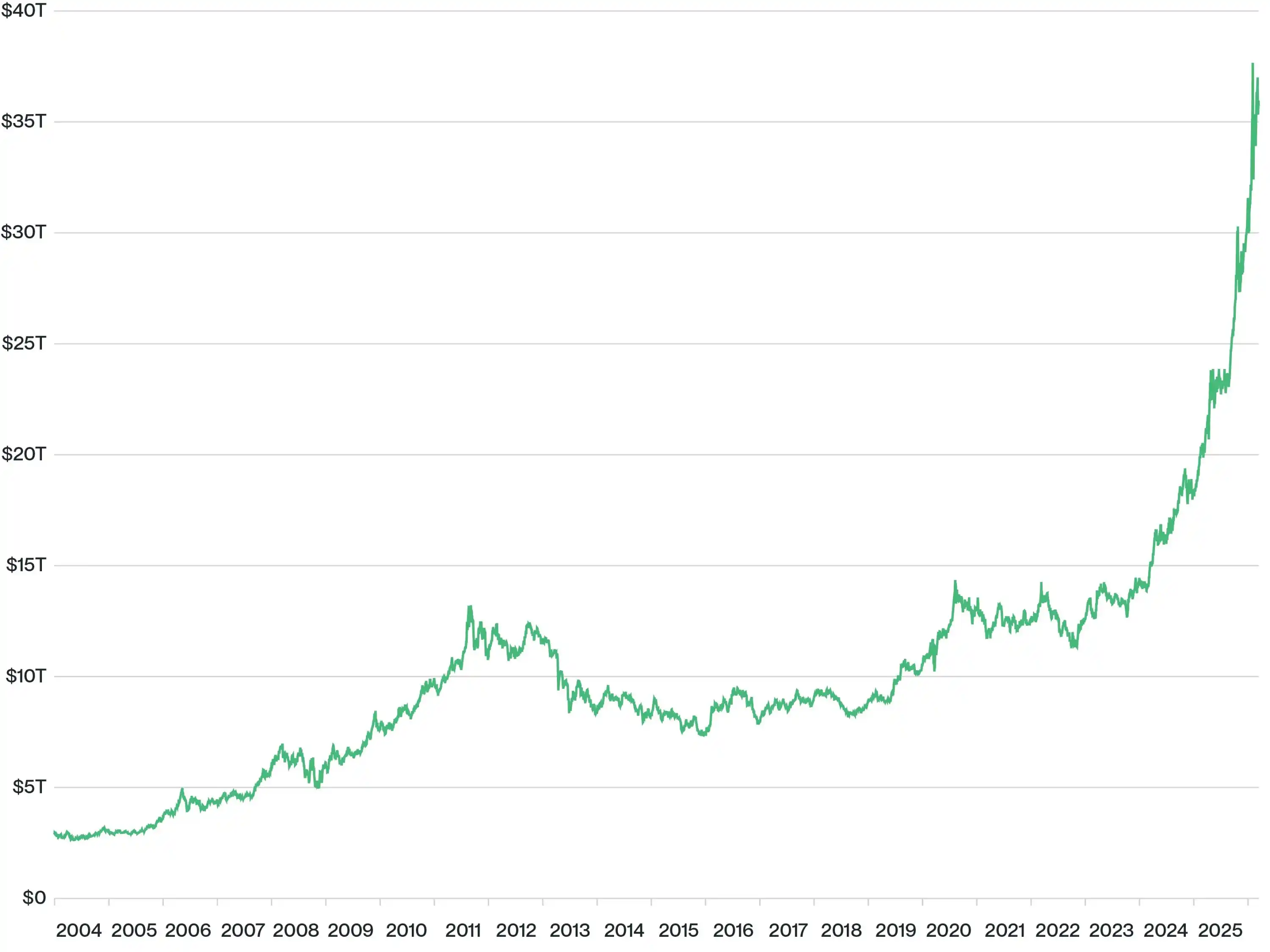
Source: Bitwise Asset Management, data from World Gold Council and Bloomberg.

The mistake people make when assessing Bitcoin's potential is ignoring this growth.

If this growth rate continues, in 10 years, the global "store-of-value market" will be worth approximately $121 trillion. At that size, Bitcoin would only need to capture 17% of the market for one coin to reach $1 million.

Growing from 4% to 17% is still significant growth, but looking at Bitcoin's recent progress, this goal is entirely within reach.

A few years ago, the US had no Bitcoin ETFs, institutional holders were scarce, and Bitcoin's volatility was too high for most to consider allocating more than 1%.

Now:

  • Bitcoin ETFs are the fastest-growing ETFs in history;
  • Institutions from the Harvard Endowment to the Abu Dhabi Sovereign Wealth Fund are holding it;
  • Bitcoin's long-term volatility has decreased, and many professional investors are considering allocation targets of 5%.

There's still a long way to go, but given these trends, capturing one-sixth of the store-of-value market within 10 years is not extreme; it seems more like a natural continuation of existing trends.

Potential Risks

Of course, we must consider both sides.

The global store-of-value market might not continue to grow as it has over the past 20 years. The past two decades featured the global financial crisis, quantitative easing, and prolonged low interest rates. These conditions may not repeat, and the gold price could decline.

Another risk is that Bitcoin might fail to increase its market share.

However, I believe these predictions might also be conservative: as concerns about government debt reach crisis levels, the store-of-value market could grow even faster in the future, and Bitcoin's eventual market share in 10 years could be significantly higher than 17%.

In my view, the base case is:

  • The store-of-value market continues to expand as it has in the past;
  • Bitcoin continues to gain share as it is doing now.

This would push Bitcoin's price far above today's levels.

Notes

(1) Long-time readers might remember I wrote on a similar theme in 2023. My views have since become more refined.

(2) Worth noting: Including silver, platinum, and palladium would make the store-of-value market larger, but for simplicity, this article compares only gold and Bitcoin.


Related Questions

QWhat is the basic framework used by the author to estimate Bitcoin's potential value?

AThe author views Bitcoin as an emerging store of value asset, similar to gold. The basic framework is to: 1) Estimate the total size of the store of value market; 2) Estimate the market share Bitcoin could capture; 3) Divide that value by 21 million (the maximum supply of Bitcoin) to get an implied price.

QAccording to the article, what was the size of the gold market in 2004 and what is it today?

AIn 2004, the entire gold market was worth approximately $2.5 trillion. Today, it has grown to nearly $40 trillion.

QWhat key mistake do people make when assessing Bitcoin's potential to reach a $1 million price?

AThe key mistake is ignoring the growth of the overall store of value market. People assume the market is static, but it has been expanding significantly over the past 20 years and is expected to continue growing.

QWhat does the author project the total store of value market to be in 10 years, and what market share would Bitcoin need to reach a $1 million price at that size?

AThe author projects the global store of value market will reach approximately $121 trillion in 10 years. At that size, Bitcoin would need to capture a 17% market share for its price to reach $1 million per coin.

QWhat recent developments does the author cite as evidence that Bitcoin is gaining traction and could increase its market share?

AThe author cites that Bitcoin ETFs have become the fastest-growing ETFs in history, institutions from the Harvard Endowment to the Abu Dhabi Sovereign Wealth Fund are holding Bitcoin, and Bitcoin's long-term volatility has decreased, making professional investors consider allocations of up to 5%.

Related Reads

XChat Is Here: Musk's Super App Plan Is Reshaping the Encrypted Social Landscape

Elon Musk’s X (formerly Twitter) is launching XChat, an encrypted communication tool supporting text, file sharing, and voice/video calls, on April 17. This move is part of a broader strategy to transform X into a global super-app similar to WeChat, integrating social, payment, and financial services. XChat aims to address Twitter’s historical weakness in private messaging and relationship-building, shifting from a public square to a closed-loop ecosystem. By retaining user relationships within X, the platform can enhance engagement and pave the way for commercial and financial activities. Encrypted messaging is not just a privacy feature but a foundational layer for trust, enabling future payment integrations. X may explore traditional payment systems, stablecoins, or even direct Bitcoin transactions. This could significantly impact the crypto industry by introducing mainstream users to encrypted payments and SocialFi concepts. While XChat may boost adoption and attract attention to crypto narratives, it also poses a threat to existing Web3 social projects that lack scale. Infrastructure projects like wallets and stablecoins may benefit, but consumer-facing decentralized social platforms could face intense competition from X’s vast user base. In summary, XChat represents a structural shift toward integrating social, informational, and financial flows, positioning X as a key player in the future of encrypted communications and digital payments.

marsbit1h ago

XChat Is Here: Musk's Super App Plan Is Reshaping the Encrypted Social Landscape

marsbit1h ago

Franklin Templeton's Latest Research: How to Understand RWA Tokenization

Franklin Templeton's research explores the rapid growth and structural evolution of real-world asset (RWA) tokenization, which has expanded from $5 billion in 2023 to over $25 billion by early 2026. This surge is driven by clearer regulations and greater trust in blockchain technology. RWA tokenization covers assets like stocks, bonds, commodities, and real estate, distinguishing them from native cryptocurrencies. The market saw a turning point as tokenization expanded from government bonds to equities, with early movers like Robinhood, Kraken, and Ondo launching tokenized stock offerings. Traditional institutions, including DTCC, NYSE, and Nasdaq, have since announced significant tokenization initiatives, signaling a major shift in securities processing. The article identifies three tokenization models: 1. **Digital Native Tokens**: Direct ownership of the underlying asset with on-chain settlement (e.g., Franklin Templeton’s money market fund). 2. **Synthetic Asset Tokens**: Indirect economic exposure via special purpose vehicles, allowing broader DeFi utility but limited investor rights. 3. **Digital Mirror Tokens**: Tokenized receipts of off-chain assets, with legacy settlement systems and restricted transferability. Synthetic tokens are permissionless, requiring only KYT checks, while digital native and mirror tokens require full KYC/AML compliance. Each model offers distinct advantages in transparency, utility, and efficiency compared to traditional systems. Tokenization is driving convergence between crypto and traditional finance, with wallets emerging as a universal financial interface.

marsbit2h ago

Franklin Templeton's Latest Research: How to Understand RWA Tokenization

marsbit2h ago

Trading

Spot
Futures

Hot Articles

What is $BITCOIN

DIGITAL GOLD ($BITCOIN): A Comprehensive Analysis Introduction to DIGITAL GOLD ($BITCOIN) DIGITAL GOLD ($BITCOIN) is a blockchain-based project operating on the Solana network, which aims to combine the characteristics of traditional precious metals with the innovation of decentralized technologies. While it shares a name with Bitcoin, often referred to as “digital gold” due to its perception as a store of value, DIGITAL GOLD is a separate token designed to create a unique ecosystem within the Web3 landscape. Its goal is to position itself as a viable alternative digital asset, although specifics regarding its applications and functionalities are still developing. What is DIGITAL GOLD ($BITCOIN)? DIGITAL GOLD ($BITCOIN) is a cryptocurrency token explicitly designed for use on the Solana blockchain. In contrast to Bitcoin, which provides a widely recognized value storage role, this token appears to focus on broader applications and characteristics. Notable aspects include: Blockchain Infrastructure: The token is built on the Solana blockchain, known for its capacity to handle high-speed and low-cost transactions. Supply Dynamics: DIGITAL GOLD has a maximum supply capped at 100 quadrillion tokens (100P $BITCOIN), although details regarding its circulating supply are currently undisclosed. Utility: While precise functionalities are not explicitly outlined, there are indications that the token could be utilized for various applications, potentially involving decentralized applications (dApps) or asset tokenization strategies. Who is the Creator of DIGITAL GOLD ($BITCOIN)? At present, the identity of the creators and development team behind DIGITAL GOLD ($BITCOIN) remains unknown. This situation is typical among many innovative projects within the blockchain space, particularly those aligning with decentralized finance and meme coin phenomena. While such anonymity may foster a community-driven culture, it intensifies concerns about governance and accountability. Who are the Investors of DIGITAL GOLD ($BITCOIN)? The available information indicates that DIGITAL GOLD ($BITCOIN) does not have any known institutional backers or prominent venture capital investments. The project seems to operate on a peer-to-peer model focused on community support and adoption rather than traditional funding routes. Its activity and liquidity are primarily situated on decentralized exchanges (DEXs), such as PumpSwap, rather than established centralized trading platforms, further highlighting its grassroots approach. How DIGITAL GOLD ($BITCOIN) Works The operational mechanics of DIGITAL GOLD ($BITCOIN) can be elaborated on based on its blockchain design and network attributes: Consensus Mechanism: By leveraging Solana’s unique proof-of-history (PoH) combined with a proof-of-stake (PoS) model, the project ensures efficient transaction validation contributing to the network's high performance. Tokenomics: While specific deflationary mechanisms have not been extensively detailed, the vast maximum token supply implies that it may cater to microtransactions or niche use cases that are still to be defined. Interoperability: There exists the potential for integration with Solana’s broader ecosystem, including various decentralized finance (DeFi) platforms. However, the details regarding specific integrations remain unspecified. Timeline of Key Events Here is a timeline that highlights significant milestones concerning DIGITAL GOLD ($BITCOIN): 2023: The initial deployment of the token occurs on the Solana blockchain, marked by its contract address. 2024: DIGITAL GOLD gains visibility as it becomes available for trading on decentralized exchanges like PumpSwap, allowing users to trade it against SOL. 2025: The project witnesses sporadic trading activity and potential interest in community-led engagements, although no noteworthy partnerships or technical advancements have been documented as of yet. Critical Analysis Strengths Scalability: The underlying Solana infrastructure supports high transaction volumes, which could enhance the utility of $BITCOIN in various transaction scenarios. Accessibility: The potential low trading price per token could attract retail investors, facilitating wider participation due to fractional ownership opportunities. Risks Lack of Transparency: The absence of publicly known backers, developers, or an audit process may yield skepticism regarding the project's sustainability and trustworthiness. Market Volatility: The trading activity is heavily reliant on speculative behavior, which can result in significant price volatility and uncertainty for investors. Conclusion DIGITAL GOLD ($BITCOIN) emerges as an intriguing yet ambiguous project within the rapidly evolving Solana ecosystem. While it attempts to leverage the “digital gold” narrative, its departure from Bitcoin's established role as a store of value underscores the need for a clearer differentiation of its intended utility and governance structure. Future acceptance and adoption will likely depend on addressing the current opacity and defining its operational and economic strategies more explicitly. Note: This report encompasses synthesised information available as of October 2023, and developments may have transpired beyond the research period.

363 Total ViewsPublished 2025.05.13Updated 2025.05.13

What is $BITCOIN

Discussions

Welcome to the HTX Community. Here, you can stay informed about the latest platform developments and gain access to professional market insights. Users' opinions on the price of BTC (BTC) are presented below.

活动图片