US Banking Giants Are Quietly Piling Into Bitcoin Credit, Claims Michael Saylor

bitcoinistPublished on 2025-12-10Last updated on 2025-12-10

Abstract

In his keynote at Bitcoin MENA 2025, Michael Saylor revealed that major US banks, including BNY Mellon, Wells Fargo, Bank of America, Charles Schwab, JP Morgan, and Citi, have shifted from excluding Bitcoin to actively building financial products around it. These institutions are now approaching him to issue credit against Bitcoin or Bitcoin derivatives like IBIT. Saylor highlighted a significant policy shift in Washington, treating Bitcoin as "digital gold" and a strategic asset. He positioned his company, MicroStrategy, as a leader in industrializing BTC-backed credit, holding 660,624 BTC and acquiring $500 million to $1 billion worth weekly. Saylor explained how BTC-backed credit, over-collateralized to protect against volatility, can be transformed into low-volatility, yield-generating "digital money" instruments, appealing to sovereign wealth funds and regulators. BTC was trading at $92,700 at the time.

At Bitcoin MENA 2025 in Abu Dhabi, Michael Saylor used his keynote to deliver a clear message: major US banks have quietly pivoted from excluding Bitcoin to actively building products on top of it – and they are now coming directly to him.

“In the past six months I have noted and been approached by BNY Mellon, by Wells Fargo, by Bank of America, by Charles Schwab, by JP Morgan, by Citi,” the Strategy (MSTR) executive chairman said. “They are all starting to issue credit against either Bitcoin or against Bitcoin derivatives like IBIT.”

Big Banks Now Want Bitcoin Exposure

Saylor contrasted that with the situation a year earlier, when “all of the large banks in the United States” still refused to bank Bitcoin. Now, he said, the sector is moving toward custody and credit. “Wells Fargo and Citi have both public announced intent to allow the custody of Bitcoin within the banks and in the year 2026 they’ll start to extend credit,” he told the audience.

Saylor framed this as the institutional expression of a broader policy shift in Washington, which he described as treating BTC as “digital gold” and, more broadly, “digital capital.” He claimed there is now “a profound consensus amongst everyone running the United States” – from the president and vice president to the Treasury, SEC and other top officials – that Bitcoin is a strategic digital asset.

“The United States is the most influential financial regulator in the world,” he said. “Whatever the US banking system does and the US security market does ripples through South America [...] Europe [...] the Middle East [...] even Hong Kong. Even the Chinese will copy what the US is doing.”

Against that backdrop, Saylor positioned Strategy as “the world’s first digital treasury company,” whose business model is to industrialize BTC-backed credit. He reported that the company now holds 660,624 BTC, including 10,600 BTC acquired “yesterday,” and is currently buying “in the range of $500 million to a billion a week” in Bitcoin. “We’re not stopping,” he said. “I think that we can buy more Bitcoin than the sellers can sell. And we’re going to take it all. And we’re going to take it out of circulation.”

The core of his argument is the conversion of volatile “digital capital” into more stable “digital credit.” Strategy over-collateralizes its credit instruments “five-to-one or ten-to-one,” aiming to protect principal even if BTC falls 90%. In return, it targets yields around 8–12.5% in its preferred and note structures, funded by BTC’s expected long-term appreciation.

Saylor presented MSTR equity as “amplified Bitcoin” because issuing credit and reinvesting in BTC can, in his model, double BTC-per-share roughly every seven years. For investors who “don’t trust anybody,” he argued, holding BTC directly remains rational; for those wanting yield and lower volatility, he pitched BTC-backed credit as the superior choice.

He then extended the logic further, outlining a path from digital credit to “digital money.” By constructing a fund that is mostly composed of short-duration BTC-backed credit (such as his “Stretch” structure), buffered with fiat instruments and cash, Saylor claimed one can create a $1 instrument with near-zero volatility and an estimated yield around 8%, distributed as tax-deferred dividends. “I could create what looks like a stablecoin [...] a $1 stablecoin stable to six significant digits that pays you 8% yield tax-deferred but powered by Bitcoin,” he said, adding that banks, asset managers or crypto firms could wrap this into coins, funds or deposit-like accounts.

The speech ended as a direct appeal to sovereign wealth funds and regulators in the region. Saylor urged nations that “want to be the Switzerland of the 21st century” to let banks custody Bitcoin, extend BTC-backed credit and ultimately offer digital-money accounts that pay several hundred basis points above the risk-free rate. “If you give people money that’s better than every other bank on Earth, all of the capital in the world will flow into that country, that bank,” he said.

At press time, BTC traded at $92,700.
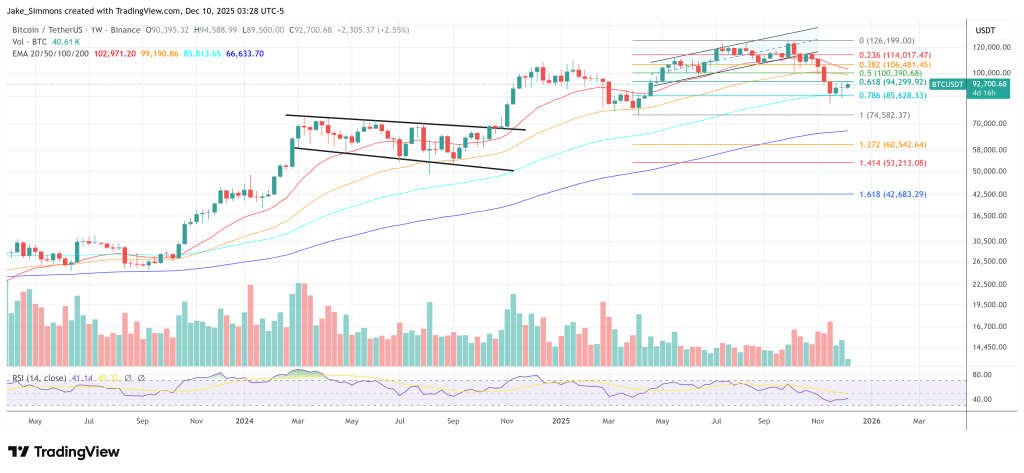
BTC still hovers below the 0.618 Fib, 1-week chart | Source: BTCUSDT on TradingView.com

Related Reads

Central Bank Responds to Call to 'Exit the Sandbox' and Allows Stablecoins

Sberbank CEO Herman Gref expressed the bank's hope for the authorization of stablecoins for domestic transactions in Russia, stating that Sber is actively discussing this possibility with the Bank of Russia. He emphasized the need to move beyond the current regulatory "sandbox" and allow basic transactional functionality with stablecoins, primarily ruble-denominated tokens for internal use. However, the Bank of Russia maintains its position that stablecoins are a form of cryptocurrency and excludes their use for domestic payments. Kirill Pronin, head of the central bank's financial market infrastructure department, argued that Russia's digital payment ecosystem is already highly developed, making such authorization unnecessary. The article notes that Russia currently operates with Digital Financial Assets (DFAs), which are tokenized versions of real assets issued on approved blockchain platforms. Some foreign digital rights, including compliant stablecoins, can be classified as DFAs. The first such recognized asset was a Kyrgyzstani ruble stablecoin, permitted only for foreign economic activity. Pronin also mentioned that the central bank is considering allowing banks and token issuers to directly issue digital assets in public blockchains, as the current method of transferring domestically issued tokens to open networks has not gained significant traction. This shift could reduce operational costs and cybersecurity risks.

RBK-crypto9m ago

Central Bank Responds to Call to 'Exit the Sandbox' and Allows Stablecoins

RBK-crypto9m ago

17 Most Anticipated Things in the Cryptocurrency Space in 2026

17 Key Crypto Developments to Watch in 2026 Stablecoin on/off ramps will mature, connecting digital dollars to local payment systems and enabling new behaviors like real-time cross-border payments and merchant adoption without bank accounts. Stablecoins will evolve into a foundational internet settlement layer. RWA tokenization will shift toward crypto-native approaches like perpetual futures for deeper liquidity. Stablecoins will see more native issuance rather than tokenization, and on-chain native debt issuance will reduce costs and improve accessibility. Banks will leverage stablecoins to innovate without overhauling legacy systems. The internet itself will become a banking layer as value moves programmatically via smart contracts and new primitives like x402. Wealth management will become personalized and automated for everyone via tokenized assets and AI-driven portfolio management. DeFi tools and tokenized private markets will expand access. AI agents will require identity verification (KYA - Know Your Agent) and new economic models to compensate content creators as agents scrape the open web. AI will also enable new research methodologies via layered, reasoning agents. Privacy will become crypto's key moat, creating strong network effects as bridging between private and public chains risks metadata leakage. Decentralized, quantum-resistant messaging will rise, emphasizing user ownership. "Secrets-as-a-service" will emerge for programmable data access control. DeFi security will evolve from "code is law" to "specification is law" with runtime enforcement of invariants. Prediction markets will expand with more contracts, AI-powered oracles, and decentralized governance. "Staked media" will rise, where commentators back arguments with verifiable, on-chain commitments. SNARKs will become efficient enough (~10,000x overhead) for verifiable cloud computing, moving beyond blockchain. Finally, crypto market structure regulation could align legal and technical frameworks, enabling networks to operate as truly open, decentralized systems.

marsbit10m ago

17 Most Anticipated Things in the Cryptocurrency Space in 2026

marsbit10m ago

Trading

Spot
Futures
活动图片