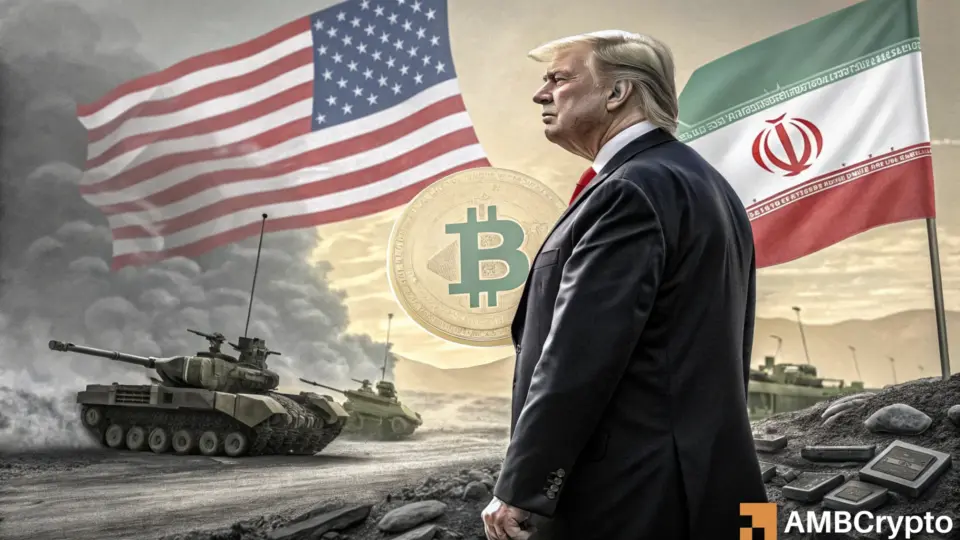
Will Trump Take Military Action Against Iran? How Will This Affect Bitcoin?

marsbitPublished on 2026-01-16Last updated on 2026-01-16

Abstract

In mid-January 2026, escalating U.S.-Iran tensions—marked by the precautionary withdrawal of U.S. personnel from key Middle Eastern bases like Al Udeid in Qatar—triggered significant movements in financial markets. Gold and silver reached record highs as investors sought traditional safe-haven assets amid geopolitical uncertainty. Bitcoin, often misclassified as purely risk-on or risk-off, surged to nearly $97,700, reflecting its role as a macro hedge asset sensitive to liquidity conditions. The market’s focus is not solely on whether the U.S. will initiate military action but on the potential scale of escalation and its impact on oil prices, dollar strength, and global liquidity. A limited conflict may be quickly absorbed by markets, especially amid expectations of loose monetary policy, but broader regional disruption could tighten liquidity and pressure risk assets, including cryptocurrencies. The key signal for a shift from risk-pricing to crisis mode will be consistent, cross-agency military preparedness rather than isolated defensive moves. Bitcoin’s near-term trajectory will depend on whether the situation fuels dollar strength and energy shocks (bearish) or reinforces its hedging appeal alongside gold (bullish).

In mid-January 2026, the market is not facing a publicly announced war plan, but rather a rapidly escalating yet officially ambiguous period of tension: the United States has begun evacuating or advising the evacuation of some personnel from key regions in the Middle East, including the Al Udeid Air Base in Qatar. According to the Financial Times, approximately 10,000 U.S. military personnel are stationed at this base; Reuters also noted that, as regional tensions escalate and Iranian officials warn of retaliation against neighboring countries hosting U.S. forces if the U.S. launches an attack, the U.S. has taken preventive evacuation measures.
For investors, the most important signal is that these actions are not merely "verbal deterrence" or media manipulation—the relocation of personnel and assets incurs extremely high real-world costs and is typically not undertaken solely for symbolic purposes. However, these measures still do not confirm an imminent military operation, meaning the market is pricing in a "probability distribution" rather than a single certain outcome.

Why This Change Is Quickly Reflected in Asset Prices

When geopolitical risks rise from background noise to actionable tail risks, the assets that react first are often those that directly price uncertainty. This week's market movements illustrate this: Reuters reported that on January 14, 2026, spot gold briefly hit a historic high of $4,639.42 per ounce, and spot silver also broke through $90 per ounce for the first time, with the rise attributed to a combination of interest rate cut expectations and geopolitical uncertainty. The following day, as Trump signaled a "pause and observe" approach, gold retreated as investors took profits.
This process itself is significant, indicating that the market is in a state where investors are willing to pay a premium for safety during unresolved situations, but panic can be quickly digested once official statements suggest de-escalation.

Bitcoin's Position in This Macro Environment

Bitcoin's reaction is often simplistically categorized as a "risk asset" or "safe-haven asset," but a more accurate description is that it is a macro asset highly sensitive to liquidity. Its short-term movements depend on whether the dominant market transmission path is "panic" (which may push up the U.S. dollar and tighten financial conditions) or "hedging demand" (driving funds toward non-sovereign stores of value).
In this event, Bitcoin clearly participated in the "macro hedging asset" rally. Bloomberg reported that Bitcoin rose to $97,694 during intraday trading on January 14, 2026, with a daily gain of up to 3.9%, reaching its highest level since mid-November. Simultaneously, this rally liquidated over $5 billion in bearish crypto options positions, indicating a significant release of structural market pressure.

The Core Issue Is Not "Whether to Use Force," but "How It Escalates"

For the market, the more tradable aspect is not the binary question of "whether Trump will launch a strike," but the nature and scale of potential escalation and its impact on oil prices, the U.S. dollar's trajectory, and global liquidity. Even within the "digital gold" narrative framework, these variables still dominate Bitcoin's short-term direction.
If the conflict is contained within a limited timeframe and does not affect energy supplies, the market can often digest the shock relatively quickly, especially against a backdrop of accommodative monetary policy expectations. However, if escalation scenarios involve regional energy disruptions or trigger broader retaliation, risk assets as a whole may face liquidity tightening pressures, including high-leverage positions in the crypto market.

What to Focus on Next

The key to determining whether the market is moving from a "risk premium phase" to a "crisis mode" lies not in individual news items, but in whether preventive actions evolve into sustained military posture adjustments and whether official statements become consistent across different agencies. Isolated defensive measures may merely be cautious behavior, while coordinated actions across agencies and regions typically indicate a higher intent to act.
Current public reports show that Reuters emphasizes preventive evacuations due to Iranian warnings, while the Financial Times and Associated Press focus more on U.S. efforts to reduce potential retaliation risks. Together, this information paints a picture of a strategy posture that is "preparing for volatility but not yet publicly committed to action."

Conclusion

Based on public information, it is impossible to determine whether Trump will definitely take military action against Iran, but the market already views this possibility as a non-negligible risk. This is why traditional safe-haven assets like gold have hit new highs and explains why Bitcoin was able to rise to around $97,000 amid macro hedging sentiment.
Bitcoin's next direction will likely depend not on a single breaking headline, but on whether the evolving situation increases the probability of an energy shock and a stronger U.S. dollar (which is generally unfavorable for liquidity-sensitive assets) or further strengthens hedging demand in an environment of combined political and monetary uncertainty—in the latter scenario, Bitcoin has often benefited in sync with gold in the past.

Related Questions

QWhat was the key market reaction to the escalating tensions between the U.S. and Iran in mid-January 2026?

ASpot gold hit a record high of $4,639.42 per ounce, and spot silver broke through $90 for the first time, driven by a combination of interest rate cut expectations and geopolitical uncertainty.

QHow did Bitcoin perform during this period of uncertainty, and what was the peak price mentioned?

ABitcoin rose to $97,694 during intraday trading on January 14, 2026, with a single-day gain of up to 3.9%, its highest level since mid-November.

QAccording to the article, what is the more accurate description of Bitcoin's role in the macro environment, as opposed to being simply a 'risk-on' or 'safe-haven' asset?

AIt is a macro asset highly sensitive to liquidity, with its short-term direction depending on whether the dominant market narrative is 'panic' or 'hedging demand'.

QWhat is the core question for the market, according to the analysis, regarding the potential U.S. military action?

AThe core question is not 'whether Trump will launch a strike,' but the nature and scale of the potential escalation and its impact on oil prices, the U.S. dollar, and global liquidity.

QWhat key factor will determine if the market moves from a 'risk premium phase' to a 'crisis mode'?

AThe key factor is whether preventive actions evolve into sustained military posture adjustments and whether official statements become consistent across different agencies, indicating a higher intent for action.

Related Reads

Mysterious Model HappyHorse Tops the Chart Overnight: Is the Video Generation Arena Welcoming a "Game Changer"?

A mysterious AI video generation model named "HappyHorse-1.0" has quietly topped the AI Video Arena leaderboard on Artificial Analysis, surpassing established models like Seedance 2.0 and others in Elo score—a user-blind-test-based ranking reflecting real perceived quality. The model’s origin was initially unknown, but technical analysis later linked it to the open-source model "daVinci-MagiHuman," jointly developed by Shanghai SII GAIR Lab and Beijing-based Sand.ai. HappyHorse-1.0, likely an optimized iteration by Sand.ai, uses a 15-billion-parameter transformer architecture for joint audio-video-text modeling. Its strong performance in human-centric scenes (e.g., portraits, narrations) helped it excel in blind tests, though it still lags in multi-character or complex motion scenarios. The achievement signals a potential shift: an open-source model rivaling closed-source alternatives in perceived quality, which could lower costs and increase flexibility for developers in vertical applications like virtual avatars. However, limitations remain, including high computational requirements (H100 GPU needed) and shorter generation lengths. While not yet threatening market leaders, HappyHorse represents progress toward open models reaching "production-ready" quality, potentially accelerating community-driven improvements in the video AI space.

marsbit47m ago

Mysterious Model HappyHorse Tops the Chart Overnight: Is the Video Generation Arena Welcoming a "Game Changer"?

marsbit47m ago

10 Claude Code Usage Tips: The Sooner You Know, The Sooner You Benefit

Here is an English summary of the article "10 Must-Know Claude Code Tips: The Sooner You Know, The Sooner You Benefit": This article shares essential tips for using Claude Code, an AI coding assistant, to significantly boost productivity. It is divided into three main sections. First, it covers three ways to launch Claude: 1) A simple GUI desktop app for non-programmers, 2) A command-line method with a key tip (`claude -c`) to resume from a specific point in the chat history, avoiding restarting context, and 3) A headless mode (`-p` flag) for automation tasks using a subscription token. Second, it details three crucial in-session techniques: 1) Using `Esc` to gracefully interrupt a response and `Esc+Esc` to revert to a previous checkpoint, 2) Using the `!` syntax (e.g., `!ls`) to run shell commands without leaving the chat, and 3) Managing context with `/clear` to remove history or `/compact` to optimize it when performance slows down. Finally, the article recommends companion software to solve human-AI collaboration bottlenecks: 1) **Superpowers**, a structured workflow methodology for higher-quality code output. 2) Voice input tools like **Typeless** and **Douban Input法** to overcome typing speed limit. 3) Tools like **Cmux** (a terminal for managing multiple AI agent instances) and **Vibe Island** (for seamless context switching between tasks) to solve the problem of lost focus when multitasking. The overall goal is to help users focus more deeply on their programming work by streamlining their interaction with Claude Code.

marsbit1h ago

10 Claude Code Usage Tips: The Sooner You Know, The Sooner You Benefit

marsbit1h ago

Trading

Spot
Futures

Hot Articles

What is $BITCOIN

DIGITAL GOLD ($BITCOIN): A Comprehensive Analysis Introduction to DIGITAL GOLD ($BITCOIN) DIGITAL GOLD ($BITCOIN) is a blockchain-based project operating on the Solana network, which aims to combine the characteristics of traditional precious metals with the innovation of decentralized technologies. While it shares a name with Bitcoin, often referred to as “digital gold” due to its perception as a store of value, DIGITAL GOLD is a separate token designed to create a unique ecosystem within the Web3 landscape. Its goal is to position itself as a viable alternative digital asset, although specifics regarding its applications and functionalities are still developing. What is DIGITAL GOLD ($BITCOIN)? DIGITAL GOLD ($BITCOIN) is a cryptocurrency token explicitly designed for use on the Solana blockchain. In contrast to Bitcoin, which provides a widely recognized value storage role, this token appears to focus on broader applications and characteristics. Notable aspects include: Blockchain Infrastructure: The token is built on the Solana blockchain, known for its capacity to handle high-speed and low-cost transactions. Supply Dynamics: DIGITAL GOLD has a maximum supply capped at 100 quadrillion tokens (100P $BITCOIN), although details regarding its circulating supply are currently undisclosed. Utility: While precise functionalities are not explicitly outlined, there are indications that the token could be utilized for various applications, potentially involving decentralized applications (dApps) or asset tokenization strategies. Who is the Creator of DIGITAL GOLD ($BITCOIN)? At present, the identity of the creators and development team behind DIGITAL GOLD ($BITCOIN) remains unknown. This situation is typical among many innovative projects within the blockchain space, particularly those aligning with decentralized finance and meme coin phenomena. While such anonymity may foster a community-driven culture, it intensifies concerns about governance and accountability. Who are the Investors of DIGITAL GOLD ($BITCOIN)? The available information indicates that DIGITAL GOLD ($BITCOIN) does not have any known institutional backers or prominent venture capital investments. The project seems to operate on a peer-to-peer model focused on community support and adoption rather than traditional funding routes. Its activity and liquidity are primarily situated on decentralized exchanges (DEXs), such as PumpSwap, rather than established centralized trading platforms, further highlighting its grassroots approach. How DIGITAL GOLD ($BITCOIN) Works The operational mechanics of DIGITAL GOLD ($BITCOIN) can be elaborated on based on its blockchain design and network attributes: Consensus Mechanism: By leveraging Solana’s unique proof-of-history (PoH) combined with a proof-of-stake (PoS) model, the project ensures efficient transaction validation contributing to the network's high performance. Tokenomics: While specific deflationary mechanisms have not been extensively detailed, the vast maximum token supply implies that it may cater to microtransactions or niche use cases that are still to be defined. Interoperability: There exists the potential for integration with Solana’s broader ecosystem, including various decentralized finance (DeFi) platforms. However, the details regarding specific integrations remain unspecified. Timeline of Key Events Here is a timeline that highlights significant milestones concerning DIGITAL GOLD ($BITCOIN): 2023: The initial deployment of the token occurs on the Solana blockchain, marked by its contract address. 2024: DIGITAL GOLD gains visibility as it becomes available for trading on decentralized exchanges like PumpSwap, allowing users to trade it against SOL. 2025: The project witnesses sporadic trading activity and potential interest in community-led engagements, although no noteworthy partnerships or technical advancements have been documented as of yet. Critical Analysis Strengths Scalability: The underlying Solana infrastructure supports high transaction volumes, which could enhance the utility of $BITCOIN in various transaction scenarios. Accessibility: The potential low trading price per token could attract retail investors, facilitating wider participation due to fractional ownership opportunities. Risks Lack of Transparency: The absence of publicly known backers, developers, or an audit process may yield skepticism regarding the project's sustainability and trustworthiness. Market Volatility: The trading activity is heavily reliant on speculative behavior, which can result in significant price volatility and uncertainty for investors. Conclusion DIGITAL GOLD ($BITCOIN) emerges as an intriguing yet ambiguous project within the rapidly evolving Solana ecosystem. While it attempts to leverage the “digital gold” narrative, its departure from Bitcoin's established role as a store of value underscores the need for a clearer differentiation of its intended utility and governance structure. Future acceptance and adoption will likely depend on addressing the current opacity and defining its operational and economic strategies more explicitly. Note: This report encompasses synthesised information available as of October 2023, and developments may have transpired beyond the research period.

363 Total ViewsPublished 2025.05.13Updated 2025.05.13

What is $BITCOIN

Discussions

Welcome to the HTX Community. Here, you can stay informed about the latest platform developments and gain access to professional market insights. Users' opinions on the price of BTC (BTC) are presented below.

活动图片