Bitcoin Bull Phase Pattern Shows When BTC Price Will Bottom At $41,400

bitcoinistPublished on 2026-04-12Last updated on 2026-04-12

Abstract

A crypto analyst, Philarekt, predicts Bitcoin's current bull phase has ended and the asset is in a prolonged bear market. Contrary to expectations of new highs, he identifies the peak at over $126,000 in October 2025 as the cycle top. Based on historical patterns where each bull phase lasts about 1,450 days and is followed by a 365-day bear market, he forecasts a further decline. Bitcoin is expected to bottom around $41,400, a 64% drop from its peak, by early October 2026. As of the writing date (April 11, 2026), BTC is 187 days into this decline with 178 days remaining until the projected low.

Bitcoin could be gearing up for its next bull phase as a crypto analyst has outlined the timeline for when the BTC price may reach its bottom. Contrary to widespread belief, the analyst does not consider the previous cycle low around $60,000 to be the final bottom. Rather, he expects further downside in the market, forecasting a deeper move toward $41,400. From this projected price floor, the market could reset, potentially giving way to the next bull cycle.

Bitcoin Past Cycle Patterns Signal Next Bottom

A crypto market analyst known as Philarekt on X has predicted the precise timeline and target for Bitcoin’s final cycle bottom. To support his predictions, the expert presented a chart comparing Bitcoin’s past market cycles from 2013 to 2026, showing when each bull run began, when the bear market ended, and how long each phase lasted.

According to Philarekt, Bitcoin’s bull phase usually begins the moment it confirms a final bottom and typically lasts about 1,450 days before reaching a peak and then reversing into a new bear market. In 2013, BTC peaked near $1,100 before falling more than 87% and forming a bottom about 365 days later. A similar trend appeared in the 2017 cycle, where Bitcoin topped around $19,000 after rallying for 1,450 days, then dropped more than 85% before bottoming in 2018, approximately 365 days later.
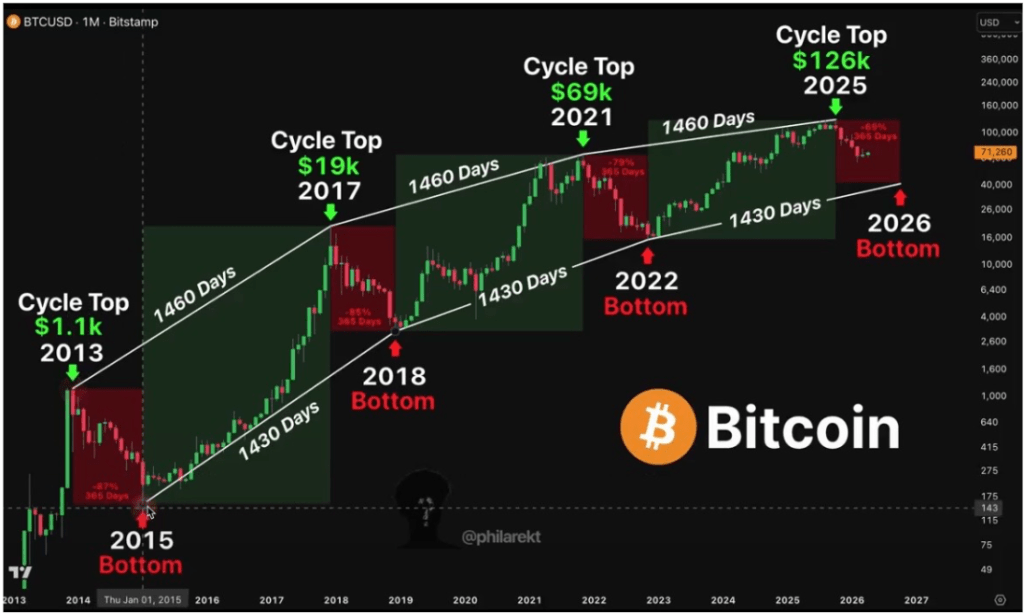
During the historical 2021 cycle, the same behavior was observed. Bitcoin had reached an all-time high above $69,000 before declining by over 79% into its 2022 bear market bottom. Based on this repeating structure, Philarekt believes Bitcoin has already reached its highest price target for the current cycle and is now progressing toward its final bottom, which the analyst expects to form within the same 365-day timeframe.

Bitcoin is now trading at $72,874. Chart: TradingView

BTC Price Projection And Bottom Target

While many analysts still expect a new all-time high to emerge in this cycle, Philarekt identifies the rally above $126,000 on October 6, 2025, as Bitcoin’s final top. He confirmed that BTC is now in a prolonged bear market, mostly trading sideways within a broader downtrend that has pushed its price as low as $60,000 since its peak.

At the time of writing, Bitcoin is trading above $72,500, reflecting a more than 42% decline in value from its ATH. Based on Philarekt’s projections, BTC could still fall by around 64% from the $126,000 top, potentially marking the cryptocurrency’s price bottom at around $41,400.

In terms of timing, Bitcoin is already 187 days into its bear market decline as of April 11, 2026, with only 178 days remaining until Philarekt’s projected bottom. This would place the cryptocurrency’s price floor around early October 2026, matching the timeline of its current ATH.

Featured image from Unsplash, chart from TradingView

Related Questions

QAccording to the analyst Philarekt, what is the projected bottom for Bitcoin's price in the current cycle?

AThe analyst forecasts that Bitcoin's price will bottom at approximately $41,400.

QHow long does the analyst predict the typical Bitcoin bull phase lasts before it peaks and reverses?

AThe analyst states that Bitcoin's bull phase typically lasts about 1,450 days before reaching a peak and reversing into a new bear market.

QBased on the article, what date did the analyst identify as the final top of the current cycle, where Bitcoin reached its highest price?

AThe analyst identified October 6, 2025, as the date Bitcoin reached its final top, with a price above $126,000.

QAs of the article's writing (April 11, 2026), how many days into the bear market decline was Bitcoin, and how many days were left until the projected bottom?

AAs of April 11, 2026, Bitcoin was 187 days into its bear market decline, with 178 days remaining until the projected bottom.

QWhat pattern from past cycles does the analyst use to support the prediction of a 365-day period to form a bottom after a peak?

AThe analyst points to the pattern from the 2013 and 2017 cycles, where Bitcoin took approximately 365 days to form a bottom after its peak.

Related Reads

The Allbirds, the Internet-Famous Shoes That Took Silicon Valley by Storm, Are Now All in on AI

Allbirds, the once-popular sustainable shoe brand favored by Silicon Valley elites and celebrities, has announced a drastic pivot from footwear manufacturing to AI infrastructure. On April 15, 2026, the company revealed plans to abandon its shoe business entirely, rebrand as "NewBird AI," and focus on GPU-as-a-service and AI cloud solutions. The move caused its stock to surge over 800% in a single day. The brand, known for its wool-based eco-friendly shoes, had struggled financially in recent years. Revenue fell from a peak of $298 million in 2022 to $152 million in 2025, with cumulative losses of $419 million over five years. In March 2026, Allbirds sold its intellectual property and footwear assets for just $39 million—a fraction of its former $4.1 billion valuation. The company secured up to $50 million in convertible notes to fund the acquisition of GPU hardware for AI compute leasing. However, the announcement lacked details about technical capacity, clients, or infrastructure plans. Critics highlight the high execution risks in the competitive AI infrastructure market, dominated by major cloud providers. The shift reflects a broader trend of companies rebranding around AI to attract investor interest, despite uncertain fundamentals. Allbirds also removed its "public benefit" corporate mission, signaling a departure from its original sustainability ethos. The move underscores the power of AI narrative in today’s capital markets, where storytelling often precedes substance.

marsbit17m ago

The Allbirds, the Internet-Famous Shoes That Took Silicon Valley by Storm, Are Now All in on AI

marsbit17m ago

The Complete Landscape of Encrypted AI Protocols: Starting from Ethereum's Main Battlefield, How to Build a New Operating System for AI Agents?

The year 2026 is emerging as a pivotal moment for the convergence of Crypto and AI, marked by AI's evolution from a tool to an autonomous economic agent. These AI agents require identity, payment channels, and verifiable execution environments—needs that blockchain is uniquely positioned to address. Ethereum is positioning itself as the trust layer for AI. Vitalik Buterin's updated framework outlines a vision where Ethereum provides verifiable, auditable infrastructure for AI, rather than accelerating its development unchecked. This is being realized through key protocol developments: - **Identity & Reputation (ERC-8004):** A standard for creating NFT-based identities for AI agents, complete with a reputation system built on verifiable on-chain interactions. - **Payments (x402):** Now under the Linux Foundation, this protocol embeds machine-to-machine payments directly into HTTP requests, enabling agents to pay for API access seamlessly with stablecoins or traditional methods. - **Execution (ERC-8211):** Allows AI agents to execute complex, multi-step DeFi transactions atomically in a single signature, overcoming a major operational bottleneck. Beyond Ethereum, other ecosystems are finding their roles. Solana is becoming a hub for high-frequency, low-cost agent payments and interactions due to its speed and low fees. Decentralized physical infrastructure networks (DePIN) provide the necessary compute power. In summary, a complementary crypto-AI stack is forming: Ethereum sets the standards for trust and identity, Solana excels at high-frequency execution, and DePIN supplies decentralized computation. The goal is not to accelerate AI uncontrollably, but to build a verifiable, decentralized foundation for the incoming AI agent economy.

marsbit23m ago

The Complete Landscape of Encrypted AI Protocols: Starting from Ethereum's Main Battlefield, How to Build a New Operating System for AI Agents?

marsbit23m ago

Trading

Spot
Futures

Hot Articles

What is $BITCOIN

DIGITAL GOLD ($BITCOIN): A Comprehensive Analysis Introduction to DIGITAL GOLD ($BITCOIN) DIGITAL GOLD ($BITCOIN) is a blockchain-based project operating on the Solana network, which aims to combine the characteristics of traditional precious metals with the innovation of decentralized technologies. While it shares a name with Bitcoin, often referred to as “digital gold” due to its perception as a store of value, DIGITAL GOLD is a separate token designed to create a unique ecosystem within the Web3 landscape. Its goal is to position itself as a viable alternative digital asset, although specifics regarding its applications and functionalities are still developing. What is DIGITAL GOLD ($BITCOIN)? DIGITAL GOLD ($BITCOIN) is a cryptocurrency token explicitly designed for use on the Solana blockchain. In contrast to Bitcoin, which provides a widely recognized value storage role, this token appears to focus on broader applications and characteristics. Notable aspects include: Blockchain Infrastructure: The token is built on the Solana blockchain, known for its capacity to handle high-speed and low-cost transactions. Supply Dynamics: DIGITAL GOLD has a maximum supply capped at 100 quadrillion tokens (100P $BITCOIN), although details regarding its circulating supply are currently undisclosed. Utility: While precise functionalities are not explicitly outlined, there are indications that the token could be utilized for various applications, potentially involving decentralized applications (dApps) or asset tokenization strategies. Who is the Creator of DIGITAL GOLD ($BITCOIN)? At present, the identity of the creators and development team behind DIGITAL GOLD ($BITCOIN) remains unknown. This situation is typical among many innovative projects within the blockchain space, particularly those aligning with decentralized finance and meme coin phenomena. While such anonymity may foster a community-driven culture, it intensifies concerns about governance and accountability. Who are the Investors of DIGITAL GOLD ($BITCOIN)? The available information indicates that DIGITAL GOLD ($BITCOIN) does not have any known institutional backers or prominent venture capital investments. The project seems to operate on a peer-to-peer model focused on community support and adoption rather than traditional funding routes. Its activity and liquidity are primarily situated on decentralized exchanges (DEXs), such as PumpSwap, rather than established centralized trading platforms, further highlighting its grassroots approach. How DIGITAL GOLD ($BITCOIN) Works The operational mechanics of DIGITAL GOLD ($BITCOIN) can be elaborated on based on its blockchain design and network attributes: Consensus Mechanism: By leveraging Solana’s unique proof-of-history (PoH) combined with a proof-of-stake (PoS) model, the project ensures efficient transaction validation contributing to the network's high performance. Tokenomics: While specific deflationary mechanisms have not been extensively detailed, the vast maximum token supply implies that it may cater to microtransactions or niche use cases that are still to be defined. Interoperability: There exists the potential for integration with Solana’s broader ecosystem, including various decentralized finance (DeFi) platforms. However, the details regarding specific integrations remain unspecified. Timeline of Key Events Here is a timeline that highlights significant milestones concerning DIGITAL GOLD ($BITCOIN): 2023: The initial deployment of the token occurs on the Solana blockchain, marked by its contract address. 2024: DIGITAL GOLD gains visibility as it becomes available for trading on decentralized exchanges like PumpSwap, allowing users to trade it against SOL. 2025: The project witnesses sporadic trading activity and potential interest in community-led engagements, although no noteworthy partnerships or technical advancements have been documented as of yet. Critical Analysis Strengths Scalability: The underlying Solana infrastructure supports high transaction volumes, which could enhance the utility of $BITCOIN in various transaction scenarios. Accessibility: The potential low trading price per token could attract retail investors, facilitating wider participation due to fractional ownership opportunities. Risks Lack of Transparency: The absence of publicly known backers, developers, or an audit process may yield skepticism regarding the project's sustainability and trustworthiness. Market Volatility: The trading activity is heavily reliant on speculative behavior, which can result in significant price volatility and uncertainty for investors. Conclusion DIGITAL GOLD ($BITCOIN) emerges as an intriguing yet ambiguous project within the rapidly evolving Solana ecosystem. While it attempts to leverage the “digital gold” narrative, its departure from Bitcoin's established role as a store of value underscores the need for a clearer differentiation of its intended utility and governance structure. Future acceptance and adoption will likely depend on addressing the current opacity and defining its operational and economic strategies more explicitly. Note: This report encompasses synthesised information available as of October 2023, and developments may have transpired beyond the research period.

363 Total ViewsPublished 2025.05.13Updated 2025.05.13

What is $BITCOIN

Discussions

Welcome to the HTX Community. Here, you can stay informed about the latest platform developments and gain access to professional market insights. Users' opinions on the price of BTC (BTC) are presented below.

活动图片