Recently, the global storage industry collectively released its semi-annual financial reports.
SK hynix reported Q2 revenue of 79.32 trillion won, a year-over-year increase of 257%; operating profit of 60.54 trillion won, skyrocketing 557% YoY; and net profit reached a staggering 93.92 trillion won, soaring 1242% YoY. The cumulative revenue for the first half of the year exceeded 100 trillion won for the first time, setting a historical record for the best six-month performance.
The operating profit margin reached 76%, meaning that for every $100 in revenue, $76 is directly converted into profit. Samsung Electronics' single-quarter operating profit was 89.5 trillion won, exceeding the total profits of 2023, 2024, and 2025 combined. Micron Technology's gross margin surged to 84.6%. In the A-share market, Longsys saw its first-half net profit increase by 62,200%, Deming Technology grew by nearly 5,000%, and BIWIN Storage grew by over 3,200%.
These are nearly the best financial results in history, but paradoxically, following the release of these record-breaking numbers, SK hynix's stock price plunged 11% in a single day, and Samsung Electronics' share price also fell simultaneously. The profit statements of storage companies are essentially the cost statements of their downstream customers. When upstream profits inflate to historical extremes, the only remaining question is, who can continue to foot the bill?
01 Storage Giants: Revenue and Profits Hit New Highs
SK hynix's Q2 earnings report delivered its best performance ever. Revenue was 79.32 trillion won, a 257% increase year-over-year; operating profit was 60.54 trillion won, a massive 557% YoY surge; and net profit reached 93.92 trillion won, skyrocketing 1242% YoY. Cumulative revenue for the first half also surpassed 100 trillion won for the first time, setting a historical best for a six-month period. However, on the day of the report's release, SK hynix's stock price fell over 13% at one point, wiping out about 20 trillion won in market value.
The core contradiction lies in long-term agreement (LTA) price locks. Hyun-Seok Song, Corporate Center President of SK hynix, stated at the 2026 Q2 earnings conference call: "Currently, we have completed signing long-term supply agreements with over 10 companies, including core customers, and are simultaneously in discussions with other leading clients to advance cooperation." Long-term supply agreements refer to contracts signed for multi-year supply of specific chip products, with contract cycles varying based on the customer and product category, typically with a baseline term of about 5 years. This model can reduce the operational uncertainty caused by short-term market fluctuations and stabilize the company's medium-to-long-term operational foundation; it also ensures customers have stable access to memory chip capacity. While this has brought high visibility of demand, it has also capped the flexibility for further price increases.
Samsung Electronics' financial report also set new historical highs, achieving sales of 171.50 trillion won, a 130% year-over-year increase; operating profit of 89.49 trillion won, up 1813.83% YoY; and net profit of 71.27 trillion won, soaring 1344.46% YoY. Among these, the Device Solutions (DS) division, responsible for memory chips and foundry business, achieved an operating profit of 89.2 trillion won, a historical record. Samsung Electronics stated that continued demand for AI servers has driven sales of high-end memory products like High Bandwidth Memory (HBM), while advanced packaging and foundry businesses also continue to benefit from AI infrastructure investment.
02 Domestic Storage Forces: From "Losses" to "Windfall Profits"
While overseas original equipment manufacturers (OEMs) reap the AI dividends with HBM, domestic storage companies are also benefiting from the AI boom.
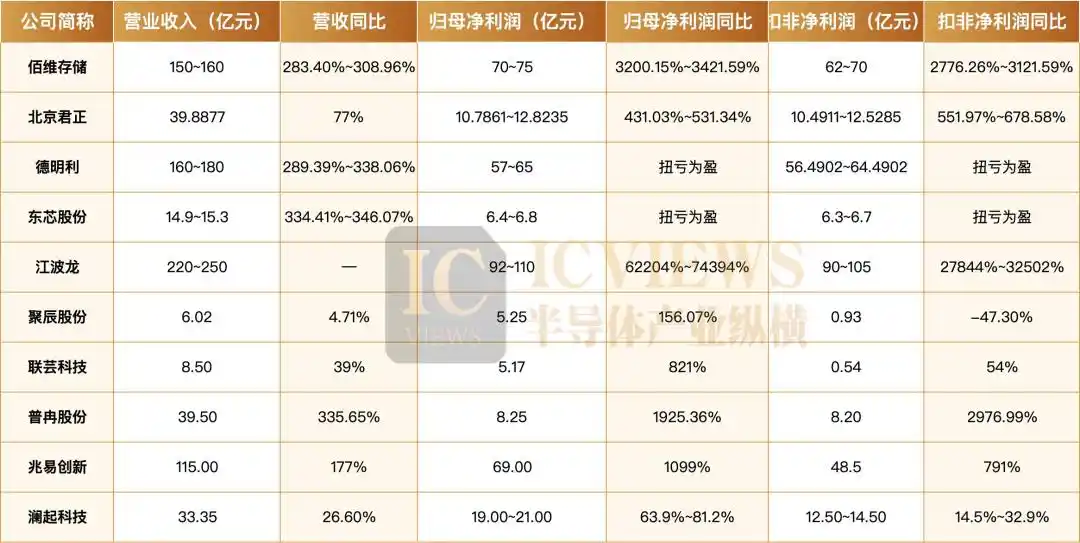
Storage OEMs and fabless design companies are seeing the most substantial profit gains. GigaDevice's first-half revenue was 11.5 billion yuan, with net profit attributable to the parent company of 6.9 billion yuan, a 1099% increase year-over-year. Beijing Ingenic Semiconductor's revenue was approximately 4 billion yuan, up 77% YoY, with net profit attributable to the parent company between 1.079 and 1.282 billion yuan, an increase of 431%-531% YoY. Dosilicon turned losses into profits, with net profit attributable to the parent company between 640 and 680 million yuan.
The profits of these companies come from product price increases + shipment volume growth + structural market share gains. Dosilicon stated that benefiting from the sustained explosion in AI computing demand and the enhanced competitiveness of domestic niche memory technology, overseas memory OEMs are accelerating their withdrawal from the niche memory market, leading to a noticeable contraction on the supply side. At the same time, downstream application demands such as network communication, industrial control, and automotive electronics are steadily recovering, further widening the supply-demand gap for niche memory chips. The supply-demand relationship in the memory chip market the company faces presents a situation of structural shortage, leading to a significant surge in product market prices.
The profit growth rates for downstream module manufacturers are even higher. Longsys' first-half revenue is estimated between 22 and 25 billion yuan, with net profit between 9.2 and 11 billion yuan, an increase of 62,204%-74,394% YoY; BIWIN Storage's first-half revenue is estimated between 15 and 16 billion yuan, with net profit between 7 and 7.5 billion yuan, growing 3,200%-3,422% YoY; Deming Technology's first-half revenue is estimated between 16 and 18 billion yuan, with net profit between 5.7 and 6.5 billion yuan.
For module manufacturers, revenue and profits are influenced not only by downstream demand but also by the supply of upstream memory wafers. Longsys stated that the company successfully renewed wafer supply agreements (LTAs or MOUs) with several major global memory wafer OEMs, securing the supply of memory wafers and laying a solid resource foundation for future long-term development. Deming Technology also indicated that relying on long-term stable cooperation with mainstream wafer manufacturers, the company effectively ensured supply chain stability and production/delivery schedules, continuously improving profitability, with profit levels significantly higher year-over-year. BIWIN Storage continues to increase investment in areas such as chip design, solutions, advanced packaging and testing, and testing equipment to enhance market competitiveness. It's important to note that the enormous profit growth for module manufacturers is also related to inventory revaluation involving "buying low and selling high." Inventory acts as a profit multiplier when prices rise but becomes a devaluation bomb once prices peak or decline.
Lastly, the easily overlooked controller chip manufacturers also belong to the "shovel sellers" benefiting from this wave. Montage Technology's first-half revenue was 3.335 billion yuan, with net profit attributable to the parent company between 1.9 and 2.1 billion yuan, an increase of 63.9%~81.2% YoY; Giantec Semiconductor's net profit attributable to the parent company was 525.33 million yuan, a 156.07% increase compared to the same period last year; Union Memory Technology's first-half revenue was 850 million yuan, up 39% YoY, with net profit attributable to the parent company of 517 million yuan, an 821% YoY increase. The profit growth for controller chip manufacturers mainly stems from the explosive increase in storage module shipments, with controller chips as essential components seeing synchronous volume growth, and they are not directly affected by inventory price fluctuations. However, it is worth noting that, affected by tight supply of memory wafer capacity and substantial price increases, the PC and smartphone terminal markets are under short-term pressure. Growth is primarily driven by demand brought by the AI industry. Moreover, upstream module manufacturers are also simultaneously expanding into controller chips. Deming Technology launched its self-developed PCIe/SATA dual-mode enterprise SSD controller chip, further enhancing the competitiveness and differentiation advantages of its enterprise storage products.
03 Who is Paying for the Record Profits?
The profits of storage companies are essentially the costs of their downstream customers. These increasing costs ultimately need to be borne by customers, but the cost-bearing capacity of downstream clients varies.
First, there are AI server manufacturers. Cloud providers are willing to pay higher premiums than smartphone manufacturers. SK hynix's 5-year LTAs are already locked with about 10 core customers. Its HBM capacity for 2026 is sold out, and most of its 2027 capacity has also been booked. In 2026, the vast majority of DRAM capacity is prioritized for the AI server sector. Users in this sector have "no choice but to buy." Training and inference of AI large models require massive amounts of high-bandwidth memory, and HBM manufacturing consumes about 3 times the wafer capacity of traditional DRAM. Producing 1GB of HBM sacrifices 3GB of traditional DDR, causing an acute supply gap for consumer-grade DRAM.
Second, there are smartphone manufacturers. The proportion of memory chips in the smartphone's total Bill of Materials (BOM) has surged from the past 10%-15% to over 20%, reaching 30%-60% even for low-end models. According to the latest Counterpoint report, mobile DRAM prices increased by over 80% quarter-over-quarter in Q2 2026. The substantial price increase of memory chips directly reshapes the material cost structure of smartphones, raising production costs across all price segments and putting further pressure on smartphone manufacturers' profitability. Even for flagship models priced above $800, the BOM cost has increased by nearly 50% year-over-year, with DRAM costs officially surpassing the main SoC chip to become the single most expensive component in flagship phones.
Third, PCs and consumer electronics. Unlike the rigid demand from AI servers, demand for PCs and consumer electronics is collapsing ahead of schedule. In the Huaqiangbei market, a 16G DDR4 memory module that cost over 700 yuan last month now sells for only 450 yuan, dropping about 35% in a single month. The increase in DRAM contract prices narrowed from 90%-95% in Q1 to around 20% in Q3, but spot prices have already started falling first. This indicates that demand collapse at the channel level has occurred ahead of contract price changes. Memory price increases not only directly affect memory prices for PCs and consumer electronics but also trigger a new round of price hikes for graphics cards. According to reports, multiple merchants in Huaqiangbei indicated that, affected by a new round of price increase notices issued by major global graphics card manufacturers, factories of major graphics card brands have implemented a comprehensive warehousing lock policy, temporarily halting bulk shipments, leading to a rapid tightening of spot supply across the entire circulation chain.
Finally, there are Edge AI chips. Players in this field are not passively footing the bill; instead, they are exploring ways to hedge costs with technology. Longsys, through joint optimization with AMD, has achieved a reduction of about 40% in DRAM usage for edge AI products. Downstream customers are using algorithm optimization and architectural innovation to permanently reduce their reliance on memory.
04 Downstream Can't Bear It: The Industry Chain Collectively Says "No" for the First Time
In July 2026, a piece of news claimed that OPPO and vivo formally rejected the storage product pricing proposed by Samsung Electronics for the third quarter of 2026. More notably, this is not an isolated incident. According to digital blogger "Digital Gossip Station," several among the top 6 domestic smartphone manufacturers have explicitly refused future quarterly price increase demands from memory suppliers. This incident is interpreted by the industry as a collective resistance by downstream terminal manufacturers against the skyrocketing storage costs, also unveiling a new round of price negotiations between the smartphone supply chain and upstream memory suppliers.
The divergence is not limited to consumer memory; disagreements have also emerged in the AI server sector. Unlike consumer electronics, storage demand for AI servers is still growing rapidly. Cloud service providers are willing to pay premiums 50% to 60% higher than smartphone manufacturers. But precisely because of this, contradictions are deepening. Memory price increases are squeezing into the capital expenditure budgets of cloud providers. Price hikes in storage and other segments might force major companies to compress procurement budgets and profit margins for network-side components (e.g., optical communication).
When price increases begin to backfire on demand, downstream players are no longer silent. Smartphone manufacturers' coping strategies have shifted from passive acceptance to active countermeasures. Besides refusing price hikes, multiple manufacturers have simultaneously adjusted production capacity plans, compressing overall shipment scales and cutting product lines with weak profitability. In Q1 2026, Xiaomi, OPPO, and vivo took the lead in raising prices for multiple smartphone models. This is a "reduce output to protect price" countermeasure—if upstream continues to raise prices, leading to萎缩 in terminal demand, it will ultimately backfire on the shipment volume and revenue of memory OEMs. To enhance its own profitability, Samsung's DS division even refused to sign a long-term DRAM supply agreement with its MX division exceeding 12 months, leading to soaring costs for the Galaxy S26 series. Samsung's top management had to intervene in the negotiations. When storage giants cannot even appease their own smartphone divisions, external customers' refusals will only be more resolute.
The slope of price increases is slowing, but the upward trend has not yet reversed. What is truly worth attention is not when prices will peak, but what changes are occurring in the power structure of the industry chain. Behind the spectacular financial reports of 2026 Q2 lies the fact that storage companies' profits have inflated to a level downstream players can no longer bear. When no new payer can be found, the super-cycle will end in a more dramatic manner than imagined.
This article is from the WeChat public account "Semiconductor Industry Vertical and Horizontal" (ID: ICViews), author: Peng Cheng.