Saudi Arabia Stock Index Falls 4.6% in Early Trading, Bitcoin Declines

华尔街日报Published on 2026-03-01Last updated on 2026-03-01

Abstract

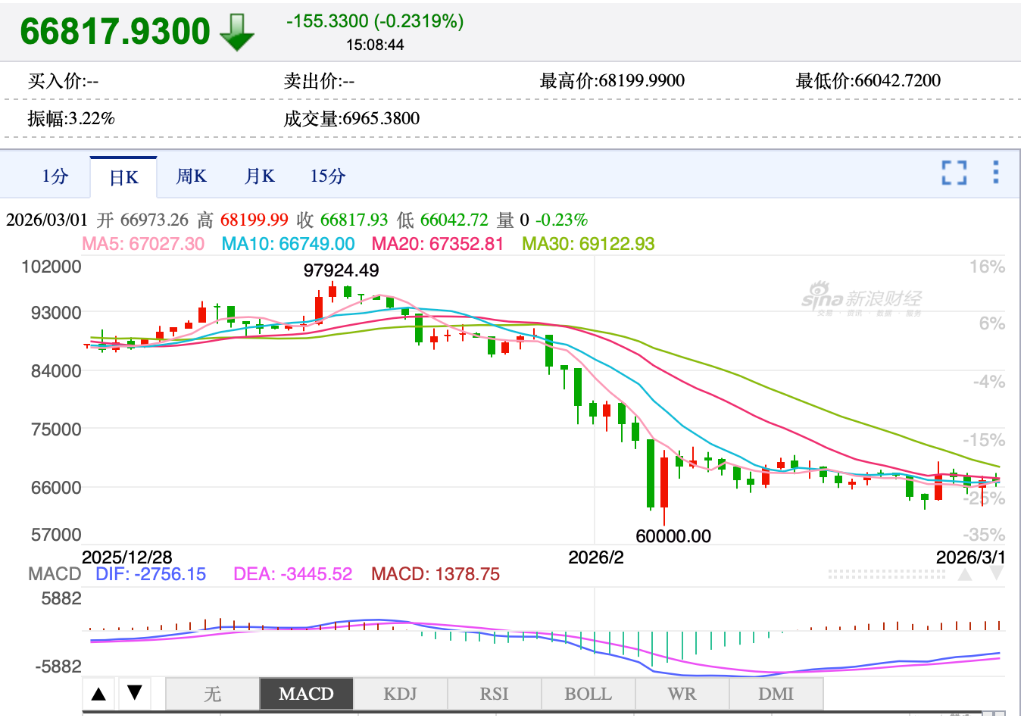
The Saudi Arabian stock market index (TASI) fell 4.6% in early trading, while Bitcoin declined to $66,791 after briefly surpassing $68,000.

Saudi Arabia's stock market index (TASI) fell 4.6% in early trading, while Bitcoin pulled back to $66,791 after earlier breaking through $68,000.

Related Questions

QWhat was the percentage decline in Saudi Arabia's Tadawul All Share Index (TASI) during early trading?

AThe Saudi Arabian Tadawul All Share Index (TASI) declined by 4.6% during early trading.

QTo what price did Bitcoin pull back to after reaching above $68,000?

ABitcoin pulled back to $66,791 after reaching above $68,000.

QWhich two major financial assets are mentioned as experiencing a downturn in the article?

AThe two major financial assets mentioned are the Saudi Arabian stock index (TASI) and Bitcoin.

QDid Bitcoin's price hit a high above $68,000 before the reported pullback?

AYes, Bitcoin's price had once risen above $68,000 before pulling back to $66,791.

QWhat is the full name of the Saudi stock index referred to by the ticker TASI?

AThe full name of TASI is the Tadawul All Share Index.

Related Reads

Will Quantum Computing Kill Bitcoin and Mining? Is This Alarmist?

The article addresses the recurring concern that quantum computing could break Bitcoin's encryption and disrupt mining. It references a Google Quantum AI white paper from March 2026, which suggests that the resources needed for a quantum computer to crack Bitcoin’s elliptic curve digital signature algorithm (ECDSA) have been reduced by about 20 times. Under ideal conditions, such an attack could theoretically derive a private key from a public key in roughly 9 minutes using 500,000 physical qubits. However, the threat is not immediate. Current quantum processors, like Google’s Willow (105 qubits) or IBM’s Condor (~1,121 qubits), are far from the scale required. The risk primarily targets transaction signatures—especially during the brief window when a transaction is broadcast but not yet confirmed, or when public keys have been historically exposed. It is estimated there is only a 10% probability of a “quantum break” by 2032. The impact on mining is considered negligible. Research indicates that quantum mining would require astronomically high qubit counts and energy—far exceeding entire national grids—making it economically and physically infeasible. The broader solution lies in post-quantum cryptography (PQC). Standards like ML-DSA and SLH-DSA are being developed, and Bitcoin improvement proposals such as BIP 360 aim to reduce quantum vulnerability by modifying transaction structures to avoid exposing public keys. While quantum computing poses a future risk to all public-key encryption systems—not just Bitcoin—the cryptocurrency ecosystem has time to adapt. Upgrades and migration to quantum-resistant algorithms are underway, ensuring the network evolves ahead of the threat.

marsbit2h ago

Will Quantum Computing Kill Bitcoin and Mining? Is This Alarmist?

marsbit2h ago

5 Minutes to Make AI Your Second Brain

This article introduces a powerful personal knowledge management system combining Claude Code and Obsidian, designed to function as an "AI second brain." Unlike traditional RAG systems that perform temporary, one-off retrievals, this system enables AI to continuously build and maintain an evolving knowledge wiki. The architecture consists of three layers: a raw data layer (notes, articles, transcripts), an AI-maintained structured knowledge base that builds cross-references, and a schema layer that governs organization and system logic. Core operations are Ingest (bringing in external information), Query (instant knowledge access), and Lint (checking consistency and fixing issues). The system's power lies in creating a "compound interest" effect for knowledge: it reduces cognitive load by offloading the tasks of connecting, organizing, and understanding information to AI, while simultaneously improving the accuracy and contextual consistency of the AI's outputs. The setup process is quick, requiring users to download Obsidian, create a vault (knowledge repository), configure Claude Code to access that vault, and apply a specific system prompt. Advanced tips include using a browser extension to easily add web content, maintaining separate vaults for work and personal life, and utilizing the "Orphans" feature to identify unlinked ideas. The main drawbacks are the need for visual thinking, a commitment to ongoing maintenance, and local storage usage. Ultimately, the system transforms scattered information into a reusable, interconnected network of knowledge.

marsbit4h ago
5 Minutes to Make AI Your Second Brain

marsbit4h ago

Trading

Spot
Futures
活动图片