Token Unlocks报告:2023加密项目解锁会有何影响?

PanewsPublished on 2023-01-25Last updated on 2023-01-25

Abstract

2023年注定会是非常“有趣”的一年,因为许多在2021年获得融资的项目可能需要通过兑现其代币来支持运营。

近日,加密分析公司TokenUnlocks发布《2022年度报告》,其中回顾了2022年加密货币行业并对2023年的市场进行了分析展望,PANews将部分内容编译如下。

“”

2022年加密货币市场回顾

”“

据CoinGecko统计数据显示,2022年全球加密货币市值大幅下降,从2021年的2.3万亿美元暴跌至仅8270亿美元,跌幅高达64%。作为市值最大的两个加密货币——BTC和ETH过去一年也呈现出大幅下跌的态势,跌幅分别达到64%和67%。究其原因,还要归结于2022年发生的几个大事件:

”“

首先,Terra生态系统崩盘,该事件导致几家大型加密公司破产;

”“

其次,加密货币交易所FTX在2022年第4季度迎来了破产闹剧;

”“

最后,也是最容易被忽视的一点就是一些项目代币迎来到期解锁,由于解锁后投资者们开始转移代币,结果引发了市场流动性激增。

”“

CoinGecko从2022年7月4日到2022年12月31日期间对143种协议进行了跟踪研究,包括DeFi、区块链、DAO、元宇宙、CEX、NFT、基础设施者7个主要项目类别,这些项目的总市值已经超过230亿美元,这一数字仅仅只是2023年初8720亿美元加密货币总市值的2.6%。
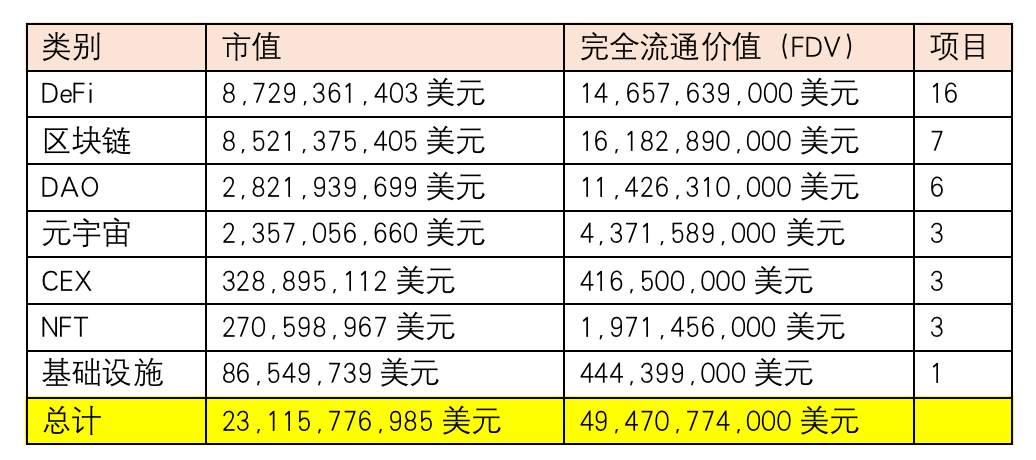
接下来,让我们再来看看代币解锁的情况。

”“

2022年初,我们跟踪了38个代币,其总锁定价值约为1425.1亿美元(注:仅仅是已分配代币,不包括质押、流动性挖矿、抵押等),令人大跌眼镜的是,2023年初这一数字已跌至146.6亿美元,这意味着代币锁定价值已下跌了89.7%。 究其原因,主要有两点:

”“

1、代币价格急剧下跌

”“

2、2022年发行的代币数量过多
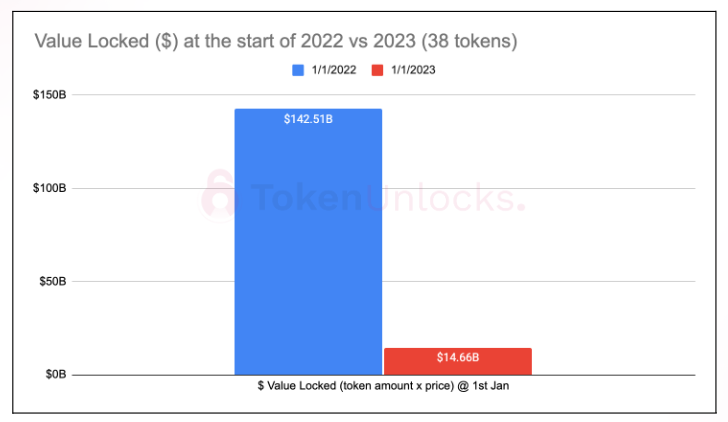
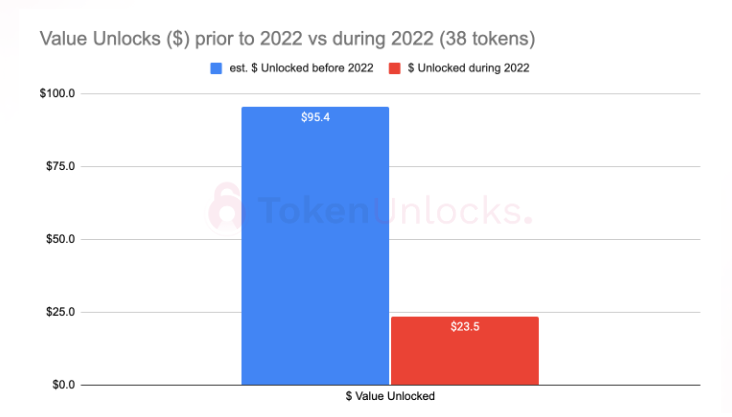
2022年之间解锁的38 个代币总估值约为954亿美元(按照截止到2021年12月31日的价格计算),而在2022 年期间解锁的代币价值为235亿美元。这意味着,仅在2022年一年内解锁的代币价值占到了之前所有年份解锁代币总价值的24.6%。当我们将锁定价值的逐年下降值与2022年解锁价值进行比较时,又发现了另一个有趣的现象:

”“

代币锁定价值的下降值为:1425亿美元–147亿美元= 1278亿美元,而解锁价值为235亿美元。

”“

想象一下,假如投资者在全年的解锁日期卖出所有头寸,那么他们平均获得的价值可能只有235美元/1278美元,即原本锁定价值的18.4%,而另外71.6%可能已经被公共市场所吸收。当然,这只是一个粗略的估计,实际上收益率还会涉及到当时的流动性、宏观效应、代币收益等其他各种因素。
不仅如此,我们还重点追踪了两种解锁机制,分别是:

”“

1、悬崖解锁(cliffunlock)

”“

2、线性解锁(linearunlock)

”“

下表列出了2022年悬崖解锁与线性解锁价值的对比。数据显示,悬崖解锁的代币价值占比约为61%(144亿美元/235美元),线性解锁的代币价值占比约为39%。与此同时,我们还可以看到,2022年解锁代币的总价值达到235亿美元,且上半年的解锁价值要比下半年高出两倍之多。

价格影响

”“

对于投资者而言,随着越来越多的代币从智能合约或钱包中解锁并在市场上流通,如果需求量保持不变,那么不难预料,这些代币价格将会下跌。

”“

下图是对收集到的数据进行分析后的一些发现:其中x轴表示解锁前后的天数,负值表示解锁之前,正值表示解锁之后,y轴表示与解锁当天价格相比变化的百分比。正如趋势图展示的那样,随着解锁日期的临近,价格通常会下跌15%,而一旦解锁完成又将趋于平缓。值得注意的是,该分析参考了比特币价格,因此相对较为准确。
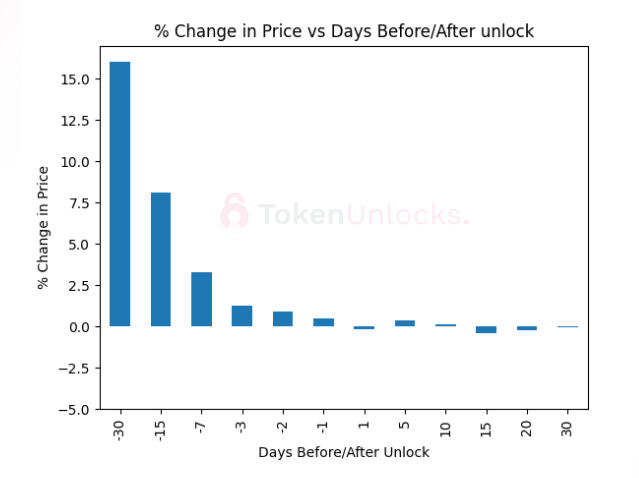
从上图中可以看出,与解锁前几天相比,代币价格在解锁日往往会下跌,因此我们想找出在解锁前30天、15天和7天做空时损失头寸的概率。
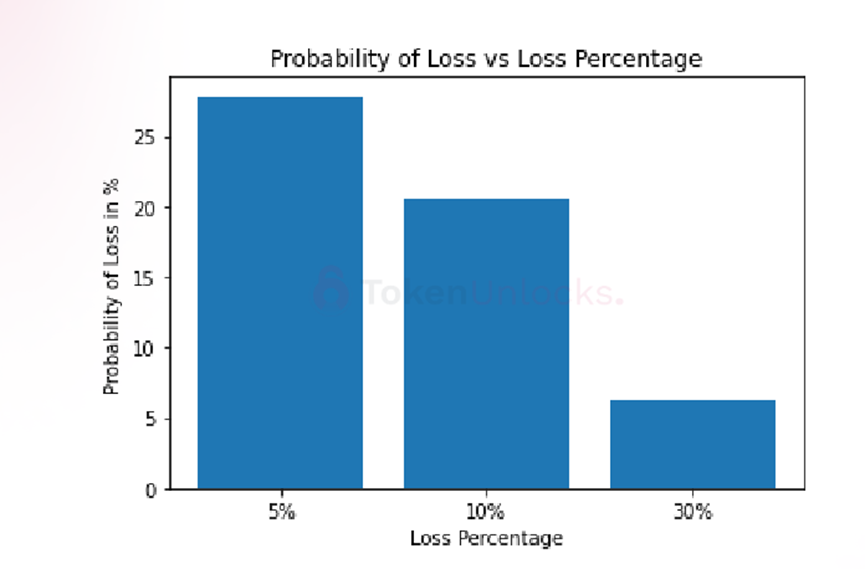
研究数据表明,代币价值损失5%的概率为27%,损失10%的概率为 20%,损失30%的概率为6%(需要注意的是,该分析考虑了比特币在短期内的价格行为)。

”“

2023年度展望

”“

报告还对2023年的加密市场进行预测,包括使用剩余市值和FDV对排名前300的加密项目进行代币解锁预测,以了解未来几年内的潜在解锁价值。为简单起见,该分析选取了2022年12月31日300个头部代币(固定供应)的统计数据,并且排除了无限量供应的代币。
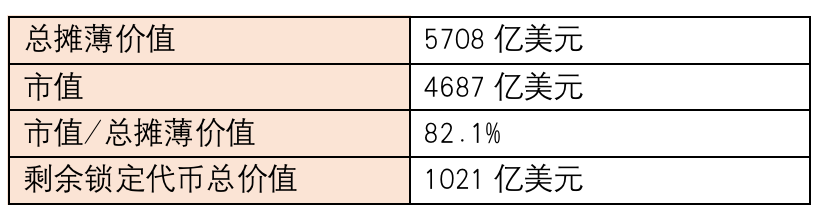
总体而言,总供应量固定的代币中已有82.1%的代币在市场上流通,而剩余的解锁代币价值约为1021亿美元。

”“

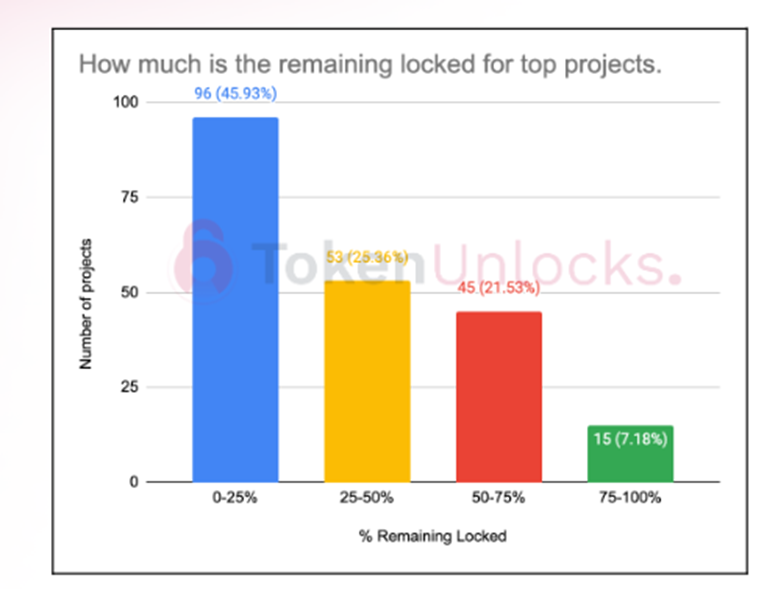
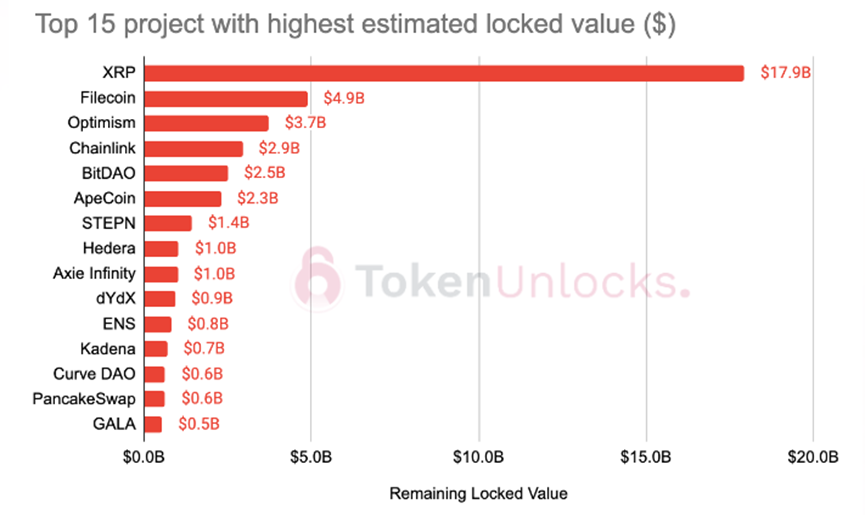
接下来,我们再看下剩余锁仓百分比(未来会在市场上进行流通),下面图表显示,96个加密项目锁定了不到总供应量25%的代币价值,其中有15个项目包含了超过75%的非流动性代币。平均而言,一个加密项目约有38.6%的总供应量需要解锁。最后一张图列出了预测剩余锁定价值最高的前15个项目,其中XRP位居榜首,代币价值高达180亿美元。
对于加密行业,2023年注定会是非常“有趣”的一年,因为许多在2021年获得融资的项目可能需要通过兑现其代币来支持运营。尽管大多数用户可能会选择离场,协议产生的收入也可能会直线下降,但相信随着越来越多分析数据的公布,加密行业的透明度在与日俱增,参与者也能够因此更深入地了解到每个项目的代币分配方式,并通过代币经济学和协议设计获得激励。

”“

相信在新的一年中,整个加密行业都能充满信心地继续前进,创造新的奇迹。

Related Reads

Is the Sharp Decline Over? Let the Data Speak

**Has the Sharp Decline Ended? Let Data Speak** Bitcoin's recent significant drop has placed short sellers in a precarious position. Three concurrent pressures—sustained outflows from ETFs, miners offloading coins to exchanges, and short-term holders capitulating—pushed the price near $63k. The asset fell 13% this week and 21% this month, roughly halving from its all-time high. A critical data point is the extremely crowded short positioning, with a short-to-long ratio reaching 8:1, representing nearly $100 billion in short interest overhead. This creates conditions for a potential short squeeze if selling pressure merely pauses, similar to the event in November 2022 which triggered a 24% rally. The selling pressures are real: spot Bitcoin ETFs have seen a record $5.4 billion outflow over 20 days. Short-term holders moved 53k loss-held BTC to exchanges in a day, and miners sent 24k BTC to Binance, a six-month high. Capital is also rotating towards AI and tech stocks like SpaceX, with $400 billion invested in AI infrastructure recently. However, on-chain data shows accumulation by long-term holders, who added 200k BTC in a month, and institutions/miners have absorbed 1.24 million BTC since 2023. This indicates strong buying beneath the surface. Key levels to watch are the $67k-$70k zone (2021 high & 2024 breakout point). A swift recovery above it suggests a leverage washout; failure could test $60k-$55k. The direction also hinges on ETF flow reversal. Currently, the S&P 500 hits new highs driven by AI, while Bitcoin and DeFi (TVL down from $173b to $73.9b) lag. The most probable path is a grinding basing process between $60k-$58k with continued ETF outflows. A less likely but explosive scenario involves a sudden flow reversal, a surge above $70k triggering a short squeeze, and a rally back above $76k. The immediate trigger depends on when the relentless selling pauses. A final cautionary note questions Bitcoin's correlation: if the high-flying U.S. stock market corrects, will Bitcoin once again miss the rally but not the decline?

foresightnews_api15m ago

Is the Sharp Decline Over? Let the Data Speak

foresightnews_api15m ago

Single-Day Plunge of 30%, Arthur Hayes Suddenly Liquidates: Why Did ZEC Get Exploded by Security Issues?

On June 5th, Zcash founder Zooko Wilcox disclosed a critical soundness vulnerability in the project's latest Orchard privacy pool. This flaw, found in the elliptic curve multiplication constraints, could allow an attacker to create unlimited counterfeit ZEC within the shielded pool, with transactions appearing valid. The vulnerability was discovered in late May by security researcher Taylor Hornby, who utilized Anthropic's new Opus 4.8 AI model for a targeted audit. The Zcash ecosystem had already performed an emergency network upgrade to patch the issue. However, the detailed disclosure triggered severe market panic, causing ZEC's price to plummet over 30% in a single day. Notably, prominent investor Arthur Hayes announced he had sold his entire ZEC position following the news. The incident starkly challenges the "technological trust" narrative central to privacy coins. Despite years of top-tier cryptographic audits, the bug persisted until uncovered with advanced AI-assisted research. This highlights the growing gap between theoretical perfection and practical implementation in privacy technology. The event serves as a industry-wide warning: in an AI-driven security landscape, the assumption that "undiscovered equals safe" is obsolete. It underscores the urgent need for continuous, proactive security practices combining AI audits, formal verification, and rapid response mechanisms.

foresightnews_api1h ago

Single-Day Plunge of 30%, Arthur Hayes Suddenly Liquidates: Why Did ZEC Get Exploded by Security Issues?

foresightnews_api1h ago

Breaking the Curse of DeFi Cascading Liquidations, Vitalik Proposes a New Solution

**Vitalik Buterin Proposes New DeFi Design to Eliminate Forced Liquidations** Ethereum co-founder Vitalik Buterin has published a proposal for a new decentralized finance (DeFi) architecture aimed at removing the automatic liquidation mechanisms prevalent in current lending protocols. The core idea involves creating synthetic assets using options as building blocks, fundamentally avoiding the抵押借贷结构 that triggers forced sell-offs. The proposal responds to a recurring flaw in DeFi: during sharp market downturns, mass自动清算 of under-collateralized positions can exacerbate price declines, creating systemic selling pressure and market instability, as evidenced by recent crypto market volatility. Buterin's model would split an asset like 1 ETH into two option-like derivatives, P and N, pegged to a price index with a set strike price and expiration. At expiry, an oracle determines the settlement price to allocate the underlying ETH between P and N holders. This design eliminates the "cliff" of instant liquidation. Instead, a position's value would gradually drift from its target peg if not actively rebalanced by the user, transferring the rebalancing decision from the protocol to the user or automated tools. A key advantage is the reduced reliance on high-frequency, real-time oracle price feeds, which are vulnerable to manipulation and errors in current systems. The delayed settlement in the options model allows for more robust, fault-tolerant oracle designs. However, significant challenges remain for practical adoption. High transaction costs (slippage) from frequent rebalancing on automated market makers (AMMs) could erode user funds. The model may not be suitable for stablecoins requiring a strict 1:1 dollar peg, as it inherently allows for value drift. Success would depend on developing new liquidity provisioning models and deep markets for these synthetic assets. The proposal represents a fundamental rethinking of DeFi risk management, challenging the industry to explore alternatives to被动集中平仓 rather than merely optimizing existing liquidation processes. It remains a theoretical framework awaiting implementation and testing by development teams.

foresightnews_api1h ago

Breaking the Curse of DeFi Cascading Liquidations, Vitalik Proposes a New Solution

foresightnews_api1h ago

Bitcoin's Decline Marks the Transformation of Crypto

Title: The Decline of Bitcoin Marks the Transformation of Crypto While Bitcoin's price recently fell below $70,000, down approximately 45% from its peak, the broader crypto industry is not following it into decline. Instead, crypto is maturing and evolving beyond its dependence on Bitcoin's price movements. Two of Bitcoin's core functions are being usurped. First, AI has captured its role as the primary speculative asset. AI, with its tangible revenue, explosive demand, and massive capital inflows ($700-830 billion in 2024), is siphoning off the speculative "hot money" that once drove Bitcoin. It also contributes to a sustained high-interest-rate environment, further tightening liquidity for assets like Bitcoin. Second, dollar-pegged stablecoins like USDC and USDT have replaced Bitcoin as the crypto market's foundational currency and primary on/off-ramp. Most trading pairs and on-chain transactions are now settled in stablecoins, severing the historical link where all capital inflows had to pass through Bitcoin first. This decoupling allows projects to thrive based on their own fundamentals rather than Bitcoin's price. Examples include Hyperliquid, an on-chain derivatives exchange with annual revenues of $8-13 billion, and prediction market platform Polymarket, valued at $200 billion with $3.65 billion in annual fees. These projects are evaluated on traditional metrics like revenue and user growth. New opportunities are emerging, particularly around privacy. Privacy coins like Zcash (ZEC) are seeing surging demand, while infrastructure like NEAR enables private, cross-chain asset transfers without requiring users to hold a specific token—privacy becomes a universal service layer. In this new paradigm, stablecoins are the universal cash, various project tokens represent equity, and privacy-enabled cross-chain coordination layers (like NEAR) act as the critical infrastructure connecting a fragmented, multi-chain ecosystem. Bitcoin is now just one asset among many. The era where the entire crypto market moved in lockstep with Bitcoin is over. The industry's health should now be judged by project fundamentals—real revenue, active users, and tokenomics that capture value—and the development of the underlying infrastructure enabling a mature, dollar-denominated crypto economy.

foresightnews_api1h ago

Bitcoin's Decline Marks the Transformation of Crypto

foresightnews_api1h ago

Trading

Spot
Futures
活动图片




