Will Bitcoin’s hashrate follow history to trigger another BTC decrease? Assessing…

AmbcryptoPublished on 2022-12-27Last updated on 2022-12-27

Abstract

Bitcoin’s hashrate hit a one-month low on Christmas day. Exchange reserves continued declining but BTC excelled in neutrality

The Bitcoin [BTC] hashrate went off the radar on 25 December, hitting as low as 170.6 ExaHash per second (EH/s), CoinWarz data revealed. According to SatoshiActFund CEO, Dennis Porter, the incident occurred due to harsh weather conditions in Texas.

""

It was paramount for the hashrate to be affected since the United States city housed a lot of Bitcoin miners. The rasping weather meant that miners had to pause operations. Meanwhile, the hashrate dip did not halt BTC transactions despite hitting the lowest in almost a month.

""

BTC: Is it time for a repeat?

""

In times past, the hashrate decreasing this much indicated a negative impact for BTC according to Korean crypto analyst Crypto Sunmoon. In fact, it implied certainty in a value decrease since the hashrate acts as the computing power for processing transactions on the Bitcoin network.

""

Explaining his opinion via his CryptoQuant publication, Crypto Sunmoon said: “Hashrate has dropped dramatically. This suggests that some miners have stopped mining and are experiencing financial difficulties. Miners who stop mining are likely to sell their Bitcoins.In the past, when the hash rate (30 EMA) reached two peaked and decreased, bitcoin prices also decreased twice.”
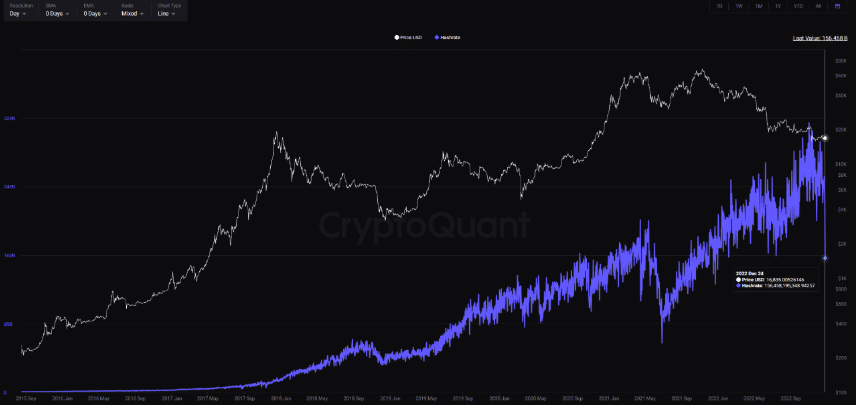
Source: CryptoQuant

""

However, early BTC signs showed that the case might be different this time. This was due to the BTC price maintaining the $16,800 region at press time. According to CoinMarketCap, this represented a neutral position over the previous data.

""

In other ends, Bitcoin exchange reserves which declined earlier were still in the same region. According to Ghoddusifar, another CryptoQuant analyst, increase in reserves were usually accompanied with an increase in the BTC price.

""

Hence, this dwindling case meant that BTC remained at risk of a further fall. Nonetheless, this could signify the start of a bullish crossover.
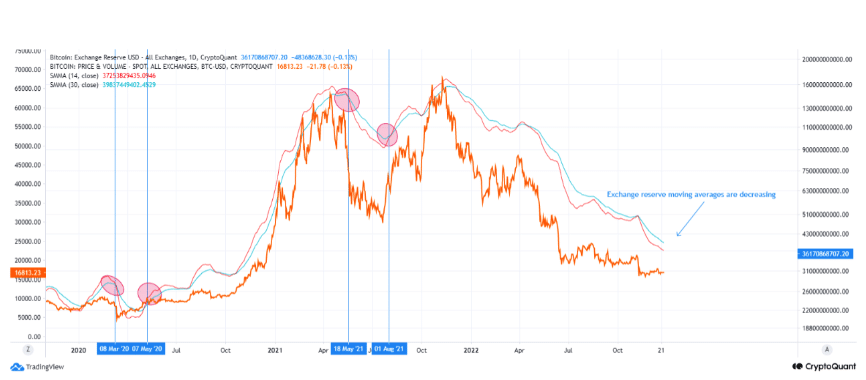
Source: CryptoQuant

""

Chartwise, here’s the state of the king coin

""

Per the four-hour chart, the Relative Strength Index (RSI) had exited its potential for buying strength. At the time of writing, the Relative Strength Index (RSI) was 51.33, maintaining neutral momentum.

""

In the short term, BTC might likely fall to the demand of bears. This was due to the condition of the Exponential Moving Average (EMA). At press time, the 20 (blue) and 50 (yellow) EMAs were closely positioned. However, the 50 EMA still remained above a bit. Hence, the bearish inference.
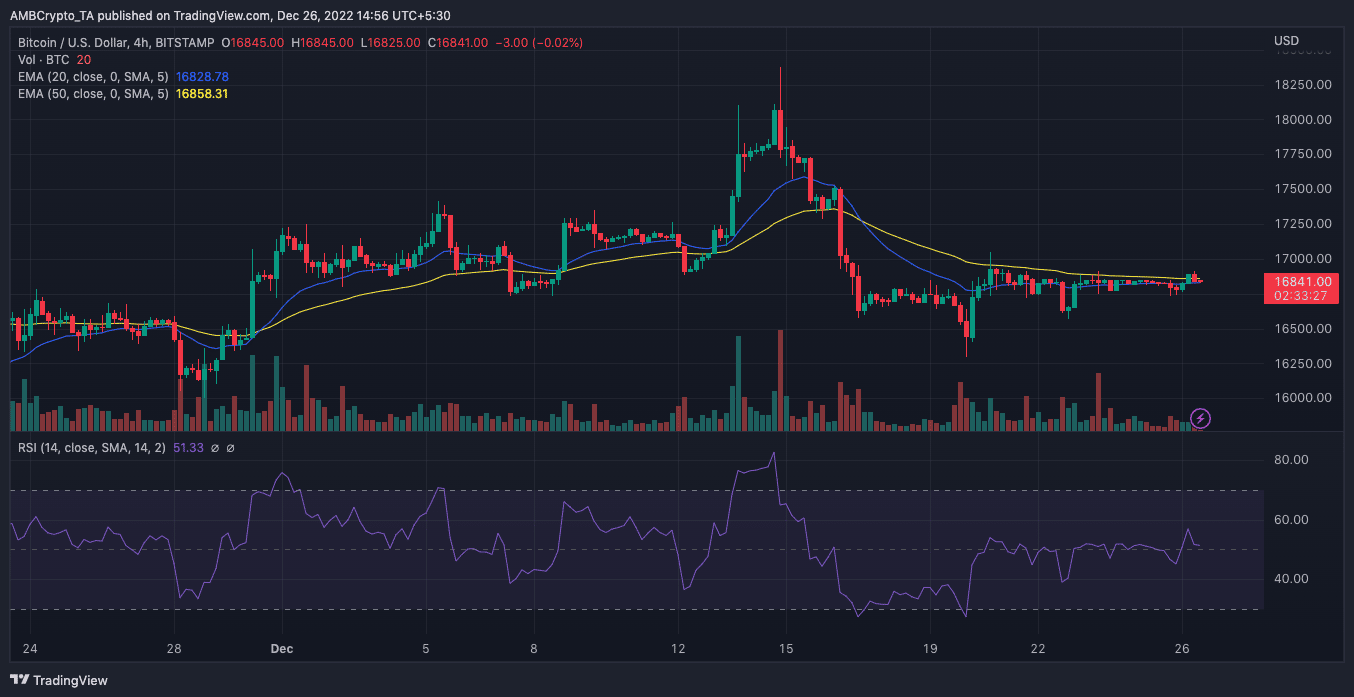
Source: TradingView

""

Regarding the hashrate, Porter tweeted in the early hours of 26 December that it had recovered and reached a weekly high in less than 24 hours. The head of the mining advocacy association also mentioned Bitcoin’s engineering was exceptional and great for the electricity grid.


Related Reads

DRAM ETF Issuer: Samsung, SK Hynix, Micron All Surpass $1 Trillion, the AI Era of Memory Chips Has Only Just Begun

Authors: Dave Mazza, Thomas DiFazio | Source: Deep Tide TechFlow The article, written by Roundhill Investments (issuer of the DRAM ETF), responds to Morningstar's caution about investing in memory chip stocks. Morningstar warns of the sector's history of boom-bust cycles, a lack of economic moats, and potential momentum-driven overvaluation. Roundhill argues the current situation is structurally different due to AI. Key points in Roundhill's rebuttal include: * **Changed Demand & Supply Dynamics:** AI infrastructure, not consumer electronics, is now the primary growth driver for memory demand. New, strict long-term supply agreements with hyperscalers reflect the high capital intensity of advanced manufacturing. * **Existence of a Moat:** High-Bandwidth Memory (HBM), essential for AI, has extremely high manufacturing barriers. The market is dominated by Samsung, SK Hynix, and Micron, with new entrants blocked by technological complexity and long lead times for equipment like ASML's EUV machines. * **Strong Fundamental Outlook:** Analyst consensus projects the three companies will rank among the world's most profitable by 2027, with combined profits of $704 billion on over $1 trillion in revenue. Their operating margins have already reached record highs. * **Valuation Re-rating:** Despite significant stock price gains, memory stocks trade at attractive valuations (e.g., a median NTM P/E of 8.37x for the DRAM ETF) relative to projected explosive EPS growth. Roundhill suggests historical valuation frameworks may no longer apply given the new profitability paradigm. Conclusion: Roundhill contends the rally is justified by fundamentals, marking a structural shift for the memory industry into a new era of sustained, AI-driven demand against constrained supply, rather than a repeat of past cycles.

marsbit53m ago

DRAM ETF Issuer: Samsung, SK Hynix, Micron All Surpass $1 Trillion, the AI Era of Memory Chips Has Only Just Begun

marsbit53m ago

EF's Epic Reorganization: 20% Layoffs, Budget Halved, Is Ethereum Gearing Up for a Leaner Future?

The Ethereum Foundation (EF) has announced a major organizational restructuring, involving a 20% staff reduction (approx. 54 employees) and a division into functional clusters like Protocol, Access, User, Community, and Institutional layers. Co-founder Vitalik Buterin further revealed plans to cut the EF's budget by around 40% over the coming years, aiming to reduce its annual spending rate from about 15% to roughly 5% by 2030, transitioning to an endowment-driven model. This overhaul is seen as a long-overdue correction to the EF's ambiguous role. As Ethereum grew, the foundation faced persistent criticism over ETH sales, perceived lack of execution, and unclear strategy, often becoming a focal point for community frustration amid ETH's price stagnation. The reform aims to redefine the EF's boundaries, narrowing its focus to core protocol research, public goods funding, and ecosystem coordination, while offloading more applied development work to the broader market. Concurrently, ecosystem forces like the newly formed Ethlabs (founded by ex-EF researchers) and other independent groups are stepping in to fill the space, signaling a shift from a centralized model to a more distributed, collaborative ecosystem structure. The move was notably praised by Solana co-founder toly, who viewed a "leaner" EF as potentially more decisive and agile.

Odaily星球日报1h ago

EF's Epic Reorganization: 20% Layoffs, Budget Halved, Is Ethereum Gearing Up for a Leaner Future?

Odaily星球日报1h ago

Trading

Spot
Futures
活动图片