[daily public chain] sol exchange accounts for 37%, and avax accounts for us $10.1 billion

Huobi ResearchPublished on 2022-03-25Last updated on 2022-03-29

Abstract

Since 2017, large-scale ambushes have emerged and the fittest have been eliminated in the wheel of the times.

Since 2017, large-scale ambushes have emerged and the fittest have been eliminated in the wheel of the times. Until this year, the public chain has ushered in a collective outbreak, from Polkadot, a cross chain network of slot auction, to many emerging public chains such as Solana, avalanche and Cardano. Ethereum has created a public chain with great competition demand, giving birth to greater market opportunities.

More than 100 public chain projects are common and cross chain, which is a new trend

At present, there are more than 100 active public chains, which can be divided into single chain and cross chain according to the attributes of the chain, and the cross chain is represented by Boca and has become the mainstream trend of this era. Overall, the number of public chains has formed a certain scale, and the competition is quite fierce.

1、Solana

Solana started the upsurge of public chain. What's the difference between them?

Solana's fire has directly stirred the upsurge of the public chain camp, including avalanche, fantom, near and so on. The market pays more attention to the public chain, and both capital, project parties and developers are full of interest in this track. So, what are the differences between them?

In terms of technical architecture:

Solana: poh clock scheme

Different from most pieces + eth2 0 scheme, Solana created a unique and innovative poh clock mechanism in the public chain circle The scheme decouples the block out time and state. In terms of global consensus, it is not limited by the hard requirements of block size and block out time. Through the global clock, a globally available time chain is generated for all nodes. The state update can be carried out asynchronously. The verifier can send state updates to other nodes in real time. The poh clock gives the participants of Solana ecology more expandable space, Further improve and expand the overall throughput capacity.

Lock data

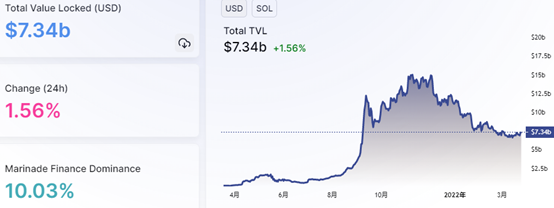
Sol's lock up scale has been pulled back from a high level, with a peak of US $15 billion in 2021. On March 24, the scale of lock up reached US $7.34 billion, and there is a large space for data callback of lock up volume.
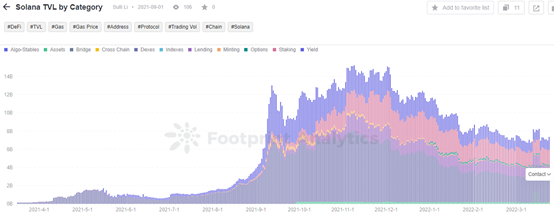
In terms of the proportion of lock up on the sol chain, the proportion of loan lock up and decentralized exchange lock up is relatively large, while the scale of loan, pledge and mining lock up is small. According to the latest data on March 24, the decentralized exchange locked positions of US $2.76 billion, while loans, pledges and mining were US $1.17 billion, US $1.65 billion and US $1.4 billion.
Token price

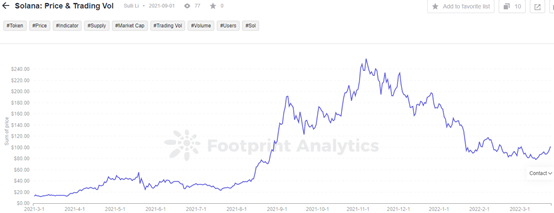
The linkage effect between slol price and lock volume is good, and the sol price has dropped from a high of more than $240 to a minimum of $80. The current price on March 24 is $102. In the later stage, we can pay attention to the ecological development, as well as the trading opportunities of the upward lock up volume and price recovery.
2. Avalanche: three chain structure

Avalanche agreement entered the public view by means of incentives, and realized the sharp rise of currency price and lock up volume. Similarly, as a smart contract platform, avalanche is very novel in architecture design and adopts the three chain structure of X chain, C chain and P chain. X chain is a transaction chain, which mainly deals with point-to-point asset creation and transaction transactions between individuals; C-chain is a smart contract chain compatible with EVM, and the basic defi projects are built on C-chain; P chain is a platform chain, which is mainly responsible for token pledge, coordinating network verifiers, creating user-defined subnets and other affairs. The three chains perform their respective functions, but complement each other, further liberating avalanche's network performance.

Lock data

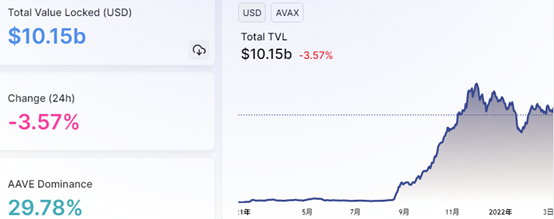
Avax lock up data increased by leaps and bounds in 2021. The data rebounded from a low of $2 billion to a maximum of more than $14 billion, with a growth space of more than six times. The current TVL value is US $10.15 billion.
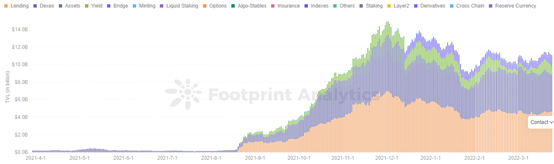
In terms of the proportion of avax chain lock, the proportion of lending, lock and decentralized exchange lock is relatively large, while the scale of mining and cross chain lock is small. On March 24, the loan lockup reached its peak. The scale of loan lockup was US $4.6 billion, that of decentralized exchange lockup was US $4 billion, and that of mining and cross chain lockup was US $900 million and US $1.1 billion.
Token price

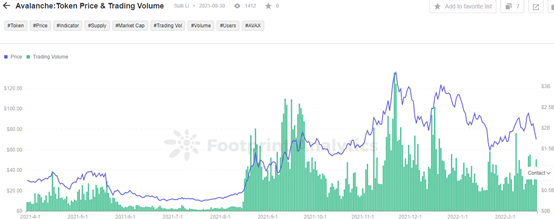
Avax experienced great growth in 2021, rising from $15 in August 2021 to a high of $135. From the second half of 2021 to the beginning of 2022, the price of avax remained around $85. Compared with the vicinity of TVL's decline, there is more room for price correction. Next, we can focus on low absorption opportunities.

Related Reads

New Wall Street Play: Yen Shorts Still Adding, But Japan Stocks Don't Rely on Carry Trade Unwinding

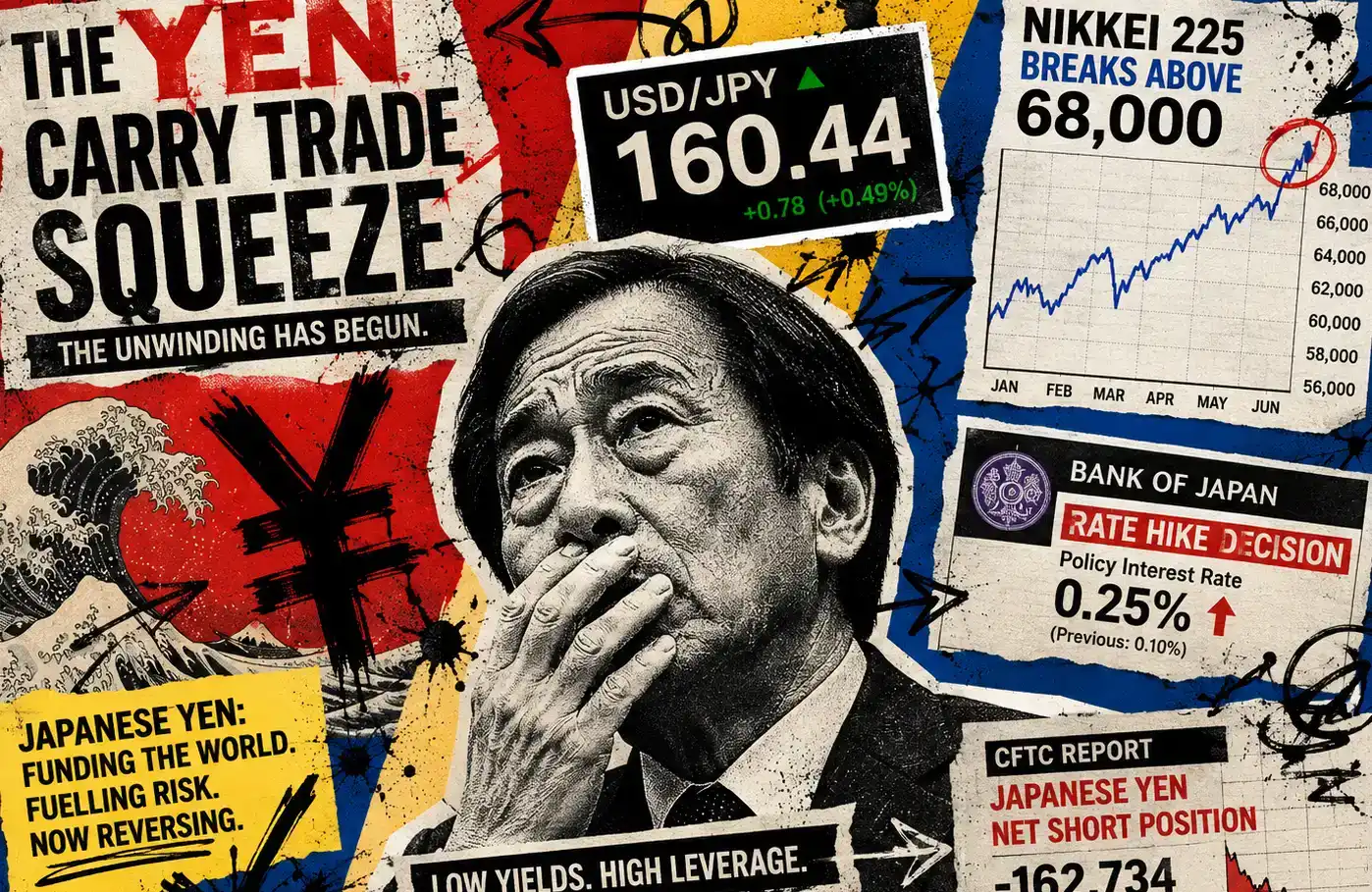
On June 3rd, USD/JPY hit 160.44, its highest level since July 2024, while the Nikkei 225 surged past 68,000 points. Contrary to popular narratives of an imminent "carry trade unwind" akin to August 2024, data reveals a more complex picture. Speculative net short positions in yen futures have actually increased, reaching -114,667 contracts by late May, suggesting traders are doubling down rather than retreating. Meanwhile, Japan's Finance Ministry conducted its largest-ever single-round FX intervention (11.73 trillion yen) in April-May but failed to hold the 160 yen line. The Nikkei's rally is not driven by carry trade dynamics. Foreign investors are aggressively buying Japanese stocks, with net purchases in 2026 running nearly 16 times higher than 2025 levels. This inflow is concentrated in AI and semiconductor-related stocks like SoftBank and Socionext, fueled by positive sector outlooks, rather than being a flight from unwinding yen shorts. Furthermore, the Nikkei has continued climbing despite the Bank of Japan's (BOJ) rate hikes to 0.75%. This disconnect exists because the current equity boom is fueled by AI-driven foreign investment, not reliant on cheap yen funding. However, this relationship remains fragile. Should the BOJ hike rates further (e.g., to 1.0%) while dollar weakness increases carry trade costs, the trajectories of the yen and Japanese stocks could reconverge, potentially triggering volatility.

marsbit3m ago

New Wall Street Play: Yen Shorts Still Adding, But Japan Stocks Don't Rely on Carry Trade Unwinding

marsbit3m ago

Broadcom's Q3 Guidance Misses Expectations by $12 Billion, After-Hours Trading Plummets Over 13%, AI Narrative "Cooling"?

On June 3, Broadcom released record Q2 FY26 results with revenue of $22.19B, up 48% YoY, and AI chip sales of $10.8B, up 143%. Adjusted EPS of $2.44 beat estimates. However, its Q3 AI semiconductor revenue guidance of $16B, while up over 200% YoY, fell roughly $1.2B (7%) short of analyst consensus expectations of $17.2B. This miss, coupled with slightly weaker-than-expected software revenue, triggered a severe market reaction. CEO Hock Tan maintained the FY26 AI revenue outlook of over $100B but did not raise it, disappointing investors who had priced in more robust growth. The stock plummeted over 13% in after-hours trading, erasing roughly $270B in market cap. The sell-off extended to peers like Marvell. A key concern for markets, particularly for Chinese optical module suppliers, was Tan's comment that the contribution of AI networking (e.g., Ethernet switches, optical interconnect chips) to AI revenue, currently near 40%, is expected to normalize to around 30% over time, signaling a potential peak in growth for that segment. Despite the guidance shortfall, Tan reiterated that AI demand remains "insatiable" and reaffirmed the long-term target of exceeding $100B in AI revenue by FY27. The reaction highlights the heightened sensitivity and premium valuation placed on AI-exposed stocks, where anything less than stellar guidance can prompt significant profit-taking. The broader question is whether this represents a cooling AI narrative or a correction in overstretched valuations.

marsbit3m ago

Broadcom's Q3 Guidance Misses Expectations by $12 Billion, After-Hours Trading Plummets Over 13%, AI Narrative "Cooling"?

marsbit3m ago

Fei-Fei Li's Team Clarifies the Concept of 'World Models', Sora Merely a Renderer

"World Models" has become a widely used yet confusing term in AI. To address this, a team led by Fei-Fei Li and World Labs proposed a functional taxonomy based on the Partially Observable Markov Decision Process framework. This taxonomy categorizes systems called "world models" into three distinct projections: Renderers, Simulators, and Planners. Renderers, like OpenAI's Sora and other video generation models, focus on producing photorealistic visual outputs for human perception. They prioritize visual fidelity over physical accuracy. Simulators, such as NVIDIA Omniverse, aim to compute precise future environmental states for computational tasks like engineering analysis or digital twins. Planners, like Vision-Language-Action models, take in observations and goals to output executable actions for robots or agents. The article clarifies that most current "world models," including Sora, are primarily Renderers. They generate convincing visuals but lack the core ability to simulate state transitions based on actions, a key requirement for a true world model in classic reinforcement learning definitions. This conceptual confusion has practical implications, leading to potential misalignment in technology selection, investment, and public understanding of AI capabilities. Clear categorization is crucial. It helps enterprises avoid costly mistakes (e.g., using a renderer for robot training), allows investors to accurately assess markets, and enables researchers to build comparable benchmarks. While future systems may integrate these functions, recognizing current boundaries is essential for honest assessment and progress.

marsbit1h ago

Fei-Fei Li's Team Clarifies the Concept of 'World Models', Sora Merely a Renderer

marsbit1h ago

Trading

Spot
Futures
活动图片